
BuddhistCatholicContemplativeEvangelicalGeneral ChristianHinduJewishLatter-day SaintMuslimNew VisionsProgressive Christian
Beliefs
- Buddhist
- Catholic
- Contemplative
- Evangelical
- General Christian
- Hindu
- Jewish
- Latter-day Saint
- More Voices
- Muslim
- New Visions
- Pagan
- Progressive Christian
Topics
- Religion News
- Food and Religion
- Sports and Religion
- Religious Art
- Religious Music and Entertainment
- Religious Events
- History and Religion
- Style and Religion
- Politics and Religion
- Women in Religion
- Recreation Outdoors and Religion
- Business Finance and Religion
- Careers Workplace and Religion
- Education and Religion
- Family Parenting and Religion
- Health Fitness and Religion
- Home and Religion
- Relationships and Religion
- Technology and Religion
- Travel and Religion
Columnists
- Buddhist Columnists
- Business Finance and Religion Columnists
- Careers Workplace and Religion Columnists
- Catholic Columnists
- Contemplative Columnists
- Education and Religion Columnists
- Evangelists Columnists
- Family Parenting and Religion Columnists
- General Christian Columnists
- Health Fitness and Religion Columnists
- Hindu Columnists
- History and Religion Columnists
- Home and Religion Columnists
- Jewish Columnists
- More Voices Columnists
- Latter Day Columnists
- Muslim Columnists
- New Visions Columnists
- Nonreligious Columnists
- Pagan Columnists
- Politics and Religion Columnists
- Progressive Columnists
- Recreation Outdoors and Religion Columnists
- Relationships and Religion Columnists
- Religion News Columnists
- Religious Art Columnists
- Religious Events Columnists
- Religious Music and Entertainment Columnists
- Sports and Religion Columnists
- Style and Religion Columnists
- Technology and Religion Columnists
- Travel and Religion Columnists
- Women in Religion Columnists
Resource Library
- 2026 Calendar
- Library of World Religions
- The 100 Most Holy Places on Earth
- Patheos Answers
- Podcasts
- Videos
- Faith Leaders Database
- Anglican Episcopalian
- Bahai
- Baptist
- Buddhism
- Christianity
- Confucianism
- Eastern Orthodoxy
- Hinduism
- Holiness and Pentecostal
- ISKCON
- Islam
- Judaism
- Lutheran
- Methodist
- The Church of Jesus Christ of Latter-day Saints
- New Age
- Paganism
- Presbytarian and Reformed
- Protestantism
- Religion Behind the Scenes
- Roman Catholic
- Scientology
- Shia Islam
- Sikhism
- Sufism
- Sunni Islam
- Taoism
- Zen
- See all religions
Research Tools
 Ad-Free & Subscriber Log-In Subscription Support
Ad-Free & Subscriber Log-In Subscription Support
Follow Patheos 

- Trending:
- Forgiveness
- |
- Marriage
- |
- Consciousness
- |
- Death Penalty
- |
- Election
- |
- Halloween

- Home
- Pagan
- Questions to a Future UUA President: How Would You Foster Multi-Faith Efforts?
Questions to a Future UUA President: How Would You Foster Multi-Faith Efforts?
Last updated on: June 3, 2017 at 5:57 am by David Pollard
Questions to a Future UUA President: How Would You Foster Multi-Faith Efforts? 2017-06-03T05:57:21+00:00 David Pollard
Patheos Explore the world's faith through different perspectives on religion and spirituality! Patheos has the views of the prevalent religions and spiritualities of the world.
This is the final article of a three part series, but don’t worry – each article stands on its own. However, here’s the link to the first article, and then yesterday’s article, in case you want to see what you missed.
Three weeks from today delegates across the country and at the UUA General Assembly will be using ranked-choice voting, in which delegates rank the candidates in order of preference: 1, 2, 3. the elect the next President of the Unitarian Universalist Association. Her term in office will continue until the 2023 General Assembly. Back in January we solicited questions from our readership to ask the candidates. Today, we will be looking at the topic which received the most proposed questions – the challenge of bringing people of different theologies and world-views into conversation, both in interfaith and interfaith contexts.
Today’s questions, which are the list ones of this series:
How would you, as UUA President, foster multi-faith efforts? And what role do you see earth-centered religious leaders playing in these efforts?
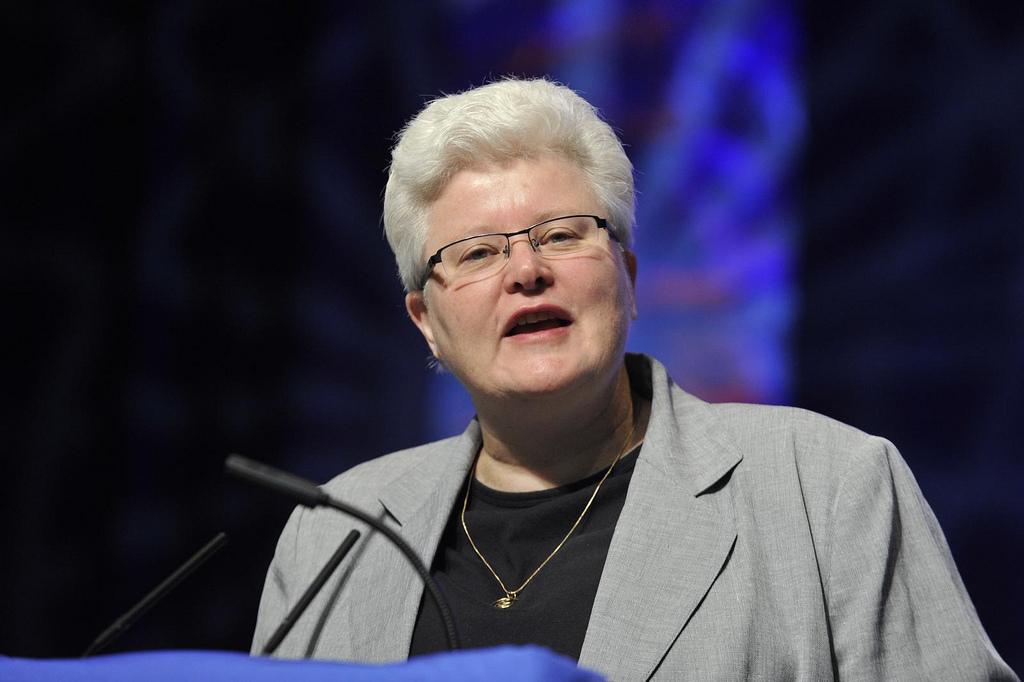
Rev. Jeanne Pupke
Response from Jeanne Pupke:
We have many interfaith partners, whom we have joined in witness and service. Yet it seems we have not successfully connected in enduring partnerships that are built on lasting connections. There is some irony in this as we, as UU, are always involved in working with multiple religious positions within our own congregations.
UU faith aspires to hold different theological viewpoints and still share covenanted community. When that is working, it feels wonderful. People bring their whole selves to the community and create space for others to do the same. It creates the deepest sense of welcome. But when instead we struggle, feel ourselves working over or against groups with differing viewpoints, it feels very frustrating and hard to be a Unitarian Universalist. How is this best done. What have we learned about making this work? Where are the books and classes on this common UU topic? For a challenge so prevalent among us, we are inventing our approach congregation by congregation. Our UU Association can help identify who is succeeding in this work and how, but it can also name the importance of these lessons to Interfaith work.
The parallels on those intra-religious experiences in our interfaith work, especially our shared justice work, are strong. When we come together across our differences, it can feel so amazing to be a part of it. However, when we struggle to find agreement on how and when, we fail to see what we can do together, and it feels as though we have failed the very idea of religion. It seems in these efforts we are often focused on events and seldom on simple relationship building. However, relationship building will serve us all in living our values well. Can the UUA spend time and encourage building lasting relationships across faiths when there is no march or witness? I believe we can and should, and would like to foster such ideas in our movement.
As President, I would also like to examine the history of our connections with other faiths a bit more deeply. We are a small faith and working with other faiths makes sense. But we need to know what kind of partners we have been through time. Our practice must be mutual and collaborative but not afraid to lead too. We should also must remember that our most frequent partners have been nonprofit organizations and organizers. We need to be clear in how we can be a strong partner to both religious and nonprofit organizations.
I recently spent times with MPOLIS, the training for interfaith fusion work organized by Dr. William Barber’s ministry partners. Eleven UUs were there working with both religious and nonprofit organizations, unions, and seminaries. Rev. Barber said that the fusion of all those sectors is needed to create the kind of coalitions that can be effective in the public square. Only when power holders see the diversity and commitment of such groups will they become convinced they must yield to the demands of the people. That is a powerful and correct analysis. If elected President, I will be following that advice to support us in strong, diverse partnerships.
I believe the Earth-Centered communities among us have the opportunity of better communicating to the many UUs who have not really known the perspectives that support pagan practice. In our services that are so often in the white liberal Protestant format, participants can be engaged in a familiar format. Service can be disembodied and overly disconnected from the lived experience. UU Pagan services, service elements, practice communities, and study groups can offer a more embodied tradition and a needed connection to the natural world. We need leaders who can, in the formats UUs know, introduce wisdom from and elements of Earth-centered rituals. There is opportunity for deepening community thought and understanding about what connects us all to the earth and how that connection requires us to work to heal the injury humans have caused to the planet.
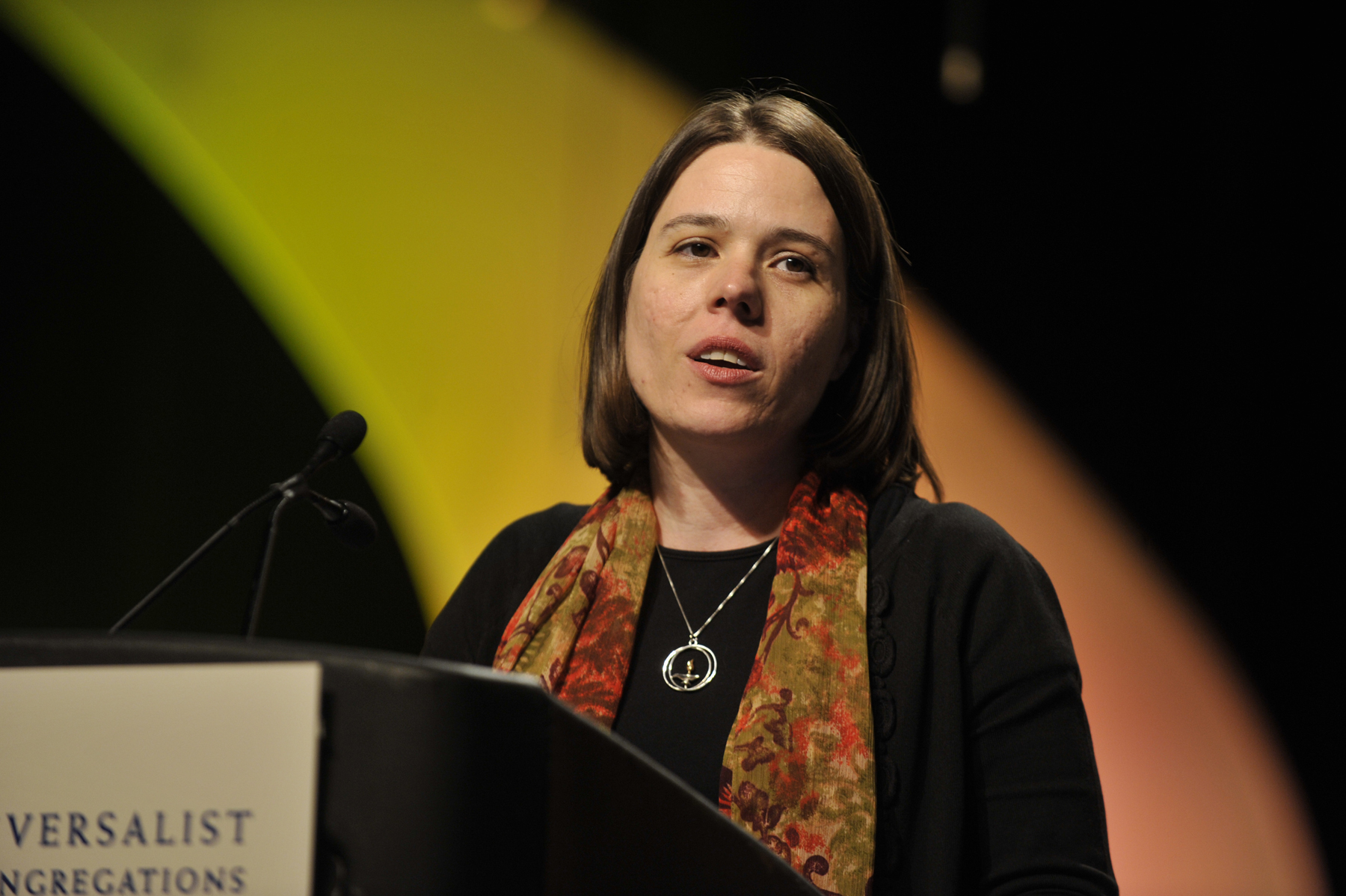
Rev. Susan Frederick-Gray
Response from Susan Frederick-Gray:
I have been encouraged to see the work that former President Peter Morales began in working with the United Church of Christ on convening multi-faith conversations. As UUA President, I would be committed to continuing this work and working nationally with interfaith partnerships. A key part of my platform in the Presidential campaign is the critical need for strong partnerships across Unitarian Universalism and beyond.
A few things strike me in this moment of time. Humanity has never been as connected across the globe than we are today, through social media, technology, and the Internet. And yet, voices of nationalism, division, and fear are on the rise. It is exactly in this moment when partnership is critical to resisting the messages of fear that separate people. Collectively, there is a need for faith communities to come together to witness for human rights, racial justice, combatting poverty and working for climate justice. This is work that could be advocated for more powerfully through interfaith networks.
As UUA, President I would bring a strong commitment to partnership to work on larger national and global issues. Partnership has been central to my leadership and ministry from my early days in interfaith congregation based community organizing (CBCO) in Tennessee and Ohio. In fact, one of the key relationships I would bring to the Presidency is with the General Minister and President of the United Church of Christ, the Rev. John Dorhauer. He and I have worked together in Arizona for immigrant rights and marriage equality. Recently, Dr. Lee Barker, the President of Meadville Lombard Theological School commented on the importance of having a sense of mission or purpose to multi-faith efforts. He talked about efforts to bring faith groups together purely for building understanding are often not as effective or sustainable as efforts to come together for a clear purpose or mission to, to achieve something together.
Today, in this country, we face a moral crisis. The realities of mass incarceration, mass deportation, the threats to health care, voting rights, to the environment and sovereignty rights by extraction industries, are issues that many faith traditions can find common cause to push for a moral agenda that demands policies that increase voting access, economic policies that foster greater equity, and the ending of mass incarceration and detention. franchisement, liberation and not just a political or economic challenganot only a political and economic challenge, for example, resist extraction industries, fight mass incarceration, demand economic policies that foster great equity, then partnerships grow deep and they last. This is the spirit I would bring to interfaith efforts and I believe that Unitarian Universalism can be helpful in building interfaith bridges because of the theological diversity within our own tradition.
I believe our work must be in partnership with Indigenous leaders and other earth-centered religious leaders. In Phoenix, our initial work on immigrant rights and resisting the brutal policing of Sheriff Joe Arpaio was by partnering with Tonatierra Indigenous Cultural Center. Because of the very profound presence of earth-centered language and spirituality in Unitarian Universalism there was a significant amount of common ground we could find in our partnership, not just in the work of justice, but in the spiritual and religious language we used.

Rev. Alison Miller
Response from Alison Miller:
One of the strengths of our faith is how we manage to create one religious community out of a people with a wide spectrum of theo/alogies, beliefs, and philosophies. I am conscious of this every time I look out at my congregation and see atheists, agnostics, and theists of all stripes and people who identify with the wisdom in Christianity, Buddhism, and earth-centered traditions sitting side by side. We are a home for multi-faith families and individuals whose religious paths are multilayered and draw from more than one source. What makes this possible is the covenant of our faith, which invites us to live by a set of ethical principles and to ground our religious path in the wisdom of multiple sources. We make space for a spectrum of beliefs and practices through our larger community-wide worships and offer affinity groups to explore a particular path more deeply.
As a candidate for UUA President, I am interested in expanding the resources and offering trainings for ministers and lay leaders around religiously diverse worship, including continuing education around cultural misappropriation. Another objective I have for congregations is continuing education around facilitating healthy conflict, including the creative tensions that arise across diverse spiritual needs. Affinity groups, such as the Covenant of UU Pagans, the UU Christian Fellowship, the UUs for Jewish Awareness, the UU Buddhist Fellowship, and the UU Humanist Association, could be vital partners with the UUA in furthering these intrafaith goals that involve supporting UU congregations/ covenanted communities that deeply nourish our spirits.
Our practice of listening, learning, and growing in faith in a religiously plural context is also a strength we bring with us as we engage in the working of community building and justice efforts in the wider world. Over the last twelve years of serving in Morristown, I have built up a network of relationships with faith leaders in Northern New Jersey. I have also served as chair of the Morris Area Interfaith Clergy Council. We have worked together to counter Islamophobia, to reduce gun violence, to end police brutality, to work for immigrant justice, and to achieve marriage equality. Unitarian Universalists have played a critical role in interfaith dialogues, worship services, and projects as we seek to navigate the complexities of our similarities and differences in faith.
If I am elected president, I plan to continue these efforts by partnering with my counterparts – faith leaders of national religious organizations – in order to leverage the power of faith communities working together towards common goals. As I have done in the past, I will be sure to include faith leaders of earth-centered traditions as a part of these collaborative efforts. I am feeling called more and more to join my voice, witness, and leadership abilities to interfaith efforts of national significance. I showed up at Standing Rock in North Dakota to support indigenous rights and to protect our water, and I also served as a chaplain for “We Belong Together: 100 Women 100 Miles Pilgrimage,” an alliance of immigrant justice leaders from around the country.
Thank you for reading these articles. We hope that they have provided you some more knowledge about the candidates running for the UUA Presidency and will (if you are a delegate to GA) allow you to cast a better informed ballot for the candidate of your choice.
If you are not a delegate and these articles have prompted you have an opinion on these candidates we recommend you contact your minister or church board member to see who is representing your church at General Assembly.
Also, we would mention that every year literally hundreds of UU Congregations leaving themselves totally unrepresented at General Assembly – so if no one in your society has expressed interest in being a delegate. Even if you can’t make the trip to New Orleans, this still can be dome as an online “remote” delegate.
For more information about the individual candidates for the UUA Presidency:
Jeanne Pupke’s campaign website
Susan Frederick-Gray’s campaign website
Alison Miller’s campaign website

Next Post

June 6, 2017 from Epictetus's Handbook
Browse Our Archives
Select a Category Current Events CUUPS Press Release Interfaith liturgy Media Review podcast Religious Education Seasonal Reflection Spiritual Practice Summary Uncategorized
Select a Month July 2026 June 2026 April 2026 January 2026 December 2025 October 2025 August 2025 July 2025 June 2025 April 2025 March 2025 February 2025 December 2024 November 2024 October 2024 August 2024 July 2024 June 2024 May 2024 April 2024 February 2024 December 2023 November 2023 October 2023 September 2023 August 2023 June 2023 May 2023 April 2023 March 2023 February 2023 January 2023 December 2022 October 2022 September 2022 August 2022 July 2022 June 2022 May 2022 April 2022 March 2022 February 2022 January 2022 December 2021 November 2021 October 2021 September 2021 August 2021 July 2021 June 2021 May 2021 April 2021 March 2021 February 2021 January 2021 December 2020 November 2020 October 2020 September 2020 August 2020 July 2020 June 2020 May 2020 April 2020 March 2020 February 2020 January 2020 December 2019 November 2019 October 2019 September 2019 August 2019 July 2019 June 2019 May 2019 April 2019 March 2019 February 2019 January 2019 December 2018 November 2018 October 2018 September 2018 August 2018 July 2018 June 2018 May 2018 April 2018 March 2018 February 2018 January 2018 December 2017 November 2017 October 2017 September 2017 August 2017 July 2017 June 2017 May 2017 April 2017 March 2017 February 2017 January 2017 December 2016 November 2016 October 2016 September 2016 August 2016 July 2016 June 2016 May 2016 April 2016 March 2016 February 2016 January 2016 December 2015 November 2015 October 2015 September 2015 August 2015 July 2015 June 2015 May 2015 April 2015 March 2015 February 2015 January 2015
Follow Us!
TAKE THE
Religious Wisdom Quiz
What does 2 John emphasize believers should walk in?
Select your answer to see how you score.
Faith and law Knowledge and power Fear and wisdom Love and truth
Related posts from Nature's Sacred Journey

New Year’s resolutions, traditions but only on Jan....
Coming of Age: a class not just for...

My story – discovering UU, starting a CUUPs...
TRENDING AT PATHEOS Pagan

I was recently chatting with someone on Instagram. She asked me what...

While there are many people who share their results, the end of...

On July 23, I saw Christopher Nolan's The Odyssey which is Homer’s...

As I write this two big events have just finished up. One...

Restoring the Watershed of Divine Love
Perhaps cooperation is not something we manufacture through legislation, ideology, or moral...

Many UUs don’t pray because of bad experiences in a previous religion,...
view all Pagan blogs
Ad-Free & Subscriber Log-In Subscription Support
- About Us
- 2026 Calendar
- Videos
- Podcasts
- Library of World Religions
- Faith In Media Tracker
- Advertise With Us
- Write for Us
- Privacy Policy
- Terms of Service
- Do Not Sell My Data
- Contact Us
- Radiant Digital
- Manage Newsletter Subscriptions
- Unsubscribe From Notifications
- Sitemap
Copyright 2008-2026, Patheos. All rights reserved.
Subscription Support Ad-Free & Subscriber Log-In
Follow Patheos