
BuddhistCatholicContemplativeEvangelicalGeneral ChristianHinduJewishLatter-day SaintMuslimNew VisionsProgressive Christian
Beliefs
- Buddhist
- Catholic
- Contemplative
- Evangelical
- General Christian
- Hindu
- Jewish
- Latter-day Saint
- More Voices
- Muslim
- New Visions
- Pagan
- Progressive Christian
Topics
- Religion News
- Food and Religion
- Sports and Religion
- Religious Art
- Religious Music and Entertainment
- Religious Events
- History and Religion
- Style and Religion
- Politics and Religion
- Women in Religion
- Recreation Outdoors and Religion
- Business Finance and Religion
- Careers Workplace and Religion
- Education and Religion
- Family Parenting and Religion
- Health Fitness and Religion
- Home and Religion
- Relationships and Religion
- Technology and Religion
- Travel and Religion
Columnists
- Buddhist Columnists
- Business Finance and Religion Columnists
- Careers Workplace and Religion Columnists
- Catholic Columnists
- Contemplative Columnists
- Education and Religion Columnists
- Evangelists Columnists
- Family Parenting and Religion Columnists
- General Christian Columnists
- Health Fitness and Religion Columnists
- Hindu Columnists
- History and Religion Columnists
- Home and Religion Columnists
- Jewish Columnists
- More Voices Columnists
- Latter Day Columnists
- Muslim Columnists
- New Visions Columnists
- Nonreligious Columnists
- Pagan Columnists
- Politics and Religion Columnists
- Progressive Columnists
- Recreation Outdoors and Religion Columnists
- Relationships and Religion Columnists
- Religion News Columnists
- Religious Art Columnists
- Religious Events Columnists
- Religious Music and Entertainment Columnists
- Sports and Religion Columnists
- Style and Religion Columnists
- Technology and Religion Columnists
- Travel and Religion Columnists
- Women in Religion Columnists
Resource Library
- 2026 Calendar
- Library of World Religions
- The 100 Most Holy Places on Earth
- Patheos Answers
- Podcasts
- Videos
- Faith Leaders Database
- Anglican Episcopalian
- Bahai
- Baptist
- Buddhism
- Christianity
- Confucianism
- Eastern Orthodoxy
- Hinduism
- Holiness and Pentecostal
- ISKCON
- Islam
- Judaism
- Lutheran
- Methodist
- The Church of Jesus Christ of Latter-day Saints
- New Age
- Paganism
- Presbytarian and Reformed
- Protestantism
- Religion Behind the Scenes
- Roman Catholic
- Scientology
- Shia Islam
- Sikhism
- Sufism
- Sunni Islam
- Taoism
- Zen
- See all religions
Research Tools
 Ad-Free & Subscriber Log-In Subscription Support
Ad-Free & Subscriber Log-In Subscription Support
Follow Patheos 

- Trending:
- Forgiveness
- |
- Marriage
- |
- Consciousness
- |
- Death Penalty
- |
- Election
- |
- Halloween

- Home
- Pagan
- Whose Solstice Is It, Anyway?
Whose Solstice Is It, Anyway?
Last updated on: December 11, 2016 at 2:00 am by D.C. McBride
Whose Solstice Is It, Anyway? 2016-12-11T02:00:02+00:00 D.C. McBride
Patheos Explore the world's faith through different perspectives on religion and spirituality! Patheos has the views of the prevalent religions and spiritualities of the world.
The Winter Solstice lies at the heart of a number of seasonal celebrations that cross religious boundaries, and modern Paganism is no exception. But what are they, and where do they come from? And how can we share these traditions in a manner that is respectful to Pagans and Christians alike?
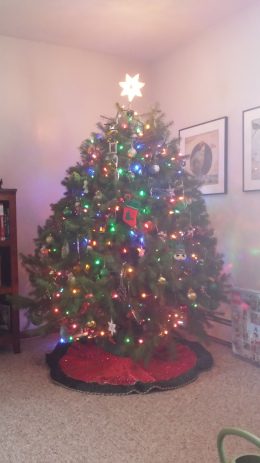
A Pagan Christmas Tree. Looking much like a regular Christmas Tree.
It’s the most wonderful time of the year, we’re often told. There are few extant rituals that involve anything like the sheer degree of mass participation called for by the modern Christmas. It seems as though we wake from our tryptophan-induced post-Thanksgiving slumber to find that every lamppost outside has already been covered in red ribbon, that one or more neighbors are actively erecting lawn decorations of questionable aesthetic merit, and that the local municipality is already in the process of bedecking a large conifer in some place of prominence (preferably near a war memorial). By mid-December, everywhere you look is covered in pine garland and holly, accompanied by oversized fake ornaments and effigies of wrapped packages. There is a Salvation Army bell-ringer outside of every grocery store, and a jolly-looking Santa holds court in the center of shopping malls great and small.
And that’s just the secular stuff!
If you’re religious, there’s a whole other layer of ritual and traditions to contend with! There’s still Thanksgiving leftovers in the fridge by the time some of your UU friends have begun celebrating Chalica and your Christian neighbors have set up that front yard Nativity scene. Your Jewish neighbors are getting ready for Hanukkah, too… If they have a keen sense of humor, they may be erecting a “Hanukkah Shrub” inside and some blue-and white lights outside. It seems that most Americans, regardless of whatever their religious background may be, are partaking in the Holiday Season in some form or another.
Arguably, many of the non-Christian Yuletide traditions were created in response to the resurgent Victorian-style Christmas celebrations that we are bombarded with today. Christmas has become so massive and all-encompassing that every child wants to be in on the game, and families feel moved to fit in. And so, many of the other faiths that make up the American religious landscape adopt the secular trappings of the overculture’s holiday and adapt it to their own theologies, whether by attaching Christmas-like aspects to existing holidays, creating new holidays out of whole cloth, or by practicing the non-overtly-Christian aspects of the Holidays alongside their own religious traditions.
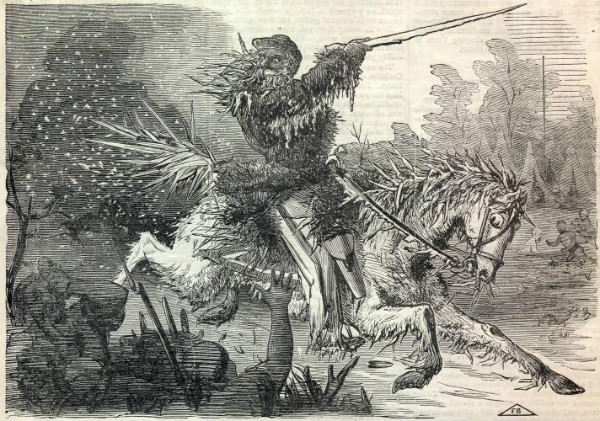
A 19th century image of Jack Frost as a Union General during the American Civil War. From WikiMedia. License.
Perhaps that’s how Christmas got its’ start, too. Imagine an early Roman Christian, if not themselves converted from the Religio Romana, then certainly a minority religion in a very Pagan Roman overculture. Perhaps they needed to adopt the trappings of the overculture’s Winter Solstice celebrations as a necessity — Christian tradition tells that these early Roman Christians faced a brutal persecution. But today, with the legitimacy of those stories increasingly in doubt, I like to look at the Christian adoption of these celebrations in a more positive light. While it is admittedly speculative on my part, I imagine that some of those early Christians still longed to partake in their favorite state holidays. And so they adapted the trappings (not the content) of their new theology in ways that syncretized with the Roman overculture’s popular Saturnalia and Sol Invictus celebrations, laying the groundwork for what would become Christmas.
Now what do you do if you are a first generation Neo-Pagan such as myself? The obvious thing that comes to mind is to do what our hypothetical Roman Christian convert would have done: appropriate the secular aspects of the overculture’s popular Christmas celebrations, and then apply it on top of the theology of your new religion. Except that for modern Pagans there’s a catch: buried inside of the secular aspects of the Christmas season lie all sorts of symbologies lifted directly out of earlier Pagan faiths. So in the process of appropriating what is arguably a very thinly Christian secular holiday, what Neo-Pagans are really doing is re-appropriating the remnants of an amalgamation of Pagan holidays and European folk traditions.
All of this begs some interesting questions. For starters, what Christian Christmas traditions are Pagan in origin? And which of those traditions are Neo-Pagans taking back? And most importantly, how can we share these traditions within our individual Unitarian-Universalist Congregations in a manner that is respectful to both Pagans and Christians alike?
What Christmas Traditions are Pagan?
As a rule of thumb, if you can’t figure out what it has to do with the birth and life of Jesus, then its either an appropriated Pagan or European folk tradition. Lets go through a few popular ones:
Gift Giving
The roots of this tradition can be found in the Roman Saturnalia, which ran from December 17th through the 23rd. On the third day of the festival, Romans would observe a day of gift-giving, often of nominal value. Popular gifts included toys for children, clay pottery, wax figurines, candles, or “gag gifts” [5].
12 Days of Christmas
This comes to us from the Heathen Yule celebration. Originally, the “Yule-tide” season began in what is now mid-November, continuing through January 12th [10][11]. Yule itself would begin on the Winter Solstice, and would conclude about 12 days later with the Jólablót. This was a three day long feast, the end of which may have signified the start of the Heathen New Year [10]. On what is now Christmas Eve, Anglo-Saxon Heathens would also celebrate Mōdraniht, or “Mother’s Night”, during which time a sacrifice would be made to honor the ancestral mothers and female dieties [10][12].
The Yule Log
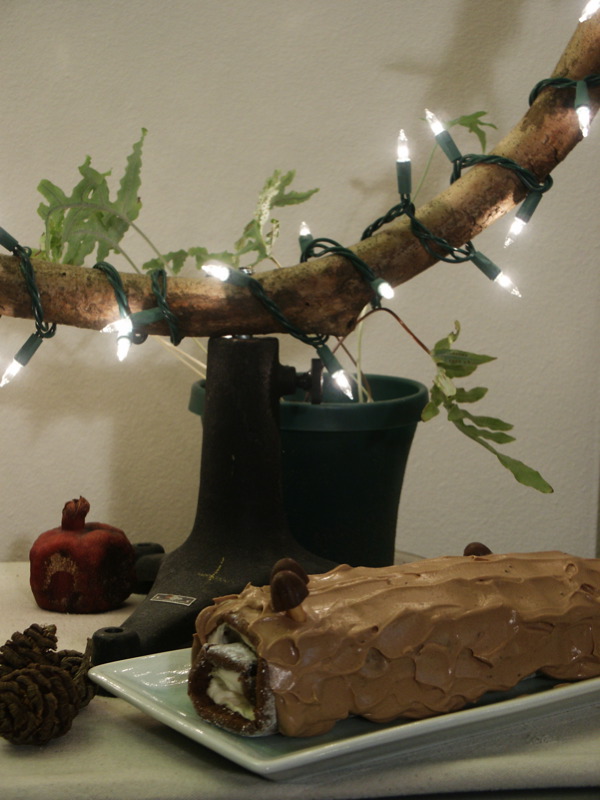
Yule Log. photo by Morgan Bell (cc) 2007.
The Yule Log is another appropriated Heathen practice. In its original form, it was a large portion of the trunk of a tree, designed to burn inside a Viking longhouse from Mother’s Night until the close of the Jólablót [13]. The log was decorated with garland and ribbons, or sometimes carved into the shape of a woman [14]. Traditions varied from place to place, although in some places the Yule Log would be specifically made of oak. Offerings of ale would be poured over it, and praises would be raised to the Gods Odin and Thor [14].
Trees, Holly, and Mistletoe
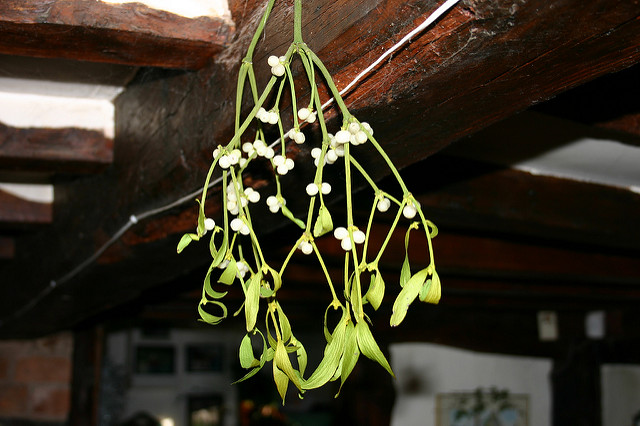
Mistletoe, photo by Lucy Hurst. (cc) 1980.
The idea of using evergreens indoors as a symbol of life in winter is very much a Pagan invention. Among the Pagan Celts, evergreens such as holly were seen as symbolic of Divine immortality [1]. Classical authors record how mistletoe held special significance among the Celts. In his Natural History [8], Pliny the Elder writes of the Celtic belief that mistletoe held fertility properties. In Norse mythology, mistletoe is known for being the insignificant little plant that was capable of mortally wounding the Divine hero Baldr. It should be noted that Baldr may fit the “Child of Light” archetype shared by the pan-Celtic Lugh, the Welsh Mabon and Pryderi, and of course, the Semetic Jesus.
Christmas Lights
As described by the Roman writer Macrobius, Saturnalia included a festival of lights ahead of the Winter Solstice, “with the abundant presence of candles symbolizing the quest for knowledge and truth” [5]. Other Pagan and folk traditions involving light abound, including the Yule Log, bonfires, and the placing candles in household windows [14].
Christmas Ham
This tradition comes to us from both the Romans and the Norse. As part of the Roman Saturnalia celebrations, families with means would sacrifice a suckling pig as an offering to Saturn [5]. In Heathen tradition, a boar was sacrificed at Yule and oaths would be made on its’ bristles [9]. In this case, the boar was associated with the God Freyr. Interestingly, both Freyr and Saturn were agricultural deities serving a similar function.
Goodies
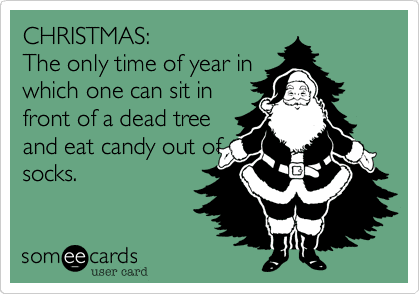
Another universal truth from the Internets
I recently saw an Internet meme that claimed Christmas as “the only time of year in which one can sit in front of a dead tree and eat candy out of socks.” It turns out that the giving of sweets to children goes back a very long time. There are a number old Celtic seasonal traditions that involve processions of children extracting sweets and cakes from their neighbors. These traditions take the form of mummers plays, a style of seasonal folk plays native to the British Isles which are performed by amateur actors that sometimes go house-to-house [4]. One particular tradition worth highlighting is known as “Hunting the Wren”. On December 26, a group of children known as the “wren boys” would go from house to house with a dead wren in an ornately decorated box. At each house, they would perform dances, songs, and small sketches. When done, they would ask the homeowners for treats and for money “to bury the wren” [1][2][3]. More on this in a bit.
Role Reversals
In Rome, Saturnalia celebrations were a time where social norms were suspended, and role reversals could take place. Gambling was permitted, and slaves could not be punished for disrespecting their masters. Furthermore, it was expected that masters would provide table service for their slaves, feeding the slaves the kind of meal usually reserved for themselves [5]. Although not a direct continuation of the Saturnalia tradition [6], by the High Middle Ages the concept would re-emerge as the popular Christmas Feasting tradition [7] where the local lord would supply his tenants with special food for Christmas Eve and Day.
Wassailing
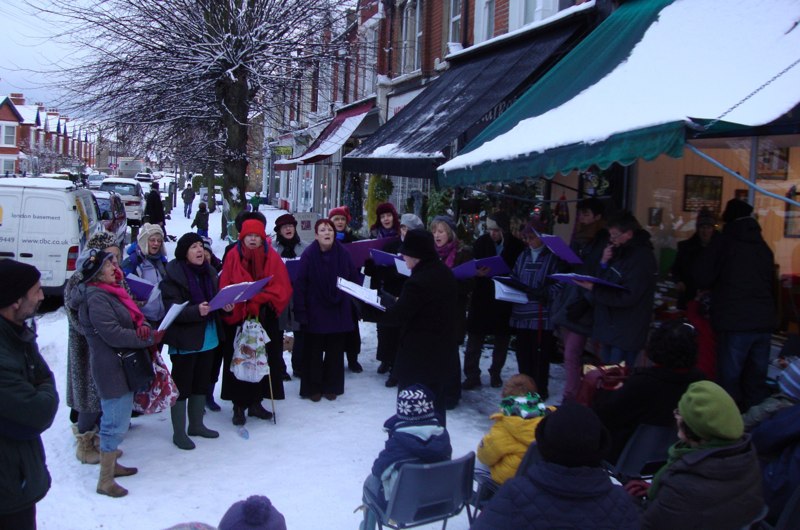
Wassailing all over the town, photo by furzedown (cc) 2010.
A popular Anglo-Saxon Christmas tradition with pre-Christian origins was that of wassailing. In its oldest form, carolers would to the house of wealthy members of the community where they would sing and ask for blessings of food and drink in return, a form of the “role reversal” traditions discussed previously [16]. Starting in the 16th century, a variation known as apple wassailing began to appear. This involved carolers going to the individual trees in a fruit orchard, singing to them while laying bread or toast at their roots and then splashing them with a mixture of hard ciders [17].
Bloodletting
Holiday bloodletting was a very popular tradition among the Celts and the Norse until long after the conversion to Christianity. In Ireland and Wales, for instance, there are records of old Christmastime traditions involving scourging or play-fighting with holly branches until blood was drawn [1]. Furthermore, the “Wren Hunt” that we discussed earlier also involved the sacrificial killing of a wren by stoning. Some historians now believe that the “wren boys” were a mock funeral procession, and that by honoring the death of the “wren king” through financial and consumable donations, each household could acknowledge and repay their own debt to nature for the year past [1][2][3]. What is telling here is that the “wren boys” skipped any homes that had experienced a death within the past year, as these households had already paid their debt to nature.
What Pagan Traditions are Being Reclaimed?
While we’re not keen on bringing back holiday bloodletting, and there is little need to re-introduce role reversal traditions (yet), there are plenty of other Yuletide rituals that are being reclaimed by different aspects of the Neo-Pagan community. For instance, some Wiccan Yuletide rituals involve stoking a red hot coal fire and then putting a yule log on it for the duration of the ritual. It is then allowed to burn out, and its ashes scattered over a garden [15]. Wassailing is another popular tradition that has been reclaimed by some Heathen and Celtic Reconstructionist groups, such as the Syracuse-based Muin Mound Grove, ADF. Modern Heathens observe a 13-night, 12-day Yule festival that they consider to be one of the most sacred times of the year [14]. Some Celtic Reconstructionist and Neo-Druidic groups reenact a version of the Wren Hunt or other mummers plays [1]. And countless Neo-Pagans of all stripes erect and decorate an evergreen tree, exchange gifts with loved ones, eat too much food, and drink too much alcohol.
I personally celebrate Winter Solstice as part of a larger holiday tradition involving my extended family. On the Winter Solstice Eve or morning (depending on whether the Solstice falls on a weekend or not), my wife and I exchange gifts with our closest friends. On Christmas Eve, we will often be at my Aunt’s home for gift exchanging and feasting with her and her her children’s families. Then on Christmas Day, we do our gift exchanging and feasting with my parents, siblings, and grandparents.
How Can We Share These Traditions Together?
What makes the Christmas season so incredibly versatile is that it contains messages that are well adapted to a variety of faith traditions. In his work, “The Apple Branch” [1], author Alexei Kondratiev highlights themes common to a number of European Winter Solstice traditions. These include symbolism dramatizing the power of light in darkness, the encouragement of family solidarity, and the giving of gifts. He writes,
Even the mythological themes that serve to validate the celebration tend to be similar in outline: a Child of Light — the returning Sun — is born at this darkest time in precarious circumstances, but as we embrace him in our affection and love he is allowed to grow and to finally reveal himself in the Light season.
This common symbolism is so powerful that elements of the modern Christian and secular Christmas were allowed to permeate into his circle’s Winter Solstice celebrations,
Virtually all Christmas customs… contribute something appropriate to the spirit of [the Winter Solstice]. In the measure that circle members experience them as embodiments of that spirit, all such local customs can and should be used. Both the Christian and the non-Christian motifs contained in the traditions will be of value to all since… they have a common source, a common goal, and reinforce each other. The “Christmas spirit” is older than Christianity, although it obviously loses non of its force in a Christian context.
And this is where I believe we can find the key to celebrating a syncretized Holiday season. Working together, we can identify those elements of the secular and religious midwinter traditions that are common to all members of our individual Congregations or communities, and we can then focus on them for the bulk of the Holiday season. Individual religious themes could then be picked out, and celebrated distinctly on those particular holy days.
To illustrate this, consider a holiday season that could be celebrated by a hypothetical UU Congregation beginning the Friday after Thanksgiving. This would be the start of a UU “Yule-tide” (“UUle-tide”?), and would continue through January 5th. Over the next five weeks, the Congregation would focus their efforts on those themes common to so many different religious traditions: the returning of the light and new beginnings, the importance of light in the darkness, the theme of family solidarity and connection, and the general sense of love, joy, and brotherhood that permeates the midwinter season. Specific services or events could then be tailored to Chalica, Advent, Hanukkah, Santa Lucia, Winter Solstice and Yule, Christmas Eve, Christmas Day, Kwanzaa, New Year’s Day, and Twelfth Night (also known as Three Kings Day).
So whose solstice is it, anyway? With so much shared imagery and tradition surrounding the Winter Solstice, it can truly be said to belong to each and every one of us. And working together, we can turn our holiday season into a woven tapestry of hope, of joy, of new beginnings, and especially of community.
In a world without end, let it be so.
Footnotes
1. Kondratiev, Alexei. The Apple Branch: A Path to Celtic Ritual. New York: Citadel Press, 2003. 131-146.
2. Ellison, Robert Lee. The Wheel Of the Year At Muin Mound Grove, ADF: A Cycle of Druid Rituals. 6th ed. East Syracuse: Dragon’s Keep Publishing, 2013. 24-6.
3. Ó Duinn, Seán. The Rites of Brigid: Goddess and Saint. Blackrock: Columba Press, 2005. 218-9.
4. Wikipedia contributors. “Mummers play.” Wikipedia, The Free Encyclopedia. Wikipedia, The Free Encyclopedia, 13 Dec. 2015. Web. 26 Dec. 2015.
5. Wikipedia contributors. “Saturnalia.” Wikipedia, The Free Encyclopedia. Wikipedia, The Free Encyclopedia, 26 Dec. 2015. Web. 26 Dec. 2015.
6. Johnson, Ben. “A Medieval Christmas.” Historic UK. Historic UK, 15 Dec. 2015. Web. 26 Dec. 2015.
7. Medievalists.net. “Seven Medieval Christmas Traditions.” Medievalists.net. Medievalists.net, 20 Dec. 2015. Web. 26 Dec. 2015.
8. Wikipedia contributors. “Ritual of oak and mistletoe.” Wikipedia, The Free Encyclopedia. Wikipedia, The Free Encyclopedia, 24 Aug. 2015. Web. 26 Dec. 2015.
9. Wikipedia contributors. “Sonargöltr.” Wikipedia, The Free Encyclopedia. Wikipedia, The Free Encyclopedia, 9 Nov. 2014. Web. 26 Dec. 2015.
10. Kvilhaug, Maria. “The Old Norse Yule Celebration – Myth and Ritual.” Freyia Völundarhúsins. Freyia Völundarhúsins, 21 Dec. 2012. Web. 22 Dec. 2015.
11. Wikipedia contributors. “Yule.” Wikipedia, The Free Encyclopedia. Wikipedia, The Free Encyclopedia, 26 Dec. 2014. Web. 26 Dec. 2015.
12. Wikipedia contributors. “Mōdraniht.” Wikipedia, The Free Encyclopedia. Wikipedia, The Free Encyclopedia, 22 Dec. 2015. Web. 26 Dec. 2015.
13. Wodening, Swain. “Yuletide Rituals.” Frigga’s Web. Frigga’s Web. Web. 22 Dec. 2015.
14. Daimler, Morgan. Where the Hawthorn Grows. Winchester: Moon Books, 2012. 104-8.
15. Farrar, Janet and Stewart. Eight Sabbats For Witches. Revised Edition. Blaine, WA: Phoenix Publishing, 1988. 146-50.
16. Wikipedia contributors. “Wassailing.” Wikipedia, The Free Encyclopedia. Wikipedia, The Free Encyclopedia, 28 Nov. 2015. Web. 27 Dec. 2015.
17. Wikipedia contributors. “Apple Wassail.” Wikipedia, The Free Encyclopedia. Wikipedia, The Free Encyclopedia, 7 Oct. 2015. Web. 27 Dec. 2015.
Previous Post
December 9, 2016
Kid-Friendly, Earth-Friendly Yule Crafts
Next Post

December 13, 2016 Time-In-Between
Browse Our Archives
Select a Category Current Events CUUPS Press Release Interfaith liturgy Media Review podcast Religious Education Seasonal Reflection Spiritual Practice Summary Uncategorized
Select a Month July 2026 June 2026 April 2026 January 2026 December 2025 October 2025 August 2025 July 2025 June 2025 April 2025 March 2025 February 2025 December 2024 November 2024 October 2024 August 2024 July 2024 June 2024 May 2024 April 2024 February 2024 December 2023 November 2023 October 2023 September 2023 August 2023 June 2023 May 2023 April 2023 March 2023 February 2023 January 2023 December 2022 October 2022 September 2022 August 2022 July 2022 June 2022 May 2022 April 2022 March 2022 February 2022 January 2022 December 2021 November 2021 October 2021 September 2021 August 2021 July 2021 June 2021 May 2021 April 2021 March 2021 February 2021 January 2021 December 2020 November 2020 October 2020 September 2020 August 2020 July 2020 June 2020 May 2020 April 2020 March 2020 February 2020 January 2020 December 2019 November 2019 October 2019 September 2019 August 2019 July 2019 June 2019 May 2019 April 2019 March 2019 February 2019 January 2019 December 2018 November 2018 October 2018 September 2018 August 2018 July 2018 June 2018 May 2018 April 2018 March 2018 February 2018 January 2018 December 2017 November 2017 October 2017 September 2017 August 2017 July 2017 June 2017 May 2017 April 2017 March 2017 February 2017 January 2017 December 2016 November 2016 October 2016 September 2016 August 2016 July 2016 June 2016 May 2016 April 2016 March 2016 February 2016 January 2016 December 2015 November 2015 October 2015 September 2015 August 2015 July 2015 June 2015 May 2015 April 2015 March 2015 February 2015 January 2015
Follow Us!
TAKE THE
Religious Wisdom Quiz
Jesus' earthly father, who was a carpenter, was named what?
Select your answer to see how you score.
Jacob Zechariah Jonathan Joseph
Related posts from Nature's Sacred Journey
April 22 Earth Day, its Our Power and...

Fear, conquer it with affirmations and meditation

Samhain — three aspects; one holiday and...Halloween
TRENDING AT PATHEOS Pagan

I was recently chatting with someone on Instagram. She asked me what...

While there are many people who share their results, the end of...

On July 23, I saw Christopher Nolan's The Odyssey which is Homer’s...

As I write this two big events have just finished up. One...

Restoring the Watershed of Divine Love
Perhaps cooperation is not something we manufacture through legislation, ideology, or moral...

Many UUs don’t pray because of bad experiences in a previous religion,...
view all Pagan blogs
Ad-Free & Subscriber Log-In Subscription Support
- About Us
- 2026 Calendar
- Videos
- Podcasts
- Library of World Religions
- Faith In Media Tracker
- Advertise With Us
- Write for Us
- Privacy Policy
- Terms of Service
- Do Not Sell My Data
- Contact Us
- Radiant Digital
- Manage Newsletter Subscriptions
- Unsubscribe From Notifications
- Sitemap
Copyright 2008-2026, Patheos. All rights reserved.
Subscription Support Ad-Free & Subscriber Log-In
Follow Patheos