
BuddhistCatholicContemplativeEvangelicalGeneral ChristianHinduJewishLatter-day SaintMuslimNew VisionsProgressive Christian
Beliefs
- Buddhist
- Catholic
- Contemplative
- Evangelical
- General Christian
- Hindu
- Jewish
- Latter-day Saint
- More Voices
- Muslim
- New Visions
- Pagan
- Progressive Christian
Topics
- Religion News
- Food and Religion
- Sports and Religion
- Religious Art
- Religious Music and Entertainment
- Religious Events
- History and Religion
- Style and Religion
- Politics and Religion
- Women in Religion
- Recreation Outdoors and Religion
- Business Finance and Religion
- Careers Workplace and Religion
- Education and Religion
- Family Parenting and Religion
- Health Fitness and Religion
- Home and Religion
- Relationships and Religion
- Technology and Religion
- Travel and Religion
Columnists
- Buddhist Columnists
- Business Finance and Religion Columnists
- Careers Workplace and Religion Columnists
- Catholic Columnists
- Contemplative Columnists
- Education and Religion Columnists
- Evangelists Columnists
- Family Parenting and Religion Columnists
- General Christian Columnists
- Health Fitness and Religion Columnists
- Hindu Columnists
- History and Religion Columnists
- Home and Religion Columnists
- Jewish Columnists
- More Voices Columnists
- Latter Day Columnists
- Muslim Columnists
- New Visions Columnists
- Nonreligious Columnists
- Pagan Columnists
- Politics and Religion Columnists
- Progressive Columnists
- Recreation Outdoors and Religion Columnists
- Relationships and Religion Columnists
- Religion News Columnists
- Religious Art Columnists
- Religious Events Columnists
- Religious Music and Entertainment Columnists
- Sports and Religion Columnists
- Style and Religion Columnists
- Technology and Religion Columnists
- Travel and Religion Columnists
- Women in Religion Columnists
Resource Library
- 2026 Calendar
- Library of World Religions
- The 100 Most Holy Places on Earth
- Patheos Answers
- Podcasts
- Videos
- Faith Leaders Database
- Anglican Episcopalian
- Bahai
- Baptist
- Buddhism
- Christianity
- Confucianism
- Eastern Orthodoxy
- Hinduism
- Holiness and Pentecostal
- ISKCON
- Islam
- Judaism
- Lutheran
- Methodist
- The Church of Jesus Christ of Latter-day Saints
- New Age
- Paganism
- Presbytarian and Reformed
- Protestantism
- Religion Behind the Scenes
- Roman Catholic
- Scientology
- Shia Islam
- Sikhism
- Sufism
- Sunni Islam
- Taoism
- Zen
- See all religions
Research Tools
 Ad-Free & Subscriber Log-In Subscription Support
Ad-Free & Subscriber Log-In Subscription Support
Follow Patheos 

- Trending:
- Forgiveness
- |
- Marriage
- |
- Consciousness
- |
- Death Penalty
- |
- Election
- |
- Halloween

- Home
- Pagan
- Before Going to Sleep
Before Going to Sleep
Last updated on: November 28, 2016 at 5:21 am by Dan Harper
Before Going to Sleep 2016-11-28T05:21:31+00:00 Dan Harper
Patheos Explore the world's faith through different perspectives on religion and spirituality! Patheos has the views of the prevalent religions and spiritualities of the world.
My Unitarian parents had my older sister and me say prayers before bed when we were children, more as a cultural practice than a spiritual practice; in the middle of the twentieth century in the United States, it was a cultural norm to have your children say their prayers before bed. But I have only the vaguest memory of this, so I suspect we only did it a handful of times, probably when we were quite young. I don’t remember my younger sister ever saying bedtime prayers, though maybe they made her do it once or twice, too.
I like the idea of some kind of reflective practice at the end of the day, though I have no interest in reciting “Now I lay me down to sleep.” Pythagoras (c. 570 – c. 495 BC), in one of his “Golden Verses,” outlined a different daily practice, which I think would make a good alternative:
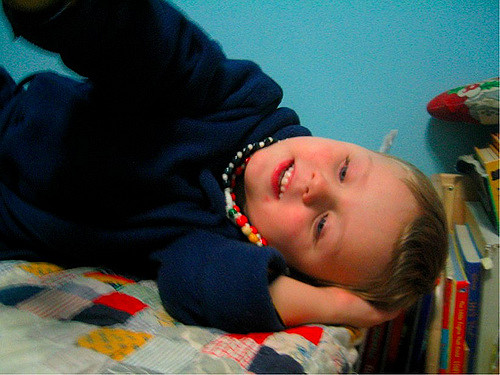
Francis Looking Cute, Bedtime Prayers. Photo by Martin Kelley (cc) 2010.
“Never suffer sleep to close your eyes after going to bed, till you have examined, by your reason, all your actions of the day. ‘Wherein have I done amiss? what have I done? what have I omitted that I ought to have done?’ If in this examination you find that you have done amiss, reprimand yourself severely for it; and if you have done any good, rejoice.”(1)
Or, as “John Shadow,” an eighteenth century English writer, described the practice: “It was a good piece of advice which Pythagoras gave to his scholars, that every night before they slept they should examine what they had been doing that day, and so discover what actions were worthy of pursuit tomorrow, and what little vices were to be prevented from slipping unawares into a habit.” John Shadow then goes on to suggest that when we get up in the morning, we should examine our dreams to learn even more about ourselves, because in our dreams we imagine circumstances which give us imaginary opportunities of pursuing our good or bad inclinations “to the utmost,” thus revealing to us our true temperament. (2)
I make every effort to forget my dreams, considering them leftovers and trash that should be emptied out, not picked through. And as for Pythagoras’s advice, I’m not sure I want to spend the moments before falling asleep reviewing all the stupid things I’ve done that day, and then reprimanding myself; that seems like a sure recipe for insomnia. Either that, or I’d fall asleep while still going over the long list of things I’d done wrong that day, which seems likely to lead to nightmares.
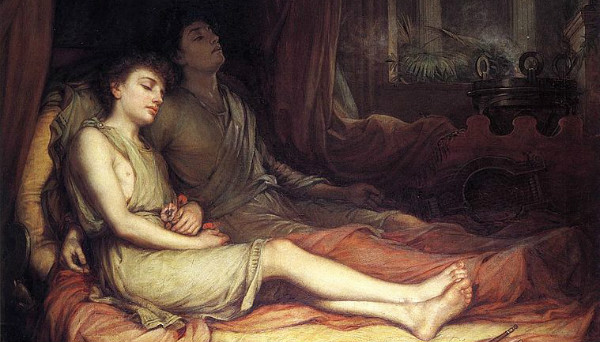
“Sleep and His Half Brother Death” by John Waterhouse. From WikiMedia.
There is also the Confucian spiritual practice of “quiet sitting,” developed by the Neo-Confucian school about a thousand years ago. The Confucians would practice quiet-sitting in the middle of the day: Sitting quietly in a chair with the back straight and hands on your knees, they would examine the “mind-heart” (unlike us Westerners, the Confucians considered mind and heart to be one). Examining the mind-heart is not easy; there is ancient Chinese metaphor that equates the mind-heart with a lively monkey which prefers to run around and finds it difficult to sit still.
The Confucians taught that when you do quiet-sitting, the goal is to get the lively monkey of the mind-heart to sit quietly so you are able to reflect on your “ren,” your humaneness; that is, you reflect on how human you are. (Quiet-sitting technique may sound like Buddhist meditation, though the Neo-Confucians would say it was different: Buddhists sat quietly to achieve an independent mental state, Neo-Confucians sat quietly to better understand themselves, so that they could act ethically and fit into the social order.) (3)
The Neo-Confucians who developed quite-sitting had servants, so they could devote a couple of hours in the middle of each day to this practice; they didn’t have to go off to work. The middle of the day might be the best time to engage in this practice: less chance of falling asleep (especially if you do it before lunch), and no chance of developing insomnia or nightmares. This may be an advantage of bedtime prayers: when you pray, you can repeat verbal formulae — “Now I lay me down to sleep”; “Our God who is in heaven”; etc. — and this repetition requires less concentration and less self-discipline, and is more conducive to comforting sleep.
I am not going to return to “Now I lay me,” nor am I fully convinced by either the Pythagoreans or the Neo-Confucians. But some kind of self-reflection each day, something to move me towards greater humaneness, would be very valuable indeed.
Notes:
(1) The translation is from The Commentary of Hierocles upon the Golden Verses of Pythagoras, rev. ed. (Glasgow: Robert Urie, 1756), p. 140; which was based on the trans. into French by Andre Dacier, as trans. from French into English (London: Jacob Tonson, 1707), see p. 304.
(2) From the August 27, 1714, issue of The Spectator; attributed to John Byrom. The Spectator vol. V, ed. Donald F. Bond (Clarendon Press: Oxford, 1965), p. 4.
<3) The description of quiet-sitting is adapted from John H. and Evelyn Nagai Berthrong, Confucianism: A Short Introduction (Oxford: Oneworld, 2000), p. 34.
Previous Post

November 25, 2016
Thankfulness and Regrets
Next Post
December 3, 2016 Yule Story
Browse Our Archives
Select a Category Current Events CUUPS Press Release Interfaith liturgy Media Review podcast Religious Education Seasonal Reflection Spiritual Practice Summary Uncategorized
Select a Month July 2026 June 2026 April 2026 January 2026 December 2025 October 2025 August 2025 July 2025 June 2025 April 2025 March 2025 February 2025 December 2024 November 2024 October 2024 August 2024 July 2024 June 2024 May 2024 April 2024 February 2024 December 2023 November 2023 October 2023 September 2023 August 2023 June 2023 May 2023 April 2023 March 2023 February 2023 January 2023 December 2022 October 2022 September 2022 August 2022 July 2022 June 2022 May 2022 April 2022 March 2022 February 2022 January 2022 December 2021 November 2021 October 2021 September 2021 August 2021 July 2021 June 2021 May 2021 April 2021 March 2021 February 2021 January 2021 December 2020 November 2020 October 2020 September 2020 August 2020 July 2020 June 2020 May 2020 April 2020 March 2020 February 2020 January 2020 December 2019 November 2019 October 2019 September 2019 August 2019 July 2019 June 2019 May 2019 April 2019 March 2019 February 2019 January 2019 December 2018 November 2018 October 2018 September 2018 August 2018 July 2018 June 2018 May 2018 April 2018 March 2018 February 2018 January 2018 December 2017 November 2017 October 2017 September 2017 August 2017 July 2017 June 2017 May 2017 April 2017 March 2017 February 2017 January 2017 December 2016 November 2016 October 2016 September 2016 August 2016 July 2016 June 2016 May 2016 April 2016 March 2016 February 2016 January 2016 December 2015 November 2015 October 2015 September 2015 August 2015 July 2015 June 2015 May 2015 April 2015 March 2015 February 2015 January 2015
Follow Us!
TAKE THE
Religious Wisdom Quiz
Who prophesied about a locust plague and called for national repentance?
Select your answer to see how you score.
Daniel Amos Micah Joel
Related posts from Nature's Sacred Journey


Fallow Season ~ Burnout, Fatigue, and Sacred Rest
The Autumn Awakening ~ Returning to Center

Five Things to do When the World Gets...
TRENDING AT PATHEOS Pagan

I was recently chatting with someone on Instagram. She asked me what...

While there are many people who share their results, the end of...

On July 23, I saw Christopher Nolan's The Odyssey which is Homer’s...

As I write this two big events have just finished up. One...

Restoring the Watershed of Divine Love
Perhaps cooperation is not something we manufacture through legislation, ideology, or moral...

Many UUs don’t pray because of bad experiences in a previous religion,...
view all Pagan blogs
Ad-Free & Subscriber Log-In Subscription Support
- About Us
- 2026 Calendar
- Videos
- Podcasts
- Library of World Religions
- Faith In Media Tracker
- Advertise With Us
- Write for Us
- Privacy Policy
- Terms of Service
- Do Not Sell My Data
- Contact Us
- Radiant Digital
- Manage Newsletter Subscriptions
- Unsubscribe From Notifications
- Sitemap
Copyright 2008-2026, Patheos. All rights reserved.
Subscription Support Ad-Free & Subscriber Log-In
Follow Patheos