
BuddhistCatholicContemplativeEvangelicalGeneral ChristianHinduJewishLatter-day SaintMuslimNew VisionsProgressive Christian
Beliefs
- Buddhist
- Catholic
- Contemplative
- Evangelical
- General Christian
- Hindu
- Jewish
- Latter-day Saint
- More Voices
- Muslim
- New Visions
- Pagan
- Progressive Christian
Topics
- Religion News
- Food and Religion
- Sports and Religion
- Religious Art
- Religious Music and Entertainment
- Religious Events
- History and Religion
- Style and Religion
- Politics and Religion
- Women in Religion
- Recreation Outdoors and Religion
- Business Finance and Religion
- Careers Workplace and Religion
- Education and Religion
- Family Parenting and Religion
- Health Fitness and Religion
- Home and Religion
- Relationships and Religion
- Technology and Religion
- Travel and Religion
Columnists
- Buddhist Columnists
- Business Finance and Religion Columnists
- Careers Workplace and Religion Columnists
- Catholic Columnists
- Contemplative Columnists
- Education and Religion Columnists
- Evangelists Columnists
- Family Parenting and Religion Columnists
- General Christian Columnists
- Health Fitness and Religion Columnists
- Hindu Columnists
- History and Religion Columnists
- Home and Religion Columnists
- Jewish Columnists
- More Voices Columnists
- Latter Day Columnists
- Muslim Columnists
- New Visions Columnists
- Nonreligious Columnists
- Pagan Columnists
- Politics and Religion Columnists
- Progressive Columnists
- Recreation Outdoors and Religion Columnists
- Relationships and Religion Columnists
- Religion News Columnists
- Religious Art Columnists
- Religious Events Columnists
- Religious Music and Entertainment Columnists
- Sports and Religion Columnists
- Style and Religion Columnists
- Technology and Religion Columnists
- Travel and Religion Columnists
- Women in Religion Columnists
Resource Library
- 2026 Calendar
- Library of World Religions
- The 100 Most Holy Places on Earth
- Patheos Answers
- Podcasts
- Videos
- Faith Leaders Database
- Anglican Episcopalian
- Bahai
- Baptist
- Buddhism
- Christianity
- Confucianism
- Eastern Orthodoxy
- Hinduism
- Holiness and Pentecostal
- ISKCON
- Islam
- Judaism
- Lutheran
- Methodist
- The Church of Jesus Christ of Latter-day Saints
- New Age
- Paganism
- Presbytarian and Reformed
- Protestantism
- Religion Behind the Scenes
- Roman Catholic
- Scientology
- Shia Islam
- Sikhism
- Sufism
- Sunni Islam
- Taoism
- Zen
- See all religions
Research Tools
 Ad-Free & Subscriber Log-In Subscription Support
Ad-Free & Subscriber Log-In Subscription Support
Follow Patheos 

- Trending:
- Forgiveness
- |
- Marriage
- |
- Consciousness
- |
- Death Penalty
- |
- Election
- |
- Halloween

- Home
- Pagan
- Gathered Here
Gathered Here
Last updated on: October 17, 2016 at 6:10 am by Amy Beltaine
Gathered Here 2016-10-17T06:10:45+00:00 Amy Beltaine
Patheos Explore the world's faith through different perspectives on religion and spirituality! Patheos has the views of the prevalent religions and spiritualities of the world.
Here it is, well past Fall Equinox, and I’m did not mark the holiday in any particular way. Litha and Lughnasadh slipped by as well. After 30 years of rituals for the Solstices, Equinoxes, and cross quarter days I’m a little puzzled that I’m not feeling the lack of the seasonal rituals more keenly. I have gained some other spiritual practices that sustain me, but they are mostly personal practices. The extent of “corporate worship” for me is when I attend Sunday services at my local UU congregation. This is rare since I’m either presenting a Sunday service or taking a needed Sunday off from work.
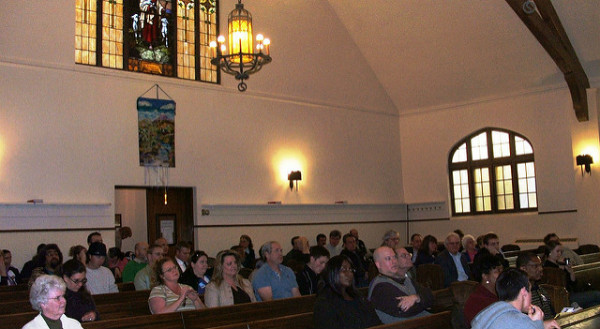
Crowd Gathers in House of Worship. photo by by AFL-CIO. (cc) 2004.
Corporate worship is what distinguishes seekers following a personal spiritual path from those creating lasting religious communities. Some say that the “spiritual but not religious” are folks who want the benefits of spirituality without the work of doing it in community, and that without community practice, you can never truly grow. The word corporate comes from the word corp which we also see in “corporeal”, or embodied. Corporate worship means worship with the whole religious body. In Christian circles the people of the congregations are the body of Christ, so corporate worship is when the body of Christ comes together.
Corporate worship is worship done with your community.
It is possible that the prediction I heard from my Seminary professors came true… When you become a minister you lose your church. At the time I laughed, “Ha ha!” I said, “my church is not just in the UU sanctuary doing the “hymn sandwich” my church is out in nature with witches and druids and earth-relating folks. I’ll never lose THAT!” Turns out I was wrong. What those professors meant was that as a minister I needed to be set apart from the congregation. I was a leader, a servant, a counselor and a prophet, but not a member or friend. When you lose your congregation you lose the corporate worship as well.
Part of it is the fact that as a professional ritual-maker I am impatient with most ritual, whether outside in nature, inside in pews, or in the fellowship hall in an improvised circle. I have not experienced the transformation of consciousness or the emotional depth or the one-ness with others that I associated with successful ritual.
Somehow I’m frustrated by the lack of ritual in Sunday services while I’m frustrated with a lack of resonance in my local Pagan groups and a lack of either in CUUPS rituals. I’m pretty sure that much of my frustration comes from me being picky. But is that a bad thing? I think it is sort of my job.
So, where can those of us who have had “peak” ritual experiences,, those of us whose job it is to find ways to create better religious experiences, find fulfilling, transformative corporate worship?
I think we need to keep trying to create it, together, for one-another.
There have been moments when I’ve experienced chills, or depth, or a sense of powerful recognition…
- The worship leader asked us to relate to the four directions, not as intellectual concepts, and not as theater, but in our bones. She asked us to breath deeply and exhale windily so that we all would hear the sound of the moving air. She asked us to stomp our feet (or hands) so we would all feel the solidity of the earth and experience it together. She asked us to snap or clap or jingle our keys so we’d feel the power of the community. She asked us to snap or tap, moving from one side of the room to the other so we could be reminded of our connections to the power of nature.
- The homily was broken into several parts, woven seamlessly with the songs. Each piece had meaning and connected the next piece.
- The whole service flowed together being handled by people who were completely relaxed and confident with what they were doing. Each of the many contributors added their piece without anxiety, layering in paint of the picture being painted in our mind’s eyes.
What is interesting to me is that these experiences happened on Sunday morning, with all the people of the congregation together AND that they are elements drawn from Pagan traditions held in the softened framework of the much maligned “hymn sandwich.” The hymn sandwich is the term used for the traditional protestant form of worship. Words, singing, words, singing, words, singing, words. It can be done well and has the charm of anything that is very familiar and comforting to many. It can be sterile, disconnected, rote, dis-embodied, and stale.
So I want that feeling back, that feeling of being a part of one larger body, but I’m not sure how to do that. I do think that a part of the path back into an integral whole involves a merge of Pagan and traditional Protestant worship.
There’s another dynamic at play though… The urgency of the pain in the world. I wonder if I am reluctant to go into the vulnerability of worshipping with others, and reluctant to open myself to the joy of worshipping with others, when I am aware of the fear, desperation, righteous anger and pain among my siblings, my city, country, and all the earth?
A colleague responded to this question with, “where is the line between the despair, anger and sadness I feel and the need I have to experience, express and feel beauty? Where is that line personally and publicly? For me, I am thinking that hard times need as much truth, transparency, firm action, understanding of the vulnerability of ourselves and each other, fierce love and and as much beauty as possible.”
Another colleague asks: “Wondering (for a friend…) Did it feel like this before? The doubt, the fear, the despair? The faith that love will “win” against an overwhelming mountain of evidence that love is so easily crushed under the footfalls of fear? Did it feel this way in Selma? In Montgomery? In Little Rock? Soweto? All of Europe in the ’30’s? Did it feel this way in the autumn of 1860 in the U.S.? Wondering … (for a friend.)”
And again, I remember the advice from my seminary professors (most of them!): “When you are in the most distress, when life feels busiest, when the world feels most broken, that is when you need to pray more, worship more, be in community more.”
We need to gather together, in one strong body. To sing together, to make meaning together, to connect to beauty together. (Click here for a link to a UU choir singing the hymn “Gathered Here.”)
What do you do to connect to beauty, with others? What do you do for corporate worship? Are you a part of the whole body of your religious community? What has moved you out of, or into that community? What will you change?

Next Post

October 18, 2016 Remembering Grandmother
Browse Our Archives
Select a Category Current Events CUUPS Press Release Interfaith liturgy Media Review podcast Religious Education Seasonal Reflection Spiritual Practice Summary Uncategorized
Select a Month July 2026 June 2026 April 2026 January 2026 December 2025 October 2025 August 2025 July 2025 June 2025 April 2025 March 2025 February 2025 December 2024 November 2024 October 2024 August 2024 July 2024 June 2024 May 2024 April 2024 February 2024 December 2023 November 2023 October 2023 September 2023 August 2023 June 2023 May 2023 April 2023 March 2023 February 2023 January 2023 December 2022 October 2022 September 2022 August 2022 July 2022 June 2022 May 2022 April 2022 March 2022 February 2022 January 2022 December 2021 November 2021 October 2021 September 2021 August 2021 July 2021 June 2021 May 2021 April 2021 March 2021 February 2021 January 2021 December 2020 November 2020 October 2020 September 2020 August 2020 July 2020 June 2020 May 2020 April 2020 March 2020 February 2020 January 2020 December 2019 November 2019 October 2019 September 2019 August 2019 July 2019 June 2019 May 2019 April 2019 March 2019 February 2019 January 2019 December 2018 November 2018 October 2018 September 2018 August 2018 July 2018 June 2018 May 2018 April 2018 March 2018 February 2018 January 2018 December 2017 November 2017 October 2017 September 2017 August 2017 July 2017 June 2017 May 2017 April 2017 March 2017 February 2017 January 2017 December 2016 November 2016 October 2016 September 2016 August 2016 July 2016 June 2016 May 2016 April 2016 March 2016 February 2016 January 2016 December 2015 November 2015 October 2015 September 2015 August 2015 July 2015 June 2015 May 2015 April 2015 March 2015 February 2015 January 2015
Follow Us!
TAKE THE
Religious Wisdom Quiz
How old was David when he became king over Israel?
Select your answer to see how you score.
20 years old 40 years old 25 years old 30 years old
Related posts from Nature's Sacred Journey

My Pagan path - a look back into...


Fallow Season ~ Burnout, Fatigue, and Sacred Rest
The Autumn Awakening ~ Returning to Center
TRENDING AT PATHEOS Pagan

I was recently chatting with someone on Instagram. She asked me what...

While there are many people who share their results, the end of...

On July 23, I saw Christopher Nolan's The Odyssey which is Homer’s...

As I write this two big events have just finished up. One...

Restoring the Watershed of Divine Love
Perhaps cooperation is not something we manufacture through legislation, ideology, or moral...

Many UUs don’t pray because of bad experiences in a previous religion,...
view all Pagan blogs
Ad-Free & Subscriber Log-In Subscription Support
- About Us
- 2026 Calendar
- Videos
- Podcasts
- Library of World Religions
- Faith In Media Tracker
- Advertise With Us
- Write for Us
- Privacy Policy
- Terms of Service
- Do Not Sell My Data
- Contact Us
- Radiant Digital
- Manage Newsletter Subscriptions
- Unsubscribe From Notifications
- Sitemap
Copyright 2008-2026, Patheos. All rights reserved.
Subscription Support Ad-Free & Subscriber Log-In
Follow Patheos