
BuddhistCatholicContemplativeEvangelicalGeneral ChristianHinduJewishLatter-day SaintMuslimNew VisionsProgressive Christian
Beliefs
- Buddhist
- Catholic
- Contemplative
- Evangelical
- General Christian
- Hindu
- Jewish
- Latter-day Saint
- More Voices
- Muslim
- New Visions
- Pagan
- Progressive Christian
Topics
- Religion News
- Food and Religion
- Sports and Religion
- Religious Art
- Religious Music and Entertainment
- Religious Events
- History and Religion
- Style and Religion
- Politics and Religion
- Women in Religion
- Recreation Outdoors and Religion
- Business Finance and Religion
- Careers Workplace and Religion
- Education and Religion
- Family Parenting and Religion
- Health Fitness and Religion
- Home and Religion
- Relationships and Religion
- Technology and Religion
- Travel and Religion
Columnists
- Buddhist Columnists
- Business Finance and Religion Columnists
- Careers Workplace and Religion Columnists
- Catholic Columnists
- Contemplative Columnists
- Education and Religion Columnists
- Evangelists Columnists
- Family Parenting and Religion Columnists
- General Christian Columnists
- Health Fitness and Religion Columnists
- Hindu Columnists
- History and Religion Columnists
- Home and Religion Columnists
- Jewish Columnists
- More Voices Columnists
- Latter Day Columnists
- Muslim Columnists
- New Visions Columnists
- Nonreligious Columnists
- Pagan Columnists
- Politics and Religion Columnists
- Progressive Columnists
- Recreation Outdoors and Religion Columnists
- Relationships and Religion Columnists
- Religion News Columnists
- Religious Art Columnists
- Religious Events Columnists
- Religious Music and Entertainment Columnists
- Sports and Religion Columnists
- Style and Religion Columnists
- Technology and Religion Columnists
- Travel and Religion Columnists
- Women in Religion Columnists
Resource Library
- 2026 Calendar
- Library of World Religions
- The 100 Most Holy Places on Earth
- Patheos Answers
- Podcasts
- Videos
- Faith Leaders Database
- Anglican Episcopalian
- Bahai
- Baptist
- Buddhism
- Christianity
- Confucianism
- Eastern Orthodoxy
- Hinduism
- Holiness and Pentecostal
- ISKCON
- Islam
- Judaism
- Lutheran
- Methodist
- The Church of Jesus Christ of Latter-day Saints
- New Age
- Paganism
- Presbytarian and Reformed
- Protestantism
- Religion Behind the Scenes
- Roman Catholic
- Scientology
- Shia Islam
- Sikhism
- Sufism
- Sunni Islam
- Taoism
- Zen
- See all religions
Research Tools
 Ad-Free & Subscriber Log-In Subscription Support
Ad-Free & Subscriber Log-In Subscription Support
Follow Patheos 

- Trending:
- Forgiveness
- |
- Marriage
- |
- Consciousness
- |
- Death Penalty
- |
- Election
- |
- Halloween

- Home
- Pagan
- Mabon: Exploring the Autumnal Equinox
Mabon: Exploring the Autumnal Equinox
Last updated on: September 16, 2019 at 4:59 am by D.C. McBride
Mabon: Exploring the Autumnal Equinox 2019-09-16T04:59:10+00:00 D.C. McBride
Patheos Explore the world's faith through different perspectives on religion and spirituality! Patheos has the views of the prevalent religions and spiritualities of the world.
Or, What is Mabon and How is it Celebrated?
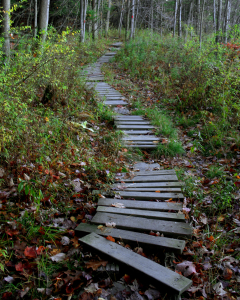
Weathered planks mark a swampy portion of the “Redwing Trail” at the Binghamton University nature preserve.
As we traverse the Wheel of the Year, those of us in the Northern Hemisphere now find ourselves at the cusp of the Autumnal Equinox. Known variously as Mabon, Harvesttide, Harvest Home, Feast of the Ingathering, Meán Fómhair, and Alban Elfed [6], many Neo-Pagan traditions celebrate this as the turning point between the “light” and “dark” halves of the year. As the equinox passes, the dark part of each day will be longer than the light part, and many of us will begin the work leading into our final harvest festival around the secular Halloween. Like its springtime counterpart, the history of Mabon is little understood by much of the Neo-Pagan community. But while an argument can be made for Ostara’s place in historical Pagan practice, Mabon as we know it is a modern invention with roots dating back to the early 1970s.
Historical Inspiration and Modern Creation
The Autumnal Equinox was not one of the four major feasts of ancient Celtic tradition [2][3], those being the great fire festivals of Samhain, Imbolc, Beltaine, and Lúghnasadh. While the Equinox itself was not honored, there is evidence that some communities would hold an observance between Lúghnasadh and Samhain to celebrate the end of the grain harvest. Some of these celebrations would serve as a conclusion to the ritual themes begun at Lúghnasadh [1], much in the style and spirit of the English “harvest home” celebration [2]. Like its English counterpart [4], these communities would ritualistically cut the last stalk of grain and preserve it as a means of ensuring the land’s continued fertility. The stalk would sometimes be fashioned into the form of an animal or a woman. The reaper who had cut it would then be charged with safekeeping this “corn dolly” for the coming year, during which time he could expect to receive special favors from the Otherworld. At the end of the next year’s harvest, the dolly would then be ritualistically burned [1].
But nonetheless, there is little evidence that any Indo-European or classical Pagan religion formally observed the Autumnal Equinox outside of the Greek cult of Demeter and Persephone, which would at this time hold the Greater Eleusinian Mysteries [5]. Even during the early years of the Neo-Pagan movement, little if any attention was paid to the equinoxes. When writing on her theory of the “Witch Cult” in Europe, Margaret Murray claimed that their festivals were held on the solstices and the four quarter days. And in Gerald Gardiner’s earliest works on Wicca, only the solstices and quarter days were celebrated. It was not until the early 1970s and the work of Aidan Kelly that the equinoxes were developed into the Neo-Pagan Wheel of the Year. According to Ronald Hutton [5], Kelly constructed a ritual based on the story of Persephone and her return to the Underworld. He then chose to name the holiday “Mabon” after the character from the Mabinogion, whom he saw as a Celtic male parallel for the Greek Persephone, both being young fertility Deities rescued from the Underworld.
Personal Opinions on Mabon
I must admit that I often overlook this High Day, and find that it has very little resonance with me. I can comprehend the symbolism of the Autumnal Equinox as the “turning point” at which we enter into the dark half of the year. One can also wax poetic about how the dark half of the year is a time for introspection and self-care. However, I personally don’t view the dark half of the year as having officially started until the two or three weeks before Samhain, and in the same manner don’t view the light half of the year as really kicking in until around Beltaine. Why this is, I don’t know… perhaps its still too warm out, perhaps the leaves haven’t quite changed color enough for my tastes. But for me, there is a certain “fall” quality to fall that doesn’t seem to kick in until the first weeks of October here in the American Northeast. By the time Samhain rolls around, it feels like we’re well into the dark half, but I just don’t get that same feeling at the Equinox (which is well enough, as we aren’t well into the dark half… its only just begun).
As my local ADF grove keeps a Gaelic hearth practice, treat the four Quarter Days as more “general purpose” holidays than we do the four Gaelic High Days. As it is unclear whether they were observed by the historical Gaels, we feel that we have some flexibility on the content and subject of the Quarter Day rituals. For instance, we celebrated Midsummer 2015 with a Vedic ritual, and used the following Autumnal Equinox as a chance to craft a ritual specifically to honor the Earth Mother. I am supportive of this decision, not the least because I keep a (mostly) Gaelic hearth. It allows for the grove to use Gaelic Hearth-inspired rituals and themes for the Gaelic High Days (which are the ones that are super-important to me and probably also to the grove’s Patron Dieties), while keeping the remaining four High Days open to spiritual exploration and experimentation. I feel that such a scheme strikes a nice balance, ensuring that the grove honors its commitment to its hearth culture and Patrons, while still giving it room to support and showcase the spiritual development of its membership.
Footnotes
1. Kondratiev, Alexei. The Apple Branch: A Path to Celtic Ritual. New York: Citadel Press, 2003. 209-19.
2. Ellison, Robert Lee. The Wheel Of the Year At Muin Mound Grove, ADF: A Cycle of Druid Rituals. 6th ed. East Syracuse: Dragon’s Keep Publishing, 2013. 143-4.
3. Powell, Thomas George Eyre. The Celts: Ancient Peoples and Places. Rev. ed. New York: Frederick A. Praeger, 1958. 116-21.
4. “Harvest Home”. Encyclopædia Britannica. Encyclopædia Britannica Online. Encyclopædia Britannica Inc., 2015. Web. 19 Sep. 2015.
5. Hutton, Ronald. “Modern Pagan Festivals: A Study in the Nature of Tradition”. Folklore. 119:3 (208): 251-273. DOI: 10.1080/00155870802352178.
6. Wikipedia contributors. “Wheel of the Year.” Wikipedia, The Free Encyclopedia. Wikipedia, The Free Encyclopedia, 4 Sep. 2016. Web. 14 Sep. 2016.
Previous Post

September 15, 2016
Lessons from Krypton
Next Post

September 19, 2016 Thealogy of the Chambered Nautilus
Browse Our Archives
Select a Category Current Events CUUPS Press Release Interfaith liturgy Media Review podcast Religious Education Seasonal Reflection Spiritual Practice Summary Uncategorized
Select a Month July 2026 June 2026 April 2026 January 2026 December 2025 October 2025 August 2025 July 2025 June 2025 April 2025 March 2025 February 2025 December 2024 November 2024 October 2024 August 2024 July 2024 June 2024 May 2024 April 2024 February 2024 December 2023 November 2023 October 2023 September 2023 August 2023 June 2023 May 2023 April 2023 March 2023 February 2023 January 2023 December 2022 October 2022 September 2022 August 2022 July 2022 June 2022 May 2022 April 2022 March 2022 February 2022 January 2022 December 2021 November 2021 October 2021 September 2021 August 2021 July 2021 June 2021 May 2021 April 2021 March 2021 February 2021 January 2021 December 2020 November 2020 October 2020 September 2020 August 2020 July 2020 June 2020 May 2020 April 2020 March 2020 February 2020 January 2020 December 2019 November 2019 October 2019 September 2019 August 2019 July 2019 June 2019 May 2019 April 2019 March 2019 February 2019 January 2019 December 2018 November 2018 October 2018 September 2018 August 2018 July 2018 June 2018 May 2018 April 2018 March 2018 February 2018 January 2018 December 2017 November 2017 October 2017 September 2017 August 2017 July 2017 June 2017 May 2017 April 2017 March 2017 February 2017 January 2017 December 2016 November 2016 October 2016 September 2016 August 2016 July 2016 June 2016 May 2016 April 2016 March 2016 February 2016 January 2016 December 2015 November 2015 October 2015 September 2015 August 2015 July 2015 June 2015 May 2015 April 2015 March 2015 February 2015 January 2015
Follow Us!
TAKE THE
Religious Wisdom Quiz
What is the main theme of Galatians?
Select your answer to see how you score.
Love above faith Spiritual gifts Justification by faith Church discipline
Related posts from Nature's Sacred Journey

April 22 Earth Day, its Our Power and...

Fear, conquer it with affirmations and meditation

Samhain — three aspects; one holiday and...Halloween
TRENDING AT PATHEOS Pagan

I was recently chatting with someone on Instagram. She asked me what...

While there are many people who share their results, the end of...

On July 23, I saw Christopher Nolan's The Odyssey which is Homer’s...

As I write this two big events have just finished up. One...

Restoring the Watershed of Divine Love
Perhaps cooperation is not something we manufacture through legislation, ideology, or moral...

Many UUs don’t pray because of bad experiences in a previous religion,...
view all Pagan blogs
Ad-Free & Subscriber Log-In Subscription Support
- About Us
- 2026 Calendar
- Videos
- Podcasts
- Library of World Religions
- Faith In Media Tracker
- Advertise With Us
- Write for Us
- Privacy Policy
- Terms of Service
- Do Not Sell My Data
- Contact Us
- Radiant Digital
- Manage Newsletter Subscriptions
- Unsubscribe From Notifications
- Sitemap
Copyright 2008-2026, Patheos. All rights reserved.
Subscription Support Ad-Free & Subscriber Log-In
Follow Patheos