
BuddhistCatholicContemplativeEvangelicalGeneral ChristianHinduJewishLatter-day SaintMuslimNew VisionsProgressive Christian
Beliefs
- Buddhist
- Catholic
- Contemplative
- Evangelical
- General Christian
- Hindu
- Jewish
- Latter-day Saint
- More Voices
- Muslim
- New Visions
- Pagan
- Progressive Christian
Topics
- Religion News
- Food and Religion
- Sports and Religion
- Religious Art
- Religious Music and Entertainment
- Religious Events
- History and Religion
- Style and Religion
- Politics and Religion
- Women in Religion
- Recreation Outdoors and Religion
- Business Finance and Religion
- Careers Workplace and Religion
- Education and Religion
- Family Parenting and Religion
- Health Fitness and Religion
- Home and Religion
- Relationships and Religion
- Technology and Religion
- Travel and Religion
Columnists
- Buddhist Columnists
- Business Finance and Religion Columnists
- Careers Workplace and Religion Columnists
- Catholic Columnists
- Contemplative Columnists
- Education and Religion Columnists
- Evangelists Columnists
- Family Parenting and Religion Columnists
- General Christian Columnists
- Health Fitness and Religion Columnists
- Hindu Columnists
- History and Religion Columnists
- Home and Religion Columnists
- Jewish Columnists
- More Voices Columnists
- Latter Day Columnists
- Muslim Columnists
- New Visions Columnists
- Nonreligious Columnists
- Pagan Columnists
- Politics and Religion Columnists
- Progressive Columnists
- Recreation Outdoors and Religion Columnists
- Relationships and Religion Columnists
- Religion News Columnists
- Religious Art Columnists
- Religious Events Columnists
- Religious Music and Entertainment Columnists
- Sports and Religion Columnists
- Style and Religion Columnists
- Technology and Religion Columnists
- Travel and Religion Columnists
- Women in Religion Columnists
Resource Library
- 2026 Calendar
- Library of World Religions
- The 100 Most Holy Places on Earth
- Patheos Answers
- Podcasts
- Videos
- Faith Leaders Database
- Anglican Episcopalian
- Bahai
- Baptist
- Buddhism
- Christianity
- Confucianism
- Eastern Orthodoxy
- Hinduism
- Holiness and Pentecostal
- ISKCON
- Islam
- Judaism
- Lutheran
- Methodist
- The Church of Jesus Christ of Latter-day Saints
- New Age
- Paganism
- Presbytarian and Reformed
- Protestantism
- Religion Behind the Scenes
- Roman Catholic
- Scientology
- Shia Islam
- Sikhism
- Sufism
- Sunni Islam
- Taoism
- Zen
- See all religions
Research Tools
 Ad-Free & Subscriber Log-In Subscription Support
Ad-Free & Subscriber Log-In Subscription Support
Follow Patheos 

- Trending:
- Forgiveness
- |
- Marriage
- |
- Consciousness
- |
- Death Penalty
- |
- Election
- |
- Halloween

- Home
- Pagan
- Sirius Rising
Sirius Rising
Last updated on: July 22, 2019 at 6:32 pm by Meghann Robern
Sirius Rising 2019-07-22T18:32:53+00:00 Meghann Robern
Patheos Explore the world's faith through different perspectives on religion and spirituality! Patheos has the views of the prevalent religions and spiritualities of the world.
 One of my very favourite aspects of being Unitarian Universalist is how deeply embedded in our traditions and expressions we hold seemingly opposite things in tension together to not only break down binaries, but also create a new space in which those opposites offer up a new way of thinking or doing.
In the Northern Hemisphere, Wiccans are past the Summer Solstice, and summer is waning. Lammas/Lughnasa will be upon us before we know it. Among all the numerous and varied histories of this time of year, from all different cultures and places in the world — Corn Maidens, Harvest Kings, Lugh of the Silver Hand, and on and on — I found the juxtaposition between the ancient Greco-Romans’ perception of the rising of the Dog Star, Sirius, with how the ancient Egyptians perceived the same astronomical event, to be the most fascinating.
I was preparing to supply a UU pulpit in late summer a couple of years ago, struggling to find a message for the congregation in a time of turmoil in our own country and beyond. In my research I found, of course, more than I ever thought was possible about sacrifices of Harvest Gods, Corn Maiden and Mother legends speaking to the worst of historical patriarchy, and a veneration of Warrior Magic. It was all parties and celebrations, and as that summer progressed, not at all what I felt needed to be spoken.
But in the midst of all of this, I read about the ancient Egyptians, and how the rising of Sirius heralded the flooding of the Nile river. The rising of the waters would deposit rich soil on their land that would stay when the waters receded, and allowed them to grow crops and sustain a civilization that did not just survive, but flourished into a dominant power in the region and beyond. For them, Sirius rising was not about the harvest itself, but the promise of the harvest to come. It was not about results, but about hope.
This is in direct contrast with how the Greco-Roman culture perceived the rising of Sirius, which preceded a period of time far more aligned with my own perception of late summer: a searing heat that destroys rather than nourishes. This is the source of the phrase “the dog days of summer,” and numerous ancient writers spoke of its ill effects. Pliny wrote that Sirius “sheds a killing light,” while Aristotle claimed it caused liquids to move of their own volition, leading to rough seas, bubbling wine, and stirring marshes. Hesiod believed it to be the cause of drought, sterilizing seeds in the earth. The most vivid description, however, comes from the astronomer Manilius:

Photo of the sun by NASA
It barks forth flame, raves with its fire, and doubles the burning heat of the sun. When it puts its torch to the earth and discharges its rays, the earth foresees its conflagration and tastes its ultimate fate. Neptune lies motionless in the midst of his waters and the green blood is drained from leaves and grass… beset by temperatures too great to bear, nature is afflicted with a sickness of its own making, alive but on a funeral pyre: such is the heat diffused among constellations, and everything is brought to a halt by a single star.
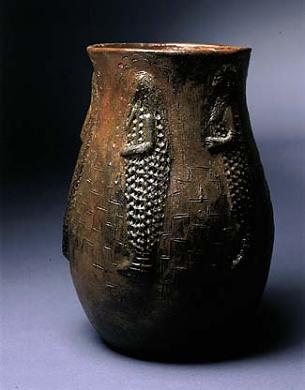
Bean Pot with Incised Corn Maiden Figures
The nature of which he speaks is not exclusive of human beings, as he writes that this period of time brings out the worst in us as well: “anger, hatred, fear, impetuosity, frayed tempers, and arguments.” As I have watched and read the news this summer, even just this week, I cannot bring myself to disagree.
I don’t know about you, but I am overwhelmed. And I realize that moments like this are why I am, religiously, a Unitarian Universalist. We don’t have a particular sacred scripture, or a creedal test, or many other things that lots of religions rely on to exist. What do have, however, are seven principles that are not beliefs, but things that we covenant, together, to make manifest in the world. Where they already exist, we support them. Where they do not yet exist, we strive to make them so. We combine reason and faith to make visions into realities, and we try to do it as inclusively as possible. And this is where I finally found my way back to the modern Wiccan rituals and traditions, and the aspect of Lughnasa that celebrates Warrior Magic.
To quote Anna Franklin and Paul Mason in their book Lammas, “The warrior here is a psychic warrior; their weapons are body, mind, and spirit. These must be trained to work in harmony. The warrior will face their own fears; they develop their spiritual courage and hone their will.” I have 1 encountered the term “social justice warrior” a lot lately, used as a pejorative. I want to own it, proudly.
As a denomination, we UUs are coming into our own identity, instead of the incoherent mishmash made famous by Garrison Keillor. We are not, as many think, the place where you can believe anything, but rather the place where your own personal beliefs, whatever they are, must tempered by the understanding that we are part of a congregational, a local, a regional, a national, and a global community, all at the same time, and that we are working towards something that brings compassion, healing, and nourishment to the multiverse. Let our warriors’ weapons be our bodies and voices in witness to the pain and suffering in all places, including that of our planet’s ecosystems.
May it be so, and blessed be.
Previous Post

July 8, 2016
Scientists Discover Life's Common Ancestor, An Ancient Living Ocean
Next Post

July 15, 2016 The Paganism of Pokémon
Browse Our Archives
Select a Category Current Events CUUPS Press Release Interfaith liturgy Media Review podcast Religious Education Seasonal Reflection Spiritual Practice Summary Uncategorized
Select a Month July 2026 June 2026 April 2026 January 2026 December 2025 October 2025 August 2025 July 2025 June 2025 April 2025 March 2025 February 2025 December 2024 November 2024 October 2024 August 2024 July 2024 June 2024 May 2024 April 2024 February 2024 December 2023 November 2023 October 2023 September 2023 August 2023 June 2023 May 2023 April 2023 March 2023 February 2023 January 2023 December 2022 October 2022 September 2022 August 2022 July 2022 June 2022 May 2022 April 2022 March 2022 February 2022 January 2022 December 2021 November 2021 October 2021 September 2021 August 2021 July 2021 June 2021 May 2021 April 2021 March 2021 February 2021 January 2021 December 2020 November 2020 October 2020 September 2020 August 2020 July 2020 June 2020 May 2020 April 2020 March 2020 February 2020 January 2020 December 2019 November 2019 October 2019 September 2019 August 2019 July 2019 June 2019 May 2019 April 2019 March 2019 February 2019 January 2019 December 2018 November 2018 October 2018 September 2018 August 2018 July 2018 June 2018 May 2018 April 2018 March 2018 February 2018 January 2018 December 2017 November 2017 October 2017 September 2017 August 2017 July 2017 June 2017 May 2017 April 2017 March 2017 February 2017 January 2017 December 2016 November 2016 October 2016 September 2016 August 2016 July 2016 June 2016 May 2016 April 2016 March 2016 February 2016 January 2016 December 2015 November 2015 October 2015 September 2015 August 2015 July 2015 June 2015 May 2015 April 2015 March 2015 February 2015 January 2015
Follow Us!
TAKE THE
Religious Wisdom Quiz
In the Sermon on the Mount, who did Jesus say would "inherit the earth"?
Select your answer to see how you score.
The just The meek The wise The strong
Related posts from Nature's Sacred Journey

April 22 Earth Day, its Our Power and...

Fear, conquer it with affirmations and meditation

Samhain — three aspects; one holiday and...Halloween
TRENDING AT PATHEOS Pagan

I was recently chatting with someone on Instagram. She asked me what...

While there are many people who share their results, the end of...

On July 23, I saw Christopher Nolan's The Odyssey which is Homer’s...

As I write this two big events have just finished up. One...

Restoring the Watershed of Divine Love
Perhaps cooperation is not something we manufacture through legislation, ideology, or moral...

Many UUs don’t pray because of bad experiences in a previous religion,...
view all Pagan blogs
Ad-Free & Subscriber Log-In Subscription Support
- About Us
- 2026 Calendar
- Videos
- Podcasts
- Library of World Religions
- Faith In Media Tracker
- Advertise With Us
- Write for Us
- Privacy Policy
- Terms of Service
- Do Not Sell My Data
- Contact Us
- Radiant Digital
- Manage Newsletter Subscriptions
- Unsubscribe From Notifications
- Sitemap
Copyright 2008-2026, Patheos. All rights reserved.
Subscription Support Ad-Free & Subscriber Log-In
Follow Patheos