
BuddhistCatholicContemplativeEvangelicalGeneral ChristianHinduJewishLatter-day SaintMuslimNew VisionsProgressive Christian
Beliefs
- Buddhist
- Catholic
- Contemplative
- Evangelical
- General Christian
- Hindu
- Jewish
- Latter-day Saint
- More Voices
- Muslim
- New Visions
- Pagan
- Progressive Christian
Topics
- Religion News
- Food and Religion
- Sports and Religion
- Religious Art
- Religious Music and Entertainment
- Religious Events
- History and Religion
- Style and Religion
- Politics and Religion
- Women in Religion
- Recreation Outdoors and Religion
- Business Finance and Religion
- Careers Workplace and Religion
- Education and Religion
- Family Parenting and Religion
- Health Fitness and Religion
- Home and Religion
- Relationships and Religion
- Technology and Religion
- Travel and Religion
Columnists
- Buddhist Columnists
- Business Finance and Religion Columnists
- Careers Workplace and Religion Columnists
- Catholic Columnists
- Contemplative Columnists
- Education and Religion Columnists
- Evangelists Columnists
- Family Parenting and Religion Columnists
- General Christian Columnists
- Health Fitness and Religion Columnists
- Hindu Columnists
- History and Religion Columnists
- Home and Religion Columnists
- Jewish Columnists
- More Voices Columnists
- Latter Day Columnists
- Muslim Columnists
- New Visions Columnists
- Nonreligious Columnists
- Pagan Columnists
- Politics and Religion Columnists
- Progressive Columnists
- Recreation Outdoors and Religion Columnists
- Relationships and Religion Columnists
- Religion News Columnists
- Religious Art Columnists
- Religious Events Columnists
- Religious Music and Entertainment Columnists
- Sports and Religion Columnists
- Style and Religion Columnists
- Technology and Religion Columnists
- Travel and Religion Columnists
- Women in Religion Columnists
Resource Library
- 2026 Calendar
- Library of World Religions
- The 100 Most Holy Places on Earth
- Patheos Answers
- Podcasts
- Videos
- Faith Leaders Database
- Anglican Episcopalian
- Bahai
- Baptist
- Buddhism
- Christianity
- Confucianism
- Eastern Orthodoxy
- Hinduism
- Holiness and Pentecostal
- ISKCON
- Islam
- Judaism
- Lutheran
- Methodist
- The Church of Jesus Christ of Latter-day Saints
- New Age
- Paganism
- Presbytarian and Reformed
- Protestantism
- Religion Behind the Scenes
- Roman Catholic
- Scientology
- Shia Islam
- Sikhism
- Sufism
- Sunni Islam
- Taoism
- Zen
- See all religions
Research Tools
 Ad-Free & Subscriber Log-In Subscription Support
Ad-Free & Subscriber Log-In Subscription Support
Follow Patheos 

- Trending:
- Forgiveness
- |
- Marriage
- |
- Consciousness
- |
- Death Penalty
- |
- Election
- |
- Halloween

- Home
- Pagan
- Conflict & Apology
Conflict & Apology
Last updated on: July 22, 2016 at 6:29 am by Maggie Beaumont
Conflict & Apology 2016-07-22T06:29:57+00:00 Maggie Beaumont
Patheos Explore the world's faith through different perspectives on religion and spirituality! Patheos has the views of the prevalent religions and spiritualities of the world.

photo by Maggie Beaumont
I need to write about conflict.
I need to write about discovering in myself an unwillingness – very nearly an inability – to change a position that no longer serves.
I need to write about discovering in myself that sometimes it can be more important to me to ‘win’ than it is to be ‘fair,’ or even to acknowledge that the person I feel angry at may just possibly be right.
I need to write about discovering in myself something I find particularly shameful: I have been unable to recognize that the opinions of someone I care about, with which I disagree, are not judgments of me personally. I’ve been unable to recognize that the other person’s opinions are not personal … not because I genuinely believe that a personal judgment is meant … but rather, because I am afraid that I could end up feeling stupid. And because I’m afraid of being laughed at.
My internal logic goes like this:
- Past experience contains examples of people who spoke those opinions and who genuinely did do damage to me or limit my ability to care for myself. Some of them did injure me quite intentionally. Others hurt me because my pain was beneath their notice.
- At a few times in the past I have sometimes too generously given someone the benefit of the doubt, and later regretted that I opened myself to harm.
- In the past I have sometimes argued for someone’s right to their opinion … and later been laughed at (by that same person) for imagining that their intentions might be good.
- So this time I feel safer if I assume what they’re saying is personal, is intended to be taken personally, is intend to injure, offend, or shame me.
There. Doesn’t that all make sense?
But, in what universe does that seem a good idea for future relationships?
Right at the moment, this feels awful.
I want to pretend I didn’t see it. But I did.
I want to pretend that it doesn’t matter, but it does.
I want to pretend that, because my opinion is the ‘right’ one and the other person is ‘wrong,’ that means I am justified in feeling angry and unsafe in that person’s presence. Which is utterly untrue, regardless of which of us is right (or even if, as can happen, both of us are right).
Where else does this show up?
All over the place.
* In my impassioned insistence that all my friends should agree with me that some particular issue is the most important – and that changing that one issue should be front and center in everything we do, whether they want to help or not. Or even, whether there is important work to do about other issues, too, or not. Even, when there are other lifesaving things we need to learn right this minute.
* In my assertion that it’s okay for me to loudly object to something you say, because the microaggressions that happened to me before you were born were so powerful — without, by the way, explaining any of them (because, you know, they were too personal or painful or whatever).
One time a long time ago I explained to a tall handsome man in his 30s that I wasn’t going to accompany him on a lonely walk after midnight because I didn’t know him very well. He patiently explained to me that my fear was “unfounded” because he wasn’t that kind of guy. I patiently explained to him that he might indeed be ‘not that kind of guy’ but that his understanding of who he was did not invalidate my experience; that my fear was accurately founded on my previous experiences with guys who said they were ‘not that kind’ – and were lying – and that meant that my fear was based on solid experience and that my caution, while unnecessary in his eyes, was clear and obviously necessary in mine.
He couldn’t understand what I was saying. He couldn’t even forgive me for saying it.
I think the same thing is happening, today, in a lot of spaces where people who have some relative privilege and people who don’t have that particular one are trying to communicate.
As an honorable, well-meaning White person I may imagine that the Black person I’m with ought to know I’m trustworthy. But what if they don’t know me well enough for that?
As a well-meaning woman whose gender presentation appears unambiguous, I may imagine that the trans person I’m with ought to know I’m safe to talk to. But what if I say something rude or intrusive? Do I think it hurts less because it comes from ignorance or inadvertence? How about casual disregard?
What if my feelings are a bit conflicted and my behavior a bit inconsistent? What would it mean … and how would it feel to a trans woman … if I wholeheartedly welcomed her into the Women’s Restroom and loudly defended her right to be there … and then pointedly excluded her from a Women’s Ritual?
Our fears are founded on our experiences – on what has happened to us, or to others in our presence, and on the stories we’ve heard and the jokes we’ve been told. Most of us are horrified by the idea that we might behave unfairly. And most of us do, actually, behave unfairly some of the time. Maybe we assume our way is the right way, or even the only way. Maybe we stand on our principals to the exclusion of someone else’s right to breathe air. And sometimes, we need to apologize. To issue a real, genuine, heartfelt apology.
“I am sincerely sorry. I think I understand what I did that was wrong. I’m sorry for my ignorance. I’m sorry that I let my emotions get in the way of taking care of our friendship.”
Notice, please that I did NOT say “I’m sorry if …” and especially I did not say “I’m sorry if your feelings were hurt.” When I hear that, I always wonder if the person means the offense would have been perfectly okay if I hadn’t noticed it, or if my feelings hadn’t been hurt. As if stealing would somehow be okay as long as the culprit didn’t get caught. Or as if telling a racist joke would ever be okay ‘as long as no Person of Color was present’ or ‘as long as it was really funny.’
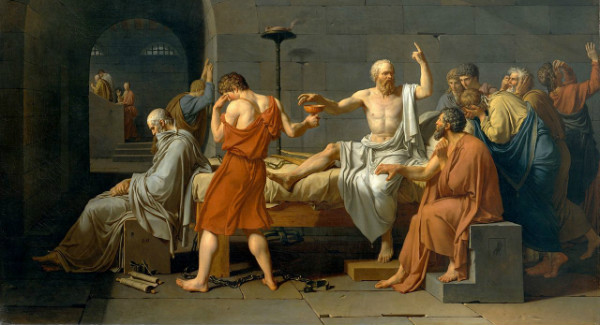
“The Death of Socrates” by Jacques-Louis David. From WikiMedia.
There’s more to say about both conflict and apology – and there are some lovely sources to read about both. Your Google, Yahoo, or DuckDuckGo search engine can help you find several. But what I’m noticing at the moment is my personal level of avoidance about this.
I don’t want to write about it, or talk about it. I want, in some internally inconsistent way, to both ‘find a way to apologize that actually heals the relationship’ and ‘pretend nothing ever happened and imagine that I behaved well.’
The Witch asks why I’m struggling so much. What is it I’m not telling you?
I’m not telling you that I’ve been struggling with this for a year, in two different settings. I’m having trouble telling you that I’m still in pain over having expressed anger badly in one place last summer. And that I’ve been trying all year to forgive someone for having opinions different from mine in a situation where I would ‘like’ it better if we all agreed.
I’m wishing I didn’t have to admit that, far too often, I’d rather be right than be loving, or even be loved. I’m wishing I didn’t have to admit that, in some secret place of my inner child’s heart, I’m terrified that if I gave up my anger I would be defenseless.
The Witch dries my tears and offers me a hug. When she lets go I find a mug of warm ginger tea in my hand. I take a sip, and discover the overtones of forgiveness.
Blessed Be
–Maggie Beaumont
Ten days before Lammas 2016
Previous Post

July 20, 2016
Is the Candle Still Burning?
Next Post

July 25, 2016 Lughnasa: Bad Harvest
Browse Our Archives
Select a Category Current Events CUUPS Press Release Interfaith liturgy Media Review podcast Religious Education Seasonal Reflection Spiritual Practice Summary Uncategorized
Select a Month July 2026 June 2026 April 2026 January 2026 December 2025 October 2025 August 2025 July 2025 June 2025 April 2025 March 2025 February 2025 December 2024 November 2024 October 2024 August 2024 July 2024 June 2024 May 2024 April 2024 February 2024 December 2023 November 2023 October 2023 September 2023 August 2023 June 2023 May 2023 April 2023 March 2023 February 2023 January 2023 December 2022 October 2022 September 2022 August 2022 July 2022 June 2022 May 2022 April 2022 March 2022 February 2022 January 2022 December 2021 November 2021 October 2021 September 2021 August 2021 July 2021 June 2021 May 2021 April 2021 March 2021 February 2021 January 2021 December 2020 November 2020 October 2020 September 2020 August 2020 July 2020 June 2020 May 2020 April 2020 March 2020 February 2020 January 2020 December 2019 November 2019 October 2019 September 2019 August 2019 July 2019 June 2019 May 2019 April 2019 March 2019 February 2019 January 2019 December 2018 November 2018 October 2018 September 2018 August 2018 July 2018 June 2018 May 2018 April 2018 March 2018 February 2018 January 2018 December 2017 November 2017 October 2017 September 2017 August 2017 July 2017 June 2017 May 2017 April 2017 March 2017 February 2017 January 2017 December 2016 November 2016 October 2016 September 2016 August 2016 July 2016 June 2016 May 2016 April 2016 March 2016 February 2016 January 2016 December 2015 November 2015 October 2015 September 2015 August 2015 July 2015 June 2015 May 2015 April 2015 March 2015 February 2015 January 2015
Follow Us!
TAKE THE
Religious Wisdom Quiz
Who said, "Do not be afraid, for those who are with us are more than those who are with them"?
Select your answer to see how you score.
Elisha Gideon Joshua Elijah
Related posts from Nature's Sacred Journey

My Pagan path - a look back into...

Celebrate our blessings and then take a stand

Spring is coming! Emerge from your shell and...

A clear concise intention is vital for spells...
TRENDING AT PATHEOS Pagan

I was recently chatting with someone on Instagram. She asked me what...

While there are many people who share their results, the end of...

On July 23, I saw Christopher Nolan's The Odyssey which is Homer’s...

As I write this two big events have just finished up. One...

Restoring the Watershed of Divine Love
Perhaps cooperation is not something we manufacture through legislation, ideology, or moral...

Many UUs don’t pray because of bad experiences in a previous religion,...
view all Pagan blogs
Ad-Free & Subscriber Log-In Subscription Support
- About Us
- 2026 Calendar
- Videos
- Podcasts
- Library of World Religions
- Faith In Media Tracker
- Advertise With Us
- Write for Us
- Privacy Policy
- Terms of Service
- Do Not Sell My Data
- Contact Us
- Radiant Digital
- Manage Newsletter Subscriptions
- Unsubscribe From Notifications
- Sitemap
Copyright 2008-2026, Patheos. All rights reserved.
Subscription Support Ad-Free & Subscriber Log-In
Follow Patheos