
BuddhistCatholicContemplativeEvangelicalGeneral ChristianHinduJewishLatter-day SaintMuslimNew VisionsProgressive Christian
Beliefs
- Buddhist
- Catholic
- Contemplative
- Evangelical
- General Christian
- Hindu
- Jewish
- Latter-day Saint
- More Voices
- Muslim
- New Visions
- Pagan
- Progressive Christian
Topics
- Religion News
- Food and Religion
- Sports and Religion
- Religious Art
- Religious Music and Entertainment
- Religious Events
- History and Religion
- Style and Religion
- Politics and Religion
- Women in Religion
- Recreation Outdoors and Religion
- Business Finance and Religion
- Careers Workplace and Religion
- Education and Religion
- Family Parenting and Religion
- Health Fitness and Religion
- Home and Religion
- Relationships and Religion
- Technology and Religion
- Travel and Religion
Columnists
- Buddhist Columnists
- Business Finance and Religion Columnists
- Careers Workplace and Religion Columnists
- Catholic Columnists
- Contemplative Columnists
- Education and Religion Columnists
- Evangelists Columnists
- Family Parenting and Religion Columnists
- General Christian Columnists
- Health Fitness and Religion Columnists
- Hindu Columnists
- History and Religion Columnists
- Home and Religion Columnists
- Jewish Columnists
- More Voices Columnists
- Latter Day Columnists
- Muslim Columnists
- New Visions Columnists
- Nonreligious Columnists
- Pagan Columnists
- Politics and Religion Columnists
- Progressive Columnists
- Recreation Outdoors and Religion Columnists
- Relationships and Religion Columnists
- Religion News Columnists
- Religious Art Columnists
- Religious Events Columnists
- Religious Music and Entertainment Columnists
- Sports and Religion Columnists
- Style and Religion Columnists
- Technology and Religion Columnists
- Travel and Religion Columnists
- Women in Religion Columnists
Resource Library
- 2026 Calendar
- Library of World Religions
- The 100 Most Holy Places on Earth
- Patheos Answers
- Podcasts
- Videos
- Faith Leaders Database
- Anglican Episcopalian
- Bahai
- Baptist
- Buddhism
- Christianity
- Confucianism
- Eastern Orthodoxy
- Hinduism
- Holiness and Pentecostal
- ISKCON
- Islam
- Judaism
- Lutheran
- Methodist
- The Church of Jesus Christ of Latter-day Saints
- New Age
- Paganism
- Presbytarian and Reformed
- Protestantism
- Religion Behind the Scenes
- Roman Catholic
- Scientology
- Shia Islam
- Sikhism
- Sufism
- Sunni Islam
- Taoism
- Zen
- See all religions
Research Tools
 Ad-Free & Subscriber Log-In Subscription Support
Ad-Free & Subscriber Log-In Subscription Support
Follow Patheos 

- Trending:
- Forgiveness
- |
- Marriage
- |
- Consciousness
- |
- Death Penalty
- |
- Election
- |
- Halloween

- Home
- Pagan
- A Healthy Form of Tribalism
A Healthy Form of Tribalism
Last updated on: July 29, 2016 at 12:39 am by D.C. McBride
A Healthy Form of Tribalism 2016-07-29T00:39:47+00:00 D.C. McBride
Patheos Explore the world's faith through different perspectives on religion and spirituality! Patheos has the views of the prevalent religions and spiritualities of the world.
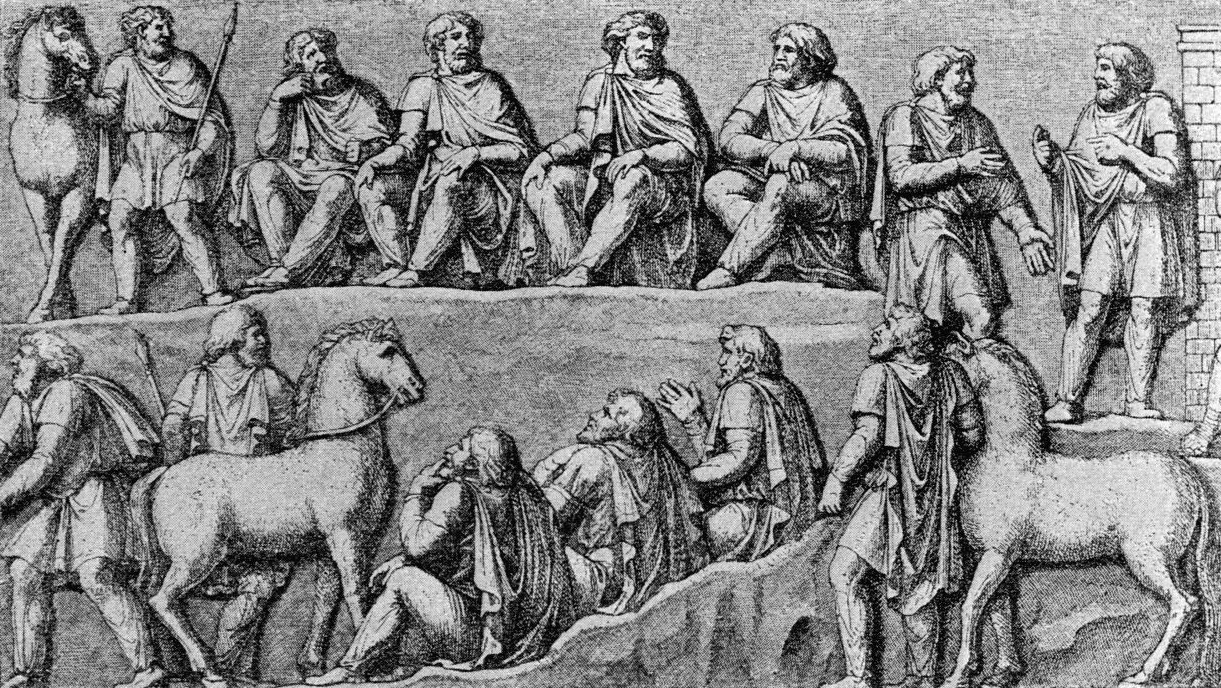
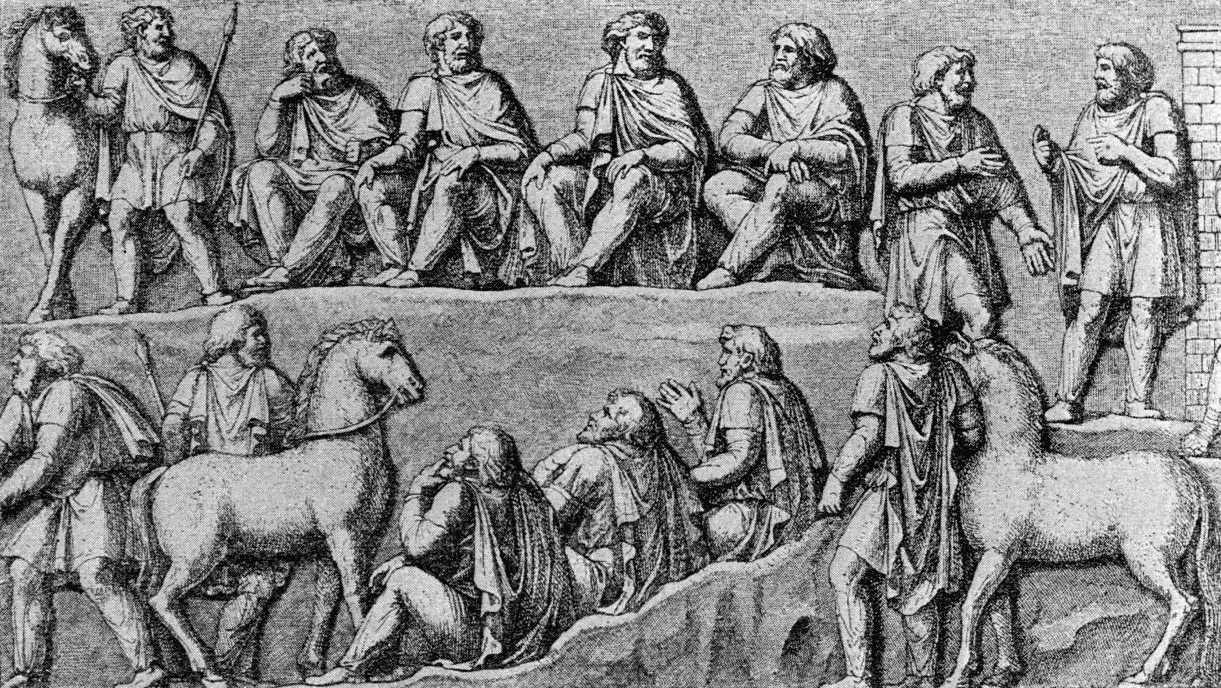
Germanic Thing (governing assembly), drawn after the depiction in a relief of the Column of Marcus Aurelius, 193 CE. (Source: Wikimedia)
Lately, I’ve been thinking a lot about the concept of “tribe” in a modern Pagan context. The impetus for this has been the presence in my life of an amazing community that I’ve been blessed to be a part of, a group of Morrígan devotees and priests that I’ve come to call “The Morrigan’s Call Tribe”. And over the last two years, this disparate group of strangers have morphed into a kind of extended family for myself and others.
Technically, we’re simply the folks who attend the Morrigu’s Daughters‘ annual “Morrigan’s Call Retreat”. Anyone is welcome to attend, and a core group of Morrigu’s Daughters members are joined by pagans from up and down the East Coast, as well as from California, Canada, and Ireland. Most attendees are either themselves devotees of the Morrígan or support those who are. There are Pagans there from a range of traditions: Druids, Devotional Polytheists, Traditional Witches, Wiccans, Celtic Reconstructionists, and Heathens. For three days in early June, we gather in central Connecticut to attend a series of workshops, rituals, and community-building activities dedicated to the Morrígna, the group of Deities that make up the complicated figure that is the Morrígan. There we eat together, learn together, and worship together. And when the weekend is over, we all go home a little closer to The Queen, to our Gods, and to each other.
In the shadow of this year’s Retreat, I’ve found myself contemplating why I would consider these folks my “tribe”, as opposed to some other flavor of community. From the questions I explored, I unearthed a definition of tribe as a healthy community that becomes a form of extended family for its’ membership. And while this definition could apply to any kind of community (believe me, I’ve seen how Penn State alumni behave), I feel that it is especially pertinent for those communities that we form within the Pagan movement. So I would like to take the opportunity to examine my personal definitions of “healthy community” and “tribe”, in the hopes that we can learn something about building lasting community.
What Makes a Healthy Community?
In my mind, there are a few factors that make a healthy community, Pagan or otherwise. Specifically, it should:
- Be relatively stable, both emotionally and politically.
- Bring together a group of people with a common set of interests.
- Give its’ members license to explore those interests with each other.
- Provide its’ members with opportunities to grow and share their common knowledge.
- Provide its’ members with opportunities to form bonds with other like-minded individuals.
- Allow its’ members to feel safe in pursuing these opportunities.
- Have well-defined boundaries for acceptable ideals and expression.
- Allow dissent within those bounds.
- Encourage respectful dialog among its’ membership.
Of these, the most important are that the community publicly provides an agreed-upon standard of acceptable behavior and beliefs, and that individual members should feel safe*.* Nobody should have to worry that they will be ostracized from the community for their self-expression and their ideas, provided that both are within the boundaries defined by the community’s ideals. I’m aware that the phrase “within the boundaries defined by the community’s ideals” may sound like a slippery slope, but I don’t agree. Whether they want to admit it or not, every community has its limits for what it considers acceptable ideals. A good example is the old misnomer that Unitarian Universalists will accept everyone, no matter what their belief. No, we do not. Someone who doesn’t believe in “the inherent worth and dignity of every individual” is going to find themselves very lonely at Sunday coffee hour.
So What Makes a Tribe?
So if that’s how I define a community, then what would turn a community into a tribe? For me, it comes down to the nature and quality of the relationship that forms amongst its’ membership. A community is a group of people that meet periodically and share common interests. A tribe looks insularly to protect, nourish and support its members. Using what I like about the extended Morrigan’s Call community as a basis, I’ve come up with six principles that I think differentiate a tribe:
- A tribe is first and foremost a healthy community.
- A tribe develops organically.
- A tribe supports its own.
- A tribe encourages its own.
- A tribe protects its own.
- A tribe forgives its own.
Principle 1: A Tribe is First and Foremost a Healthy Community
Central to this view of tribe is the idea that it is a close-knit community that supports each other. In order for this to happen, it must first be a healthy community. This means that members feel free to express themselves and form bonds with each other, and that community standards for behavior and beliefs are well documented.
Principle 2: A Tribe Develops Organically
Alternately titled, “A Tribe is Not Made, It’s Grown”. I don’t think that it is possible to engineer a tribe from the top-down, as the fabric of a tribe is the quality of the interactions among it’s members. A real, honest-to-goodness tribe can only form when all members of a community feel so bonded together and so safe within it that they start to support each other outside of the context of the community. So if you’re a group leader who hopes to someday grow a tribe, then the best thing that you can do is form as healthy a community as possible (see Principle #1).
In contrast, any attempt by a community’s leadership to “force form” a tribe through top-down methods should be taken as a red flag. The methods required to force a community to interact as an extended family would involve community leaders exerting control over the social interactions of people in the group, and may be indicative of a cult. Remember! When in doubt, consult the ABCDEF (Advanced Bonewits’ Cult Danger Evaluation Frame)!
Principle 3: A Tribe Supports its Own
Members of a tribe come together to support each other in times of need. Even if it’s with nothing more than heartfelt prayers and virtual Facebook hugs, one of the hallmarks of a tribe is the ability of its membership to strive to lift each other up. Even if only from afar, tribemates voluntarily share in each other’s’ daily struggles, family news, little joys and sorrows. Common tribal activities I’ve seen include prayer circles, magickal workings, political activism, and holiday card lists (yes, I have a Yule card list).
Principle 4: A Tribe Encourages its Own
If a member of the tribe is trying out a new project or life goal, others will throw encouragement their way. If somebody is posting to social media that they’ve had a crappy day, tribemates will jump in to offer condolences or try to lift the mood. For me, if I see a tribemate on Facebook feeling down on themselves, I’ll often reach back and give them a heartfelt pep speech.
Principle 5: A Tribe Protects its Own
When a someone is in trouble, their tribemates jump in to help. People who are close enough to show up in person might offer roadside assistance, provide a sober ride, or help get someone away from a bad situation. People who live at a distance might help by finding resources for things like domestic violence shelters and suicide hotlines. When someone is the most vulnerable, members of their tribe will step in to help in any way they can.
Principle 6: A Tribe Forgives its Own
This is the most difficult principle, and in my opinion is the real test of the strength of the tribe. What should happen when a member of your tribe screws up? I feel that a tribe should forgive minor or major screw-ups, to a point. As with anything of this matter, there are so many complicating factors: the nature of the incident, the way in which people were hurt, the ethos of the tribe, and its well-defined guidelines of acceptable behavior. If a tribe has a hard line on being inclusive and anti-hate, I wouldn’t expect it to forgive someone for being a neo-Nazi. But if a leader on a power trip simply causes a lot of hurt feelings, the tribe should come together and try to see if they can keep them in the fold while still allowing everyone to heal.
Building Lasting Community
So what can we learn from this in our own efforts to build lasting community? This being Nature’s Path, there will be many people reading this article who are trying to create community in their own CUUPS chapter, or who may be trying to build their CUUPS chapter into a lasting institution. CUUPS chapters have a leg up on the journey to becoming healthy community, as the UUA Principles and the CUUPS Continental Vision provide those “well defined community ideals” that I keep on bringing up. Its then up to an individual chapter’s coordinators to create a space where people can connect with one another, learn things, and feel safe while doing it.
If you want to form lasting community, make sure that your chapter has the basics down. Make sure everybody feels safe to express themselves and to disagree. Encourage respectful dialog through leading by example. Then as an individual, try to model the behaviors that turn a community into a tribe. Take a personal interest in other members. Cheer them on when they seem down. Help them out when they’re in trouble. Be a good neighbor. Be a good friend.
Be family.
Previous Post
July 28, 2016
What Lammas Is and Is Not
Next Post

August 1, 2016 Lughnasa — At the Crossroads
Browse Our Archives
Select a Category Current Events CUUPS Press Release Interfaith liturgy Media Review podcast Religious Education Seasonal Reflection Spiritual Practice Summary Uncategorized
Select a Month July 2026 June 2026 April 2026 January 2026 December 2025 October 2025 August 2025 July 2025 June 2025 April 2025 March 2025 February 2025 December 2024 November 2024 October 2024 August 2024 July 2024 June 2024 May 2024 April 2024 February 2024 December 2023 November 2023 October 2023 September 2023 August 2023 June 2023 May 2023 April 2023 March 2023 February 2023 January 2023 December 2022 October 2022 September 2022 August 2022 July 2022 June 2022 May 2022 April 2022 March 2022 February 2022 January 2022 December 2021 November 2021 October 2021 September 2021 August 2021 July 2021 June 2021 May 2021 April 2021 March 2021 February 2021 January 2021 December 2020 November 2020 October 2020 September 2020 August 2020 July 2020 June 2020 May 2020 April 2020 March 2020 February 2020 January 2020 December 2019 November 2019 October 2019 September 2019 August 2019 July 2019 June 2019 May 2019 April 2019 March 2019 February 2019 January 2019 December 2018 November 2018 October 2018 September 2018 August 2018 July 2018 June 2018 May 2018 April 2018 March 2018 February 2018 January 2018 December 2017 November 2017 October 2017 September 2017 August 2017 July 2017 June 2017 May 2017 April 2017 March 2017 February 2017 January 2017 December 2016 November 2016 October 2016 September 2016 August 2016 July 2016 June 2016 May 2016 April 2016 March 2016 February 2016 January 2016 December 2015 November 2015 October 2015 September 2015 August 2015 July 2015 June 2015 May 2015 April 2015 March 2015 February 2015 January 2015
Follow Us!
TAKE THE
Religious Wisdom Quiz
Who brought to Jesus the woman taken in adultery?
Select your answer to see how you score.
The Pharisees The Apostles The Disciples The Publicans
Related posts from Nature's Sacred Journey

Stringing Together the “Beads” of New Ideas

The Festival Fire – A Divination for Building...
TRENDING AT PATHEOS Pagan

When we talk about Greek religion, we often begin with the dodekatheion—the...

I was recently chatting with someone on Instagram. She asked me what...

While there are many people who share their results, the end of...

On July 23, I saw Christopher Nolan's The Odyssey which is Homer’s...

As I write this two big events have just finished up. One...

Restoring the Watershed of Divine Love
Perhaps cooperation is not something we manufacture through legislation, ideology, or moral...
view all Pagan blogs
Ad-Free & Subscriber Log-In Subscription Support
- About Us
- 2026 Calendar
- Videos
- Podcasts
- Library of World Religions
- Faith In Media Tracker
- Advertise With Us
- Write for Us
- Privacy Policy
- Terms of Service
- Do Not Sell My Data
- Contact Us
- Radiant Digital
- Manage Newsletter Subscriptions
- Unsubscribe From Notifications
- Sitemap
Copyright 2008-2026, Patheos. All rights reserved.
Subscription Support Ad-Free & Subscriber Log-In
Follow Patheos