
BuddhistCatholicContemplativeEvangelicalGeneral ChristianHinduJewishLatter-day SaintMuslimNew VisionsProgressive Christian
Beliefs
- Buddhist
- Catholic
- Contemplative
- Evangelical
- General Christian
- Hindu
- Jewish
- Latter-day Saint
- More Voices
- Muslim
- New Visions
- Pagan
- Progressive Christian
Topics
- Religion News
- Food and Religion
- Sports and Religion
- Religious Art
- Religious Music and Entertainment
- Religious Events
- History and Religion
- Style and Religion
- Politics and Religion
- Women in Religion
- Recreation Outdoors and Religion
- Business Finance and Religion
- Careers Workplace and Religion
- Education and Religion
- Family Parenting and Religion
- Health Fitness and Religion
- Home and Religion
- Relationships and Religion
- Technology and Religion
- Travel and Religion
Columnists
- Buddhist Columnists
- Business Finance and Religion Columnists
- Careers Workplace and Religion Columnists
- Catholic Columnists
- Contemplative Columnists
- Education and Religion Columnists
- Evangelists Columnists
- Family Parenting and Religion Columnists
- General Christian Columnists
- Health Fitness and Religion Columnists
- Hindu Columnists
- History and Religion Columnists
- Home and Religion Columnists
- Jewish Columnists
- More Voices Columnists
- Latter Day Columnists
- Muslim Columnists
- New Visions Columnists
- Nonreligious Columnists
- Pagan Columnists
- Politics and Religion Columnists
- Progressive Columnists
- Recreation Outdoors and Religion Columnists
- Relationships and Religion Columnists
- Religion News Columnists
- Religious Art Columnists
- Religious Events Columnists
- Religious Music and Entertainment Columnists
- Sports and Religion Columnists
- Style and Religion Columnists
- Technology and Religion Columnists
- Travel and Religion Columnists
- Women in Religion Columnists
Resource Library
- 2026 Calendar
- Library of World Religions
- The 100 Most Holy Places on Earth
- Patheos Answers
- Podcasts
- Videos
- Faith Leaders Database
- Anglican Episcopalian
- Bahai
- Baptist
- Buddhism
- Christianity
- Confucianism
- Eastern Orthodoxy
- Hinduism
- Holiness and Pentecostal
- ISKCON
- Islam
- Judaism
- Lutheran
- Methodist
- The Church of Jesus Christ of Latter-day Saints
- New Age
- Paganism
- Presbytarian and Reformed
- Protestantism
- Religion Behind the Scenes
- Roman Catholic
- Scientology
- Shia Islam
- Sikhism
- Sufism
- Sunni Islam
- Taoism
- Zen
- See all religions
Research Tools
 Ad-Free & Subscriber Log-In Subscription Support
Ad-Free & Subscriber Log-In Subscription Support
Follow Patheos 

- Trending:
- Forgiveness
- |
- Marriage
- |
- Consciousness
- |
- Death Penalty
- |
- Election
- |
- Halloween

- Home
- Pagan
- On Conflict
On Conflict
Last updated on: June 24, 2016 at 5:00 am by Maggie Beaumont
On Conflict 2016-06-24T05:00:49+00:00 Maggie Beaumont
Patheos Explore the world's faith through different perspectives on religion and spirituality! Patheos has the views of the prevalent religions and spiritualities of the world.
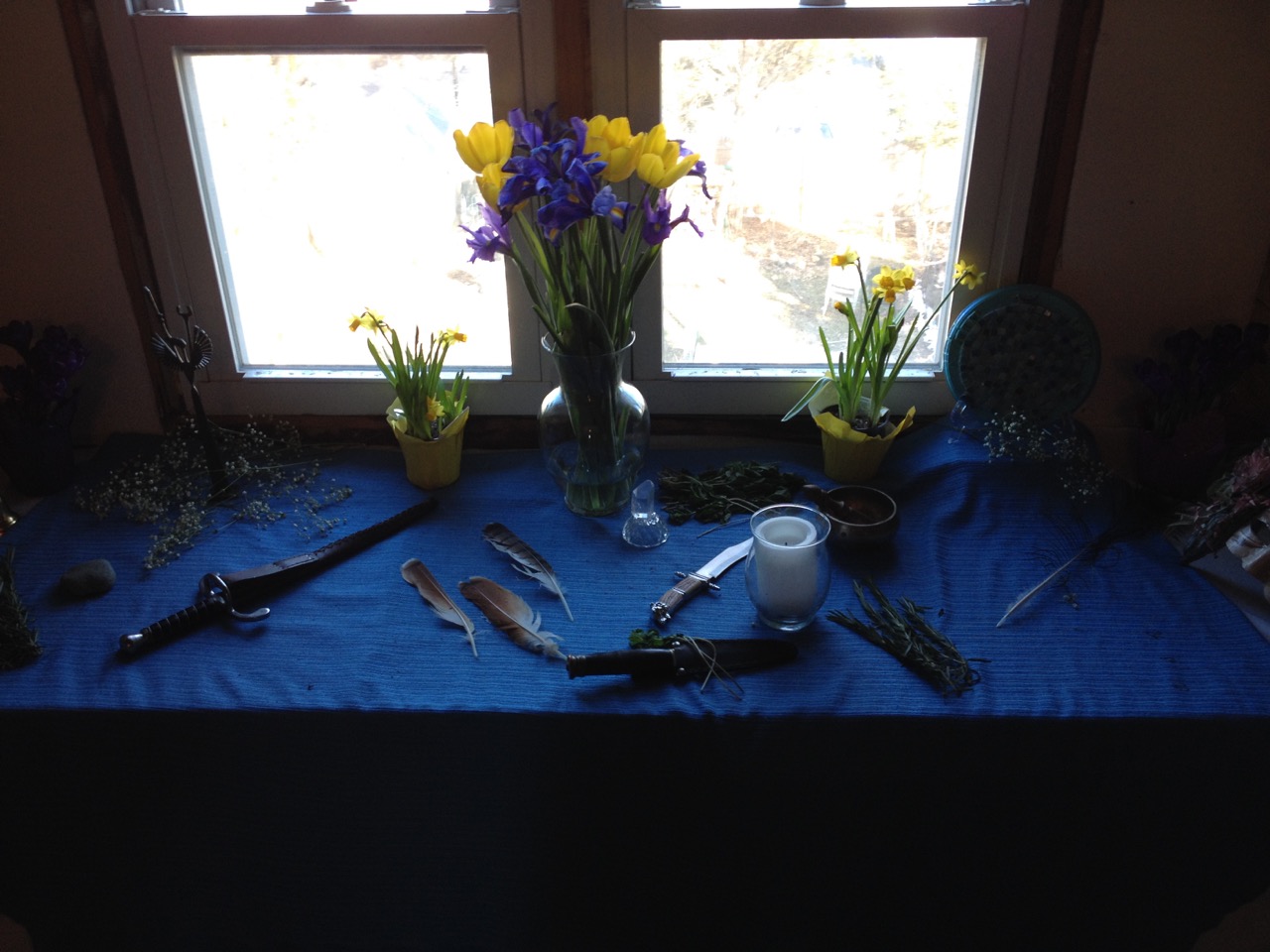
photo by Maggie Beaumont
Lots of conflict in our world at the moment. Global, national, regional; oppression of some people by other people in dozens of kinds; people who understand vs. people who don’t – on all sides of nearly any question. Red states, Blue states, questions of what behavior should be allowed, questions of what anger is justified – and if justified, what kind of reaction is appropriate. Or not.
Often, at least in buddy movies and coming of age stories, conflict can become the beginning of a lifelong friendship as two opponents come to see themselves as not so different after all.
Often, at least in adventure novels and divorce movies, conflict can become the end of a relationship as two companions become opponents over some issue, and finally come to see themselves unable to ever again be friends, or lovers, or business partners, or spouses. Sometimes conflict causes one ex-spouse to leave a whole community, or to be thrown out. Most of us have seen this before; some of us have lived it.
How do we understand conflict? How do we manage it? What do we say and how do we say it, when someone’s words sting us? How do we manage the energy in the room when someone indulges in name-calling, or won’t stop labeling another’s actions? How do we manage what happens if it gets physical? How do we contain the raw emotion and limit the damage at a time when both sides are upset?
These are big questions, to which I personally have few answers. In the UUA and its associated congregations, covenanted communities such as CUUPS, and likeminded groups, we’ve made some important attempts to work with conflict.
Mission statements and Covenants tell us how we ‘ought to’ behave, or how we ‘agree to’ behave. Safe Congregations policies tell us what to do after the fact. But little tells us how to deal with what happens ‘during’ conflict, especially when we see (from our side) what looks like the other side ‘acting out of bounds.’
Sometimes in community, people take sides. A conflict that began as two individuals disagreeing gets blown up into two factions disagreeing. Often that can lead to louder, harsher, more frightening conflict. Equally often, it can mercifully lead to a few cooler heads finding a way to take center stage, to seek and find the common ground.
Usually, there is more common ground than the combatants can see.
Recently I was privileged to witness an exercise in conflict management. Two sides were asked to notice their differences. A list developed immediately: political opposites, one likes sports and the other likes to workout alone, one prefers consensus process and the other prefers authoritarian leadership, one believes ‘natural’ hierarchies are always a good thing and the other prefers egalitarian culture, and so on.
Then the leader asked the same people to call out the similarities within those differences. Both are passionate about politics, both appreciate athletic prowess, both agree that a group should know how decisions get made. You get the idea.
When I take that exercise into some current conflicts, I can make my own lists. Both sides want our country to be great (albeit they may hold different definitions of ‘great’). Both sides feel oppressed by the dominant culture (though in different ways). Both sides felt bad about what happened (even though they offered different solutions). Both sides feel wronged, each blaming the other equally.
The Witch looks over my shoulder.
“You’re being so brave,” she says.
I burst into tears. I don’t feel brave at all.
“It’s hard to write about conflict,” she says, “you’ve never done it well. But this is a pretty good attempt.”
She offers me a hug, which I gratefully lean into.
“Did you tell them how you feel?” she asks.
I tell her I’ll try.
So. How I feel is ‘frightened.’ I don’t feel qualified to talk about conflict, I’m so bad at dealing with it in my own life. Usually I either walk away feeling stepped on, or else I speak up too loudly and forcefully, insisting that I’m right and the other person has to listen. At times like that, I can’t tell until later that the anger I feel is trying to cover up my hurt. After I’ve spoken too forcefully I feel guilty, sometimes for weeks. Feeling triggered is no excuse, even when it’s true.
So I find it scary to try to talk about conflict. And yet, somehow we must. Even when we’re in fear.
The Witch is stroking my hair, helping me release my feelings. I notice my shoulders falling back to where they belong. I take a breath.
“Can you tell them about the magic you do?”
Sure, I say. Maybe that’s easier anyway.
The magic I’m doing lately, about conflict, is forgiveness work. I do it in private, without the other side present, because the only consciousness I can change at will is my own. I cast a circle, I light a candle, I sit in silence awhile, and then begin.
Some of it is self-forgiveness: “I forgive myself for judging myself as bad and wrong because I did X.” Usually this is a series of sentences, each one with a different X. Often they’re interspersed with a slightly different sentence: “I forgive myself for judging myself as Y because Z,” again with lots of possibilities.
Some of it is explicitly stating my forgiveness of the other side. “I forgive A for what they said” or “I forgive B for what they did.” Here I try not to characterize what was said or done. I might quote the words exactly, if I’m sure of them, but I don’t say “for calling me names” or “for yelling at me” because maybe my impression of what they said isn’t accurate. I might name their action exactly (“throwing the rock,” for example), if I’m sure of it, but I don’t say “for attacking me” even if that’s what it felt like.
I speak each one out loud.
Sometimes I spend only a few minutes here. Once, not too long ago, I sat speaking, and weeping, for nearly an hour. In a tightly overscheduled life, I still try to stay with the work until it feels ‘done’ – at least for now, for tonight, for the particular conflict.
Most conflicts are thoroughly eased, at least inside me, in a single session. One conflict continues to come forward for healing, more than a handful of times so far. Even that one, the strife is easing. At least on my side of the conflict; I’m not at present in communication with the other side.
Often when the magic has completed I can speak an apology to the person on the other side. Usually that apology has been accepted, or sometimes brushed away as unnecessary. Sometimes I can see that each of us has grown and changed from our experience of being in conflict. Sometimes I can see that the other person has worked as hard at this as I.
One conflict from decades ago – My Goddess, nearly fifty years ago in fact – finally healed when one of us was able to say to the other “I’m sorry,” and received a sincere apology in return… after each of us had done the work, each in our own way, to acknowledge our part in the disaster.
For the ways in which I fall short, I am heartily sorry. For the ways in which I have hurt you, I am sincerely sorry. For the ways in which I have let you hurt me, I accept my part in the responsibility and am sorry there, too.
The Witch rubs my shoulders, helping the tension release again.
She speaks. “I do not tell you that you have done well here,” she says, “because I know you will not believe it. I ask you to accept that this is enough, for today.”
Blessed Be.
–Maggie Beaumont
–Litha 2016
Previous Post

June 22, 2016
Real Weddings and Real Weddings
Next Post

June 29, 2016 CUUPS Convocation is Taking Shape!
Browse Our Archives
Select a Category Current Events CUUPS Press Release Interfaith liturgy Media Review podcast Religious Education Seasonal Reflection Spiritual Practice Summary Uncategorized
Select a Month July 2026 June 2026 April 2026 January 2026 December 2025 October 2025 August 2025 July 2025 June 2025 April 2025 March 2025 February 2025 December 2024 November 2024 October 2024 August 2024 July 2024 June 2024 May 2024 April 2024 February 2024 December 2023 November 2023 October 2023 September 2023 August 2023 June 2023 May 2023 April 2023 March 2023 February 2023 January 2023 December 2022 October 2022 September 2022 August 2022 July 2022 June 2022 May 2022 April 2022 March 2022 February 2022 January 2022 December 2021 November 2021 October 2021 September 2021 August 2021 July 2021 June 2021 May 2021 April 2021 March 2021 February 2021 January 2021 December 2020 November 2020 October 2020 September 2020 August 2020 July 2020 June 2020 May 2020 April 2020 March 2020 February 2020 January 2020 December 2019 November 2019 October 2019 September 2019 August 2019 July 2019 June 2019 May 2019 April 2019 March 2019 February 2019 January 2019 December 2018 November 2018 October 2018 September 2018 August 2018 July 2018 June 2018 May 2018 April 2018 March 2018 February 2018 January 2018 December 2017 November 2017 October 2017 September 2017 August 2017 July 2017 June 2017 May 2017 April 2017 March 2017 February 2017 January 2017 December 2016 November 2016 October 2016 September 2016 August 2016 July 2016 June 2016 May 2016 April 2016 March 2016 February 2016 January 2016 December 2015 November 2015 October 2015 September 2015 August 2015 July 2015 June 2015 May 2015 April 2015 March 2015 February 2015 January 2015
Follow Us!
TAKE THE
Religious Wisdom Quiz
True or False: Paul wrote to Titus about overseers needing to be hospitable and able to teach.
Select your answer to see how you score.
FALSE TRUE
Related posts from Nature's Sacred Journey


Fallow Season ~ Burnout, Fatigue, and Sacred Rest

The Autumn Awakening ~ Returning to Center

Five Things to do When the World Gets...
TRENDING AT PATHEOS Pagan

I was recently chatting with someone on Instagram. She asked me what...

While there are many people who share their results, the end of...

On July 23, I saw Christopher Nolan's The Odyssey which is Homer’s...

As I write this two big events have just finished up. One...

Restoring the Watershed of Divine Love
Perhaps cooperation is not something we manufacture through legislation, ideology, or moral...

Many UUs don’t pray because of bad experiences in a previous religion,...
view all Pagan blogs
Ad-Free & Subscriber Log-In Subscription Support
- About Us
- 2026 Calendar
- Videos
- Podcasts
- Library of World Religions
- Faith In Media Tracker
- Advertise With Us
- Write for Us
- Privacy Policy
- Terms of Service
- Do Not Sell My Data
- Contact Us
- Radiant Digital
- Manage Newsletter Subscriptions
- Unsubscribe From Notifications
- Sitemap
Copyright 2008-2026, Patheos. All rights reserved.
Subscription Support Ad-Free & Subscriber Log-In
Follow Patheos