
BuddhistCatholicContemplativeEvangelicalGeneral ChristianHinduJewishLatter-day SaintMuslimNew VisionsProgressive Christian
Beliefs
- Buddhist
- Catholic
- Contemplative
- Evangelical
- General Christian
- Hindu
- Jewish
- Latter-day Saint
- More Voices
- Muslim
- New Visions
- Pagan
- Progressive Christian
Topics
- Religion News
- Food and Religion
- Sports and Religion
- Religious Art
- Religious Music and Entertainment
- Religious Events
- History and Religion
- Style and Religion
- Politics and Religion
- Women in Religion
- Recreation Outdoors and Religion
- Business Finance and Religion
- Careers Workplace and Religion
- Education and Religion
- Family Parenting and Religion
- Health Fitness and Religion
- Home and Religion
- Relationships and Religion
- Technology and Religion
- Travel and Religion
Columnists
- Buddhist Columnists
- Business Finance and Religion Columnists
- Careers Workplace and Religion Columnists
- Catholic Columnists
- Contemplative Columnists
- Education and Religion Columnists
- Evangelists Columnists
- Family Parenting and Religion Columnists
- General Christian Columnists
- Health Fitness and Religion Columnists
- Hindu Columnists
- History and Religion Columnists
- Home and Religion Columnists
- Jewish Columnists
- More Voices Columnists
- Latter Day Columnists
- Muslim Columnists
- New Visions Columnists
- Nonreligious Columnists
- Pagan Columnists
- Politics and Religion Columnists
- Progressive Columnists
- Recreation Outdoors and Religion Columnists
- Relationships and Religion Columnists
- Religion News Columnists
- Religious Art Columnists
- Religious Events Columnists
- Religious Music and Entertainment Columnists
- Sports and Religion Columnists
- Style and Religion Columnists
- Technology and Religion Columnists
- Travel and Religion Columnists
- Women in Religion Columnists
Resource Library
- 2026 Calendar
- Library of World Religions
- The 100 Most Holy Places on Earth
- Patheos Answers
- Podcasts
- Videos
- Faith Leaders Database
- Anglican Episcopalian
- Bahai
- Baptist
- Buddhism
- Christianity
- Confucianism
- Eastern Orthodoxy
- Hinduism
- Holiness and Pentecostal
- ISKCON
- Islam
- Judaism
- Lutheran
- Methodist
- The Church of Jesus Christ of Latter-day Saints
- New Age
- Paganism
- Presbytarian and Reformed
- Protestantism
- Religion Behind the Scenes
- Roman Catholic
- Scientology
- Shia Islam
- Sikhism
- Sufism
- Sunni Islam
- Taoism
- Zen
- See all religions
Research Tools
 Ad-Free & Subscriber Log-In Subscription Support
Ad-Free & Subscriber Log-In Subscription Support
Follow Patheos 

- Trending:
- Forgiveness
- |
- Marriage
- |
- Consciousness
- |
- Death Penalty
- |
- Election
- |
- Halloween

- Home
- Pagan
- Oceans Are for Everybody
Oceans Are for Everybody
Last updated on: June 8, 2016 at 5:00 am by Liz Fisher
Oceans Are for Everybody 2016-06-08T05:00:12+00:00 Liz Fisher
Patheos Explore the world's faith through different perspectives on religion and spirituality! Patheos has the views of the prevalent religions and spiritualities of the world.
 Today is United Nations World Oceans Day. Earth-based spiritual traditions honor the Ocean as the heart and lungs of the planet. The Seventh UU Principle, Respect for the interdependent web of all existence of which we are a part, reflects this. Science confirms the integral role ocean ecosystems play in the survival of the Earth by reminding us that fifty percent of our oxygen comes from the ocean.
World Oceans Day is an opportunity to think about our impact on the oceans and to remember the crucial role they play in our lives. This year’s theme for World Oceans Day is healthy oceans, healthy planet.
“The ocean is the heart of our planet**.** Like your heart pumping blood to every part of your body, the ocean connects people across the Earth, no matter where we live. The ocean regulates the climate, feeds millions of people every year, produces oxygen, is the home to an incredible array of wildlife, provides us with important medicines, and so much more! In order to ensure the health and safety of our communities and future generations, it’s imperative that we take the responsibility to care for the ocean as it cares for us.” (from UN announcement.)
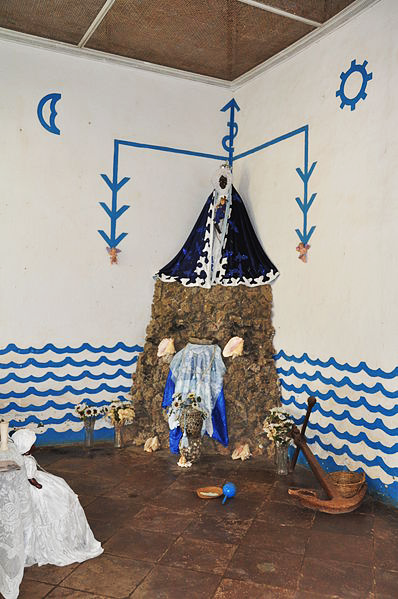
The temple of the Yemayà divinity in Trinidad – Cuba, 2010, Wikicommons
Many earth-based traditions hold the Ocean as sacred. In Santeria, she is Yemaya, one of the two main female deities. Ritual is a key part of expressing our spiritual feelings. All across South and Central America hundreds of thousands gather to send little boats with written petitions offering fruits and flowers, and multicolored paper flags to Yemaya, the Queen of the Ocean. She is an independent deity, not linked to a male god. Her stature reinforces the rights of independence for women. She is seen as nurturing, compassionate and protective.
Appreciation for the status of the ocean has been steadily growing. Thirty years ago there was no World Oceans Day. Until then, too many humans thought: “out of sight, out of mind.” Not anymore. World Oceans Day has been unofficially celebrated every June 8 since its original proposal in 1992 by Canada at the Earth Summit in Rio de Janeiro, Brazil. It was officially recognized by the United Nations in 2008.
This is an essential move forward in the recognition of the importance of the oceans to the survival of those of us who live on land. We are reminded that over two-thirds of the Earth is covered by water (71 percent); 29 percent is land. Less than 1 percent of the Earth’s water is fresh water, and 2-3 percent is contained in glaciers and ice caps.
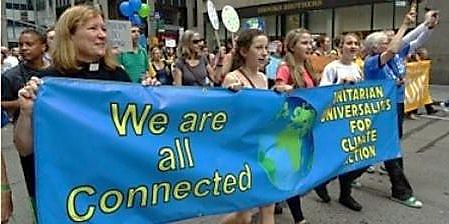 Unitarian Universalists have been taking action on behalf of the environment. The UU Ministry for The Earth envisions a world in which reverence, gratitude, and care for the living Earth are central to the lives of all people. This group’s mission is connecting and inspiring an active community of UUs for environmental justice, spiritual renewal, climate action and shared reverence for our Earth home. As UU pagans who belief the Earth is sacred, we have an opportunity to encourage this group to feature more prominently the health of the oceans among the many pressing environmental concerns they address. We know that even if we do not live near the Ocean, She is for Everyone. Educating about the Oceans all across the country and in every congregation can bring remarkable results.
Simple information can have tremendous spiritual impact and motivate constructive activism. For example, if current use of plastic in packaging continues, by 2050 there will be more plastic than fish in the ocean. One suggestion is to challenge the concept of convenience by reducing the amount of plastic that we use in our daily living. Here are two simple suggestions: don’t use plastic straws, ask for paper instead. Another is to support elimination of plastic shopping bags in retail outlets. Carry your own cloth shopping bags.
At the World Oceans Day Celebration this past weekend at the Monterey Bay Aquarium (MBA) Julie Packard, Founder and Director, noted that ocean conservation was added after land conservation had gained visibility and popularity. By coming to appreciate the oceans, the interconnection of all life has been more accurately and thoroughly understood.
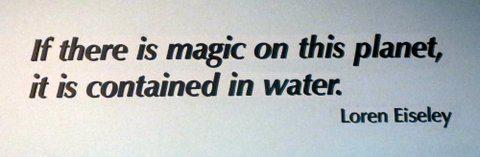
Quote on wall of Monterey Aquarium, photo by Bob Fisher
The Monterey Bay Aquarium (MBA) is located in Monterey, California. Founded in 1984, it contains a 28-foot-high, 333,000 gallon tank for viewing California coastal marine life. In this tank, the aquarium was the first in the world to grow live Giant Kelp. Visitors are able to inspect the creatures of the kelp forest at several levels in the building.
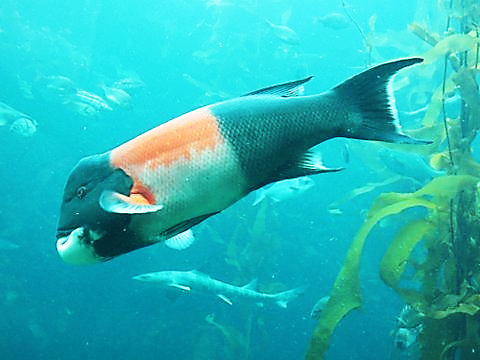
Image of Kelp Tank with California Sheephead and Shark at Monterey Bay Aquarium, by Bob Fisher.
Education is the central mission of the Aquarium which primarily focuses on the local marine population. For example, interpretive signs teach that the Sheephead is a unique fish which morphs from female to male during the course of its life. Other postings dispel misconceptions about the shark fostered by trendy films and literature.
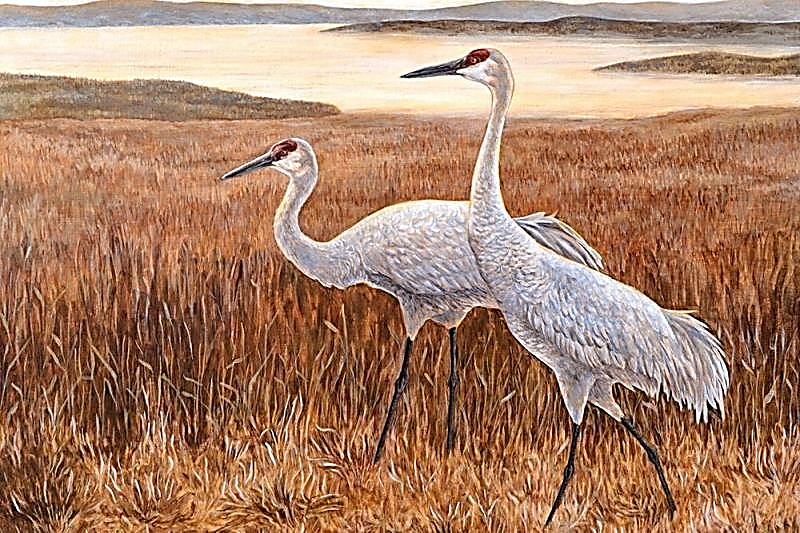
Sandhill Cranes by Rebecca Jabs, courtesy of the artist, a student in the CSU Monterey Bay Science Illustration Program
Education and engagement of youth are vital goals of the local schools and Aquarium programming. One of the areas they study is the significance of shore birds to the overall healthy interrelationship of Ocean creatures.
After a field trip to remove invasive plants from a bird’s natural habitat one fifth grade student explained, “I realized in the end that it’s not about making the world completely eco-friendly and fixing it all, it’s about doing your part or all you can.”

This year at the MBA World Oceans Day Ceremony, actor Adrian Grenier, founder of the Lonely Whale Foundation, received an award from the Paul Walker Foundation, a group that has worked closely with the Aquarium. The Lonely Whale Foundation is teaching children in Chicago about the ocean. Because the ocean is for everyone they want people who do not necessarily live on the coasts to develop a deep appreciation for the ocean.
Grenier comments: “We have taken a leadership role to deliver curriculum that helps our children develop empathy for marine life and take beneficial actions that create a nurturing environment. This, along with policy change, is a critical complement to affect awareness more quickly.”
Their website contains a wealth of information that can be used by anyone to educate about initiatives that can be taken. http://www.lonelywhale.org/#intro
The environmentalism of celebrities is meant to encourage each of us to speak to our own audiences of friends, family, colleagues and through people oriented media outlets. This is something we as Earth-based Unitarian Universalists can do. The opportunities in our congregations, association and communities and related groups like UU Ministry for Earth are numerous. They can be inventive, life cycle affirming and provide hope. What a satisfying and effective way to put our Earth-based spiritual beliefs to practical use.
Previous Post

June 7, 2016
Seneca: more on "The Shortness of Life," XVI
Next Post
June 10, 2016 Seven Wonders of the Natural World - In Your Own Backyard
Browse Our Archives
Select a Category Current Events CUUPS Press Release Interfaith liturgy Media Review podcast Religious Education Seasonal Reflection Spiritual Practice Summary Uncategorized
Select a Month July 2026 June 2026 April 2026 January 2026 December 2025 October 2025 August 2025 July 2025 June 2025 April 2025 March 2025 February 2025 December 2024 November 2024 October 2024 August 2024 July 2024 June 2024 May 2024 April 2024 February 2024 December 2023 November 2023 October 2023 September 2023 August 2023 June 2023 May 2023 April 2023 March 2023 February 2023 January 2023 December 2022 October 2022 September 2022 August 2022 July 2022 June 2022 May 2022 April 2022 March 2022 February 2022 January 2022 December 2021 November 2021 October 2021 September 2021 August 2021 July 2021 June 2021 May 2021 April 2021 March 2021 February 2021 January 2021 December 2020 November 2020 October 2020 September 2020 August 2020 July 2020 June 2020 May 2020 April 2020 March 2020 February 2020 January 2020 December 2019 November 2019 October 2019 September 2019 August 2019 July 2019 June 2019 May 2019 April 2019 March 2019 February 2019 January 2019 December 2018 November 2018 October 2018 September 2018 August 2018 July 2018 June 2018 May 2018 April 2018 March 2018 February 2018 January 2018 December 2017 November 2017 October 2017 September 2017 August 2017 July 2017 June 2017 May 2017 April 2017 March 2017 February 2017 January 2017 December 2016 November 2016 October 2016 September 2016 August 2016 July 2016 June 2016 May 2016 April 2016 March 2016 February 2016 January 2016 December 2015 November 2015 October 2015 September 2015 August 2015 July 2015 June 2015 May 2015 April 2015 March 2015 February 2015 January 2015
Follow Us!
TAKE THE
Religious Wisdom Quiz
Who wrote many letters (epistles) in the New Testament?
Select your answer to see how you score.
John Peter Paul Jude
Related posts from Nature's Sacred Journey

Fallow Season ~ Burnout, Fatigue, and Sacred Rest
The Autumn Awakening ~ Returning to Center

Five Things to do When the World Gets...
TRENDING AT PATHEOS Pagan

I was recently chatting with someone on Instagram. She asked me what...

While there are many people who share their results, the end of...

On July 23, I saw Christopher Nolan's The Odyssey which is Homer’s...

As I write this two big events have just finished up. One...

Restoring the Watershed of Divine Love
Perhaps cooperation is not something we manufacture through legislation, ideology, or moral...

Many UUs don’t pray because of bad experiences in a previous religion,...
view all Pagan blogs
Ad-Free & Subscriber Log-In Subscription Support
- About Us
- 2026 Calendar
- Videos
- Podcasts
- Library of World Religions
- Faith In Media Tracker
- Advertise With Us
- Write for Us
- Privacy Policy
- Terms of Service
- Do Not Sell My Data
- Contact Us
- Radiant Digital
- Manage Newsletter Subscriptions
- Unsubscribe From Notifications
- Sitemap
Copyright 2008-2026, Patheos. All rights reserved.
Subscription Support Ad-Free & Subscriber Log-In
Follow Patheos