
BuddhistCatholicContemplativeEvangelicalGeneral ChristianHinduJewishLatter-day SaintMuslimNew VisionsProgressive Christian
Beliefs
- Buddhist
- Catholic
- Contemplative
- Evangelical
- General Christian
- Hindu
- Jewish
- Latter-day Saint
- More Voices
- Muslim
- New Visions
- Pagan
- Progressive Christian
Topics
- Religion News
- Food and Religion
- Sports and Religion
- Religious Art
- Religious Music and Entertainment
- Religious Events
- History and Religion
- Style and Religion
- Politics and Religion
- Women in Religion
- Recreation Outdoors and Religion
- Business Finance and Religion
- Careers Workplace and Religion
- Education and Religion
- Family Parenting and Religion
- Health Fitness and Religion
- Home and Religion
- Relationships and Religion
- Technology and Religion
- Travel and Religion
Columnists
- Buddhist Columnists
- Business Finance and Religion Columnists
- Careers Workplace and Religion Columnists
- Catholic Columnists
- Contemplative Columnists
- Education and Religion Columnists
- Evangelists Columnists
- Family Parenting and Religion Columnists
- General Christian Columnists
- Health Fitness and Religion Columnists
- Hindu Columnists
- History and Religion Columnists
- Home and Religion Columnists
- Jewish Columnists
- More Voices Columnists
- Latter Day Columnists
- Muslim Columnists
- New Visions Columnists
- Nonreligious Columnists
- Pagan Columnists
- Politics and Religion Columnists
- Progressive Columnists
- Recreation Outdoors and Religion Columnists
- Relationships and Religion Columnists
- Religion News Columnists
- Religious Art Columnists
- Religious Events Columnists
- Religious Music and Entertainment Columnists
- Sports and Religion Columnists
- Style and Religion Columnists
- Technology and Religion Columnists
- Travel and Religion Columnists
- Women in Religion Columnists
Resource Library
- 2026 Calendar
- Library of World Religions
- The 100 Most Holy Places on Earth
- Patheos Answers
- Podcasts
- Videos
- Faith Leaders Database
- Anglican Episcopalian
- Bahai
- Baptist
- Buddhism
- Christianity
- Confucianism
- Eastern Orthodoxy
- Hinduism
- Holiness and Pentecostal
- ISKCON
- Islam
- Judaism
- Lutheran
- Methodist
- The Church of Jesus Christ of Latter-day Saints
- New Age
- Paganism
- Presbytarian and Reformed
- Protestantism
- Religion Behind the Scenes
- Roman Catholic
- Scientology
- Shia Islam
- Sikhism
- Sufism
- Sunni Islam
- Taoism
- Zen
- See all religions
Research Tools
 Ad-Free & Subscriber Log-In Subscription Support
Ad-Free & Subscriber Log-In Subscription Support
Follow Patheos 

- Trending:
- Forgiveness
- |
- Marriage
- |
- Consciousness
- |
- Death Penalty
- |
- Election
- |
- Halloween

- Home
- Pagan
- Dis-Spelling the Prosperity Gospel
Dis-Spelling the Prosperity Gospel
Last updated on: May 18, 2019 at 6:26 pm by Amy Beltaine
Dis-Spelling the Prosperity Gospel 2019-05-18T18:26:50+00:00 Amy Beltaine
Patheos Explore the world's faith through different perspectives on religion and spirituality! Patheos has the views of the prevalent religions and spiritualities of the world.

Nudie Jeans repair shop. Courtesy Nudie Jeans
In high school, one day, I split my slacks. Mortified, I sidled into the school office with my backpack drooped strategically over my exposed backside. There, I asked to use the phone so my mom could drive to school and drop off an intact pair of pants. While I was waiting for my emergency delivery the school secretary expressed her praise for my excellent choices and good thinking. Clearly I was a “good girl”, unlike the other girl, last week, who had solved a similar predicament in a different way. This “bad girl” had left school property to go to the nearby mall to get her jeans mended.
My class analysis wasn’t very developed back then, but even so, I knew something was wrong with the school official’s judgement. I wasn’t “good” because I had a stay-at-home Mom. The other girl wasn’t “bad” because she handled her problem herself. Maybe her mom worked, or maybe she didn’t even have a spare pair of pants. Those were accidents of birth. These facts pointed to the privilege I enjoyed and that my dad worked to maintain.
As an adult I know that even he didn’t earn that privilege… He had it because his parents could afford to send him to college.
I remember that day often. The illusion that having options means you are “good” and  not having options means that you are “bad” distracts us from the truth. Of course, I have other privileges, like skin privilege and education privilege and the US of A privilege, that give me options as well. We sometimes talk about these dynamics as intersectionality. This is a topic, many topics, for other days.
Once I started paying attention I started noticing all the ways that we equate “net worth” with “worth” in our capitalistic world. There’s even a religious group called “The Family” that explicitly preaches that those who have money are blessed by God. I don’t mean they just preach “thank God for what you have.” No, they preach that they can tell who is in God’s favor by looking at their bank account. This extremist group (look them up, their connection with U.S. Senators is truly frightening) is not alone. The prosperity gospel can be traced from Puritanism and permeates through much popular religion and Christianity. The idea is basically that God rewards your faith with success and prosperity. Poverty is a sign of lack of faith and God’s disfavor. Class dynamics and the poison of the prosperity gospel are laced throughout politics, business and white culture.
Then there are the ways that these dynamics play out in UU Earth-Relating communities. I have been asking myself for a few years now: why do I notice a tension between UU congregation leadership and Earth-Relating congregants around issues of money? Is there a class difference at play between UU leadership and Earth-Relating UUs?

Courtesy of Clipart Panda
In the 80’s I experienced the Pagan community in Portland Oregon as predominantly white, educated, and in large part “downwardly mobile”. I use downwardly mobile to describe those who were raised with economically privileged backgrounds (landed or educated or simply “comfortable”) who have chosen to do as little wage labor as possible. That decision could be based on a rejection of the values of their parents, a desire to ‘live lightly on the earth’, or to ‘drop out of the system’, or to focus on the values in Paganism that they most resonated with.
When I moved to Ithaca, NY the Pagans I met were true to the demographics I’d observed in Portland. The book “Voices from the Pagan Census”, published in 2003, indicates that the average income for Neo-Pagans is roughly the same as the income average for the United States. The same survey found that Neo-Pagans are significantly more educated than the national average. (92.2% have more than a high school diploma versus 43% of the US population.) This information is consistent with my observations.
I’m aware that Neo-Pagan doesn’t define or encompass the many diverse Earth-Relating religions. People of color, the working poor and other communities have robust Earth-Relating faith groups among them and many Earth-Relating faith paths gather diverse adherents. However, census data no longer includes religion information (as of 1936) and I was unable to find data that would show me average income for Earth-Relating religions more broadly. So many of my perceptions are anecdotal. I’d love to learn more from others out there. Please comment if you have information to share!
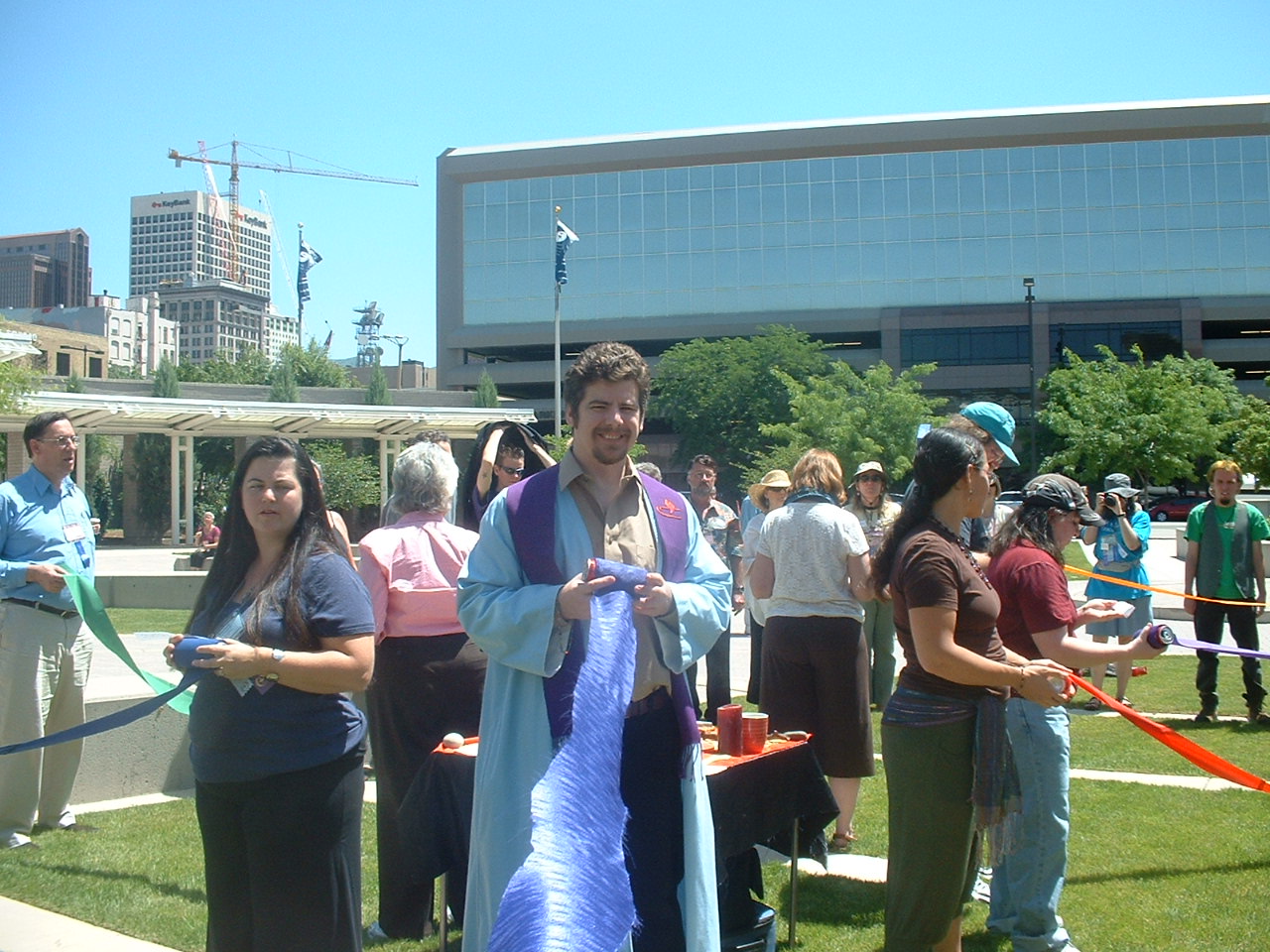
Invoking 7 principles at UU General Assembly 2009, Photo by Imari Kariotis
What I can and do offer is the observation that according to the book “One Nation Under God” published in 1993, Unitarian Universalism is ranked second only to the Jewish community in income, over 50% have a college degree and UUs are well above average in property ownership. This suggests that CUUPS members will find common ground with other UU congregants around education level but will, on average, have significantly less discretionary income. The book mentions one other thing about UUs. We have strongly been influenced by Puritan theology and the tendencies toward equating hard work with being good. The tenets of the prosperity gospel come with that. But… UU’s have the second principle: “Justice, Equity, and Compassion in Human Relations.” We have work to do here!
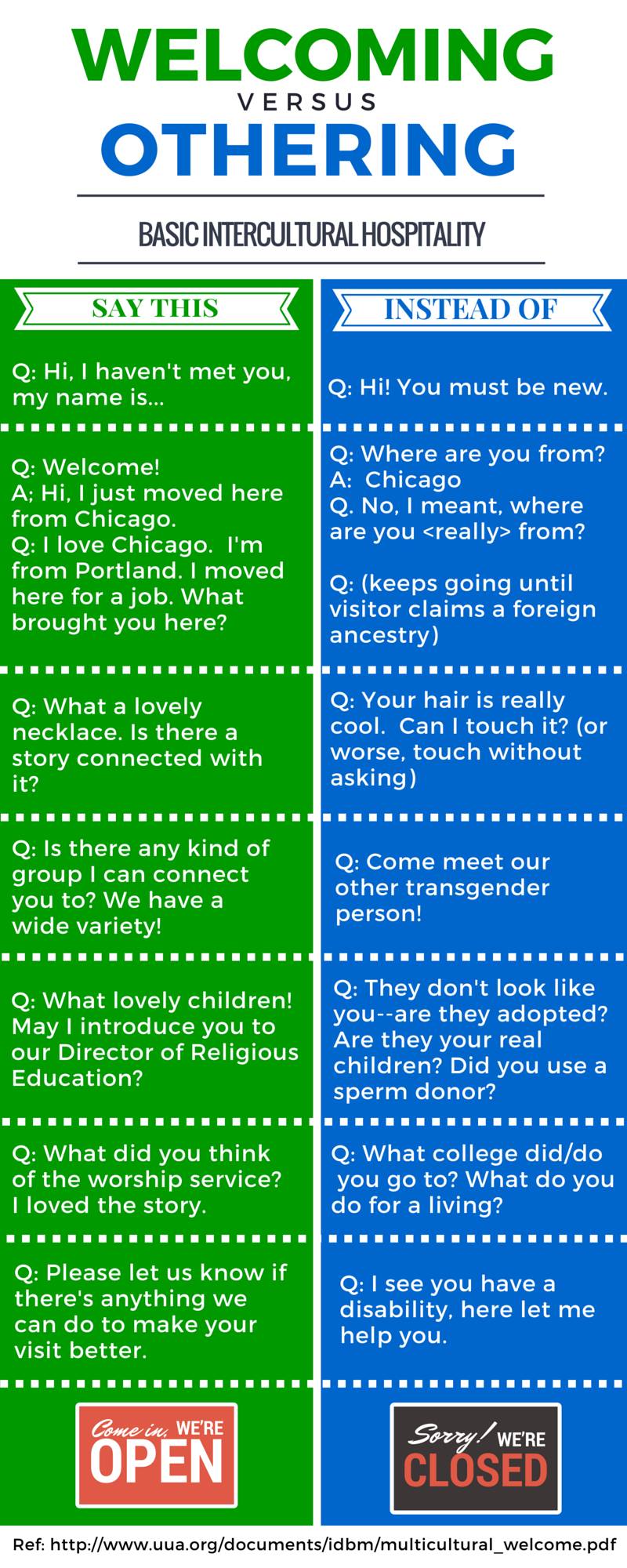
See more at http://www.uua.org/documents/idbm/multicultural_welcome.pdf
This suggests four things to me: 1) CUUPS may have a role in educating congregations to be welcoming to income-diverse people. 2) We need to pay attention to how class and means are at play when we find ourselves in conflict, and when we work together to be in relationship. 3) We all have work to do to discover and break the spell of the prosperity gospel that equates means with worth, and we can do that together. And 4) As we dive into class dynamics we must be in partnership with people of color and other marginalized groups, groups who often are economically marginalized, recognizing the other dynamics of intersectionality.
What might that look like? Here’s one idea. When we are among our broader religious communities, pay attention to what folks face economically. Then join the congregation’s membership team, the welcoming team, the greeters on Sunday (you get the idea) and put those observations into practice. Here’s another idea. Collaborate with UUA staff on improving this document that talks about the difference between welcoming and othering. http://www.uua.org/documents/idbm/multicultural_welcome.pdf
I know this essay is only scratching the surface, and I don’t want us to over-focus so that we forget the impacts of intersectionality. My hope is that I am inviting us into further conversation. My hope is that we are individually and together, casting our banishing spells, in our own ways, on the curse of the prosperity gospel.

Banishing Spell kit from www.misi.uk.co

Next Post
May 18, 2016 Bridge-Building through Mary Mother of God
Browse Our Archives
Select a Category Current Events CUUPS Press Release Interfaith liturgy Media Review podcast Religious Education Seasonal Reflection Spiritual Practice Summary Uncategorized
Select a Month July 2026 June 2026 April 2026 January 2026 December 2025 October 2025 August 2025 July 2025 June 2025 April 2025 March 2025 February 2025 December 2024 November 2024 October 2024 August 2024 July 2024 June 2024 May 2024 April 2024 February 2024 December 2023 November 2023 October 2023 September 2023 August 2023 June 2023 May 2023 April 2023 March 2023 February 2023 January 2023 December 2022 October 2022 September 2022 August 2022 July 2022 June 2022 May 2022 April 2022 March 2022 February 2022 January 2022 December 2021 November 2021 October 2021 September 2021 August 2021 July 2021 June 2021 May 2021 April 2021 March 2021 February 2021 January 2021 December 2020 November 2020 October 2020 September 2020 August 2020 July 2020 June 2020 May 2020 April 2020 March 2020 February 2020 January 2020 December 2019 November 2019 October 2019 September 2019 August 2019 July 2019 June 2019 May 2019 April 2019 March 2019 February 2019 January 2019 December 2018 November 2018 October 2018 September 2018 August 2018 July 2018 June 2018 May 2018 April 2018 March 2018 February 2018 January 2018 December 2017 November 2017 October 2017 September 2017 August 2017 July 2017 June 2017 May 2017 April 2017 March 2017 February 2017 January 2017 December 2016 November 2016 October 2016 September 2016 August 2016 July 2016 June 2016 May 2016 April 2016 March 2016 February 2016 January 2016 December 2015 November 2015 October 2015 September 2015 August 2015 July 2015 June 2015 May 2015 April 2015 March 2015 February 2015 January 2015
Follow Us!
TAKE THE
Religious Wisdom Quiz
Who recognized Jesus as "the Christ" in the Temple as an infant?
Select your answer to see how you score.
Zechariah Joseph Simeon Peter
Related posts from Nature's Sacred Journey


Stringing Together the “Beads” of New Ideas
TRENDING AT PATHEOS Pagan

I was recently chatting with someone on Instagram. She asked me what...

While there are many people who share their results, the end of...

On July 23, I saw Christopher Nolan's The Odyssey which is Homer’s...

As I write this two big events have just finished up. One...

Restoring the Watershed of Divine Love
Perhaps cooperation is not something we manufacture through legislation, ideology, or moral...

Many UUs don’t pray because of bad experiences in a previous religion,...
view all Pagan blogs
Ad-Free & Subscriber Log-In Subscription Support
- About Us
- 2026 Calendar
- Videos
- Podcasts
- Library of World Religions
- Faith In Media Tracker
- Advertise With Us
- Write for Us
- Privacy Policy
- Terms of Service
- Do Not Sell My Data
- Contact Us
- Radiant Digital
- Manage Newsletter Subscriptions
- Unsubscribe From Notifications
- Sitemap
Copyright 2008-2026, Patheos. All rights reserved.
Subscription Support Ad-Free & Subscriber Log-In
Follow Patheos