
BuddhistCatholicContemplativeEvangelicalGeneral ChristianHinduJewishLatter-day SaintMuslimNew VisionsProgressive Christian
Beliefs
- Buddhist
- Catholic
- Contemplative
- Evangelical
- General Christian
- Hindu
- Jewish
- Latter-day Saint
- More Voices
- Muslim
- New Visions
- Pagan
- Progressive Christian
Topics
- Religion News
- Food and Religion
- Sports and Religion
- Religious Art
- Religious Music and Entertainment
- Religious Events
- History and Religion
- Style and Religion
- Politics and Religion
- Women in Religion
- Recreation Outdoors and Religion
- Business Finance and Religion
- Careers Workplace and Religion
- Education and Religion
- Family Parenting and Religion
- Health Fitness and Religion
- Home and Religion
- Relationships and Religion
- Technology and Religion
- Travel and Religion
Columnists
- Buddhist Columnists
- Business Finance and Religion Columnists
- Careers Workplace and Religion Columnists
- Catholic Columnists
- Contemplative Columnists
- Education and Religion Columnists
- Evangelists Columnists
- Family Parenting and Religion Columnists
- General Christian Columnists
- Health Fitness and Religion Columnists
- Hindu Columnists
- History and Religion Columnists
- Home and Religion Columnists
- Jewish Columnists
- More Voices Columnists
- Latter Day Columnists
- Muslim Columnists
- New Visions Columnists
- Nonreligious Columnists
- Pagan Columnists
- Politics and Religion Columnists
- Progressive Columnists
- Recreation Outdoors and Religion Columnists
- Relationships and Religion Columnists
- Religion News Columnists
- Religious Art Columnists
- Religious Events Columnists
- Religious Music and Entertainment Columnists
- Sports and Religion Columnists
- Style and Religion Columnists
- Technology and Religion Columnists
- Travel and Religion Columnists
- Women in Religion Columnists
Resource Library
- 2026 Calendar
- Library of World Religions
- The 100 Most Holy Places on Earth
- Patheos Answers
- Podcasts
- Videos
- Faith Leaders Database
- Anglican Episcopalian
- Bahai
- Baptist
- Buddhism
- Christianity
- Confucianism
- Eastern Orthodoxy
- Hinduism
- Holiness and Pentecostal
- ISKCON
- Islam
- Judaism
- Lutheran
- Methodist
- The Church of Jesus Christ of Latter-day Saints
- New Age
- Paganism
- Presbytarian and Reformed
- Protestantism
- Religion Behind the Scenes
- Roman Catholic
- Scientology
- Shia Islam
- Sikhism
- Sufism
- Sunni Islam
- Taoism
- Zen
- See all religions
Research Tools
 Ad-Free & Subscriber Log-In Subscription Support
Ad-Free & Subscriber Log-In Subscription Support
Follow Patheos 

- Trending:
- Forgiveness
- |
- Marriage
- |
- Consciousness
- |
- Death Penalty
- |
- Election
- |
- Halloween

- Home
- Pagan
- Isis
Isis
Last updated on: December 29, 2015 at 8:20 am by Dan Harper
Isis 2015-12-29T08:20:38+00:00 Dan Harper
Patheos Explore the world's faith through different perspectives on religion and spirituality! Patheos has the views of the prevalent religions and spiritualities of the world.
Isis is a well-known Egyptian goddess who needs little introduction. This beautiful little sculpture of Isis dates from a period when the Romans ruled Egypt; so Isis is wearing an Egyptian headdress, but she’s also wearing Roman clothing.
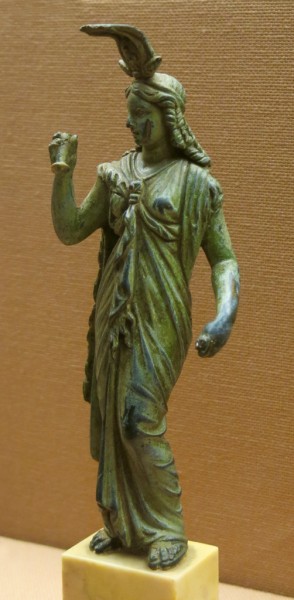
Above: Isis with sistrum, from Roman Imperial period, c. 100 BCE to 200 CE; bronze. Boston Museum of Fine Arts, accession no. 04.1713.
She is shaking a sistrum, an small percussion instrument that was used almost exclusively by women. Kara Cooney, a professor of Egyptian art and architecture, interprets the sistrum in terms of sexuality: “The sistrum was a kind of rattle — a wooden handle supporting bars of metal, each piercing small rings that clanged together when the instrument was vibrated. The sistrum itself represented human sexuality — round objects penetrated by a phallic rod holding them in place” (1). This interpretation could be accurate, but it could be overly influenced by Freud and Co., and therefore anachronistic.
The archaeologist Joyce Tyldesley offers another interpretation; she says the sistrum, which “was played only by women,” was “a rather large loop-shaped rattle with a long handle, often featuring the head of Hathor [another Egyptian goddess], which had initially represented the papyrus reeds of the Nile Delta where, mythology decreed, Hathor had been forced to hide with her young son. Eventually the sistrum lost all trace of its original meaning and instead started to serve as a religious symbol for life itself. It consequently become absorbed by other deities, and was particularly identified with the cult of Isis at the end of the Dynastic period.” (2) And this sculpture in fact does date from the end of the Dynastic period, the time when Isis had taken over the sistrum form Hathor.
Thus in this sculpture, we see the goddess Isis at the end of some three millennia of change and development. She is wearing the flowing robes of Rome rather than the simple sheath dress of Dynastic Egypt. She wears a headdress that identifies her as Isis, though it is not the older stepped headdress of Isis seen in sculptures from 500 years earlier (see, e.g., the sculpture of Isis below, from c. 685-525 BCE). And she has taken over the sistrum from Hathor and other goddesses.
Although their adherents may say otherwise, art and material culture does not show gods and goddesses as unchanging and fixed; instead, they grow and evolve over time.
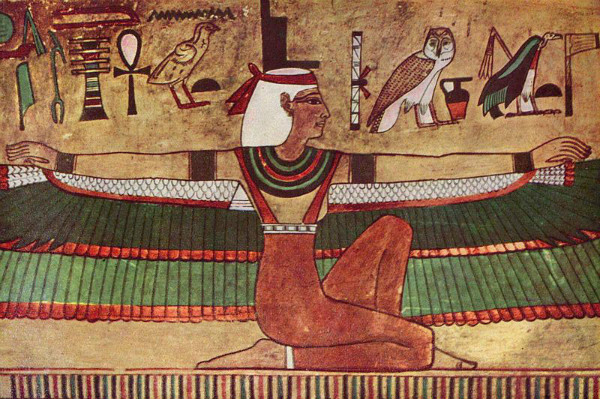
Isis at tomb of of Seti I in the Valley of the Kings. From WikiMedia. License.
Notes:
(1) Kara Cooney, The Woman Who Would Be King (New York: Broadway Books, 2014), p. 39.
(2) Joyce Tyldesley, Daughters of Isis: Women of Ancient Egypt (London: Penguin, 1994), p. 139.
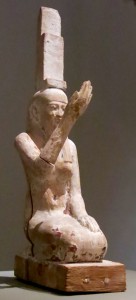
Above: Isis mourning Osiris, from Dynasty 26, c. 685-525 BCE; wood. Boston Museum of Fine Arts, accession no. 72.4172.
Previous Post

December 28, 2015
Solstice Rituals
Next Post

December 31, 2015 A CUUPS Year in Review!
Browse Our Archives
Select a Category Current Events CUUPS Press Release Interfaith liturgy Media Review podcast Religious Education Seasonal Reflection Spiritual Practice Summary Uncategorized
Select a Month July 2026 June 2026 April 2026 January 2026 December 2025 October 2025 August 2025 July 2025 June 2025 April 2025 March 2025 February 2025 December 2024 November 2024 October 2024 August 2024 July 2024 June 2024 May 2024 April 2024 February 2024 December 2023 November 2023 October 2023 September 2023 August 2023 June 2023 May 2023 April 2023 March 2023 February 2023 January 2023 December 2022 October 2022 September 2022 August 2022 July 2022 June 2022 May 2022 April 2022 March 2022 February 2022 January 2022 December 2021 November 2021 October 2021 September 2021 August 2021 July 2021 June 2021 May 2021 April 2021 March 2021 February 2021 January 2021 December 2020 November 2020 October 2020 September 2020 August 2020 July 2020 June 2020 May 2020 April 2020 March 2020 February 2020 January 2020 December 2019 November 2019 October 2019 September 2019 August 2019 July 2019 June 2019 May 2019 April 2019 March 2019 February 2019 January 2019 December 2018 November 2018 October 2018 September 2018 August 2018 July 2018 June 2018 May 2018 April 2018 March 2018 February 2018 January 2018 December 2017 November 2017 October 2017 September 2017 August 2017 July 2017 June 2017 May 2017 April 2017 March 2017 February 2017 January 2017 December 2016 November 2016 October 2016 September 2016 August 2016 July 2016 June 2016 May 2016 April 2016 March 2016 February 2016 January 2016 December 2015 November 2015 October 2015 September 2015 August 2015 July 2015 June 2015 May 2015 April 2015 March 2015 February 2015 January 2015
Follow Us!
TAKE THE
Religious Wisdom Quiz
How many times did Elijah stretch over dead child?
Select your answer to see how you score.
5 4 2 3
Related posts from Nature's Sacred Journey



TRENDING AT PATHEOS Pagan

I was recently chatting with someone on Instagram. She asked me what...

While there are many people who share their results, the end of...

On July 23, I saw Christopher Nolan's The Odyssey which is Homer’s...

As I write this two big events have just finished up. One...

Restoring the Watershed of Divine Love
Perhaps cooperation is not something we manufacture through legislation, ideology, or moral...

Many UUs don’t pray because of bad experiences in a previous religion,...
view all Pagan blogs
Ad-Free & Subscriber Log-In Subscription Support
- About Us
- 2026 Calendar
- Videos
- Podcasts
- Library of World Religions
- Faith In Media Tracker
- Advertise With Us
- Write for Us
- Privacy Policy
- Terms of Service
- Do Not Sell My Data
- Contact Us
- Radiant Digital
- Manage Newsletter Subscriptions
- Unsubscribe From Notifications
- Sitemap
Copyright 2008-2026, Patheos. All rights reserved.
Subscription Support Ad-Free & Subscriber Log-In
Follow Patheos