
BuddhistCatholicContemplativeEvangelicalGeneral ChristianHinduJewishLatter-day SaintMuslimNew VisionsProgressive Christian
Beliefs
- Buddhist
- Catholic
- Contemplative
- Evangelical
- General Christian
- Hindu
- Jewish
- Latter-day Saint
- More Voices
- Muslim
- New Visions
- Pagan
- Progressive Christian
Topics
- Religion News
- Food and Religion
- Sports and Religion
- Religious Art
- Religious Music and Entertainment
- Religious Events
- History and Religion
- Style and Religion
- Politics and Religion
- Women in Religion
- Recreation Outdoors and Religion
- Business Finance and Religion
- Careers Workplace and Religion
- Education and Religion
- Family Parenting and Religion
- Health Fitness and Religion
- Home and Religion
- Relationships and Religion
- Technology and Religion
- Travel and Religion
Columnists
- Buddhist Columnists
- Business Finance and Religion Columnists
- Careers Workplace and Religion Columnists
- Catholic Columnists
- Contemplative Columnists
- Education and Religion Columnists
- Evangelists Columnists
- Family Parenting and Religion Columnists
- General Christian Columnists
- Health Fitness and Religion Columnists
- Hindu Columnists
- History and Religion Columnists
- Home and Religion Columnists
- Jewish Columnists
- More Voices Columnists
- Latter Day Columnists
- Muslim Columnists
- New Visions Columnists
- Nonreligious Columnists
- Pagan Columnists
- Politics and Religion Columnists
- Progressive Columnists
- Recreation Outdoors and Religion Columnists
- Relationships and Religion Columnists
- Religion News Columnists
- Religious Art Columnists
- Religious Events Columnists
- Religious Music and Entertainment Columnists
- Sports and Religion Columnists
- Style and Religion Columnists
- Technology and Religion Columnists
- Travel and Religion Columnists
- Women in Religion Columnists
Resource Library
- 2026 Calendar
- Library of World Religions
- The 100 Most Holy Places on Earth
- Patheos Answers
- Podcasts
- Videos
- Faith Leaders Database
- Anglican Episcopalian
- Bahai
- Baptist
- Buddhism
- Christianity
- Confucianism
- Eastern Orthodoxy
- Hinduism
- Holiness and Pentecostal
- ISKCON
- Islam
- Judaism
- Lutheran
- Methodist
- The Church of Jesus Christ of Latter-day Saints
- New Age
- Paganism
- Presbytarian and Reformed
- Protestantism
- Religion Behind the Scenes
- Roman Catholic
- Scientology
- Shia Islam
- Sikhism
- Sufism
- Sunni Islam
- Taoism
- Zen
- See all religions
Research Tools
 Ad-Free & Subscriber Log-In Subscription Support
Ad-Free & Subscriber Log-In Subscription Support
Follow Patheos 

- Trending:
- Forgiveness
- |
- Marriage
- |
- Consciousness
- |
- Death Penalty
- |
- Election
- |
- Halloween

- Home
- Pagan
- Why Did The Pagan Go To Church?
Why Did The Pagan Go To Church?
Last updated on: November 13, 2015 at 5:00 am by Alison Leigh Lilly
Why Did The Pagan Go To Church? 2015-11-13T05:00:34+00:00 Alison Leigh Lilly
Patheos Explore the world's faith through different perspectives on religion and spirituality! Patheos has the views of the prevalent religions and spiritualities of the world.
Druid Reflections on the UU Experience, Part 1
It sounds like the beginning of a joke, doesn’t it? Like the classic: why did the chicken cross the road? Actually, I quite like that joke. It’s not very funny, maybe, but it reminds us to think like a chicken. This isn’t one of Aesop’s animals, a fox trotting across the street to the post office to mail a letter to her sweetheart, or a goat on his way to the grocery store. Why did the chicken cross the road? That is to say, what’s a road to a chicken?

“Curious Chicken” Ian Southwell (cc) 2012
I think it started as a lark. Not the chicken — I mean, the desire to go to church. I have never been what you might call a group joiner. People my age who have been “unchurched” for most if not all of their lives may start looking for a community when they have children of their own, hoping for a nurturing environment in which their kids can begin to explore their spiritual side while mom and dad steal an hour of quiet from the endless round of daycare, dance class, soccer games and such. Clever me, I skipped right over this step by marrying a man with kids from a previous marriage, and they already have enough relatives, grandparents and step-grandparents to drag them to half a dozen different kinds of church — that is, when my husband and I aren’t rousing them at dawn to light candles and sing the sun to rising.
If anything, my urge to find a church was selfish: as the classic not-so-very-evil stepmom, without kids of my own, I began to worry that one day I’d end up a lonely old widow shambling around in her slippers with only her cats for company. Sometimes Pagans can be a little bit scary about old women. They can idolize the hag on the outskirts of the village: call her a “witch,” give her some symbolic power as the outcast and edge-walker, and then get on with ignoring her. It might be a good idea to start making some nice Christian friends now, I thought, so there’ll be some folks to miss me when I die, or at least notice my absence before the cats got to gnawing on my bones.
The deeper truth, though, is that I often feel as if I have more in common with progressive Christians — those who are “unchurched” or “de-churched” or “SBNR” or merely ambivalent about church and prefer to call their communities “societies” or “fellowships”. And yet I never feel more profoundly Pagan than when I’m surrounded by people who aren’t. It’s this strange contradiction that I think lies behind a lot of the on-going discussion in our community about the usefulness and accuracy of the labels we use for our big, floppy and sometimes quite unwieldy Pagan umbrella. Modern Paganism continues to work towards embodying values like social justice and ecological awareness, compassion and respect for others. But we are a very young community still, and it’s easy for us to get distracted by the desire to prove our sincerity, to flaunt our uniqueness, or to throw around our intellectual weight. It’s especially tricky for those of us who place value on interfaith outreach, who see it not as a talent show where we can show off our differences, but as an authentic engagement with others who have something to teach us — if we are willing to listen, to be challenged, and to change. Sometimes I need something more from my spiritual community than yet another quest for the next best meditative technique or nitpicking over the historical accuracy of this or that folk tradition. Other times, I just need to dance in a circle to the weaving rhythm of the drums.
So my search for a church began. It wasn’t a very long one. I knew Unitarian Universalism to be a liberal spiritual community where I was likely to find those progressive values that most inspire me. I’m sure many UUs would say that they strive to be accepting of everyone, regardless of political persuasion, but then liberals always say that, bless their bleeding hearts. UU also has a reputation for being Pagan-friendly — the saying goes that in UU, on the east coast, Jesus is optional; in the midwest, God is optional; and on the west coast, clothing is optional. (Though I have yet to test this hypothesis in full.) I knew a few UU-Pagans who adored their church communities, and glancing through some of the ubiquitous explanatory pamphlets, I found myself nodding along with the Seven Principles. Inherent worth and dignity of all? Yep. Justice and compassion? Check. Ecological awareness of the interdependent web of all existence? You bet. Nurturing the spiritual growth of the community and its members? Ah, that would be the real test…
If I was going to join any kind of church, naturally it would have to accept me as an out-and-proud, enthusiastically polytheistic, animistic, tree-hugging, dirt-worshipping Druid, and not ask me to water down my practice or box in my theology. But it would also have to offer something more than mere acceptance.
Acceptance on its own, while nice, doesn’t do much for me, perhaps for the same reason that Groucho Marx wouldn’t join any club that would have him as a member. I’ve often found myself wondering if this explains the tendency, among Pagan and non-Pagan spiritual seekers alike, to wander in and out of various groups, from coven to grove to circle and back again. I’ve seen this behavior attributed to a seeker’s lack of maturity or fear of commitment, taken as a sign that they have no respect for the tried-and-tested lessons of history and tradition, or that they do not take their spiritual journey seriously — or just the opposite, that they are too serious, too idealistic and impatient with the necessary imperfections of real religious community in which, it is argued, we must “take the bad with the good” and accept hierarchy and literalism as necessary components of sustainable community and meaningful worship. I don’t think any of these claims are true, at least not as often as we might think.
As an apologetic dabbler myself, I’ve dropped in on my fair share of public rituals hosted by groups of various Pagan persuasions. Some of them have been elaborate, beautiful and cold; some have been endearingly clumsy; some, full of unexpected rainstorms that doused all the candles and left the smudge sticks soggy. But what all these groups had in common was that, eventually, I found myself reading the myriad subtle signs which politely but firmly communicated, “All Positions Filled.”
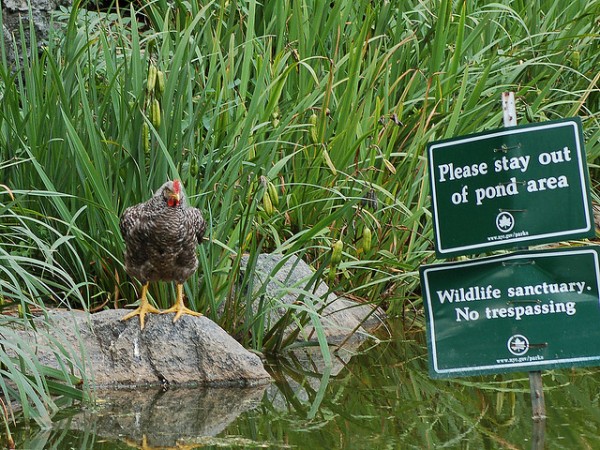
Urban Chicken – Robert (cc) 2006
As an embodied, experiential approach to the spiritual life, Paganism lends itself to charismatic leaders and a passion for impressive ritual performance. The appeal of joining an established group is that it can offer organization and infrastructure to support a deepening spiritual life in relationship with others, but the tendency among many Pagan groups (as I’ve experienced them, anyway) is to assume that new members are also neophytes, whose participation in the community is necessarily shallow, limited until they’ve proven themselves to be competent and charismatic in their own right. In other words, too many Pagan groups are not so much looking to grow their community as to expand their audience. “Acceptance” in such cases means little more than the price of admission, as in “we accept all major credit cards.” This kind of acceptance can leave many spiritual wanderers feeling unmoved — or rather, inclined to move on — still always seeking that special something, the magic of connection that carries us beyond the relative safety of mere acceptance and into a place where we feel valued.
It was in my own wanderings that I first came upon Unitarian Universalism. What did UU have to offer, besides simple acceptance? It turns out, this is a question UUs have been asking themselves for centuries now. In his post The baby is the bathwater: Why I haven’t joined the Unitarian church, non-theist Pagan John Halstead explored his ambivalence about the UU community, quoting writers from a hundred years ago whose handwringing over wishy-washy liberal impotence “could have been written today.” John noted:
It could have been written by me, or by many other people with whom I attend the First Unitarian church on Sundays. I think there are a handful of people there who believe in Unitarian Universalism, for whom UUism is their religion. But it seems that, for many more — Pagans, Buddhists, Christians, and others of various labels or none at all — Unitarianism is less an object of faith or a religious identity, and more of a convenient meeting place.
And so, it was with a mixture of curiosity and low expectations that I attended my first Sunday service at the local UU church last year. I’d read on the church’s website that their minister didn’t even identify as Christian; she was a Buddhist, with an appreciation for nature-centered spirituality. Since my husband had been raised Buddhist and we were both madly in love with the natural world, we figured this church might be a good place to start. One Sunday morning in July, almost on a whim, we decided to drop in. As an unreformed dabbler, my hope springs eternal that the next group I explore will be the one that feels like home; and in the meantime, sitting in on the worship services of other faiths always gives me something to think about, or perhaps just a reminder of all the reasons I love being Pagan. So we headed through the doors that Sunday, sharpie-scribbled guest name tags sticky on our breasts, like secret agents undertaking a kind of covert interfaith operation. Why did the Pagan go to church? To get to the other side…
But what’s a road to a Pagan who’s grown so used to wandering in the spiritual wilderness that she’s more inclined to stop and talk to the trees than to another human being? Where we were going, we didn’t need roads. But Unitarian Universalism didn’t even need a minister, it turned out — because that Sunday, the minister was on her yearly summer sabbatical and a member of the congregation was up at the lectern, sharing his thoughts on the spiritual value of uncertainty. Two points to UU, I thought to myself: giving a voice to the community instead of having hang-ups about hierarchy, and allowing that voice to speak about the beauty of questioning, curiosity and mystery. And then something magical happened. After the service, the woman sitting next to us asked us what we thought, and we ended up having a great conversation about whether or not spiritual uncertainty really was valuable, and what were its limitations, and how do we find solid ground to stand on in order to work for those principles of compassion, respect, justice and peace that we love so well.
Here was a community arguing passionately with itself. Here was a community in tension, prodding at the boundaries between self and other. Broken open at its very heart, incomplete and in process. Here was a community, I thought, with something to offer. What it offered was not simple answers or a self-identity I could wear like a suit of armor. What it offered was a sense of spaciousness, big enough for even wanderers like me, a space in which my wandering itself might be valued, might even be essential. And what it offered was, yes, a convenient meeting place.

Hens Together
Oregon Dept. of Agriculture (cc) 2008
I came to UU out of curiosity; but I’ve stayed because this community has proven big enough to embrace those tensions that energize and inspire my spiritual journey. I find myself challenged to think and rethink, to grow, to become a better person; but just as often I’m the one challenging others, and always they respond to that challenge as though it were something to be treasured rather than something to be avoided. I stay, because this community is one within which I can continue to cross boundaries, without having to leave my community behind.
This, really, is the theme of this series here on Nature’s Path, to which I have been trying to introduce you in my own rambling sort of way. Maybe UUs are a little bit wishy-washy. But as the Daoists will tell you, there is no rock so hard that it can withstand the soft persistence of water. Over the last year, I’ve explored many facets of UU life: the chalice circle, the Sunday service, the CUUPS group, the annual church retreat, even the boardroom. And if there’s one thing I’ve learned from this on-going exploration, it’s that, when it comes to us wanderers, never underestimate the value of a convenient meeting place.
Previous Post

November 9, 2015
The Lure of Consumption, the Magic of Intention
Next Post
November 16, 2015 Pastoral Prayer for November 16
Browse Our Archives
Select a Category Current Events CUUPS Press Release Interfaith liturgy Media Review podcast Religious Education Seasonal Reflection Spiritual Practice Summary Uncategorized
Select a Month July 2026 June 2026 April 2026 January 2026 December 2025 October 2025 August 2025 July 2025 June 2025 April 2025 March 2025 February 2025 December 2024 November 2024 October 2024 August 2024 July 2024 June 2024 May 2024 April 2024 February 2024 December 2023 November 2023 October 2023 September 2023 August 2023 June 2023 May 2023 April 2023 March 2023 February 2023 January 2023 December 2022 October 2022 September 2022 August 2022 July 2022 June 2022 May 2022 April 2022 March 2022 February 2022 January 2022 December 2021 November 2021 October 2021 September 2021 August 2021 July 2021 June 2021 May 2021 April 2021 March 2021 February 2021 January 2021 December 2020 November 2020 October 2020 September 2020 August 2020 July 2020 June 2020 May 2020 April 2020 March 2020 February 2020 January 2020 December 2019 November 2019 October 2019 September 2019 August 2019 July 2019 June 2019 May 2019 April 2019 March 2019 February 2019 January 2019 December 2018 November 2018 October 2018 September 2018 August 2018 July 2018 June 2018 May 2018 April 2018 March 2018 February 2018 January 2018 December 2017 November 2017 October 2017 September 2017 August 2017 July 2017 June 2017 May 2017 April 2017 March 2017 February 2017 January 2017 December 2016 November 2016 October 2016 September 2016 August 2016 July 2016 June 2016 May 2016 April 2016 March 2016 February 2016 January 2016 December 2015 November 2015 October 2015 September 2015 August 2015 July 2015 June 2015 May 2015 April 2015 March 2015 February 2015 January 2015
Follow Us!
TAKE THE
Religious Wisdom Quiz
Who said, "Behold the Lamb of God, who takes away the sin of the world"?
Select your answer to see how you score.
John the Baptist Peter Mary Paul
Related posts from Nature's Sacred Journey

My Pagan path - a look back into...

Five Things to do When the World Gets...

My story – discovering UU, starting a CUUPs...

Wheel of the Year: Beltane (May Day)
TRENDING AT PATHEOS Pagan

When we talk about Greek religion, we often begin with the dodekatheion—the...

I was recently chatting with someone on Instagram. She asked me what...

While there are many people who share their results, the end of...

On July 23, I saw Christopher Nolan's The Odyssey which is Homer’s...

As I write this two big events have just finished up. One...

Restoring the Watershed of Divine Love
Perhaps cooperation is not something we manufacture through legislation, ideology, or moral...
view all Pagan blogs
Ad-Free & Subscriber Log-In Subscription Support
- About Us
- 2026 Calendar
- Videos
- Podcasts
- Library of World Religions
- Faith In Media Tracker
- Advertise With Us
- Write for Us
- Privacy Policy
- Terms of Service
- Do Not Sell My Data
- Contact Us
- Radiant Digital
- Manage Newsletter Subscriptions
- Unsubscribe From Notifications
- Sitemap
Copyright 2008-2026, Patheos. All rights reserved.
Subscription Support Ad-Free & Subscriber Log-In
Follow Patheos