
BuddhistCatholicContemplativeEvangelicalGeneral ChristianHinduJewishLatter-day SaintMuslimNew VisionsProgressive Christian
Beliefs
- Buddhist
- Catholic
- Contemplative
- Evangelical
- General Christian
- Hindu
- Jewish
- Latter-day Saint
- More Voices
- Muslim
- New Visions
- Pagan
- Progressive Christian
Topics
- Religion News
- Food and Religion
- Sports and Religion
- Religious Art
- Religious Music and Entertainment
- Religious Events
- History and Religion
- Style and Religion
- Politics and Religion
- Women in Religion
- Recreation Outdoors and Religion
- Business Finance and Religion
- Careers Workplace and Religion
- Education and Religion
- Family Parenting and Religion
- Health Fitness and Religion
- Home and Religion
- Relationships and Religion
- Technology and Religion
- Travel and Religion
Columnists
- Buddhist Columnists
- Business Finance and Religion Columnists
- Careers Workplace and Religion Columnists
- Catholic Columnists
- Contemplative Columnists
- Education and Religion Columnists
- Evangelists Columnists
- Family Parenting and Religion Columnists
- General Christian Columnists
- Health Fitness and Religion Columnists
- Hindu Columnists
- History and Religion Columnists
- Home and Religion Columnists
- Jewish Columnists
- More Voices Columnists
- Latter Day Columnists
- Muslim Columnists
- New Visions Columnists
- Nonreligious Columnists
- Pagan Columnists
- Politics and Religion Columnists
- Progressive Columnists
- Recreation Outdoors and Religion Columnists
- Relationships and Religion Columnists
- Religion News Columnists
- Religious Art Columnists
- Religious Events Columnists
- Religious Music and Entertainment Columnists
- Sports and Religion Columnists
- Style and Religion Columnists
- Technology and Religion Columnists
- Travel and Religion Columnists
- Women in Religion Columnists
Resource Library
- 2026 Calendar
- Library of World Religions
- The 100 Most Holy Places on Earth
- Patheos Answers
- Podcasts
- Videos
- Faith Leaders Database
- Anglican Episcopalian
- Bahai
- Baptist
- Buddhism
- Christianity
- Confucianism
- Eastern Orthodoxy
- Hinduism
- Holiness and Pentecostal
- ISKCON
- Islam
- Judaism
- Lutheran
- Methodist
- The Church of Jesus Christ of Latter-day Saints
- New Age
- Paganism
- Presbytarian and Reformed
- Protestantism
- Religion Behind the Scenes
- Roman Catholic
- Scientology
- Shia Islam
- Sikhism
- Sufism
- Sunni Islam
- Taoism
- Zen
- See all religions
Research Tools
 Ad-Free & Subscriber Log-In Subscription Support
Ad-Free & Subscriber Log-In Subscription Support
Follow Patheos 

- Trending:
- Forgiveness
- |
- Marriage
- |
- Consciousness
- |
- Death Penalty
- |
- Election
- |
- Halloween

- Home
- Pagan
- What's a Deity?
What's a Deity?
Last updated on: November 3, 2015 at 5:00 am by Dan Harper
What's a Deity? 2015-11-03T05:00:51+00:00 Dan Harper
Patheos Explore the world's faith through different perspectives on religion and spirituality! Patheos has the views of the prevalent religions and spiritualities of the world.
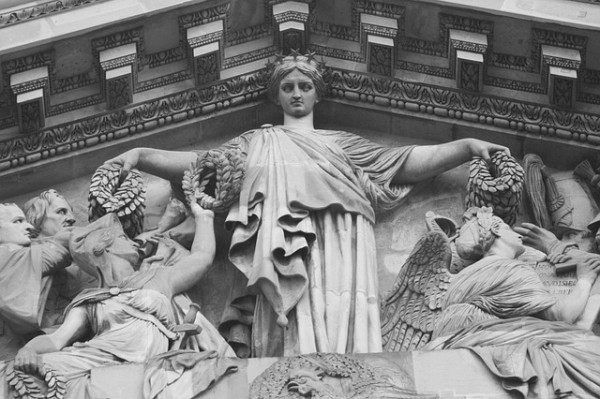
Temple in Paris, France (public domain photo)
The past weeks I’ve been posting images of deities. But what is a deity, anyway?
Here in the United States, popular culture has been heavily influenced by Protestant Christian culture, and so when we are asked to define a deity, we default to the concept of a monotheistic transcendent deity. If we have to draw a picture of this deity, we might either draw a picture of a man with a white beard sitting on a cloud, or say that this deity is transcendent and can’t be pictured.
However, most of the human race, for most of human history, has had a far more complex and nuanced understanding of deities. In our own Western cultural tradition, which extends back to the civilizations of Rome, Greece, and the ancient Near East more generally, we can find a great diversity of deities. Here’s a list of some of the categories of deity we can identify in the Western religious traditions:
• a single transcendent deity, e.g., the transcendent god of Xenophanes and other early Greek philosophers; God for some Jews; God the Father for some Christian sects
• a most powerful deity among other deities, e.g., Zeus in ancient Greece
• greater deities, e.g., the more powerful ancient Egyptian deities such as Horus, Osiris, and Ra
• lesser deities, e.g., the Titans in ancient Greece
• local deities, e.g., river gods, deities of a grove or forest, etc.
• household deities, e.g., the household gods of ancient Rome, etc.
• deified humans, e.g., the ancient Egyptian Pharaoh, Roman emperors deified after death, etc. (some might argue that the Virgin Mary of some Christian sects fits into this category)
• humans that are more than mortal but slightly less than gods, e.g., Herakles for the ancient Greeks, Jesus for the Christian followers of Arius, etc.
• humans with special powers who are worthy of veneration, e.g., canonized saints, sports figures and celebrities, etc.
• abstract concepts as deities, e.g., god as the unmoved mover in Aristotle, scientific method, financial success, etc.
These are just the first examples from the Western religious traditions that come to my mind. Then we can add in all the deities which are current in our increasingly multicultural world, such as the vast hierarchy of Hindu deities, the several Buddhas (who may appear as humans with special powers, but who may also appear as transcendent deities), ancestors who are venerated (as in some African traditions), deities as part of nature or tied to natural places (as with some Navajo deities), etc., etc.
I don’t believe we should accept without question the U.S. Protestant Christian definition of deity as a single transcendent god in whom one either believes or doesn’t believe. Humans in the U.S. today venerate a variety of deities, many of which look nothing like the U.S. Protestant transcendent God. And that veneration can take a variety of forms, from overt public worship to more covert forms of veneration. Given that, don’t you think that there is a lot more religion in the U.S. today than is captured by polls which ask whether people believe in “God” and attend “church”?
Previous Post

November 2, 2015
Bringing Back the Dead
Next Post
November 5, 2015 Demokratia or Death
Browse Our Archives
Select a Category Current Events CUUPS Press Release Interfaith liturgy Media Review podcast Religious Education Seasonal Reflection Spiritual Practice Summary Uncategorized
Select a Month July 2026 June 2026 April 2026 January 2026 December 2025 October 2025 August 2025 July 2025 June 2025 April 2025 March 2025 February 2025 December 2024 November 2024 October 2024 August 2024 July 2024 June 2024 May 2024 April 2024 February 2024 December 2023 November 2023 October 2023 September 2023 August 2023 June 2023 May 2023 April 2023 March 2023 February 2023 January 2023 December 2022 October 2022 September 2022 August 2022 July 2022 June 2022 May 2022 April 2022 March 2022 February 2022 January 2022 December 2021 November 2021 October 2021 September 2021 August 2021 July 2021 June 2021 May 2021 April 2021 March 2021 February 2021 January 2021 December 2020 November 2020 October 2020 September 2020 August 2020 July 2020 June 2020 May 2020 April 2020 March 2020 February 2020 January 2020 December 2019 November 2019 October 2019 September 2019 August 2019 July 2019 June 2019 May 2019 April 2019 March 2019 February 2019 January 2019 December 2018 November 2018 October 2018 September 2018 August 2018 July 2018 June 2018 May 2018 April 2018 March 2018 February 2018 January 2018 December 2017 November 2017 October 2017 September 2017 August 2017 July 2017 June 2017 May 2017 April 2017 March 2017 February 2017 January 2017 December 2016 November 2016 October 2016 September 2016 August 2016 July 2016 June 2016 May 2016 April 2016 March 2016 February 2016 January 2016 December 2015 November 2015 October 2015 September 2015 August 2015 July 2015 June 2015 May 2015 April 2015 March 2015 February 2015 January 2015
Follow Us!
TAKE THE
Religious Wisdom Quiz
Who was the high priest during the boyhood of Samuel?
Select your answer to see how you score.
Hophni Phinehas Eli Ahijah
Related posts from Nature's Sacred Journey



TRENDING AT PATHEOS Pagan

I was recently chatting with someone on Instagram. She asked me what...

While there are many people who share their results, the end of...

On July 23, I saw Christopher Nolan's The Odyssey which is Homer’s...

As I write this two big events have just finished up. One...

Restoring the Watershed of Divine Love
Perhaps cooperation is not something we manufacture through legislation, ideology, or moral...

Many UUs don’t pray because of bad experiences in a previous religion,...
view all Pagan blogs
Ad-Free & Subscriber Log-In Subscription Support
- About Us
- 2026 Calendar
- Videos
- Podcasts
- Library of World Religions
- Faith In Media Tracker
- Advertise With Us
- Write for Us
- Privacy Policy
- Terms of Service
- Do Not Sell My Data
- Contact Us
- Radiant Digital
- Manage Newsletter Subscriptions
- Unsubscribe From Notifications
- Sitemap
Copyright 2008-2026, Patheos. All rights reserved.
Subscription Support Ad-Free & Subscriber Log-In
Follow Patheos