
BuddhistCatholicContemplativeEvangelicalGeneral ChristianHinduJewishLatter-day SaintMuslimNew VisionsProgressive Christian
Beliefs
- Buddhist
- Catholic
- Contemplative
- Evangelical
- General Christian
- Hindu
- Jewish
- Latter-day Saint
- More Voices
- Muslim
- New Visions
- Pagan
- Progressive Christian
Topics
- Religion News
- Food and Religion
- Sports and Religion
- Religious Art
- Religious Music and Entertainment
- Religious Events
- History and Religion
- Style and Religion
- Politics and Religion
- Women in Religion
- Recreation Outdoors and Religion
- Business Finance and Religion
- Careers Workplace and Religion
- Education and Religion
- Family Parenting and Religion
- Health Fitness and Religion
- Home and Religion
- Relationships and Religion
- Technology and Religion
- Travel and Religion
Columnists
- Buddhist Columnists
- Business Finance and Religion Columnists
- Careers Workplace and Religion Columnists
- Catholic Columnists
- Contemplative Columnists
- Education and Religion Columnists
- Evangelists Columnists
- Family Parenting and Religion Columnists
- General Christian Columnists
- Health Fitness and Religion Columnists
- Hindu Columnists
- History and Religion Columnists
- Home and Religion Columnists
- Jewish Columnists
- More Voices Columnists
- Latter Day Columnists
- Muslim Columnists
- New Visions Columnists
- Nonreligious Columnists
- Pagan Columnists
- Politics and Religion Columnists
- Progressive Columnists
- Recreation Outdoors and Religion Columnists
- Relationships and Religion Columnists
- Religion News Columnists
- Religious Art Columnists
- Religious Events Columnists
- Religious Music and Entertainment Columnists
- Sports and Religion Columnists
- Style and Religion Columnists
- Technology and Religion Columnists
- Travel and Religion Columnists
- Women in Religion Columnists
Resource Library
- 2026 Calendar
- Library of World Religions
- The 100 Most Holy Places on Earth
- Patheos Answers
- Podcasts
- Videos
- Faith Leaders Database
- Anglican Episcopalian
- Bahai
- Baptist
- Buddhism
- Christianity
- Confucianism
- Eastern Orthodoxy
- Hinduism
- Holiness and Pentecostal
- ISKCON
- Islam
- Judaism
- Lutheran
- Methodist
- The Church of Jesus Christ of Latter-day Saints
- New Age
- Paganism
- Presbytarian and Reformed
- Protestantism
- Religion Behind the Scenes
- Roman Catholic
- Scientology
- Shia Islam
- Sikhism
- Sufism
- Sunni Islam
- Taoism
- Zen
- See all religions
Research Tools
 Ad-Free & Subscriber Log-In Subscription Support
Ad-Free & Subscriber Log-In Subscription Support
Follow Patheos 

- Trending:
- Forgiveness
- |
- Marriage
- |
- Consciousness
- |
- Death Penalty
- |
- Election
- |
- Halloween

- Home
- Pagan
- Ma-ku
Ma-ku
Last updated on: November 24, 2015 at 5:00 am by Dan Harper
Ma-ku 2015-11-24T05:00:54+00:00 Dan Harper
Patheos Explore the world's faith through different perspectives on religion and spirituality! Patheos has the views of the prevalent religions and spiritualities of the world.
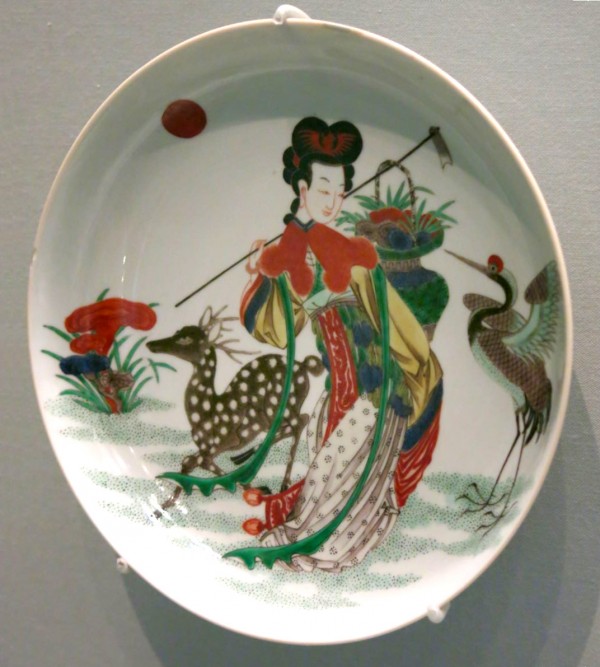
Ma-ku is a Taoist deity of longevity. In the image below, she can be identified by her hoe and a basket of the fungus of immortality. This Ching dynasty porcelain presentation dish was made sometime in the eighteenth century, and is now in the Asian Art Museum in San Francisco (accession no. B60P376):
Today in the West, Ma-ku’s name is sometimes translated as “Hemp Maiden,” which has led a number of Westerners to misappropriate her as the patron deity of pot smokers; you can find plenty of Web sites that state this as an absolute fact. Note, however, the iconography of Ma-ku often shows her, not with marijuana, but with a basket of the fungus of immortality. And so, not surprisingly, other Western writers have jumped to the conclusion that Ma-ku is not the goddess of marijuana, but rather the goddess of psychoactive mushrooms. Obviously, psychoactive mushrooms do not produce longevity, but we Westerners do love to superimpose our own meanings on the gods and goddesses of other times and other cultures.
Rather than imposing Western values on Ma-ku, I’m more interested in learning her role and place in Chinese culture. I found it difficult to locate good solid information about Ma-ku in English. But Mesny’s Chinese Miscellany (1899), though not a scholarly work and probably biased by a colonial outlook, has a useful entry on Ma-ku under the general heading of Gods and Goddesses:
MA KU
Ma Ku: A Taoist immortalised female saint or Hsien Nu; a portrait of Ma Ku is very popular as an emblem of longevity, and is one of the very best presents a person can make to his superiors on the occasion of a birthday feast.
During my stay in Kuei-chou, I received several such presents, in the form of a portrait of Ma Ku with a pilgrim’s staff and a basket of flowers over her shoulder, the whole embroidered in fancy coloured silk floss, on a scarlet satin tablet some 8 or 10 feet long by about 3 feet wide.
Mayers writing of Ma Ku says that she is “One of the female celebrities of Taoist fable. She is said to have been a sister of the immortalized soothsayer Wang Feng-ping (see Wang Yuan), and like him to have been admitted into the ranks of the genii [i.e., the immortals]. It is related that once when Fang-ping revealed himself in the presence of Ts’ai Ching, whom he chose as his disciple and taught, by corporeal sublimation, to free himself from the bonds of death, the genii was accompanied by his sister Ma Ku, who appeared in the semblance of a damsel of eighteen or twenty, arrayed in gorgeous apparel, and who waited on her brother and his pupil with strange viands served in platters of gold and chrysoprase.
“The wife of Ts’ai Ching was newly delivered of a child, seeing which Ma Ku took some grains of rice and threw them on the ground, where they at once became transformed into cinnabar (the magic of the alchemists). Fang-ping seeing this exclaimed with a smile, ‘Sister, do you still indulge in child’s play?’ to which the damsel replied: ‘Since I have been our handmaid, thrice has the eastern sea become fields where the mulberry grows!’…
“Hence the Tsang Sang Chih Pien, signifying the cyclic revolutions of nature and cataclysms occurring upon the earth’s surface such as beings of immeasurable longevity alone are priveleged to witness more than once.” It is on this account that the image or portrait of Ma Ku is so highly prized by the Chinese as an emblem of extreme long life and happiness.
— William Mesny, ed., Mesny’s Chinese Miscellany: A Text Book of Notes on China and the Chinese, vol. III, (Shanghai: Shanghai Mercury, 1899), p. 286.
Previous Post

November 20, 2015
Giving Thanks in the Dark
Next Post

November 25, 2015 Seizing An Alternative
Browse Our Archives
Select a Category Current Events CUUPS Press Release Interfaith liturgy Media Review podcast Religious Education Seasonal Reflection Spiritual Practice Summary Uncategorized
Select a Month July 2026 June 2026 April 2026 January 2026 December 2025 October 2025 August 2025 July 2025 June 2025 April 2025 March 2025 February 2025 December 2024 November 2024 October 2024 August 2024 July 2024 June 2024 May 2024 April 2024 February 2024 December 2023 November 2023 October 2023 September 2023 August 2023 June 2023 May 2023 April 2023 March 2023 February 2023 January 2023 December 2022 October 2022 September 2022 August 2022 July 2022 June 2022 May 2022 April 2022 March 2022 February 2022 January 2022 December 2021 November 2021 October 2021 September 2021 August 2021 July 2021 June 2021 May 2021 April 2021 March 2021 February 2021 January 2021 December 2020 November 2020 October 2020 September 2020 August 2020 July 2020 June 2020 May 2020 April 2020 March 2020 February 2020 January 2020 December 2019 November 2019 October 2019 September 2019 August 2019 July 2019 June 2019 May 2019 April 2019 March 2019 February 2019 January 2019 December 2018 November 2018 October 2018 September 2018 August 2018 July 2018 June 2018 May 2018 April 2018 March 2018 February 2018 January 2018 December 2017 November 2017 October 2017 September 2017 August 2017 July 2017 June 2017 May 2017 April 2017 March 2017 February 2017 January 2017 December 2016 November 2016 October 2016 September 2016 August 2016 July 2016 June 2016 May 2016 April 2016 March 2016 February 2016 January 2016 December 2015 November 2015 October 2015 September 2015 August 2015 July 2015 June 2015 May 2015 April 2015 March 2015 February 2015 January 2015
Follow Us!
TAKE THE
Religious Wisdom Quiz
Which couple taught Apollos more accurately about Jesus in Ephesus?
Select your answer to see how you score.
Priscilla and Aquila Ananias and Sapphira Mary and Joseph Lydia and Titus
Related posts from Nature's Sacred Journey

Stringing Together the “Beads” of New Ideas
TRENDING AT PATHEOS Pagan

I was recently chatting with someone on Instagram. She asked me what...

While there are many people who share their results, the end of...

On July 23, I saw Christopher Nolan's The Odyssey which is Homer’s...

As I write this two big events have just finished up. One...

Restoring the Watershed of Divine Love
Perhaps cooperation is not something we manufacture through legislation, ideology, or moral...

Many UUs don’t pray because of bad experiences in a previous religion,...
view all Pagan blogs
Ad-Free & Subscriber Log-In Subscription Support
- About Us
- 2026 Calendar
- Videos
- Podcasts
- Library of World Religions
- Faith In Media Tracker
- Advertise With Us
- Write for Us
- Privacy Policy
- Terms of Service
- Do Not Sell My Data
- Contact Us
- Radiant Digital
- Manage Newsletter Subscriptions
- Unsubscribe From Notifications
- Sitemap
Copyright 2008-2026, Patheos. All rights reserved.
Subscription Support Ad-Free & Subscriber Log-In
Follow Patheos