
BuddhistCatholicContemplativeEvangelicalGeneral ChristianHinduJewishLatter-day SaintMuslimNew VisionsProgressive Christian
Beliefs
- Buddhist
- Catholic
- Contemplative
- Evangelical
- General Christian
- Hindu
- Jewish
- Latter-day Saint
- More Voices
- Muslim
- New Visions
- Pagan
- Progressive Christian
Topics
- Religion News
- Food and Religion
- Sports and Religion
- Religious Art
- Religious Music and Entertainment
- Religious Events
- History and Religion
- Style and Religion
- Politics and Religion
- Women in Religion
- Recreation Outdoors and Religion
- Business Finance and Religion
- Careers Workplace and Religion
- Education and Religion
- Family Parenting and Religion
- Health Fitness and Religion
- Home and Religion
- Relationships and Religion
- Technology and Religion
- Travel and Religion
Columnists
- Buddhist Columnists
- Business Finance and Religion Columnists
- Careers Workplace and Religion Columnists
- Catholic Columnists
- Contemplative Columnists
- Education and Religion Columnists
- Evangelists Columnists
- Family Parenting and Religion Columnists
- General Christian Columnists
- Health Fitness and Religion Columnists
- Hindu Columnists
- History and Religion Columnists
- Home and Religion Columnists
- Jewish Columnists
- More Voices Columnists
- Latter Day Columnists
- Muslim Columnists
- New Visions Columnists
- Nonreligious Columnists
- Pagan Columnists
- Politics and Religion Columnists
- Progressive Columnists
- Recreation Outdoors and Religion Columnists
- Relationships and Religion Columnists
- Religion News Columnists
- Religious Art Columnists
- Religious Events Columnists
- Religious Music and Entertainment Columnists
- Sports and Religion Columnists
- Style and Religion Columnists
- Technology and Religion Columnists
- Travel and Religion Columnists
- Women in Religion Columnists
Resource Library
- 2026 Calendar
- Library of World Religions
- The 100 Most Holy Places on Earth
- Patheos Answers
- Podcasts
- Videos
- Faith Leaders Database
- Anglican Episcopalian
- Bahai
- Baptist
- Buddhism
- Christianity
- Confucianism
- Eastern Orthodoxy
- Hinduism
- Holiness and Pentecostal
- ISKCON
- Islam
- Judaism
- Lutheran
- Methodist
- The Church of Jesus Christ of Latter-day Saints
- New Age
- Paganism
- Presbytarian and Reformed
- Protestantism
- Religion Behind the Scenes
- Roman Catholic
- Scientology
- Shia Islam
- Sikhism
- Sufism
- Sunni Islam
- Taoism
- Zen
- See all religions
Research Tools
 Ad-Free & Subscriber Log-In Subscription Support
Ad-Free & Subscriber Log-In Subscription Support
Follow Patheos 

- Trending:
- Forgiveness
- |
- Marriage
- |
- Consciousness
- |
- Death Penalty
- |
- Election
- |
- Halloween

- Home
- Pagan
- Ho Hsien-ku
Ho Hsien-ku
Last updated on: November 17, 2015 at 5:00 am by Dan Harper
Ho Hsien-ku 2015-11-17T05:00:14+00:00 Dan Harper
Patheos Explore the world's faith through different perspectives on religion and spirituality! Patheos has the views of the prevalent religions and spiritualities of the world.
Ho Hsien-ku [Pinyin: He Xian’gu] is one of the Eight Taoist Immortals (Pa-hsien, Pinyin Baxian), and the only one who is unambiguously female. Six of the other Eight Immortals are definitely male, though at least one source (W. Perceval Yetts, “Eight Immortals,” p. 805) notes that Lan Ts’ai-ho may be depicted by artists as gender-ambiguous.
These Immortals began as humans, and transcended their humanity to become more than human. They could not be classed as either God or saint in the senses of those words used in the dominant Western religious traditions; but given their immortality and their powers, I would class them as deities. “The Eight Immortals are a group of seven men and one woman who are said to have attained immortality inspired by each other, and who continue to serve humanity by appearing in seances and inspirations” (Livia Kohn, Daoism and Chinese Culture, [Cambridge, Mass.: Three Pines Press, 2004], p. 164).
Below the photograph, I’ll append a brief biographical account of Ho Hsien-ku by W. Perceval Yetts, from “The Eight Immortals,” The Journal of the Royal Asiatic Society of Great Britain and Ireland, (London: 1916), pp. 781-783 (endotes are Yetts’ own notes).
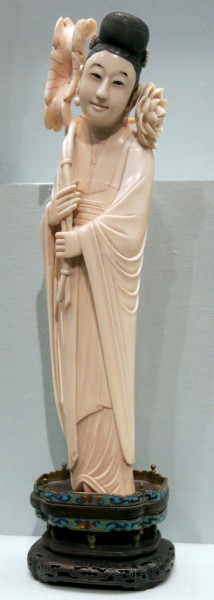
Ho Hsien-ku with a lotus, an ivory sculpture made between 1850 and 1911 (Ch’ing Dynasty) at the Asian Art Museum (accession no. R2005.71.47).
“Ho Hsien-ku,” from “The Eight Immortals by Perceval Yetts:
Ho Hsien-ku is shown as a comely girl sometimes dressed in elaborate robes, but more often wearing over a simple garment the leafy cape and skirt affected by the hsien [English: enlightened one, immortal]. A large ladle is her recognized emblem. Its bowl, made of bamboo basketwork, is often filled with several objects associated with Taoist immortality, e.g., the magic fungus (1) and peach; (2) sprigs of bamboo and of pine; (3) and flowers of the narcissus. (4) The place of the ladle may be taken by the more picturesque long-stalked lotus bloom; and sometimes she holds just a fly-whisk or the basket of wild fruit and herbs gathered for her mother.
Biography from Lieh hsien chuan [Collected Biographies of Immortals by Lieh-hsien chuan], ii, 32, 33:
Ho Hsien-ku was the daughter of Ho T‘ai, of the town of Tsêng-ch‘êng, in the prefecture of Canton. At birth she had six long hairs on the crown of her head. When she was about 14 or 15 a divine personage appeared to her in a dream and instructed her to eat powdered mica, (5) in order that her body might become etherealized and immune from death. So she swallowed it, and also vowed to remain a virgin.
Up hill and down dale she used to flit just like a creature with wings. Every day at dawn she sallied forth, to return at dusk, bringing back mountain fruits she had gathered for her mother. Later on by slow degrees she gave up taking ordinary food. (6)
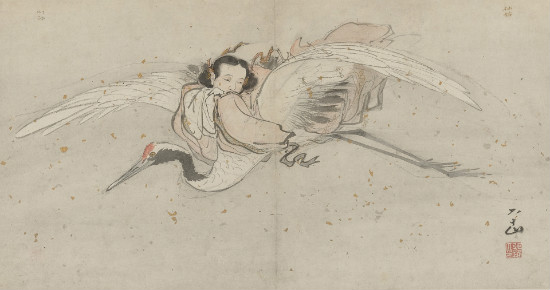
Courtesy of WikiMedia.
The Empress Wu (7) dispatched a messenger to summon her to attend at the palace, but on the way thither she [Ho Hsien-ku] disappeared. (8)
In the ching lung period (about A.D. 707) she ascended on high in broad daylight, (9) and became a hsien. In the ninth year of the t‘ien pao period (A.D. 750) Ho Hsien-ku reappeared, standing amidst rainbow clouds over a shrine dedicated to Ma Ku. Again, in the to li period (about A.D. 772) she appeared in the flesh on the Hsiao-shih Tower at Canton.
NOTES
[These are W. Perceval Yetts’s own notes.]
(1) This, the most ubiquitous object in Chinese art, has received various botanical names. (See Bretschneider, “Botanicum Sinicum,” Journal of the Chinese British Royal Asiatic Society, vol. xxv, p. 40, and vol. xxix, p. 418.) Its branches expand into flattened umbilicated extremities with scalloped edges. It is probably largely because of the resistance its wood-like substance offers to decay that it has been adopted as the emblem par excellence of immortality. There are records of its supernatural qualities having been recognized as early as the third century B.C. (see Chavannes, Les Mémoires historiques de Se-ma Ts’ien, vol. ii, p. 176 seq.), and to the present day it is sold by native apothecaries as a drug capable of prolonging life.
(2) Any representation of the magic peach is a covert allusion to that enigmatical figure, Hsi Wang Mu, the Queen of Taoist Fairyland. Among the wonders of her mountain domain was the tree that bore but once in 3,000 years peaches the taste of which gave immortality.
(3) Bamboo and pine, being evergreen, are emblems of longevity.
(4) The name the narcissus bears is sufficient reason why it should be included in this category.
(5) For the meaning of [what is here translated as “mica”]: see note by Dr. Laufer in *T‘oung Pao,*vol. xvi, p. 192. Perhaps a parallel may be found here between the alchemy of China and the West. Talc, a mineral often confused with mica, figures prominently in the writings of mediaeval alchemists, and as late as 1670 it was advocated as a mysterious preservative of youth and beauty by the Apothecary in Ordinary to the English Royal Honsehold, N. le Febure by name, in his Compleat Body of Chymistry, pt. ii, p. 106 seq.
(6) One of the first steps on the road to hsien-ship. Taoists are often said to have given up the ordinary diet of cereals. Some gradually reduce their food till they die of starvation. So emaciated is their condition that their bodies after death become mummified, and thus they do actually attain a kind of corporeal immortality. Particulars of this aspect of Chinese eschatology are to be found in an article by the writer in The Journal of the Royal Asiatic Society for July, 1911.
(7) The notorious woman who, through the possession of an extraordinary personality and a genius for intrigue, rose from obscurity to become the supreme ruler of China during the latter part of the seventh century. See Mayers, Chinese Reader’s Manual, pt. i, No. 862; and Giles, Biographical Dictionary, No. 2331.
(8) I.e., Ho Hsien-ku eluded the envoy. Chinese legend abounds in instances of summonses to Court being sent to hermit sages and others who had cut themselves off from worldly affairs. The recipients have almost invariably shown a consistent contempt for mundane honors by refusing to comply, and imperial curiosity as to their reputed wisdom or powers of magic has remained unsatisfied.
(9) The actual period of the day or night when emancipation from earthly ties takes place and the final stage in becoming a hsien is completed is considered in Taoist lore to have a determining influence upon the subsequent career of the hsien. See, for example, the following passage from the Chi hsien lu: “When (after death) the body remains like that of a living man, the condition is that of release from the flesh, shih chieh; when the legs do not become discolored nor the skin wrinkled — that is shih chieh; when the eyes remain bright and unsunken, in no respect differing from those of a living man — that is shih chieh; when resuscitation follows death — that is shih chieh; when the corpse vanishes before it is encoffined, and when the hair falls off before the mortal body soars (to heaven) — both of these are shih chieh. Most perfect is the release that takes place in broad daylight, but less complete is the release that occurs at midnight. When it takes place at dawn or at dusk, then the persons concerned are relegated to a terrestrial abode” (i.e. they will not reach the celestial paradise, but remain in haunts of the hsien on earth, such as the K’un-lun Mountains, the Isles of the Blest, and the Five Sacred Hills).
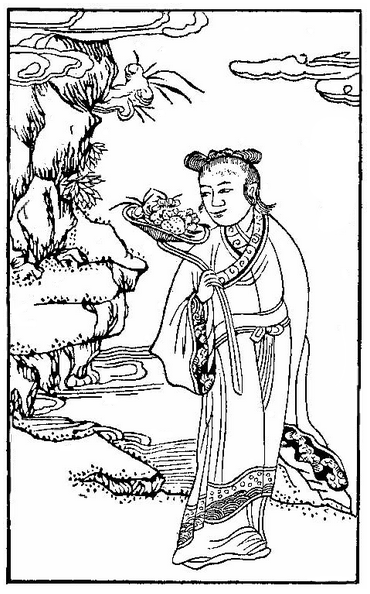
Drawing of Ho Hsien-ku in Yetts, p. 781 (public domain image).
Previous Post

November 16, 2015
Pastoral Prayer for November 16
Next Post
November 18, 2015 How And Why And Whether to Pray
Browse Our Archives
Select a Category Current Events CUUPS Press Release Interfaith liturgy Media Review podcast Religious Education Seasonal Reflection Spiritual Practice Summary Uncategorized
Select a Month July 2026 June 2026 April 2026 January 2026 December 2025 October 2025 August 2025 July 2025 June 2025 April 2025 March 2025 February 2025 December 2024 November 2024 October 2024 August 2024 July 2024 June 2024 May 2024 April 2024 February 2024 December 2023 November 2023 October 2023 September 2023 August 2023 June 2023 May 2023 April 2023 March 2023 February 2023 January 2023 December 2022 October 2022 September 2022 August 2022 July 2022 June 2022 May 2022 April 2022 March 2022 February 2022 January 2022 December 2021 November 2021 October 2021 September 2021 August 2021 July 2021 June 2021 May 2021 April 2021 March 2021 February 2021 January 2021 December 2020 November 2020 October 2020 September 2020 August 2020 July 2020 June 2020 May 2020 April 2020 March 2020 February 2020 January 2020 December 2019 November 2019 October 2019 September 2019 August 2019 July 2019 June 2019 May 2019 April 2019 March 2019 February 2019 January 2019 December 2018 November 2018 October 2018 September 2018 August 2018 July 2018 June 2018 May 2018 April 2018 March 2018 February 2018 January 2018 December 2017 November 2017 October 2017 September 2017 August 2017 July 2017 June 2017 May 2017 April 2017 March 2017 February 2017 January 2017 December 2016 November 2016 October 2016 September 2016 August 2016 July 2016 June 2016 May 2016 April 2016 March 2016 February 2016 January 2016 December 2015 November 2015 October 2015 September 2015 August 2015 July 2015 June 2015 May 2015 April 2015 March 2015 February 2015 January 2015
Follow Us!
TAKE THE
Religious Wisdom Quiz
What does "meek" mean in the Beatitudes?
Select your answer to see how you score.
Very rich Angry and harsh Gentle and humble Funny
Related posts from Nature's Sacred Journey

Stringing Together the “Beads” of New Ideas
TRENDING AT PATHEOS Pagan

I was recently chatting with someone on Instagram. She asked me what...

While there are many people who share their results, the end of...

On July 23, I saw Christopher Nolan's The Odyssey which is Homer’s...

As I write this two big events have just finished up. One...

Restoring the Watershed of Divine Love
Perhaps cooperation is not something we manufacture through legislation, ideology, or moral...

Many UUs don’t pray because of bad experiences in a previous religion,...
view all Pagan blogs
Ad-Free & Subscriber Log-In Subscription Support
- About Us
- 2026 Calendar
- Videos
- Podcasts
- Library of World Religions
- Faith In Media Tracker
- Advertise With Us
- Write for Us
- Privacy Policy
- Terms of Service
- Do Not Sell My Data
- Contact Us
- Radiant Digital
- Manage Newsletter Subscriptions
- Unsubscribe From Notifications
- Sitemap
Copyright 2008-2026, Patheos. All rights reserved.
Subscription Support Ad-Free & Subscriber Log-In
Follow Patheos