
BuddhistCatholicContemplativeEvangelicalGeneral ChristianHinduJewishLatter-day SaintMuslimNew VisionsProgressive Christian
Beliefs
- Buddhist
- Catholic
- Contemplative
- Evangelical
- General Christian
- Hindu
- Jewish
- Latter-day Saint
- More Voices
- Muslim
- New Visions
- Pagan
- Progressive Christian
Topics
- Religion News
- Food and Religion
- Sports and Religion
- Religious Art
- Religious Music and Entertainment
- Religious Events
- History and Religion
- Style and Religion
- Politics and Religion
- Women in Religion
- Recreation Outdoors and Religion
- Business Finance and Religion
- Careers Workplace and Religion
- Education and Religion
- Family Parenting and Religion
- Health Fitness and Religion
- Home and Religion
- Relationships and Religion
- Technology and Religion
- Travel and Religion
Columnists
- Buddhist Columnists
- Business Finance and Religion Columnists
- Careers Workplace and Religion Columnists
- Catholic Columnists
- Contemplative Columnists
- Education and Religion Columnists
- Evangelists Columnists
- Family Parenting and Religion Columnists
- General Christian Columnists
- Health Fitness and Religion Columnists
- Hindu Columnists
- History and Religion Columnists
- Home and Religion Columnists
- Jewish Columnists
- More Voices Columnists
- Latter Day Columnists
- Muslim Columnists
- New Visions Columnists
- Nonreligious Columnists
- Pagan Columnists
- Politics and Religion Columnists
- Progressive Columnists
- Recreation Outdoors and Religion Columnists
- Relationships and Religion Columnists
- Religion News Columnists
- Religious Art Columnists
- Religious Events Columnists
- Religious Music and Entertainment Columnists
- Sports and Religion Columnists
- Style and Religion Columnists
- Technology and Religion Columnists
- Travel and Religion Columnists
- Women in Religion Columnists
Resource Library
- 2026 Calendar
- Library of World Religions
- The 100 Most Holy Places on Earth
- Patheos Answers
- Podcasts
- Videos
- Faith Leaders Database
- Anglican Episcopalian
- Bahai
- Baptist
- Buddhism
- Christianity
- Confucianism
- Eastern Orthodoxy
- Hinduism
- Holiness and Pentecostal
- ISKCON
- Islam
- Judaism
- Lutheran
- Methodist
- The Church of Jesus Christ of Latter-day Saints
- New Age
- Paganism
- Presbytarian and Reformed
- Protestantism
- Religion Behind the Scenes
- Roman Catholic
- Scientology
- Shia Islam
- Sikhism
- Sufism
- Sunni Islam
- Taoism
- Zen
- See all religions
Research Tools
 Ad-Free & Subscriber Log-In Subscription Support
Ad-Free & Subscriber Log-In Subscription Support
Follow Patheos 

- Trending:
- Forgiveness
- |
- Marriage
- |
- Consciousness
- |
- Death Penalty
- |
- Election
- |
- Halloween

- Home
- Pagan
- Demokratia or Death
Demokratia or Death
Last updated on: November 5, 2015 at 5:00 am by David Pollard
Demokratia or Death 2015-11-05T05:00:25+00:00 David Pollard
Patheos Explore the world's faith through different perspectives on religion and spirituality! Patheos has the views of the prevalent religions and spiritualities of the world.
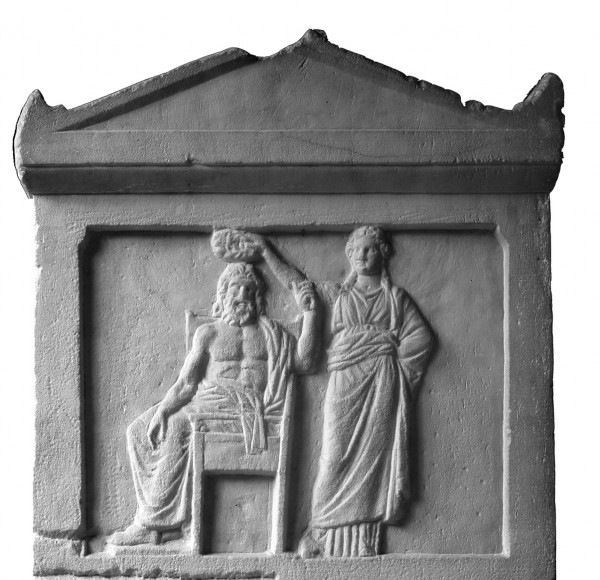
Demokratia: a woman crowning old man Demos, the people, a detail from an Athenian law sculpted in marble, 336 BCE
For the past few centuries Democracy is often cited as classical Athens greatest gift to the modern world. However, what went on in Athens does not bear much resemblance to what is practiced in 21st century America.
In modern times we are deeply grateful for the separation of church and state, indeed you frequently hear Pagans express wishes that it were more rigorously adhered to. In a sense classical Athens had separation of Church and State, in that Christianity was still centuries away from being created. Yet, most Athenians were quite pious, and their religious life was reflected in how proceedings were conducted. Sessions were often opened with curses upon any who might mislead the public in the days proceedings.
Starting around 500BCE, there was a deity specific to this new form of government, Demokratia, Not surprisingly her fame did not long outlast the use of that form of government. Athena, the city’s patron deity was not seen to be an advocate of this new form of government either, her influence preceded this era by several centuries – and the type of campaigns that were most closely associated with her were typically military, not political. If there was one of the Olympian gods which which had a special relationship with democracy, it was Hermes. Hermes was seen to have sway over communication and persuasiveness. Both of which are vitally important when you’re trying to speak to several hundred to a few thousand people (without amplification) and convince them of maters of civic import. Hermes’ cadueues was used as a 6ft tall “talking stick” so that the speaker wouldn’t be quite as lost in the crowd. Likewise, the first sign of real trouble for democracy was when one night a bunch of drunk rich boys smashed statue every statue of Hermes they could get their hands on. Most of these were in front of middle class homes to bring good fortune to travelers. This occurred immediately before a military venture against an ally of Sparta, which ended in disaster. A couple years later (411BCE) a group of young aristocrats brought in some Spartan mercenaries and set themselves up as a junta using the mercenaries as death squads against the previous elected leadership. After a few months the junta collapsed and Athens went back to a democracy only to revert again to oligarchy in 404 and 401 BCE.
Despite all the involvement of Hermes and Demokratia and the regular invocations and purification’s that took place – this actually was a big decrease in the involvement of religions in public affairs. The standard way that government was done in the world at that time was that you would have a king who was also simultaneously the head of state and high priest of the state religion, if not considered a god outright. The priests who conducted rites on behalf of the Assembly had no authority or privilege beyond what was need to conduct their duties. There vote counted the same as anyone else. If they got stuck on a jury they got the same lousy pay as anyone else.
There were limits to this smaller religious role. For instance, while being an atheist was not specifically illegal, teaching atheism, especially that the civic deities did not exist was considered a crime. The most famous instance of this was the case of Socrates who was tried, convicted and executed for this in 399 BCE. Socrates was not a fan of democracy, he refused to participate in it, and thought that the idea that the general public having any part of making governing decisions was an incredibly stupid idea. As a philosopher his students were the children of Athens wealthy aristocrats, most of whom were not particularly pleased about democracy either. His views were well known all over town, Aristophanes had been making fun of him in his plays for twenty-five years prior to his death. What turned public opinion of his anti-democrat views from harmless foolery to a judicial lynch mob? It’s what his students did. The revolts in 411, 404 and 401BCE that were listed above where young aristocrats came in with mercenaries and wiped out the local elected leaders. Well, the young men who lead those revolts were former students of Socrates. He never spoken against them, never suggested they step down, never indicated any regret that democracy had been overthrown. Perhaps if there had only been one instance of this, Socrates would never have been prosecuted. But after three times, people started connecting the dots and noticing who had taught these would be tyrants. And while no one could be found to ever suggest that Socrates advocated people taking up arms, or hiring mercenaries against the elected leaders – what they determined was that by his constant teaching against Athenian democracy he in effect was teaching atheism against the civic goddess Demokratia.
By this point the damage was done, after having had its democratic leadership wiped out three times in little over a decade, between Sparta, Macedonia and later on the Romans – Athens occasionally would revolt and have a few years of democracy, but it was always put down. In fact it never really had a stable democracy going until the last few decades, and with its current dire financial problems one might wonder about my use of the word ‘stable’.
When we look at our own version of democracy’s problems in dealing with monied interests I’m hoping that there’s some useful lessons we can find here, other than it can always get worse. What do you think?
—
Two books I found useful for this article:
“Greek Realities: Life and Thought in Ancient Greece” Finley Hooper 1967.
“The Trial of Socrates” I. F. Stone 1988. Mr. Stone was not a historian, but a famous investigative journalist who attempted to recreate the missing case for the prosecution. Fascinating reading!
Previous Post

November 3, 2015
What's a Deity?
Next Post
November 6, 2015 Creating Rituals for Pagan Groups in a UU Context
Browse Our Archives
Select a Category Current Events CUUPS Press Release Interfaith liturgy Media Review podcast Religious Education Seasonal Reflection Spiritual Practice Summary Uncategorized
Select a Month July 2026 June 2026 April 2026 January 2026 December 2025 October 2025 August 2025 July 2025 June 2025 April 2025 March 2025 February 2025 December 2024 November 2024 October 2024 August 2024 July 2024 June 2024 May 2024 April 2024 February 2024 December 2023 November 2023 October 2023 September 2023 August 2023 June 2023 May 2023 April 2023 March 2023 February 2023 January 2023 December 2022 October 2022 September 2022 August 2022 July 2022 June 2022 May 2022 April 2022 March 2022 February 2022 January 2022 December 2021 November 2021 October 2021 September 2021 August 2021 July 2021 June 2021 May 2021 April 2021 March 2021 February 2021 January 2021 December 2020 November 2020 October 2020 September 2020 August 2020 July 2020 June 2020 May 2020 April 2020 March 2020 February 2020 January 2020 December 2019 November 2019 October 2019 September 2019 August 2019 July 2019 June 2019 May 2019 April 2019 March 2019 February 2019 January 2019 December 2018 November 2018 October 2018 September 2018 August 2018 July 2018 June 2018 May 2018 April 2018 March 2018 February 2018 January 2018 December 2017 November 2017 October 2017 September 2017 August 2017 July 2017 June 2017 May 2017 April 2017 March 2017 February 2017 January 2017 December 2016 November 2016 October 2016 September 2016 August 2016 July 2016 June 2016 May 2016 April 2016 March 2016 February 2016 January 2016 December 2015 November 2015 October 2015 September 2015 August 2015 July 2015 June 2015 May 2015 April 2015 March 2015 February 2015 January 2015
Follow Us!
TAKE THE
Religious Wisdom Quiz
Who saw the vision of the valley of dry bones?
Select your answer to see how you score.
Jeremiah Daniel Isaiah Ezekiel
Related posts from Nature's Sacred Journey



Honoring a S/hero, Human Decency, and Being the...

Stringing Together the “Beads” of New Ideas
TRENDING AT PATHEOS Pagan

I was recently chatting with someone on Instagram. She asked me what...

While there are many people who share their results, the end of...

On July 23, I saw Christopher Nolan's The Odyssey which is Homer’s...

As I write this two big events have just finished up. One...

Restoring the Watershed of Divine Love
Perhaps cooperation is not something we manufacture through legislation, ideology, or moral...

Many UUs don’t pray because of bad experiences in a previous religion,...
view all Pagan blogs
Ad-Free & Subscriber Log-In Subscription Support
- About Us
- 2026 Calendar
- Videos
- Podcasts
- Library of World Religions
- Faith In Media Tracker
- Advertise With Us
- Write for Us
- Privacy Policy
- Terms of Service
- Do Not Sell My Data
- Contact Us
- Radiant Digital
- Manage Newsletter Subscriptions
- Unsubscribe From Notifications
- Sitemap
Copyright 2008-2026, Patheos. All rights reserved.
Subscription Support Ad-Free & Subscriber Log-In
Follow Patheos