
BuddhistCatholicContemplativeEvangelicalGeneral ChristianHinduJewishLatter-day SaintMuslimNew VisionsProgressive Christian
Beliefs
- Buddhist
- Catholic
- Contemplative
- Evangelical
- General Christian
- Hindu
- Jewish
- Latter-day Saint
- More Voices
- Muslim
- New Visions
- Pagan
- Progressive Christian
Topics
- Religion News
- Food and Religion
- Sports and Religion
- Religious Art
- Religious Music and Entertainment
- Religious Events
- History and Religion
- Style and Religion
- Politics and Religion
- Women in Religion
- Recreation Outdoors and Religion
- Business Finance and Religion
- Careers Workplace and Religion
- Education and Religion
- Family Parenting and Religion
- Health Fitness and Religion
- Home and Religion
- Relationships and Religion
- Technology and Religion
- Travel and Religion
Columnists
- Buddhist Columnists
- Business Finance and Religion Columnists
- Careers Workplace and Religion Columnists
- Catholic Columnists
- Contemplative Columnists
- Education and Religion Columnists
- Evangelists Columnists
- Family Parenting and Religion Columnists
- General Christian Columnists
- Health Fitness and Religion Columnists
- Hindu Columnists
- History and Religion Columnists
- Home and Religion Columnists
- Jewish Columnists
- More Voices Columnists
- Latter Day Columnists
- Muslim Columnists
- New Visions Columnists
- Nonreligious Columnists
- Pagan Columnists
- Politics and Religion Columnists
- Progressive Columnists
- Recreation Outdoors and Religion Columnists
- Relationships and Religion Columnists
- Religion News Columnists
- Religious Art Columnists
- Religious Events Columnists
- Religious Music and Entertainment Columnists
- Sports and Religion Columnists
- Style and Religion Columnists
- Technology and Religion Columnists
- Travel and Religion Columnists
- Women in Religion Columnists
Resource Library
- 2026 Calendar
- Library of World Religions
- The 100 Most Holy Places on Earth
- Patheos Answers
- Podcasts
- Videos
- Faith Leaders Database
- Anglican Episcopalian
- Bahai
- Baptist
- Buddhism
- Christianity
- Confucianism
- Eastern Orthodoxy
- Hinduism
- Holiness and Pentecostal
- ISKCON
- Islam
- Judaism
- Lutheran
- Methodist
- The Church of Jesus Christ of Latter-day Saints
- New Age
- Paganism
- Presbytarian and Reformed
- Protestantism
- Religion Behind the Scenes
- Roman Catholic
- Scientology
- Shia Islam
- Sikhism
- Sufism
- Sunni Islam
- Taoism
- Zen
- See all religions
Research Tools
 Ad-Free & Subscriber Log-In Subscription Support
Ad-Free & Subscriber Log-In Subscription Support
Follow Patheos 

- Trending:
- Forgiveness
- |
- Marriage
- |
- Consciousness
- |
- Death Penalty
- |
- Election
- |
- Halloween

- Home
- Pagan
- The Difficult Magic of Welcome
The Difficult Magic of Welcome
Last updated on: September 16, 2015 at 4:47 am by Rev. Catharine Clarenbach
The Difficult Magic of Welcome 2015-09-16T04:47:30+00:00 Rev. Catharine Clarenbach
Patheos Explore the world's faith through different perspectives on religion and spirituality! Patheos has the views of the prevalent religions and spiritualities of the world.
“In the middle of my life’s way, I found myself in a dark wood…” – Dante Alighieri, The Divine Comedy
Walking through the Dark Wood
Especially when one is open, when one adheres to a tenet of “A responsible search for truth and meaning” and “Direct experience of that transcending mystery and wonder, affirmed in all cultures, which moves us to a renewal of the spirit and an openness to the forces which create and uphold life,” (the fourth Principle and first Source in Unitarian Universalism)… Especially when one takes these seriously…Perhaps, especially when one is a Pagan-UU or UU-Pagan…
Under these conditions, one may embark—seemingly fearlessly—on a spiritual journey. You find yourself, as Dante did, on a path. You are seeking the Love that will not let you go; the Divine Who Is/Are Male, Female, Both, and Neither; the Right Place; the Time out of Time; or the acquaintance of A God Who Could be Real (see Nancy Ellen Abrams’ book of that name). Under these conditions, you may find things that are intensely private, intimate, and that take a while to be shared. Are we in our congregations willing to hear what one another has to share about our spiritual journey? Really hear?
I have questions for my UU siblings, for our religious leaders, for myself:
Do we in fact support the combination of the First Source and the Fourth Principle? What religious and spiritual expressions are culturally supported in our congregations and other gatherings?

exuberant prayer
What do we do when someone’s theology is different from the culture of our congregations?
Admitting the Heart’s Truth
At General Assembly this past June, Rev. Marlin Lavanhar preached about a humanist congregant who nonetheless prayed in tongues. In the case of this congregant (I don’t know his race), glossolalia was part of his past he kept, something comforting and connecting.
That practice was also something he felt he had to hide from other congregants and—for a long while—his minister. Praying in tongues, or speaking in tongues, was something that he believed would be reviled in his congregation, and so he kept his mouth shut, so to speak. It wasn’t until he came to a place and time that felt welcoming of all of who he is that he was able to “admit” to his spiritual practice.
Let me say that again: Admit to his spiritual practice.
We claim, at least in print, to support the responsible search for truth and meaning. That, “The living tradition which we share comes from many sources,” all of which stem from awe, mystery, and wonder.
When someone feels like he has to admit his theology or spiritual practice to his minister, as though it were a sin from which to be absolved, there is a problem. There is a problem of integrity, of shared authenticity, and certainly of welcome and hospitality.
Racist Ignorance
A Black minister explained that they would prefer to be addressed as Rev.{first name} in conversation and emails and the like. Using their honorific is simply the appropriate form of address in their tradition, and what they prefer. They explained in a sermon that it would never occur to them to call their own elders and ministers from their home church simply by their first name.
NB: Many white ministers, including yours truly, sign emails, “Rev. so-and-so” and introduce themselves as “Rev. thus-and-such.” Racist hypocrisy aside, let us continue.
In the case of my Black colleague, a white congregant took it upon themselves in coffee hour to ask, “Do you prefer to be called Reverend because your people were disrespected for so long and so you think it’s important for us to call you Reverend?” (emphasis mine) Your people. Your people???
The white congregant was asking the Black minister not only to defend the theology and history of using various forms of address. She was also asking the minister in an othering way, a way that made it clear that she, the congregant, did not respect the minister’s choice and tradition, from wherever it may have emerged. Her question was not welcoming (the minister had not been at this church long), it was distancing, and was rooted in the idea that the minister’s practice and request for that practice to be respected were somehow less than acceptable. The idea that the choice of address was rooted in theology, perfectly legitimate theology, and not simply some kind of overcompensation, never occurred in that congregant’s mind.
A White Woman’s Invitation to the Body and the Spirit
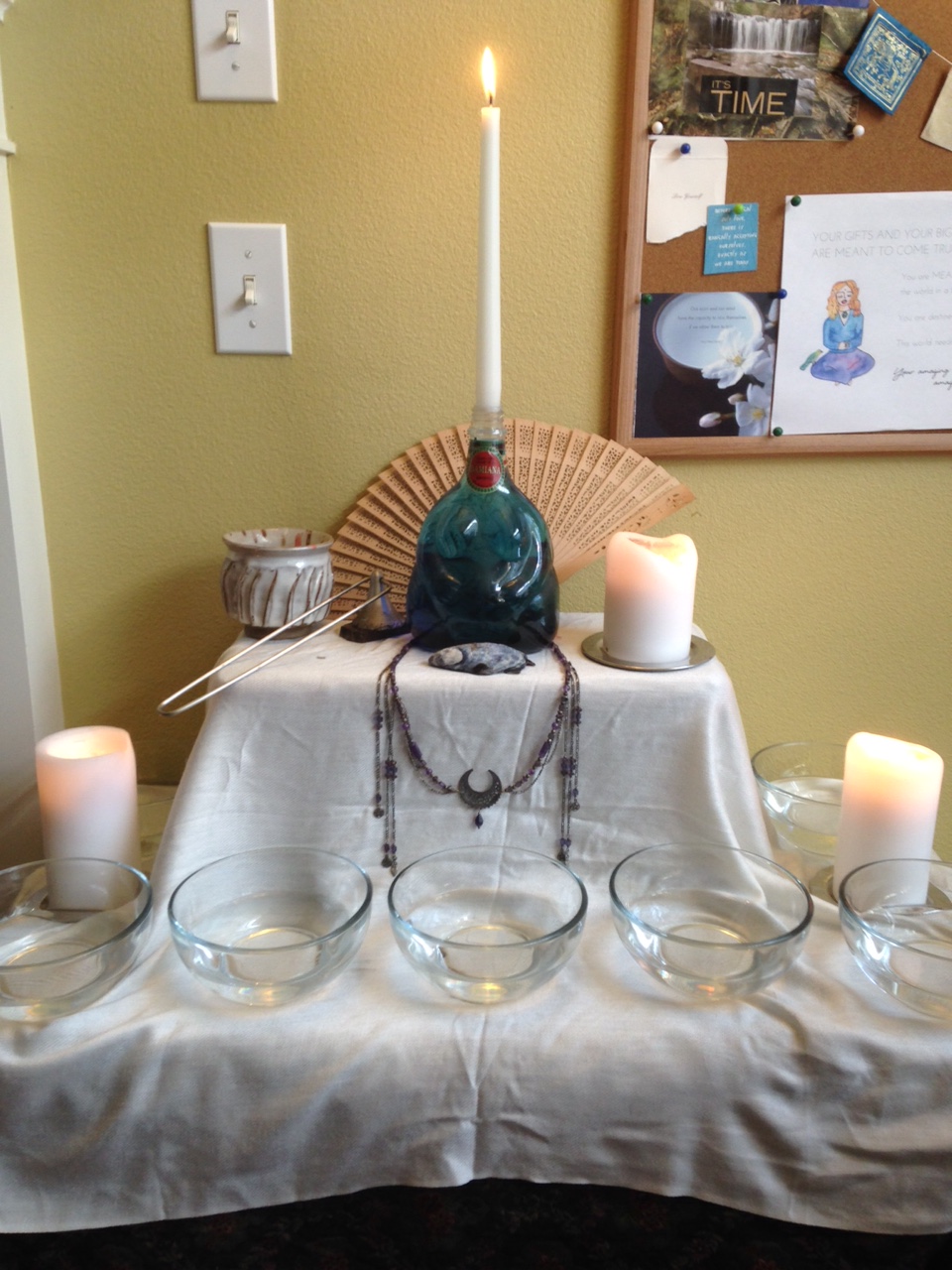
ancestor altar
My practice comes out of the blood, sweat, and tears methods of Four Quarters Interfaith Sanctuary, and I am a duly initiated priestess of the Third Degree in Stone Circle Wicca. My practice has also come from the Unitarian
Universalist traditions, and from All Souls Unitarian, Washington, DC, where I was ordained a UU minister.

My practice also emerges from time with the Afro-Cuban Santerían houses and times of worship into which I have been invited. Let me note, and note again, that I am NOT an expert on Santeria. I hold no initiations in the tradition. I am not a scholar of the faith. I write humbly and carefully here, knowing that it is all too easy for me to stumble.
The practice of Santeria—or more properly la Regla de Ocha—is a practice of the body and the spirit at least as much of the mind. Ocha, coming from its Yoruba parent, Ifa, is old, variable, and came to the Americas by way of the horrors of the Middle Passage.
It is a practice of ancestor veneration. It is a practice of worship of the Orisha, the saints/angels/deities of the tradition.
Drumming, dancing, trance possession, singing, various forms of divination, study, work, shared meals, layers of initiation, and animal sacrifice are all integral parts of the tradition’s practices.
There are few houses of Ocha that would initiate a white woman, and for good reason. Nonetheless, I have been invited into Ocha practices and skills and ceremonies—ones I have no “right” to, except for the grace and hospitality of my hosts.
How do We Welcome?
Some questions: One, how does it feel inside you to read the above? To read about Ocha, if you didn’t know about it before? To read, even in passing, of the religious and sacred practice of animal sacrifice?
Furthermore, how can you imagine welcoming an Ocha practitioner into your congregation? Suppose they came to visit, just to see whether there were something for them in your congregation. What would they find? Why would they come back, or not?
How strong is your inclination to write off the question of hospitality in this case as “too extreme”? What could a blood, sweat, and tears religion like Ocha have to do with Unitarian Universalism. Just as I have heard white UUs write off the necessity of welcome and hospitality to Catholic or Pentecostal Latin@ neighbors, I suspect I would hear the same things again. “They have their own traditions,” “Why would they be interested in us?” “What do we have to offer that they don’t already have?”
Do we think so little of our own traditions that we are afraid to invite our neighbors in? Are we so frightened of other people’s practice that we dare not even ask them to come and teach us what we do not know?
We UU’s, we often think we know what needs knowing. That we have gone as far as needs going.
And yet…and yet we are as ignorant as anyone else. We are as slow-going as anyone else. And I think that once we get a grip on those two facts, and bring ourselves humbly to the feet of our neighbors, members, and friends—especially our neighbors of color—then we can move forward toward Beloved Community, toward the world we dream about, toward justice and love.
With love and blessings to you and to your house. – Rev. Catharine
Previous Post
September 12, 2015
Why CUUPS is a Deep Expression of Paganism
Next Post

September 17, 2015 All Lives Do Not Matter
Browse Our Archives
Select a Category Current Events CUUPS Press Release Interfaith liturgy Media Review podcast Religious Education Seasonal Reflection Spiritual Practice Summary Uncategorized
Select a Month July 2026 June 2026 April 2026 January 2026 December 2025 October 2025 August 2025 July 2025 June 2025 April 2025 March 2025 February 2025 December 2024 November 2024 October 2024 August 2024 July 2024 June 2024 May 2024 April 2024 February 2024 December 2023 November 2023 October 2023 September 2023 August 2023 June 2023 May 2023 April 2023 March 2023 February 2023 January 2023 December 2022 October 2022 September 2022 August 2022 July 2022 June 2022 May 2022 April 2022 March 2022 February 2022 January 2022 December 2021 November 2021 October 2021 September 2021 August 2021 July 2021 June 2021 May 2021 April 2021 March 2021 February 2021 January 2021 December 2020 November 2020 October 2020 September 2020 August 2020 July 2020 June 2020 May 2020 April 2020 March 2020 February 2020 January 2020 December 2019 November 2019 October 2019 September 2019 August 2019 July 2019 June 2019 May 2019 April 2019 March 2019 February 2019 January 2019 December 2018 November 2018 October 2018 September 2018 August 2018 July 2018 June 2018 May 2018 April 2018 March 2018 February 2018 January 2018 December 2017 November 2017 October 2017 September 2017 August 2017 July 2017 June 2017 May 2017 April 2017 March 2017 February 2017 January 2017 December 2016 November 2016 October 2016 September 2016 August 2016 July 2016 June 2016 May 2016 April 2016 March 2016 February 2016 January 2016 December 2015 November 2015 October 2015 September 2015 August 2015 July 2015 June 2015 May 2015 April 2015 March 2015 February 2015 January 2015
Follow Us!
TAKE THE
Religious Wisdom Quiz
Which Old Testament prophet's book has the most chapters?
Select your answer to see how you score.
Jeremiah Isaiah Daniel Ezekiel
Related posts from Nature's Sacred Journey


Stringing Together the “Beads” of New Ideas


We Call Out with a "Strong Voice" to...
TRENDING AT PATHEOS Pagan

I was recently chatting with someone on Instagram. She asked me what...

While there are many people who share their results, the end of...

On July 23, I saw Christopher Nolan's The Odyssey which is Homer’s...

As I write this two big events have just finished up. One...

Restoring the Watershed of Divine Love
Perhaps cooperation is not something we manufacture through legislation, ideology, or moral...

Many UUs don’t pray because of bad experiences in a previous religion,...
view all Pagan blogs
Ad-Free & Subscriber Log-In Subscription Support
- About Us
- 2026 Calendar
- Videos
- Podcasts
- Library of World Religions
- Faith In Media Tracker
- Advertise With Us
- Write for Us
- Privacy Policy
- Terms of Service
- Do Not Sell My Data
- Contact Us
- Radiant Digital
- Manage Newsletter Subscriptions
- Unsubscribe From Notifications
- Sitemap
Copyright 2008-2026, Patheos. All rights reserved.
Subscription Support Ad-Free & Subscriber Log-In
Follow Patheos