
BuddhistCatholicContemplativeEvangelicalGeneral ChristianHinduJewishLatter-day SaintMuslimNew VisionsProgressive Christian
Beliefs
- Buddhist
- Catholic
- Contemplative
- Evangelical
- General Christian
- Hindu
- Jewish
- Latter-day Saint
- More Voices
- Muslim
- New Visions
- Pagan
- Progressive Christian
Topics
- Religion News
- Food and Religion
- Sports and Religion
- Religious Art
- Religious Music and Entertainment
- Religious Events
- History and Religion
- Style and Religion
- Politics and Religion
- Women in Religion
- Recreation Outdoors and Religion
- Business Finance and Religion
- Careers Workplace and Religion
- Education and Religion
- Family Parenting and Religion
- Health Fitness and Religion
- Home and Religion
- Relationships and Religion
- Technology and Religion
- Travel and Religion
Columnists
- Buddhist Columnists
- Business Finance and Religion Columnists
- Careers Workplace and Religion Columnists
- Catholic Columnists
- Contemplative Columnists
- Education and Religion Columnists
- Evangelists Columnists
- Family Parenting and Religion Columnists
- General Christian Columnists
- Health Fitness and Religion Columnists
- Hindu Columnists
- History and Religion Columnists
- Home and Religion Columnists
- Jewish Columnists
- More Voices Columnists
- Latter Day Columnists
- Muslim Columnists
- New Visions Columnists
- Nonreligious Columnists
- Pagan Columnists
- Politics and Religion Columnists
- Progressive Columnists
- Recreation Outdoors and Religion Columnists
- Relationships and Religion Columnists
- Religion News Columnists
- Religious Art Columnists
- Religious Events Columnists
- Religious Music and Entertainment Columnists
- Sports and Religion Columnists
- Style and Religion Columnists
- Technology and Religion Columnists
- Travel and Religion Columnists
- Women in Religion Columnists
Resource Library
- 2026 Calendar
- Library of World Religions
- The 100 Most Holy Places on Earth
- Patheos Answers
- Podcasts
- Videos
- Faith Leaders Database
- Anglican Episcopalian
- Bahai
- Baptist
- Buddhism
- Christianity
- Confucianism
- Eastern Orthodoxy
- Hinduism
- Holiness and Pentecostal
- ISKCON
- Islam
- Judaism
- Lutheran
- Methodist
- The Church of Jesus Christ of Latter-day Saints
- New Age
- Paganism
- Presbytarian and Reformed
- Protestantism
- Religion Behind the Scenes
- Roman Catholic
- Scientology
- Shia Islam
- Sikhism
- Sufism
- Sunni Islam
- Taoism
- Zen
- See all religions
Research Tools
 Ad-Free & Subscriber Log-In Subscription Support
Ad-Free & Subscriber Log-In Subscription Support
Follow Patheos 

- Trending:
- Forgiveness
- |
- Marriage
- |
- Consciousness
- |
- Death Penalty
- |
- Election
- |
- Halloween

- Home
- Pagan
- Why I am Still a UU Pagan
Why I am Still a UU Pagan
Last updated on: August 3, 2015 at 5:00 am by Liz Fisher
Why I am Still a UU Pagan 2015-08-03T05:00:19+00:00 Liz Fisher
Patheos Explore the world's faith through different perspectives on religion and spirituality! Patheos has the views of the prevalent religions and spiritualities of the world.
In my spiritual practice, I am drawn to creative expression that utilizes drama, psychology, symbols, art, music and philosophy. Identifying as a Unitarian Universalist Pagan involves me in a community with others who appreciate eclectic, passionate approaches to spiritual inquiry and practice. Here I can shape my spiritual orientation without being bound by required practices or dictated beliefs. The Unitarian Universalist Principles summarize my beliefs accurately without limiting my spiritual journey. This is why I am still a UU Pagan.
In UUism there is a flexibility of form that appeals to me. Over the last thirty plus years, I have taken leadership positions in several congregations, UU Pagan ritual groups, organizations concerned with issues related to feminist spiritual and social perspectives, and racial equality. Currently I primarily follow UU internet presentations, blogs and respond to calls to action. Each of these forms of relating has given me a sense of empowerment coupled with connection.
The chalice is the one religious symbol we share. Its artistic representations are many and varied, which enhances its meaning and usefulness for me. 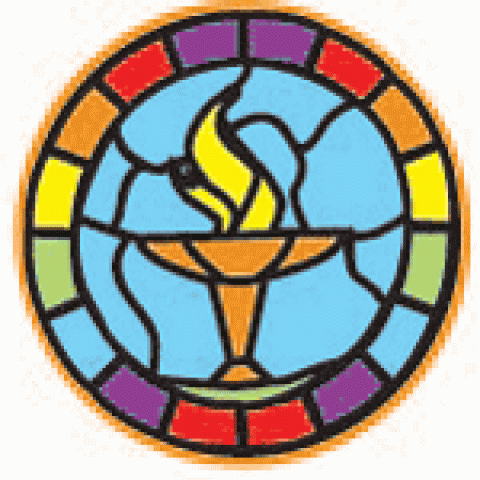
Hans Deutsch, an Austrian artist, first brought together the chalice and the flame as a Unitarian symbol when he was working with the Unitarian Service Committee during World War II. For several years I served as a Regional Volunteer Coordinator for the UUSC in Northern California, which gives me a personal connection to this symbol. Also, The Chalice and The Blade by Riane Eisler pointed out the prominence of the chalice in pre-patriarchal Goddess traditions, one of the ancestral strands I incorporate in my own Paganism. Other Unitarian Universalists see their own particular beliefs and practices in this symbol, making the chalice a unifying image.
Creative ritual is something that is prominent in UU Paganism. My theatrical side appreciates the opportunity to develop unique expressions using a variety of artistic mediums. In Rise Up & Call Her Name, I crafted creative rituals for each session which invite participants to explore their own views of spirituality. Judging from the many groups that have used the course, there is a significant desire among contemporary Unitarian Universalists to fashion meaningful rituals that also honor earth-based traditions.
The thoroughly American philosophical movement known as Transcendentalism has been a part of my spiritual orientation since my high school English classes in Northern Ohio in the early 1960s. The perspectives articulated by these free thinkers for me are natural antecedents to modern UU Paganism. Ralph Waldo Emerson’s comments about the Oversoul had a major impact on me. This concept suggests there is a spiritual presence that provides a web-like structure…an interconnectedness…which, when fully felt, dissolves the illusion of isolation. This is the “sacred circle of life” named in the sixth source of inspiration in the Unitarian Universalist Principles.
Incorporating women honoring religious imagery into both my individual and collective spiritual practices has been a central feature of my UU paganism, which I have been able to successfully share with others throughout the UU Spiritual community. I want to especially honor here the female deity Hecate (also spelled Hekate) because many traditions honor her on August 13th at the Feast of Hecate. I first met the female deity Hecate in 1971 in the book Women’s Mysteries: Ancient and Modern – A Psychological Interpretation of the Feminine Principle as Portrayed in Myth, Story, and Dreams by M. Esther Harding*.* (See my earlier column Honoring the Dark, Part 3)
I also knew Hekate as the Cosmic Soul which reminded me of Emerson’s Oversoul. I consult Hekate when I need guidance. I experience this as my inner voice that speaks the truth accurately. I feel Her as protection allowing me to be my authentic self. I shape my own ways of honoring Her which can be simple, done anytime, anywhere.
Harding, a Jungian Psychologist, also made me aware that Hecate was especially honored at the times of the dark moon. She points out that love and healing are associated with the dark moon. On August 13th, Hecate is honored in Greece with offerings left at crossroads, places symbolizing several possible outcomes, asking Her to control devastating storms. This year, August 13 is a dark moon, making it an especially relevant time for all of us to remember the challenges that are facing Greece economically, a time to ask for Hecate’s assistance.
My spiritual beliefs tell me that what happens in Greece will impact each of our own lives in some way. Those of us who feel the common good is a sacred trust, and who believe in interconnection, social suffering that can be averted is morally wrong. Wealth belongs to those who actively seek to assure the common good.
I am still a UU Pagan, then, because of the outlook expressed in the Purposes and Principles, which include:
- Individual search for truth and meaning
- Intellectual sharing and inquiry
- Emphasis on love, not dogma
- Interconnection and mutual appreciation
I honor this sense of a natural system that is interconnected (our Seventh Principle.) The other Principles inform my personal and social commitments. I use the symbols I choose to help me create: a psychological state of well-being; a philosophical outlook that supports social justice; a theatrically stimulating experience that gives me symbols I can reference; and artistic beauty that is nourishing to me. I also want to count myself as a participant in the spiritually and ethically motivated collective actions for equality, peace and interconnectedness that Unitarian Universalism is known for and that my Paganism features.
Previous Post

July 29, 2015
One Earth
Next Post
August 6, 2015 Tending to Your Joy: Pagan Lessons from Pixar's Inside Out
Browse Our Archives
Select a Category Current Events CUUPS Press Release Interfaith liturgy Media Review podcast Religious Education Seasonal Reflection Spiritual Practice Summary Uncategorized
Select a Month July 2026 June 2026 April 2026 January 2026 December 2025 October 2025 August 2025 July 2025 June 2025 April 2025 March 2025 February 2025 December 2024 November 2024 October 2024 August 2024 July 2024 June 2024 May 2024 April 2024 February 2024 December 2023 November 2023 October 2023 September 2023 August 2023 June 2023 May 2023 April 2023 March 2023 February 2023 January 2023 December 2022 October 2022 September 2022 August 2022 July 2022 June 2022 May 2022 April 2022 March 2022 February 2022 January 2022 December 2021 November 2021 October 2021 September 2021 August 2021 July 2021 June 2021 May 2021 April 2021 March 2021 February 2021 January 2021 December 2020 November 2020 October 2020 September 2020 August 2020 July 2020 June 2020 May 2020 April 2020 March 2020 February 2020 January 2020 December 2019 November 2019 October 2019 September 2019 August 2019 July 2019 June 2019 May 2019 April 2019 March 2019 February 2019 January 2019 December 2018 November 2018 October 2018 September 2018 August 2018 July 2018 June 2018 May 2018 April 2018 March 2018 February 2018 January 2018 December 2017 November 2017 October 2017 September 2017 August 2017 July 2017 June 2017 May 2017 April 2017 March 2017 February 2017 January 2017 December 2016 November 2016 October 2016 September 2016 August 2016 July 2016 June 2016 May 2016 April 2016 March 2016 February 2016 January 2016 December 2015 November 2015 October 2015 September 2015 August 2015 July 2015 June 2015 May 2015 April 2015 March 2015 February 2015 January 2015
Follow Us!
TAKE THE
Religious Wisdom Quiz
Be strong and work, for I am with you. My Spirit remains among you according to what covenant?
Select your answer to see how you score.
The Mosaic covenant The covenant made when Israel came out of Egypt The new covenant The Abrahamic Covenant
Related posts from Nature's Sacred Journey

Stringing Together the “Beads” of New Ideas
Love and Fear in the Age of Pandemic
TRENDING AT PATHEOS Pagan

I was recently chatting with someone on Instagram. She asked me what...

While there are many people who share their results, the end of...

On July 23, I saw Christopher Nolan's The Odyssey which is Homer’s...

As I write this two big events have just finished up. One...

Restoring the Watershed of Divine Love
Perhaps cooperation is not something we manufacture through legislation, ideology, or moral...

Many UUs don’t pray because of bad experiences in a previous religion,...
view all Pagan blogs
Ad-Free & Subscriber Log-In Subscription Support
- About Us
- 2026 Calendar
- Videos
- Podcasts
- Library of World Religions
- Faith In Media Tracker
- Advertise With Us
- Write for Us
- Privacy Policy
- Terms of Service
- Do Not Sell My Data
- Contact Us
- Radiant Digital
- Manage Newsletter Subscriptions
- Unsubscribe From Notifications
- Sitemap
Copyright 2008-2026, Patheos. All rights reserved.
Subscription Support Ad-Free & Subscriber Log-In
Follow Patheos