
BuddhistCatholicContemplativeEvangelicalGeneral ChristianHinduJewishLatter-day SaintMuslimNew VisionsProgressive Christian
Beliefs
- Buddhist
- Catholic
- Contemplative
- Evangelical
- General Christian
- Hindu
- Jewish
- Latter-day Saint
- More Voices
- Muslim
- New Visions
- Pagan
- Progressive Christian
Topics
- Religion News
- Food and Religion
- Sports and Religion
- Religious Art
- Religious Music and Entertainment
- Religious Events
- History and Religion
- Style and Religion
- Politics and Religion
- Women in Religion
- Recreation Outdoors and Religion
- Business Finance and Religion
- Careers Workplace and Religion
- Education and Religion
- Family Parenting and Religion
- Health Fitness and Religion
- Home and Religion
- Relationships and Religion
- Technology and Religion
- Travel and Religion
Columnists
- Buddhist Columnists
- Business Finance and Religion Columnists
- Careers Workplace and Religion Columnists
- Catholic Columnists
- Contemplative Columnists
- Education and Religion Columnists
- Evangelists Columnists
- Family Parenting and Religion Columnists
- General Christian Columnists
- Health Fitness and Religion Columnists
- Hindu Columnists
- History and Religion Columnists
- Home and Religion Columnists
- Jewish Columnists
- More Voices Columnists
- Latter Day Columnists
- Muslim Columnists
- New Visions Columnists
- Nonreligious Columnists
- Pagan Columnists
- Politics and Religion Columnists
- Progressive Columnists
- Recreation Outdoors and Religion Columnists
- Relationships and Religion Columnists
- Religion News Columnists
- Religious Art Columnists
- Religious Events Columnists
- Religious Music and Entertainment Columnists
- Sports and Religion Columnists
- Style and Religion Columnists
- Technology and Religion Columnists
- Travel and Religion Columnists
- Women in Religion Columnists
Resource Library
- 2026 Calendar
- Library of World Religions
- The 100 Most Holy Places on Earth
- Patheos Answers
- Podcasts
- Videos
- Faith Leaders Database
- Anglican Episcopalian
- Bahai
- Baptist
- Buddhism
- Christianity
- Confucianism
- Eastern Orthodoxy
- Hinduism
- Holiness and Pentecostal
- ISKCON
- Islam
- Judaism
- Lutheran
- Methodist
- The Church of Jesus Christ of Latter-day Saints
- New Age
- Paganism
- Presbytarian and Reformed
- Protestantism
- Religion Behind the Scenes
- Roman Catholic
- Scientology
- Shia Islam
- Sikhism
- Sufism
- Sunni Islam
- Taoism
- Zen
- See all religions
Research Tools
 Ad-Free & Subscriber Log-In Subscription Support
Ad-Free & Subscriber Log-In Subscription Support
Follow Patheos 

- Trending:
- Forgiveness
- |
- Marriage
- |
- Consciousness
- |
- Death Penalty
- |
- Election
- |
- Halloween

- Home
- Pagan
- Tending to Your Joy: Pagan Lessons from Pixar's Inside Out
Tending to Your Joy: Pagan Lessons from Pixar's Inside Out
Last updated on: August 6, 2015 at 6:00 am by Alison Leigh Lilly
Tending to Your Joy: Pagan Lessons from Pixar's Inside Out 2015-08-06T06:00:49+00:00 Alison Leigh Lilly
Patheos Explore the world's faith through different perspectives on religion and spirituality! Patheos has the views of the prevalent religions and spiritualities of the world.
Back, back, back in the back of your mind
Are you learning an angry language?
Tell me boy, boy, boy, are you tending to your joy?
– Ani DiFranco, “Back, Back, Back”

Last week, I took my stepkids to see the new Pixar movie, Inside Out, a story about the personified emotions that live inside the mind of an 11-year-old girl named Riley. Spoiler alert: not only was it fun for the whole family — with lots of laughs (pretty much every time Lewis Black had a line) and tears (damn you, Pixar, and your ruthless tugging of my heartstrings) — but it was also a fascinating exploration of what a Pagan might call the “inner landscape,” the wilderness of the soul. From the fey bizarreness of Imagination Land and Dream Production to the perilous realm of Abstract Thinking, the shadowy caverns of the Subconscious, and the vast labyrinthine halls of Long Term Memory (maybe they even lead into the Akashic records?)…
It was particularly interesting to see how each of my stepkids responded to the movie. The youngest (who is ten years old) demanded to know why love wasn’t included as one of the emotions. “Is love just an emotion,” I asked her, “or is it an action, something we choose to do?” After a somewhat skeptical pause, she replied, “No, it’s an emotion!”
Kids. They say the darnedest things. You never know what they’re picking up by osmosis from the rest of society, even without you realizing it.
When I asked them what they thought the movie was trying to say, the littlest piped up again, “That you can’t really appreciate good things like joy, without the bad things, like sadness. You have to have bad things so that the good things stand out more.”
“Really? Where did you learn that?” I asked her. I like to torture my kids with the Socratic method, which has led to some awesome conversations but can also sometimes backfire. This time, I was just too surprised to sound dispassionately curious. The kids could tell that I Had Opinions, and it put them on the defensive.
“I didn’t learn it anywhere, nobody told it to me. It’s just true!” the youngest objected.
There are lots of adults who believe this, too. In fact, there are a lot of Pagans who will use exactly this explanation for why we embrace both darkness and light, both life and death, as essential and sacred aspects of the spiraling cycle of existence. And that’s a fine explanation, as far as it goes…
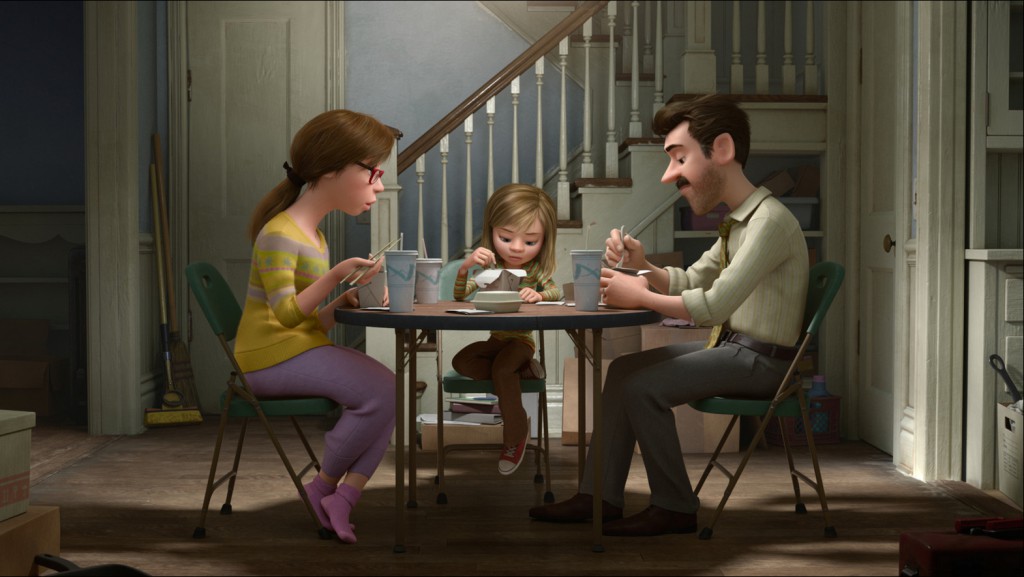 The trouble is, it doesn’t actually get us very far. This kind of dualism doesn’t even get us to the heart of what Inside Out is challenging us to question: whether our classifications of the world — as well as our own inner landscape and its denizens — as good or bad, positive or negative, useful or useless, is maybe missing the point.
We are used to thinking of certain emotions like anger, fear and sadness, as “negative”… and yet, in the wilds of the inner world, each serves a purpose. Inside Out introduces us to Fear as a desire for safety and stability that allows us to assess risks and plan for the future. The emotion of Anger, the movie suggests, is rooted in our desire for fairness and equality, our need to see that the world is both just and beautiful (and doesn’t contain an abomination like broccoli pizza). Even Disgust (who also has something to say about broccoli pizza) has a role to play: helping us to establish and maintain healthy boundaries, to keep out the literal and metaphorical poisons that might harm us.
And what about Sadness? Does it have a purpose? Is it just a “negative” emotion that we should only acknowledge when we need it to help Joy shine more brightly? That’s the question that Inside Outchallenges us to ask ourselves, and it’s what the story of 11-year-old Riley and her emotional upheaval attempts to explore. The belief that “we need negative things so that we can appreciate positive things” is where the story begins, but it’s definitely not where we end up by the closing credits.
My oldest stepdaughter, by now a well-trained diplomat and peacemaker in family arguments conversations, asked me what Ithought the movie was trying to say. “I think the movie is saying that Sadness helps us to connect with others, and it invites others to connect with us.” I told her. “Sadness allowed Riley to be vulnerable and open, and she was also able to be gentle and compassionate with others, to offer them a safe space when they were feeling vulnerable. Joy is fun and uplifting, but she can be kind of relentless, even selfish, when she’s not tempered by this awareness of how fragile we all can be sometimes…”
 Inside Out is not only about discovering the meaningfulness of Sadness, but coming to appreciate the limitations of Joy — why a life (and a society) built around the pursuit of happiness can sometimes lead us astray. Throughout the movie, Joy struggles to lug around an armful of glowing, bowling-ball-sized memories of happy childhood moments, to hold onto them no matter what and protect them from any touch of Sadness (who can’t seem to help wanting to reach out and touch everything). When we become hoarders of happiness — whether these are experiences of earthly joys, or moments of spiritual ecstasy and divine blessing — those experiences can become a burden that keeps us from living a full and adventurous life. Without such experiences, it’s true that we can begin to shut down. But when we obsess over our own happiness as if it were an emotional commodity, something we can acquire, possess or consume, we risk losing our way and cutting ourselves off from the fullness of life in complex relationship with the world around us.
Meaningful, complex relationships require us to nurture complex inner lives, in which a diversity of desires and values can thrive. Another thing I’ve heard a lot of adults (who really should know better) claim is that “you can’t control your emotions.” This is one of those half-truths that can easily become an excuse to get a little lazy in our journey towards self-knowledge. And it’s one that Inside Outgrapples with in a surprisingly nuanced way, considering it’s a kids movie featuring a talking pink elephant-cat-hybrid.
Can you control your emotions? Should you? I winced when, at the beginning of the movie, Riley’s mom asks her to keep smiling because her joyful presence is such a big help as their family struggles with their move to a new city. Warning bells were going off in the parenting part of my brain: *You don’t ask a child to be happy for your sake!*Riley’s Joy, who acts a lot like a loving inner-parent at times, also tries to circumscribe the role of Sadness in Riley’s inner life. Like many of us, Riley has both internal and external forces at work, and her own emotions play a role in keeping each other in check. Later, after Joy and Sadness get sucked away and lost in the wilds of Riley’s inner landscape — leaving only Anger, Fear and Disgust to man the control board at Headquarters — these three remaining emotions frantically try to keep things running until Joy gets back. They try to “do what Joy would do”… and of course, this only leads to one mess after another.

Is this simply Riley trying to “control her emotions” and failing? Is the problem that she isn’t letting her emotions direct her actions, or do they have too much control? What’s really going on here?
Pagans might call this problem “soul fragmentation.” There are numerous practices and traditions that center on the process of retrieving those bits and pieces of ourselves that have gotten lost or forgotten as the result of trauma in our lives. Inside Out is a modern-day story of the shamanic journey into the Otherworld, a journey of both self-recovery and self-discovery.
In this Other-/inner world, we encounter guides and companions that help us along the way and provide us with magical gifts, as well as monsters lurking in the dark… and even mischievous sprites who delight in niggling us with annoying TV ad jingles. A product of our modern mostly-materialist society, Inside Out portrays this world as entirely within a person’s individual mind, but many cultures from around the world have understood that there are no hard-and-fast boundaries between what is “inside” and what is “out.” The inner world and the Otherworld mix and mingle, with only a thin, ever-shifting veil between them. Either way, the journey into the wilds of this inside-out realm serves the same purpose: it is a time when we are tried and tested, when we discover wildly diverse aspects of ourselves and learn what their strengths and limitations really are.
Inside Out even offers us a peek of what might happen if we fail in this endeavor. If you’re one of those folks who likes to sit through a movie’s end credits, you’ll be treated to glimpses “inside” a number of other characters — including the pizzeria hipster chick, the “cool girl” at school, and the angry bus driver. These glimpses are not only funny but shockingly poignant, as they show individuals whose emotions have been reduced to poor copies of each other. The hipster chick’s emotions all roll their eyes along with her Disgust; the bus driver has five versions of Anger at the wheel, all fuming over the traffic. When Joy and Sadness are lost, we see Riley begin to slip down this path as well — her other emotions try to imitate Joy, to make up for that absence. When we lose touch with a part of ourselves, other aspects of the self may step in to try to “play the part.” Perhaps there was a time when that angry bus driver lost touch with his sense of fairness and justice, and so eventually his own joy, disgust and fear were enlisted to compensate. How many of us have done the same, mistaking our self-righteousness or rage for a sense of joy?
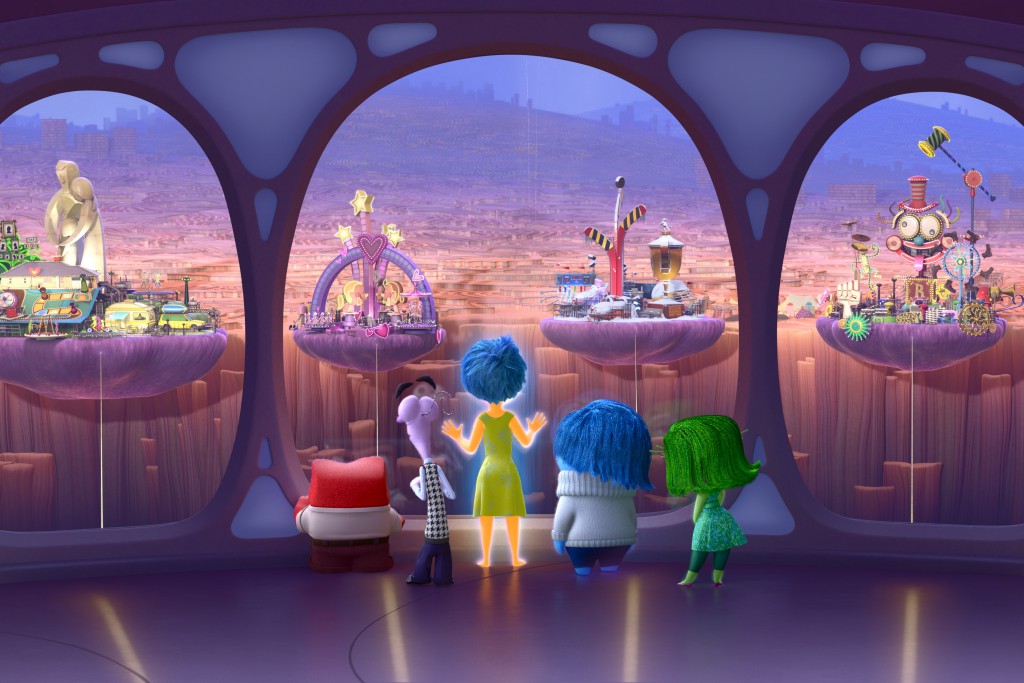
Ultimately, the shamanic journey of soul retrieval is about restoring our integrity, the wholeness of the self. Through this journey into the Otherworld, we find that dynamic balance in which our own complexity and inner diversity can shine. When we lose our sense of joy — or our ability to grieve, or our desire for justice, or our strength to maintain healthy boundaries — then we need to “practice happiness,” as the singer Ani DiFranco puts it, tending to our joy, or our sorrow, or our anger. This isn’t merely trying to exert control over our emotions. It’s about cultivating inner flexibility and creativity. The result of such a journey is a wild and complex inner landscape, in which the many aspects of ourselves continually challenge and temper one another, engaged in an on-going sacred conversation of discovery. May we find ourselves centered and grounded in the harmonies of those many voices.
Photo Credits:
All pictures are screenshots from Inside Out, ©2015 Disney•Pixar. All Rights Reserved.
Alison Leigh Lilly dwells in the lovely, rain-drizzled cityscape of Seattle, where she shares her home with her brilliant and bearded husband, her black cat, two pet frogs, and innumerable cedar trees. Nurturing the earth-rooted, sea-soaked, mist-and-mystic spiritual heritage of her Celtic ancestors, she explores themes of peace, poesis and wilderness through essays, poetry and podcasting. You can learn more about her work on her website at: alisonleighlilly.com
Previous Post

August 3, 2015
Why I am Still a UU Pagan
Browse Our Archives
Select a Category Current Events CUUPS Press Release Interfaith liturgy Media Review podcast Religious Education Seasonal Reflection Spiritual Practice Summary Uncategorized
Select a Month July 2026 June 2026 April 2026 January 2026 December 2025 October 2025 August 2025 July 2025 June 2025 April 2025 March 2025 February 2025 December 2024 November 2024 October 2024 August 2024 July 2024 June 2024 May 2024 April 2024 February 2024 December 2023 November 2023 October 2023 September 2023 August 2023 June 2023 May 2023 April 2023 March 2023 February 2023 January 2023 December 2022 October 2022 September 2022 August 2022 July 2022 June 2022 May 2022 April 2022 March 2022 February 2022 January 2022 December 2021 November 2021 October 2021 September 2021 August 2021 July 2021 June 2021 May 2021 April 2021 March 2021 February 2021 January 2021 December 2020 November 2020 October 2020 September 2020 August 2020 July 2020 June 2020 May 2020 April 2020 March 2020 February 2020 January 2020 December 2019 November 2019 October 2019 September 2019 August 2019 July 2019 June 2019 May 2019 April 2019 March 2019 February 2019 January 2019 December 2018 November 2018 October 2018 September 2018 August 2018 July 2018 June 2018 May 2018 April 2018 March 2018 February 2018 January 2018 December 2017 November 2017 October 2017 September 2017 August 2017 July 2017 June 2017 May 2017 April 2017 March 2017 February 2017 January 2017 December 2016 November 2016 October 2016 September 2016 August 2016 July 2016 June 2016 May 2016 April 2016 March 2016 February 2016 January 2016 December 2015 November 2015 October 2015 September 2015 August 2015 July 2015 June 2015 May 2015 April 2015 March 2015 February 2015 January 2015
Follow Us!
TAKE THE
Religious Wisdom Quiz
At Jesus' crucifixion what did the soldiers place on His head?
Select your answer to see how you score.
Crown of Jewels Crown of Nettles Crown of Thorns Crown of Thistles
Related posts from Nature's Sacred Journey

My Pagan path - a look back into...

Five Things to do When the World Gets...

My story – discovering UU, starting a CUUPs...

Wheel of the Year: Beltane (May Day)
TRENDING AT PATHEOS Pagan

When we talk about Greek religion, we often begin with the dodekatheion—the...

I was recently chatting with someone on Instagram. She asked me what...

While there are many people who share their results, the end of...

On July 23, I saw Christopher Nolan's The Odyssey which is Homer’s...

As I write this two big events have just finished up. One...

Restoring the Watershed of Divine Love
Perhaps cooperation is not something we manufacture through legislation, ideology, or moral...
view all Pagan blogs
Ad-Free & Subscriber Log-In Subscription Support
- About Us
- 2026 Calendar
- Videos
- Podcasts
- Library of World Religions
- Faith In Media Tracker
- Advertise With Us
- Write for Us
- Privacy Policy
- Terms of Service
- Do Not Sell My Data
- Contact Us
- Radiant Digital
- Manage Newsletter Subscriptions
- Unsubscribe From Notifications
- Sitemap
Copyright 2008-2026, Patheos. All rights reserved.
Subscription Support Ad-Free & Subscriber Log-In
Follow Patheos