
BuddhistCatholicContemplativeEvangelicalGeneral ChristianHinduJewishLatter-day SaintMuslimNew VisionsProgressive Christian
Beliefs
- Buddhist
- Catholic
- Contemplative
- Evangelical
- General Christian
- Hindu
- Jewish
- Latter-day Saint
- More Voices
- Muslim
- New Visions
- Pagan
- Progressive Christian
Topics
- Religion News
- Food and Religion
- Sports and Religion
- Religious Art
- Religious Music and Entertainment
- Religious Events
- History and Religion
- Style and Religion
- Politics and Religion
- Women in Religion
- Recreation Outdoors and Religion
- Business Finance and Religion
- Careers Workplace and Religion
- Education and Religion
- Family Parenting and Religion
- Health Fitness and Religion
- Home and Religion
- Relationships and Religion
- Technology and Religion
- Travel and Religion
Columnists
- Buddhist Columnists
- Business Finance and Religion Columnists
- Careers Workplace and Religion Columnists
- Catholic Columnists
- Contemplative Columnists
- Education and Religion Columnists
- Evangelists Columnists
- Family Parenting and Religion Columnists
- General Christian Columnists
- Health Fitness and Religion Columnists
- Hindu Columnists
- History and Religion Columnists
- Home and Religion Columnists
- Jewish Columnists
- More Voices Columnists
- Latter Day Columnists
- Muslim Columnists
- New Visions Columnists
- Nonreligious Columnists
- Pagan Columnists
- Politics and Religion Columnists
- Progressive Columnists
- Recreation Outdoors and Religion Columnists
- Relationships and Religion Columnists
- Religion News Columnists
- Religious Art Columnists
- Religious Events Columnists
- Religious Music and Entertainment Columnists
- Sports and Religion Columnists
- Style and Religion Columnists
- Technology and Religion Columnists
- Travel and Religion Columnists
- Women in Religion Columnists
Resource Library
- 2026 Calendar
- Library of World Religions
- The 100 Most Holy Places on Earth
- Patheos Answers
- Podcasts
- Videos
- Faith Leaders Database
- Anglican Episcopalian
- Bahai
- Baptist
- Buddhism
- Christianity
- Confucianism
- Eastern Orthodoxy
- Hinduism
- Holiness and Pentecostal
- ISKCON
- Islam
- Judaism
- Lutheran
- Methodist
- The Church of Jesus Christ of Latter-day Saints
- New Age
- Paganism
- Presbytarian and Reformed
- Protestantism
- Religion Behind the Scenes
- Roman Catholic
- Scientology
- Shia Islam
- Sikhism
- Sufism
- Sunni Islam
- Taoism
- Zen
- See all religions
Research Tools
 Ad-Free & Subscriber Log-In Subscription Support
Ad-Free & Subscriber Log-In Subscription Support
Follow Patheos 

- Trending:
- Forgiveness
- |
- Marriage
- |
- Consciousness
- |
- Death Penalty
- |
- Election
- |
- Halloween

- Home
- Pagan
- Years, Seasons, Moons, and Weeks: The Holiness of Time
Years, Seasons, Moons, and Weeks: The Holiness of Time
Last updated on: July 15, 2015 at 12:01 am by Rev. Catharine Clarenbach
Years, Seasons, Moons, and Weeks: The Holiness of Time 2015-07-15T00:01:40+00:00 Rev. Catharine Clarenbach
Patheos Explore the world's faith through different perspectives on religion and spirituality! Patheos has the views of the prevalent religions and spiritualities of the world.
In the Wiccan tradition in which I was trained, as in many others, we practice with deep attention to time. Our ceremonies are based on the demands of the season, the needs of the community, and of course, the whim of the ritualists. We write, share, build ceremony, and meditate on the various states each six-week section the solar calendar invites. Time is holy.
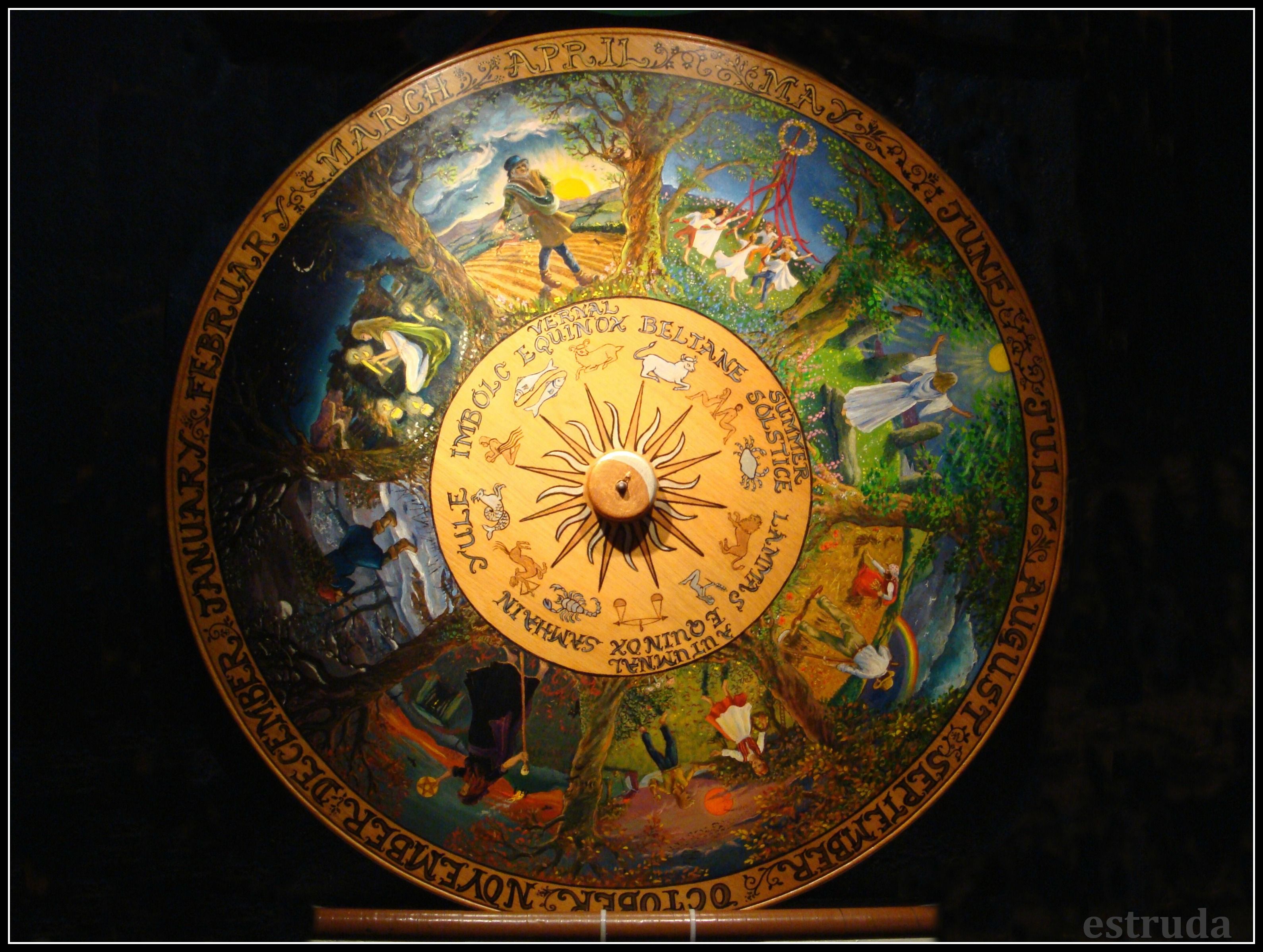
Many of us move through the Labyrinth, that time out of time. Time small, the time we take to trace the labyrinth’s curves, and time great, a lifetime of in and out, back and forth, lessons taught and lessons learned. Time is holy.
Some of us celebrate the esbats, or full moons, and some celebrate both full and new moons. Some follow astrological forms and methods and organize our practice around the spheres’ celestial music. At any time at any places, we may be invited into magic, ritual, song, or simply deep attention to the holiness of a given moment. Time is holy.
Other traditions share the experience of holy time. While they may have greater emphasis on holy space than many Pagans do, even UU’s—cathedrals, synagogues, temples—time is holy too.
In the Roman Catholic tradition in which I was brought up, we had a liturgical calendar. Various colors for different seasons. Various states of mind. Various prayers. Various music. Various shades and contours to the Mass. Time is holy.
Pema Chodron, a powerfully accessible Buddhist teacher, writes about the Pause, perhaps the smallest unit of time we make holy with attention. Just once, or multiple times a day, one may inhabit a pause, a breath, a moment out of the rest of work, play, relaxation. Time, all time, any time, is holy.
There is another tradition that carries a particularly powerful sense of the holiness of time, and that is Judaism. In Judaism, the very first thing Adonai calls holy, or “qadosh,” is the Sabbath, commonly referred to as the Day of Rest. The Day of *shalom—*peace, yes, but also delight and wellbeing.
 Shabbat in Hebrew, Shabbos in Yiddish, is not merely a day to abstain from work. It is a day of rest and delight. Of family and sexuality. Of beauty and tradition. (I must also point out here that in traditional Jewish families there entails a lot of work for women on the day before Shabbat— preparing food for the next day, preparing the house, etc. This additional work, holy as it is, should not be overlooked.)
I do not suggest that non-Jewish UUs, much less those who root ourselves in the Sixth Source, take up the Jewish traditions of Shabbat wholesale. For one thing, most of us lack the depth of understanding and experience to do so well and faithfully. Furthermore, and more deeply, we do enough appropriating as it is.
I do, however, think it is wholesome to create a weekly practice, perhaps around the dinner table, that nurtures our sense of holy time. This weekly time around a meal is more accessible than regular ceremony under the changing moon. I have been separated for two years now from the Stone Circle where I joined others and celebrated those tw’eekly liturgies. I need a reminder that the season, not just the year, is turning by smaller increments than the Eight Holidays. I need a reminder that my work and the life of my family are sacred. This holy time, a time of mirth and reverence, can be the Pause, writ large, the Wheel, writ small.
So what might it be, this attention to holy time?
What grounds you in your particular tradition or practice?
In my life, the altar is the spatial center of my solitary meditations. Song and conscious breathing at my altar are the temporal centers. So for me, part of weekly holy time is dusting and perhaps organizing my altar a bit. Perhaps attending to the candles on a seasonal altar. Perhaps tending the plants in my holy space. Reverent attention. Solitary, reverent attention.

But what about mirth? What about the delight half of the rest and delight/mirth and reverence duo?
That’s where dinner comes in, especially—but not exclusively—if we have children. There may be family favorites, special candles or plates, a special tablecloth. All kinds of things that can bring kids into the experience. Plates they’ve painted and napkins they’ve embroidered depending on their ages. Singing. Hand gestures and games. Blessings. Appreciation of one another and of the food and the plants, animals, people, and systems that have brought it to us. Reminders of the solar season we inhabit or the phase of the moon we are in. There are nearly infinite ways to make a weekly dinner as simple or as festively complex as we’d like.
In my house, honestly, it comes and goes.
We do have special candles. We do have special china. There are foods we may eat for the day, and those foods change for the season. But it comes and goes. I know few people whose observances are perfect, whatever that word might mean for us; we do not have Holy Days of Obligation, after all!
Still, time is holy.
Time is holy, and this is the time we have been given, the time we have, spend, kill, or inhabit.
May we find time to remind ourselves of the sacredness of life, of the holiness of work and of rest, of mirth and of reverence, all bound together in the tapestry of time. So may it be.
Images acquired through Creative Commons.
Previous Post

July 14, 2015
New Moon Chalice Lighting - July 2015
Next Post
July 16, 2015 Gaia Community's Annual Patron
Browse Our Archives
Select a Category Current Events CUUPS Press Release Interfaith liturgy Media Review podcast Religious Education Seasonal Reflection Spiritual Practice Summary Uncategorized
Select a Month July 2026 June 2026 April 2026 January 2026 December 2025 October 2025 August 2025 July 2025 June 2025 April 2025 March 2025 February 2025 December 2024 November 2024 October 2024 August 2024 July 2024 June 2024 May 2024 April 2024 February 2024 December 2023 November 2023 October 2023 September 2023 August 2023 June 2023 May 2023 April 2023 March 2023 February 2023 January 2023 December 2022 October 2022 September 2022 August 2022 July 2022 June 2022 May 2022 April 2022 March 2022 February 2022 January 2022 December 2021 November 2021 October 2021 September 2021 August 2021 July 2021 June 2021 May 2021 April 2021 March 2021 February 2021 January 2021 December 2020 November 2020 October 2020 September 2020 August 2020 July 2020 June 2020 May 2020 April 2020 March 2020 February 2020 January 2020 December 2019 November 2019 October 2019 September 2019 August 2019 July 2019 June 2019 May 2019 April 2019 March 2019 February 2019 January 2019 December 2018 November 2018 October 2018 September 2018 August 2018 July 2018 June 2018 May 2018 April 2018 March 2018 February 2018 January 2018 December 2017 November 2017 October 2017 September 2017 August 2017 July 2017 June 2017 May 2017 April 2017 March 2017 February 2017 January 2017 December 2016 November 2016 October 2016 September 2016 August 2016 July 2016 June 2016 May 2016 April 2016 March 2016 February 2016 January 2016 December 2015 November 2015 October 2015 September 2015 August 2015 July 2015 June 2015 May 2015 April 2015 March 2015 February 2015 January 2015
Follow Us!
TAKE THE
Religious Wisdom Quiz
Who interpreted dreams for a Persian king about goats and rams?
Select your answer to see how you score.
Daniel Obadiah Hosea Joel
Related posts from Nature's Sacred Journey

My Pagan path - a look back into...

Celebrate our blessings and then take a stand

Spring is coming! Emerge from your shell and...

A clear concise intention is vital for spells...
TRENDING AT PATHEOS Pagan

When we talk about Greek religion, we often begin with the dodekatheion—the...

I was recently chatting with someone on Instagram. She asked me what...

While there are many people who share their results, the end of...

On July 23, I saw Christopher Nolan's The Odyssey which is Homer’s...

As I write this two big events have just finished up. One...

Restoring the Watershed of Divine Love
Perhaps cooperation is not something we manufacture through legislation, ideology, or moral...
view all Pagan blogs
Ad-Free & Subscriber Log-In Subscription Support
- About Us
- 2026 Calendar
- Videos
- Podcasts
- Library of World Religions
- Faith In Media Tracker
- Advertise With Us
- Write for Us
- Privacy Policy
- Terms of Service
- Do Not Sell My Data
- Contact Us
- Radiant Digital
- Manage Newsletter Subscriptions
- Unsubscribe From Notifications
- Sitemap
Copyright 2008-2026, Patheos. All rights reserved.
Subscription Support Ad-Free & Subscriber Log-In
Follow Patheos