
BuddhistCatholicContemplativeEvangelicalGeneral ChristianHinduJewishLatter-day SaintMuslimNew VisionsProgressive Christian
Beliefs
- Buddhist
- Catholic
- Contemplative
- Evangelical
- General Christian
- Hindu
- Jewish
- Latter-day Saint
- More Voices
- Muslim
- New Visions
- Pagan
- Progressive Christian
Topics
- Religion News
- Food and Religion
- Sports and Religion
- Religious Art
- Religious Music and Entertainment
- Religious Events
- History and Religion
- Style and Religion
- Politics and Religion
- Women in Religion
- Recreation Outdoors and Religion
- Business Finance and Religion
- Careers Workplace and Religion
- Education and Religion
- Family Parenting and Religion
- Health Fitness and Religion
- Home and Religion
- Relationships and Religion
- Technology and Religion
- Travel and Religion
Columnists
- Buddhist Columnists
- Business Finance and Religion Columnists
- Careers Workplace and Religion Columnists
- Catholic Columnists
- Contemplative Columnists
- Education and Religion Columnists
- Evangelists Columnists
- Family Parenting and Religion Columnists
- General Christian Columnists
- Health Fitness and Religion Columnists
- Hindu Columnists
- History and Religion Columnists
- Home and Religion Columnists
- Jewish Columnists
- More Voices Columnists
- Latter Day Columnists
- Muslim Columnists
- New Visions Columnists
- Nonreligious Columnists
- Pagan Columnists
- Politics and Religion Columnists
- Progressive Columnists
- Recreation Outdoors and Religion Columnists
- Relationships and Religion Columnists
- Religion News Columnists
- Religious Art Columnists
- Religious Events Columnists
- Religious Music and Entertainment Columnists
- Sports and Religion Columnists
- Style and Religion Columnists
- Technology and Religion Columnists
- Travel and Religion Columnists
- Women in Religion Columnists
Resource Library
- 2026 Calendar
- Library of World Religions
- The 100 Most Holy Places on Earth
- Patheos Answers
- Podcasts
- Videos
- Faith Leaders Database
- Anglican Episcopalian
- Bahai
- Baptist
- Buddhism
- Christianity
- Confucianism
- Eastern Orthodoxy
- Hinduism
- Holiness and Pentecostal
- ISKCON
- Islam
- Judaism
- Lutheran
- Methodist
- The Church of Jesus Christ of Latter-day Saints
- New Age
- Paganism
- Presbytarian and Reformed
- Protestantism
- Religion Behind the Scenes
- Roman Catholic
- Scientology
- Shia Islam
- Sikhism
- Sufism
- Sunni Islam
- Taoism
- Zen
- See all religions
Research Tools
 Ad-Free & Subscriber Log-In Subscription Support
Ad-Free & Subscriber Log-In Subscription Support
Follow Patheos 

- Trending:
- Forgiveness
- |
- Marriage
- |
- Consciousness
- |
- Death Penalty
- |
- Election
- |
- Halloween

- Home
- Pagan
- Summer Solstice – Season of Passion and Social Justice
Summer Solstice – Season of Passion and Social Justice
Last updated on: July 6, 2015 at 5:04 am by Liz Fisher
Summer Solstice – Season of Passion and Social Justice 2015-07-06T05:04:16+00:00 Liz Fisher
Patheos Explore the world's faith through different perspectives on religion and spirituality! Patheos has the views of the prevalent religions and spiritualities of the world.
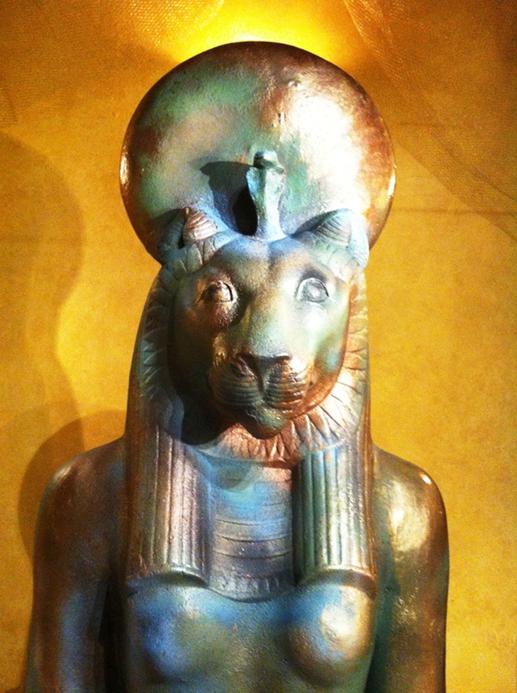
Sekhmet head – courtesy of Karen Tate
This is the season of fire, both in its transformative and destructive forms. Sekhmet, the Sun Goddess has something to teach us at this most important sacred season. Horrible and celebratory events have coincided. How do we make sense of what’s going on?
Sekhmet is an Egyptian goddess of the sun and one who is appropriate to honor at this time both because of Summer Solstice and because of the happenings in the world.
I have learned to appreciate Sekhmet by listening to Karen Tate, author, ritualist, scholar, and host of the entertaining radio show Voices of The Sacred Feminine on blog talk radio. Karen feels that not only is she a powerful presence, Sekhmet shows us how to claim our own confidence. She is that energy and power down deep inside that we can call upon when we must stand up and be counted, speak out, make things happen. In these times it is important for us to find our voices and to raise them even if we feel that we are in the minority because of our spiritual beliefs; or that we will be excluded because of our passion for equal treatment, compassion, and the demand that a diverse society be supported.
Social Justice activism and advocacy is an important Unitarian Universalist tradition and current practice. As UU pagans we weave our spirituality with our concern for social justice. We hold up the Female Divine and the Male Divine in our spiritual practices within the Unitarian Universalist Association where the beliefs of both liberal monotheistic traditions and ethical humanistic atheism are abundant. Yet we have found common ground. How do we bridge to monotheistic religions and secular ones that hold the same social justice values that we do? How do we bridge to pagan traditions that feel at odds with Christian traditions, even progressive ones, because of their theology? There is an opportunity here.
The last three weeks have seen many events that make this a season of great transformational energies in the world. A horrendous massacre of nine African American socially engaged citizens in a church in South Carolina by a white racist terrorist was followed by an outpouring of advocacy for love and forgiveness on the part of those related to the victims. At the same time, calls for removing the Confederate Flag which historically represents those advocating slavery were equally forceful.
During his eulogy honoring the slain Rev. Clementa Pinckney, President Obama clearly outlined the racism that still exists in the United States. He also acknowledged the Mother Emmanuel church was an important institution: “Not just for blacks, not just for Christians, but for every American who cares about the steady expansion of human rights and human dignity in this country; a foundation stone for liberty and justice for all.”
On June 26, the same day as the service was held, the Supreme Court announced its decision to legalize marriage regardless of gender, reasserted that love is the basis of this sacred union. Commenting on the marriage ruling, President Obama said: “This decision affirms what millions of Americans already believe in our hearts. When all Americans are treated as people, we are all more free.”
On June 27, a flag that is the emblem of the slave-holding South is removed from a monument of South Carolina Statehouse grounds by an African American woman, Bree Newsome, who climbed the flag pole. She does her action “in the name of God” and quotes the Bible. In an interview later, she also claims affinity with those who are not Christian who protest racism because of their ethical values.
In developing Rise Up and Call Her Name: A Woman-honoring Journey into Global Earth-based Spiritualities I collaborated with several African American women. The title is derived from a ritual written by Adele Smith an African American UU minister to honor ancestors who fought for freedom for African Americans. We then go on to honor women of all races who fought for racial and sexual equality and ones who honor the divine feminine. By dialoging with African Americans committed to honoring Jesus as well as ones who are agnostic or atheistic but who appreciate African American cultural contributions, we found ways for overcoming historical prejudices based on theologies that are exclusive of one another.
In the Rise Up course Ancestral Outraged Mother is introduced. Joanne Braxton, Distinguished Professor of American Studies at the College of William and Mary and a minister, believes the ancestral figure most common in the world of contemporary black women writers is an outraged mother. This ancestral mother embodies the values of sacrifice, nurturance, and personal courage. She employs reserves of spiritual strength while she protects her children as she fights for justice for the community. Prof. Braxton feels the great African American female writers – including Maya Angelou, Toni Morrison and Alice Walker – all represent this maternal ancestor in their works. I couldn’t help but think of Bree Newsome and the African American women who supported her action. They were demonstrating the strength and commitment of black women and they were outraged.
In my study of the diverse African American religious traditions, social history and cultural movements, I see the earth-honoring, pantheistic traditions of Africa being carried in the African diaspora and continuing to influence African American religious expression as well as the wider culture. As liberal religious pagans, we can create bridges cross-culturally by focusing on values while never abandoning our spiritual beliefs and practices. I have found numerous openings where we can form understandings that will lead to working together across racial and religious divides.
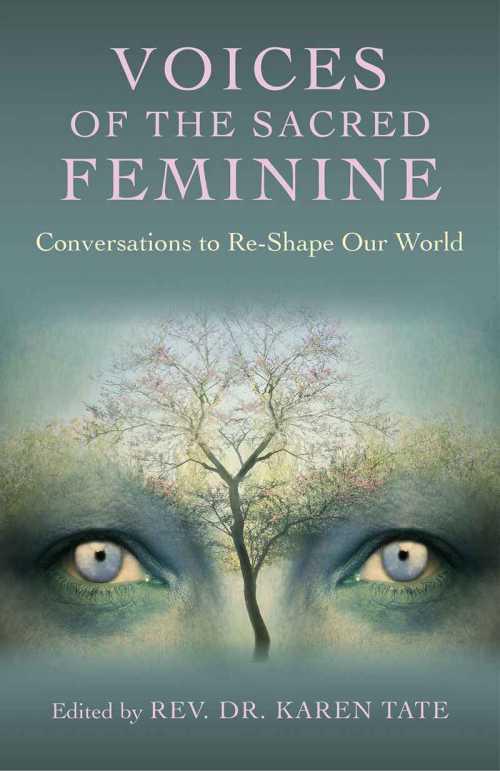
Voices of the Sacred Feminine (cover)
We can also benefit from bridging to other pagans who care about working against racism and sexism. Karen Tate is a leader in this regard. She is tenacious in recruiting provocative and thoughtful people to interview on her radio show. Recently she edited a book of forty essays by people she interviewed entitled Voices of the Sacred Feminine: Conversations to Re-Shape Our World. Rev. Shirley Ranck and myself have essays in this book that deal with material we included in our UU curricula Cakes for the Queen of Heaven and Rise Up and Call Her Name. Karen has spoken numerous times to Unitarian Universalist groups. Her books are great sources of ritual ideas, well researched information and inspiring wisdom.
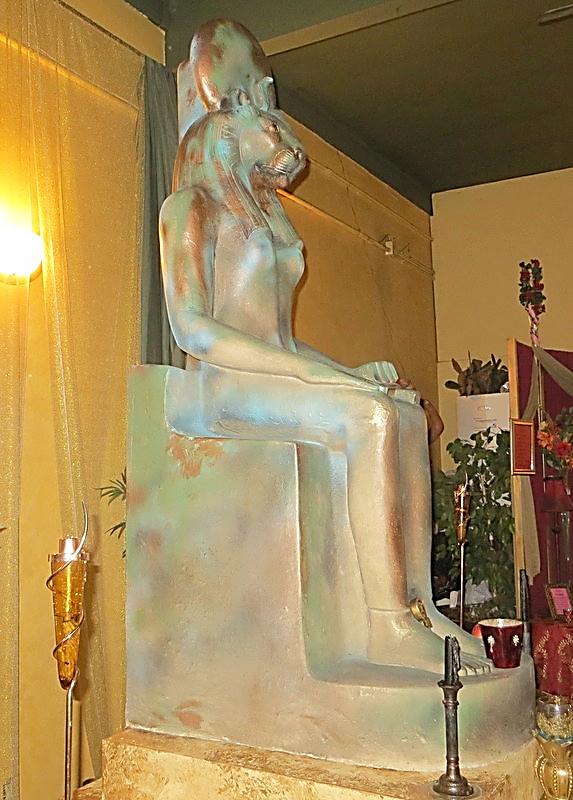
Sekhmet statue in Temple – courtesy of Karen Tate
She has loaned her magnificent icon of Sekhmet that is over 15 feet high and resides in the Goddess Temple and Museum of Orange County, California where Ava Park, founder of the Temple, is the presiding priestess. I had the opportunity to spend time in this Temple with Sekhmet and could feel her protection, empowerment, and her encouragement to persevere and to carry the fire of determination in my own life. If you have the opportunity, I encourage you to visit the Temple and Museum which is both gorgeous and informative. You will not be disappointed. Ava Park has combined in the gatherings she hosts at the Temple, in the educational exhibits she offers which are now becoming a museum, and in her services both beautiful rituals and programs on important social perspectives. The upcoming ecofeminist conference at the Temple, to be held on July 25- 26, is a perfect example of this. For information about both of these women who are doing inspiring and important work check their websites.
If we connect across the divides and keep the Conversations going, we are much stronger, feel more supported and are able to open our hearts to the larger truths of peace, love and justice that we all seek.
Previous Post

June 26, 2015
About General Assembly and CUUPS
Next Post
July 8, 2015 In Support of our own: understanding Unitarian Universalist Idealization
Browse Our Archives
Select a Category Current Events CUUPS Press Release Interfaith liturgy Media Review podcast Religious Education Seasonal Reflection Spiritual Practice Summary Uncategorized
Select a Month July 2026 June 2026 April 2026 January 2026 December 2025 October 2025 August 2025 July 2025 June 2025 April 2025 March 2025 February 2025 December 2024 November 2024 October 2024 August 2024 July 2024 June 2024 May 2024 April 2024 February 2024 December 2023 November 2023 October 2023 September 2023 August 2023 June 2023 May 2023 April 2023 March 2023 February 2023 January 2023 December 2022 October 2022 September 2022 August 2022 July 2022 June 2022 May 2022 April 2022 March 2022 February 2022 January 2022 December 2021 November 2021 October 2021 September 2021 August 2021 July 2021 June 2021 May 2021 April 2021 March 2021 February 2021 January 2021 December 2020 November 2020 October 2020 September 2020 August 2020 July 2020 June 2020 May 2020 April 2020 March 2020 February 2020 January 2020 December 2019 November 2019 October 2019 September 2019 August 2019 July 2019 June 2019 May 2019 April 2019 March 2019 February 2019 January 2019 December 2018 November 2018 October 2018 September 2018 August 2018 July 2018 June 2018 May 2018 April 2018 March 2018 February 2018 January 2018 December 2017 November 2017 October 2017 September 2017 August 2017 July 2017 June 2017 May 2017 April 2017 March 2017 February 2017 January 2017 December 2016 November 2016 October 2016 September 2016 August 2016 July 2016 June 2016 May 2016 April 2016 March 2016 February 2016 January 2016 December 2015 November 2015 October 2015 September 2015 August 2015 July 2015 June 2015 May 2015 April 2015 March 2015 February 2015 January 2015
Follow Us!
TAKE THE
Religious Wisdom Quiz
Which New Testament book has the most Old Testament quotes?
Select your answer to see how you score.
Hebrews Romans Matthew Revelation
Related posts from Nature's Sacred Journey

Stringing Together the “Beads” of New Ideas

Love and Fear in the Age of Pandemic
TRENDING AT PATHEOS Pagan

When we talk about Greek religion, we often begin with the dodekatheion—the...

I was recently chatting with someone on Instagram. She asked me what...

While there are many people who share their results, the end of...

On July 23, I saw Christopher Nolan's The Odyssey which is Homer’s...

As I write this two big events have just finished up. One...

Restoring the Watershed of Divine Love
Perhaps cooperation is not something we manufacture through legislation, ideology, or moral...
view all Pagan blogs
Ad-Free & Subscriber Log-In Subscription Support
- About Us
- 2026 Calendar
- Videos
- Podcasts
- Library of World Religions
- Faith In Media Tracker
- Advertise With Us
- Write for Us
- Privacy Policy
- Terms of Service
- Do Not Sell My Data
- Contact Us
- Radiant Digital
- Manage Newsletter Subscriptions
- Unsubscribe From Notifications
- Sitemap
Copyright 2008-2026, Patheos. All rights reserved.
Subscription Support Ad-Free & Subscriber Log-In
Follow Patheos