
BuddhistCatholicContemplativeEvangelicalGeneral ChristianHinduJewishLatter-day SaintMuslimNew VisionsProgressive Christian
Beliefs
- Buddhist
- Catholic
- Contemplative
- Evangelical
- General Christian
- Hindu
- Jewish
- Latter-day Saint
- More Voices
- Muslim
- New Visions
- Pagan
- Progressive Christian
Topics
- Religion News
- Food and Religion
- Sports and Religion
- Religious Art
- Religious Music and Entertainment
- Religious Events
- History and Religion
- Style and Religion
- Politics and Religion
- Women in Religion
- Recreation Outdoors and Religion
- Business Finance and Religion
- Careers Workplace and Religion
- Education and Religion
- Family Parenting and Religion
- Health Fitness and Religion
- Home and Religion
- Relationships and Religion
- Technology and Religion
- Travel and Religion
Columnists
- Buddhist Columnists
- Business Finance and Religion Columnists
- Careers Workplace and Religion Columnists
- Catholic Columnists
- Contemplative Columnists
- Education and Religion Columnists
- Evangelists Columnists
- Family Parenting and Religion Columnists
- General Christian Columnists
- Health Fitness and Religion Columnists
- Hindu Columnists
- History and Religion Columnists
- Home and Religion Columnists
- Jewish Columnists
- More Voices Columnists
- Latter Day Columnists
- Muslim Columnists
- New Visions Columnists
- Nonreligious Columnists
- Pagan Columnists
- Politics and Religion Columnists
- Progressive Columnists
- Recreation Outdoors and Religion Columnists
- Relationships and Religion Columnists
- Religion News Columnists
- Religious Art Columnists
- Religious Events Columnists
- Religious Music and Entertainment Columnists
- Sports and Religion Columnists
- Style and Religion Columnists
- Technology and Religion Columnists
- Travel and Religion Columnists
- Women in Religion Columnists
Resource Library
- 2026 Calendar
- Library of World Religions
- The 100 Most Holy Places on Earth
- Patheos Answers
- Podcasts
- Videos
- Faith Leaders Database
- Anglican Episcopalian
- Bahai
- Baptist
- Buddhism
- Christianity
- Confucianism
- Eastern Orthodoxy
- Hinduism
- Holiness and Pentecostal
- ISKCON
- Islam
- Judaism
- Lutheran
- Methodist
- The Church of Jesus Christ of Latter-day Saints
- New Age
- Paganism
- Presbytarian and Reformed
- Protestantism
- Religion Behind the Scenes
- Roman Catholic
- Scientology
- Shia Islam
- Sikhism
- Sufism
- Sunni Islam
- Taoism
- Zen
- See all religions
Research Tools
 Ad-Free & Subscriber Log-In Subscription Support
Ad-Free & Subscriber Log-In Subscription Support
Follow Patheos 

- Trending:
- Forgiveness
- |
- Marriage
- |
- Consciousness
- |
- Death Penalty
- |
- Election
- |
- Halloween

- Home
- Pagan
- Retreats, Consensus, and Death and Dying
Retreats, Consensus, and Death and Dying
Last updated on: July 24, 2015 at 5:00 am by Maggie Beaumont
Retreats, Consensus, and Death and Dying 2015-07-24T05:00:55+00:00 Maggie Beaumont
Patheos Explore the world's faith through different perspectives on religion and spirituality! Patheos has the views of the prevalent religions and spiritualities of the world.
The Witch bids me leave my desk and curl up in the comfy chair to talk to you just now.
She reminds me that I’m barely home from a month of too much travel. She wonders what I think I should tell you – and whether that’s the same as what I want to say?
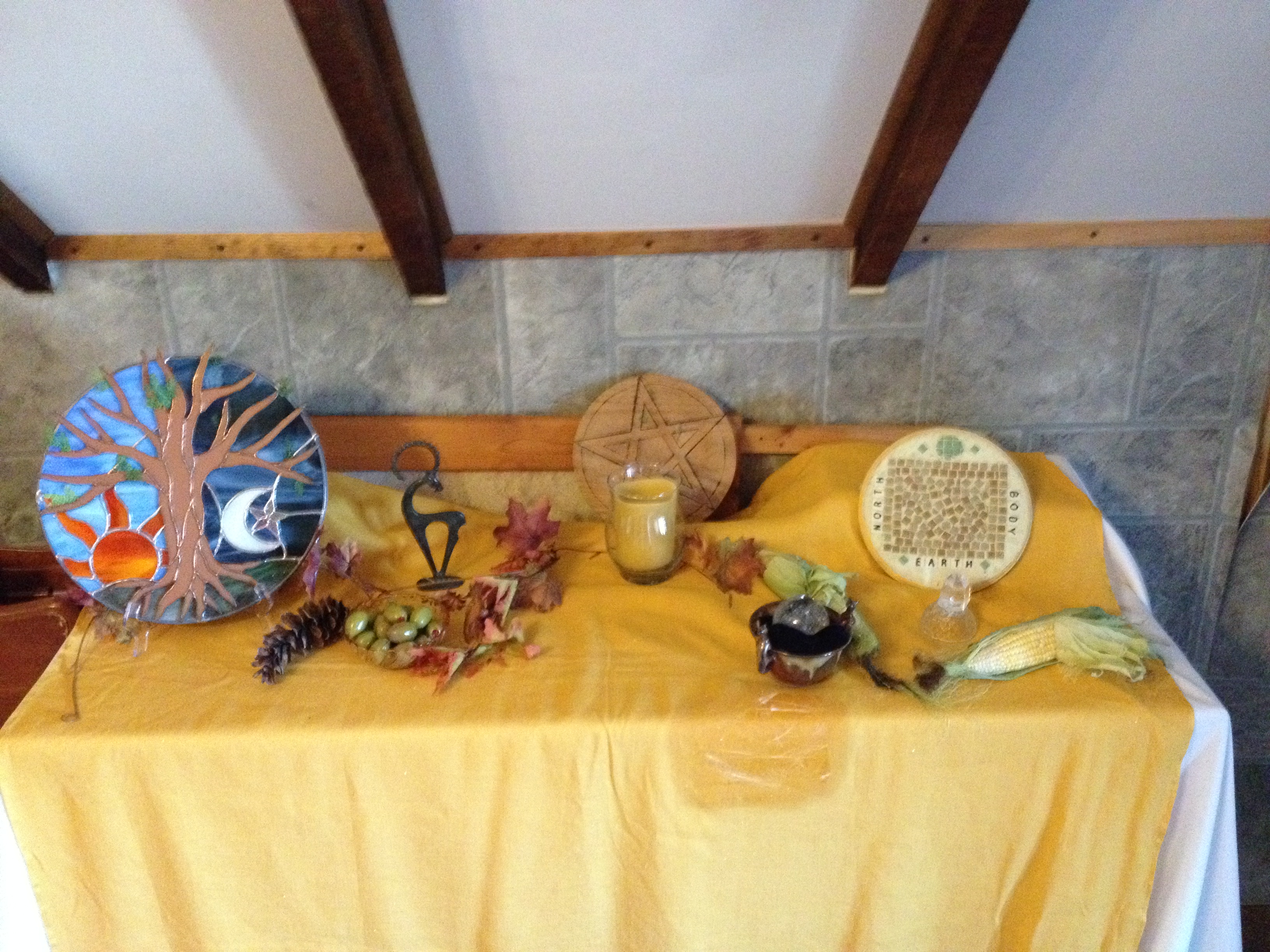
Earth altar, Ostara, coven ritual (photo by Maggie Beaumont)
Just days after the deepest retreat of my summer (deep magic and personal practice with almost 60 of my once-a-year best friends), I’m still buzzing with the joy of the work, the depth of the work, the self-reflection the work has brought to me. Not yet quite back into my mundane life, I spent last night doing chaplaincy at the hospital.
We used to say that the ‘personal’ is ‘political.’ From my perspective today, the ‘magickal’ is ‘medical,’ and vice versa.
Our work in retreat this year was around personal autonomy; questions of ‘us’ and ‘them,’ working with our own racism, ageism, sexism, heterosexism, cissexism, ableism, classism; setting boundaries; speaking up for ourselves; being betrayed and being the betrayer; claiming our own power; dealing with gossip, recognizing our human imperfections, learning and growing in community. It was an extraordinary week, full of painful lows and amazing highs.
My work in the hospital setting is also focused on personal autonomy, helping patients work through the process of setting boundaries, supporting patients in speaking up for themselves and supporting families in speaking up for their loved ones; making choices, claiming what power remains to us, recognizing our bodies’ limitations. It was a night full of intense, deeply personal conversations about what would probably happen next, and how to cope with that. Sadness and acceptance in equal measure, along with planning for the future.
In both settings, any question may have dozens of ‘sides.’ What feels like strong challenge to one can feel like painful betrayal to another, like wimping out to a third, like ‘nothing’s happening’ to a fourth. When we ask Divinity to speak through us, we may hear different things in Divinity’s words. When we ask the doctors for medical or surgical solutions, we also may hear different things. In both cases, what we think we want may simply not be possible; what we ask for, and receive, may turn out to have hidden consequences.
So much of what I do these days involves being a bridge between two distinct places. I’m a Unitarian Universalist, devoted to fairness, egalitarian process, democratic structure and governance, rational consideration. I’m a Witch, devoted to personal responsibility, consensus process, spiritual insight. I’ve been told (more than a few times) that these ideals are in conflict, but most of the time I find they uphold each other and give depth to my ability to be in each community.
Consensus process is difficult to do well, but hugely satisfying when we get it right. The chance for a minority voice to be fully heard is huge; the distinction between ‘it’s not perfect, but I support this choice’ and ‘I disagree and won’t go along’ is huge – and can include 6 or 8 stops along the way – and community is empowered in a different way than in ‘majority rule’ situations. Consensus process often takes longer than either-or voting, but sometimes not much longer. In a setting where there are many viewpoints, consensus process can be a fairer way to distribute power than, for easy example, the elimination tournament that is the modern election process in the US today.
In the hospital setting, medical personnel discuss what is possible for the patient, what is useful and helpful, what guidelines recommend (if guidelines for this situation exist). They don’t vote; sometimes one doctor is the decision maker, after collecting as much input as necessary from others on the team, or sometimes a team reaches consensus. Then they bring their proposals about treatment to the patient. When the patient cannot communicate, the doctors meet with the family instead.
The doctors seek to provide the best care for the patient, consistent with what can be known or deduced about what the patient would want. In the absence of an Advance Directive, that means sitting down with the family. In the absence of a Designated Health-Care Proxy (that is, a named decision-maker who knows what the patient wants and has the patient’s authority to have the final ‘say’), that means sitting down with as many family members as want to participate, especially if they are all of e al legal standing as next-of-kin.
The doctors explain what they know about the patient’s condition, the likely prognosis, and what can be done that might change the prognosis, prolong life, or improve quality of life, or (rarely) all three. The family asks questions, offers insights about what the patient would want. Family members disagree about what the patient would want. They disagree about what they personally want for the patient. One wants the patient to live as long as possible no matter what it takes. One wants the patient to be comfortable with no pain, no matter what it takes. When there’s no clear decision maker, consensus process is the best we can do. (Usually no one in the family is skilled at reaching consensus).
Often the family members have no clear idea what side effects might occur if the doctors just did what has been asked. The doctors explain how each possible choice might play out. The family discusses, vents, asks the same questions again and again. This is never an easy time; even when the patient is very old, even when the patient has been clear with the family, this is never an easy time.
In the meeting, the chaplain breathes slowly, consciously radiating calm and peace. Sometimes that’s all there is to do.
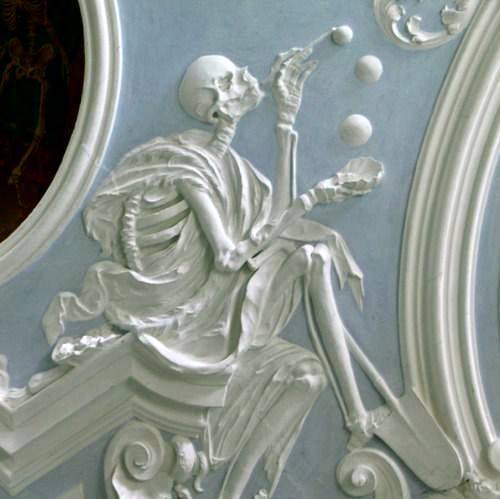
ceiling detail at St. Michael Benedictine, a former monastery now a city hospital in Bamberg, Germany (photo supplied by Angie Buchanan)
The Witch says I’m speaking in generalities and have clearly not thought enough about what I want to say to you today.
I pause, reflect, light a candle, make a cup of tea.
The Witch is right. Some of what’s here tonight is that I don’t want to say too much. A lot of what I don’t want to say is confidential – patient autonomy includes control over what hospital personnel can reveal (not much), though some of those personal details are much on my mind at the moment. Even though the details are different in every family meeting, and even though the issues and challenges are often the same. Tonight this work is still a little raw.
What I really want to tell you is:
- Have an advance directive.
- Have the conversation with your family members about what you would want if you can’t be asked.
- Have the conversation with your family about what your actual condition is, your real prognosis, what you and your doctor expect for the future.
- You might also consider having that conversation with your pastor, your Pagan leadership, your grovemates.
And the Witch reminds me: Prayer helps.
I want to unpack that last a little bit. Many of my UU-rationalist friends object to prayer on principle; many of my Pagan friends object to prayer but do spellwork or journeying or conversations with Deity instead.
As a chaplain, my job is to let the patient lead. If the patient wants to discuss, we discuss. If the patient wants to ramble on, expressing what’s on their mind until enough has been vented to allow them to sleep, I’m learning to listen deeply and allow their process to go where it will.
If the patient wants prayer, my job is to pray authentically to The Divine as I understand The Divine, using language that is adequately comfortable for both the patient and me, even when our spiritual and religious traditions are sharply different. Sometimes, my job can even be to pray silently, in my own fashion, while the patient and family members pray silently in theirs.
Once in awhile a young medical professional will ask if I really think prayer has any effect. I tell them it does; at the very least, praying calms the patient or family member who asks for prayer (and yes, prayer can also upset the patient who doesn’t want it). At the very most, it appears to me that prayer can set an intention out into the universe like an anchor, holding the vessel pointing into the waves for the smoothest ride available – or, if you prefer, directly invoking The Divine to make the waves gentler.
The Witch asks me to look into the candle flame awhile longer and tell you what is present for me just now.
Just now I am grateful. I am grateful for this life I have been living, and for the lives my patients have led so far. I am grateful for the training I have received and for the ability to synthesize new abilities from training in different, apparently-unrelated fields. I am grateful for trust and trustworthiness.
And I am grateful for Principles to live by:
Work to limit the harm I do and accept responsibility for it.
Honor the inherent worth and dignity of every being.
Seek justice, equity and compassion in all my relationships.
Experience a free and responsible search for meaning.
Honor the interdependent wonder of everything.
Don’t coddle weakness.
Say what I mean, mean what I say, and keep my promises.
The Witch wants you to notice that some of these are UU, and some are not. This is as it should be.
The Witch wants you to notice that Death is natural, and will come to all of us – even me, even you.
But: nothing about dying-in-hospital is natural unless the patient has communicated what the patient wants. The Witch wants me to tell you, exhort you, beg you: Have the conversation. Designate a Health-Care proxy. Write and sign an Advance Directive. You can always tear it up if it’s never needed. You can always write a new one as things change. But don’t leave it up to a midnight meeting over cold coffee in a conference room with crying family members. Your family, if it’s ever needed, will thank you for it.
Blessed Be.
Previous Post

July 24, 2015
The Give and Take of Lammas
Next Post

July 27, 2015 Community vs. Spirituality: Why Does it Feel Like a Battle?
Browse Our Archives
Select a Category Current Events CUUPS Press Release Interfaith liturgy Media Review podcast Religious Education Seasonal Reflection Spiritual Practice Summary Uncategorized
Select a Month July 2026 June 2026 April 2026 January 2026 December 2025 October 2025 August 2025 July 2025 June 2025 April 2025 March 2025 February 2025 December 2024 November 2024 October 2024 August 2024 July 2024 June 2024 May 2024 April 2024 February 2024 December 2023 November 2023 October 2023 September 2023 August 2023 June 2023 May 2023 April 2023 March 2023 February 2023 January 2023 December 2022 October 2022 September 2022 August 2022 July 2022 June 2022 May 2022 April 2022 March 2022 February 2022 January 2022 December 2021 November 2021 October 2021 September 2021 August 2021 July 2021 June 2021 May 2021 April 2021 March 2021 February 2021 January 2021 December 2020 November 2020 October 2020 September 2020 August 2020 July 2020 June 2020 May 2020 April 2020 March 2020 February 2020 January 2020 December 2019 November 2019 October 2019 September 2019 August 2019 July 2019 June 2019 May 2019 April 2019 March 2019 February 2019 January 2019 December 2018 November 2018 October 2018 September 2018 August 2018 July 2018 June 2018 May 2018 April 2018 March 2018 February 2018 January 2018 December 2017 November 2017 October 2017 September 2017 August 2017 July 2017 June 2017 May 2017 April 2017 March 2017 February 2017 January 2017 December 2016 November 2016 October 2016 September 2016 August 2016 July 2016 June 2016 May 2016 April 2016 March 2016 February 2016 January 2016 December 2015 November 2015 October 2015 September 2015 August 2015 July 2015 June 2015 May 2015 April 2015 March 2015 February 2015 January 2015
Follow Us!
TAKE THE
Religious Wisdom Quiz
What happened to Lot’s wife when she looked back at Sodom?
Select your answer to see how you score.
She turned into a pillar of salt She lost her voice She disappeared She was blinded
Related posts from Nature's Sacred Journey

My Pagan path - a look back into...

Celebrate our blessings and then take a stand

Spring is coming! Emerge from your shell and...

A clear concise intention is vital for spells...
TRENDING AT PATHEOS Pagan

When we talk about Greek religion, we often begin with the dodekatheion—the...

I was recently chatting with someone on Instagram. She asked me what...

While there are many people who share their results, the end of...

On July 23, I saw Christopher Nolan's The Odyssey which is Homer’s...

As I write this two big events have just finished up. One...

Restoring the Watershed of Divine Love
Perhaps cooperation is not something we manufacture through legislation, ideology, or moral...
view all Pagan blogs
Ad-Free & Subscriber Log-In Subscription Support
- About Us
- 2026 Calendar
- Videos
- Podcasts
- Library of World Religions
- Faith In Media Tracker
- Advertise With Us
- Write for Us
- Privacy Policy
- Terms of Service
- Do Not Sell My Data
- Contact Us
- Radiant Digital
- Manage Newsletter Subscriptions
- Unsubscribe From Notifications
- Sitemap
Copyright 2008-2026, Patheos. All rights reserved.
Subscription Support Ad-Free & Subscriber Log-In
Follow Patheos