
BuddhistCatholicContemplativeEvangelicalGeneral ChristianHinduJewishLatter-day SaintMuslimNew VisionsProgressive Christian
Beliefs
- Buddhist
- Catholic
- Contemplative
- Evangelical
- General Christian
- Hindu
- Jewish
- Latter-day Saint
- More Voices
- Muslim
- New Visions
- Pagan
- Progressive Christian
Topics
- Religion News
- Food and Religion
- Sports and Religion
- Religious Art
- Religious Music and Entertainment
- Religious Events
- History and Religion
- Style and Religion
- Politics and Religion
- Women in Religion
- Recreation Outdoors and Religion
- Business Finance and Religion
- Careers Workplace and Religion
- Education and Religion
- Family Parenting and Religion
- Health Fitness and Religion
- Home and Religion
- Relationships and Religion
- Technology and Religion
- Travel and Religion
Columnists
- Buddhist Columnists
- Business Finance and Religion Columnists
- Careers Workplace and Religion Columnists
- Catholic Columnists
- Contemplative Columnists
- Education and Religion Columnists
- Evangelists Columnists
- Family Parenting and Religion Columnists
- General Christian Columnists
- Health Fitness and Religion Columnists
- Hindu Columnists
- History and Religion Columnists
- Home and Religion Columnists
- Jewish Columnists
- More Voices Columnists
- Latter Day Columnists
- Muslim Columnists
- New Visions Columnists
- Nonreligious Columnists
- Pagan Columnists
- Politics and Religion Columnists
- Progressive Columnists
- Recreation Outdoors and Religion Columnists
- Relationships and Religion Columnists
- Religion News Columnists
- Religious Art Columnists
- Religious Events Columnists
- Religious Music and Entertainment Columnists
- Sports and Religion Columnists
- Style and Religion Columnists
- Technology and Religion Columnists
- Travel and Religion Columnists
- Women in Religion Columnists
Resource Library
- 2026 Calendar
- Library of World Religions
- The 100 Most Holy Places on Earth
- Patheos Answers
- Podcasts
- Videos
- Faith Leaders Database
- Anglican Episcopalian
- Bahai
- Baptist
- Buddhism
- Christianity
- Confucianism
- Eastern Orthodoxy
- Hinduism
- Holiness and Pentecostal
- ISKCON
- Islam
- Judaism
- Lutheran
- Methodist
- The Church of Jesus Christ of Latter-day Saints
- New Age
- Paganism
- Presbytarian and Reformed
- Protestantism
- Religion Behind the Scenes
- Roman Catholic
- Scientology
- Shia Islam
- Sikhism
- Sufism
- Sunni Islam
- Taoism
- Zen
- See all religions
Research Tools
 Ad-Free & Subscriber Log-In Subscription Support
Ad-Free & Subscriber Log-In Subscription Support
Follow Patheos 

- Trending:
- Forgiveness
- |
- Marriage
- |
- Consciousness
- |
- Death Penalty
- |
- Election
- |
- Halloween

- Home
- Pagan
- Honoring the Dark, Part 3
Honoring the Dark, Part 3
Last updated on: March 2, 2015 at 6:00 am by Liz Fisher
Honoring the Dark, Part 3 2015-03-02T06:00:38+00:00 Liz Fisher
Patheos Explore the world's faith through different perspectives on religion and spirituality! Patheos has the views of the prevalent religions and spiritualities of the world.
Witches are associated with the dark, which is often understood to be synonymous with evil and destructive powers. (See Part 1 of this series.) Conventional dominant culture logic follows that because witches are female, all females are untrustworthy, bring negative energy and need to be carefully controlled, especially ones who seek to act independently and with forceful intention. Does this sound familiar? These popular misconceptions foster misogyny, or the hatred of women.
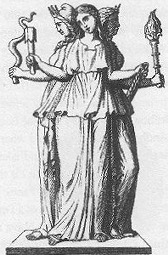 The Goddess Hekate (or Hecate in Latin), Queen of the Witches, taught me to see the power and beauty of the dark. My understanding of this began well before I did much study of witchcraft and pagan beliefs. In the early 1970s, I encountered the goddess Hekate in the classic book Women’s Mysteries: Ancient and Modern by M. Esther Harding. This book, first published in 1935, was a forerunner of modern paganism, especially the feminist and Jungian varieties. As one reviewer phrased it, “even by today’s standards, this book serves as an excellent introduction to pagan ideas.”
Hekate, Goddess of the Dark Moon, carries a torch and a snake, symbols of the wisdom that comes from this dark. In the metaphorical and literal sense, this goddess reveals understandings about death, birth and rebirth, teaching us not to be afraid of liminal experiences and transitions.
In the Homeric Hymn to Demeter, Hekate is witness to both the descent and the return of Persephone into the underworld. By being both behind and in front of Persephone, Hekate thoroughly protects and guides her.
Queen of the Night Hekate rules what is hidden from immediate logical interpretation and knowing—the dark. The dominate culture may call it the dark side, linking all manner of negative, hateful and destructive images to this unknown. I encourage all of us not to fall prey to this deception. The dark is rich, fecund, and yes, good for you and the planet.
Hekate encourages us to be open to the unknown in order to receive important information coming from the spiritual world of feeling and intuition emanating from our personal and collective subconscious wealth of knowledge. These qualities are considered female and therefore inferior, even dangerous, in our society where the aggressive, alpha male is seen as the norm.
As Unitarian Universalist pagans we have a much different view. Unitarian Universalism is well-known for its efforts to counter prejudice and mistreatment of women. UU pagans espouse commitment to life sustaining values, equality and compassion. We also often identify as witches. So, how do we reconcile all this? I suggest that we intentionally construct a non-prejudicial definition of darkness. By incorporating this meaning in our ceremonies and educational efforts, we will be making a valuable contribution to ending hateful treatment of women.
Is this easy, given the connotation that dark has been assigned? Not at all. We have to ask people to reconsider their use of a favorite phrase. The rewards are immense, however. When we use a truer, balanced definition of darkness, an entire world of empowering metaphors and images becomes available to aid our emotional processing.
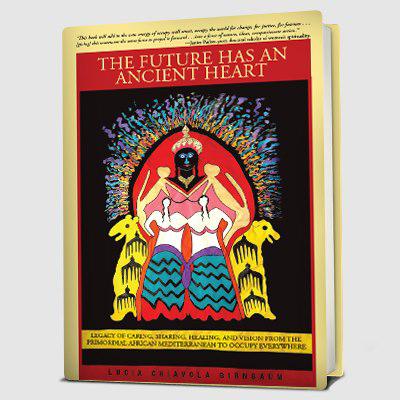
artist: Lucia Ruyle – used with permission
One such image which has spoken to me is the Dark Mother. Lucia Birnbaum, a scholar who has explored her own Sicilian roots and written extensively on the image of the Dark Mother teaches the values this image holds. Her latest book, The Future Has an Ancient Heart, bears a cover image by the fabric artist Lydia Ruyle. A black woman emerges from the sea and the black earth. She encompasses all forms of life. The borders and background of the image are the yellow of harvest passing into the black of renewal and the red of perpetual life.
Lucia is quick to point out that the Dark Mother has nothing to do with forced motherhood. Women’s choice of whether to become biological mothers is quite separate from appreciating the presence and power of the Dark Mother who is an intelligence in the Universe that predates modern patriarchy and has origins in Africa. What the Dark Mother teaches is a reverence for creation.
Professor Necia Desiree Harkless, Egyptologist, author of Heart to Heart, and a Unitarian Universalist says of Birnbaum’s insights: “The incredible mosaics of humankind will be transformed through the nurturant values of the Dark Mother that are grounded in justice, equality and peace for all. My African American mother and father who knew of the virtues of the Black Virgin before I was born can now rest in peace in mother earth as the transformations continue…”
As I discovered the many forms of dark goddesses through varied spiritual traditions around the globe, the dark womb that resided within my body took on a much fuller meaning. The cycles that my female body passed through each month became allies rather than disabilities. I knew then that giving birth physically was not a necessity but a choice given to each woman. The real issue for each female is reclaiming her full personhood. The Freudian penis envy I had been taught about in my college psychology classes that women were supposed to be driven by gave way to a true appreciation of the complexity of the female body.
These feelings have nothing to do with female superiority or male bashing as those who seek to discredit feminism claim. Quite the contrary. By exploring these beliefs, I have come to appreciate ever more deeply the true value of every human being, female and male. Each carries the powers of the Dark Mother. Birnbaum also reminds us of the Dark Mother’s teachings of reverence for all. In her book she talks about her partnership with her husband Wally. She, a secular sociologist, and he, a physicist, found in their own ethnic roots the Ancient Dark Mother who teaches the values of compassion, caring and nurturing.
This three part series, then, seeks to raise the issue of how we use the words dark, darkness, and black in our culture. When we examine these words in a spiritual context that values organic process, woman-honoring perspectives, cross-cultural appreciation, and the dignity and worth of each human being we become able to benefit from a fresher, healthier perspective. Racism, sexism and all the isms take their rightful place as debilitating to all of us spiritually and damaging to society as a whole. UU Paganism is uniquely positioned to take on the challenge of educating on these issues. Many of us have already done so. May our numbers continue to grow.
Previous Post

February 27, 2015
What can you say about Re-Enchantment?
Next Post
March 4, 2015 The CUUPS Podcast #28 - March 2015
Browse Our Archives
Select a Category Current Events CUUPS Press Release Interfaith liturgy Media Review podcast Religious Education Seasonal Reflection Spiritual Practice Summary Uncategorized
Select a Month July 2026 June 2026 April 2026 January 2026 December 2025 October 2025 August 2025 July 2025 June 2025 April 2025 March 2025 February 2025 December 2024 November 2024 October 2024 August 2024 July 2024 June 2024 May 2024 April 2024 February 2024 December 2023 November 2023 October 2023 September 2023 August 2023 June 2023 May 2023 April 2023 March 2023 February 2023 January 2023 December 2022 October 2022 September 2022 August 2022 July 2022 June 2022 May 2022 April 2022 March 2022 February 2022 January 2022 December 2021 November 2021 October 2021 September 2021 August 2021 July 2021 June 2021 May 2021 April 2021 March 2021 February 2021 January 2021 December 2020 November 2020 October 2020 September 2020 August 2020 July 2020 June 2020 May 2020 April 2020 March 2020 February 2020 January 2020 December 2019 November 2019 October 2019 September 2019 August 2019 July 2019 June 2019 May 2019 April 2019 March 2019 February 2019 January 2019 December 2018 November 2018 October 2018 September 2018 August 2018 July 2018 June 2018 May 2018 April 2018 March 2018 February 2018 January 2018 December 2017 November 2017 October 2017 September 2017 August 2017 July 2017 June 2017 May 2017 April 2017 March 2017 February 2017 January 2017 December 2016 November 2016 October 2016 September 2016 August 2016 July 2016 June 2016 May 2016 April 2016 March 2016 February 2016 January 2016 December 2015 November 2015 October 2015 September 2015 August 2015 July 2015 June 2015 May 2015 April 2015 March 2015 February 2015 January 2015
Follow Us!
TAKE THE
Religious Wisdom Quiz
How lonely sits the city once full of people! How like a widow has she become! Which destroyed city does this mourn?
Select your answer to see how you score.
Nineveh Babylon Jerusalem Samaria
Related posts from Nature's Sacred Journey

My story – discovering UU, starting a CUUPs...

Ostara & Commitment; Planting Seeds & Growing With...


TRENDING AT PATHEOS Pagan

I was recently chatting with someone on Instagram. She asked me what...

While there are many people who share their results, the end of...

On July 23, I saw Christopher Nolan's The Odyssey which is Homer’s...

As I write this two big events have just finished up. One...

Restoring the Watershed of Divine Love
Perhaps cooperation is not something we manufacture through legislation, ideology, or moral...

Many UUs don’t pray because of bad experiences in a previous religion,...
view all Pagan blogs
Ad-Free & Subscriber Log-In Subscription Support
- About Us
- 2026 Calendar
- Videos
- Podcasts
- Library of World Religions
- Faith In Media Tracker
- Advertise With Us
- Write for Us
- Privacy Policy
- Terms of Service
- Do Not Sell My Data
- Contact Us
- Radiant Digital
- Manage Newsletter Subscriptions
- Unsubscribe From Notifications
- Sitemap
Copyright 2008-2026, Patheos. All rights reserved.
Subscription Support Ad-Free & Subscriber Log-In
Follow Patheos