
BuddhistCatholicContemplativeEvangelicalGeneral ChristianHinduJewishLatter-day SaintMuslimNew VisionsProgressive Christian
Beliefs
- Buddhist
- Catholic
- Contemplative
- Evangelical
- General Christian
- Hindu
- Jewish
- Latter-day Saint
- More Voices
- Muslim
- New Visions
- Pagan
- Progressive Christian
Topics
- Religion News
- Food and Religion
- Sports and Religion
- Religious Art
- Religious Music and Entertainment
- Religious Events
- History and Religion
- Style and Religion
- Politics and Religion
- Women in Religion
- Recreation Outdoors and Religion
- Business Finance and Religion
- Careers Workplace and Religion
- Education and Religion
- Family Parenting and Religion
- Health Fitness and Religion
- Home and Religion
- Relationships and Religion
- Technology and Religion
- Travel and Religion
Columnists
- Buddhist Columnists
- Business Finance and Religion Columnists
- Careers Workplace and Religion Columnists
- Catholic Columnists
- Contemplative Columnists
- Education and Religion Columnists
- Evangelists Columnists
- Family Parenting and Religion Columnists
- General Christian Columnists
- Health Fitness and Religion Columnists
- Hindu Columnists
- History and Religion Columnists
- Home and Religion Columnists
- Jewish Columnists
- More Voices Columnists
- Latter Day Columnists
- Muslim Columnists
- New Visions Columnists
- Nonreligious Columnists
- Pagan Columnists
- Politics and Religion Columnists
- Progressive Columnists
- Recreation Outdoors and Religion Columnists
- Relationships and Religion Columnists
- Religion News Columnists
- Religious Art Columnists
- Religious Events Columnists
- Religious Music and Entertainment Columnists
- Sports and Religion Columnists
- Style and Religion Columnists
- Technology and Religion Columnists
- Travel and Religion Columnists
- Women in Religion Columnists
Resource Library
- 2026 Calendar
- Library of World Religions
- The 100 Most Holy Places on Earth
- Patheos Answers
- Podcasts
- Videos
- Faith Leaders Database
- Anglican Episcopalian
- Bahai
- Baptist
- Buddhism
- Christianity
- Confucianism
- Eastern Orthodoxy
- Hinduism
- Holiness and Pentecostal
- ISKCON
- Islam
- Judaism
- Lutheran
- Methodist
- The Church of Jesus Christ of Latter-day Saints
- New Age
- Paganism
- Presbytarian and Reformed
- Protestantism
- Religion Behind the Scenes
- Roman Catholic
- Scientology
- Shia Islam
- Sikhism
- Sufism
- Sunni Islam
- Taoism
- Zen
- See all religions
Research Tools
 Ad-Free & Subscriber Log-In Subscription Support
Ad-Free & Subscriber Log-In Subscription Support
Follow Patheos 

- Trending:
- Forgiveness
- |
- Marriage
- |
- Consciousness
- |
- Death Penalty
- |
- Election
- |
- Halloween

- Home
- Pagan
- Honoring the Dark, Part Two
Honoring the Dark, Part Two
Last updated on: February 2, 2015 at 6:00 am by Liz Fisher
Honoring the Dark, Part Two 2015-02-02T06:00:21+00:00 Liz Fisher
Patheos Explore the world's faith through different perspectives on religion and spirituality! Patheos has the views of the prevalent religions and spiritualities of the world.
In January, many of us celebrated the contributions of Dr. Martin Luther King, Jr. to American society. Brave efforts to overcome racial inequities were the focus. The movie Selma brought that pivotal event into heightened public awareness again. Dr King invited the Unitarian Universalist Association leaders, minister and lay both, to come to Selma to stand with the protesters, and more than any other denomination, they came. In 1966 Dr. King delivered the Ware Lecture at the UU General Assembly: a powerful address entitled Don’t Sleep through the Revolution which detailed the importance of desegregation and social action. Listening to Dr. King’s address reminds me of the power of words and how they are used.
During the 1960s Civil Rights Movement “Black is Beautiful” became a slogan, popularized by Dr. King as he challenged the connotations given to the word black.
See King delivering his statement in the video https://www.youtube.com/watch?v=nGLF0X3WIiE.
(As an aside, when King talks about claiming his manhood in this video, we have to remember that King’s frequent use of man, mankind and brotherhood to denote all humans pre-dates consciousness about sexist language.)
Jacque James, former Director of Worship Resources for the UUA, co-edited the book Been in the Storm So Long (published by the UUA in 1991). The title is taken from a tradition African American spiritual, and is a collection of inspirational readings which embody the struggles and triumphs of black UUs.
She says: “We shape language and we are shaped by it. In our culture, white is esteemed. It is heavenly, sunlike, clean, pure, immaculate, innocent, and beautiful. At the same time, black is evil, wicked, gloomy, depressing, angry, sullen. Ascribing negative and positive values to black and white enhances the institutionalization of this culture’s racism.”
These assumptions also apply to the words light and dark. I have long observed that the interpretations of dark and darkness in popular American culture have a lot to do with the social climate we live in today. As pagans who take a broad, multicultural perspective, we can do much to correct attitudes by challenging the light over dark perspective. So often, however, we fall into the same dichotomies as we pit the so called dark forces against the protective and illuminating light.
Even Dr. King struggled with the embedded negative connotations of darkness. Take the statement in this poster. [“Darkness cannot drive out darkness: only
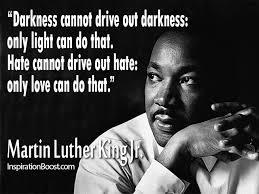
“Darkness can not drive out darkness.”
light can do that. Hate cannot drive out hate: only love can do that.”] Here he uses darkness as something to “drive out.” It seems to me this comes from a specific theological view that has found its way into spiritual directives of most religions. Many otherwise inspiring attitudes fall short when they start to reference “shadow side,” difficult dark times, even devil’s food cake which is dark chocolate, angle’s food cake is white! (Complicating the identities of the chocoholics among us…) When theological beliefs perpetuate injustices, UU Pagans must take the time to counter them.
The previous example shows Martin Luther King himself was guilty of this when he worked with Biblical concepts. To me, Dr. King was one of the clearest ethical thinkers, and principled in his actions and conscience. I am a fan of his thinking, advocacy, spiritual integrity and admire his superbly articulate addresses. Yet, I still object to this statement and his use of sexist language. I truly believe King valued all people, women included, equally. He was the first voice to challenge the misuse of the word black. Yet when it came to challenging theological concepts or language that excluded women, even he fell woefully short.
While I believe I know what he intended, I still can see the misunderstanding that is perpetuated when we use darkness in a pejorative way or use male descriptives to include all genders. So if you have ever used darkness to mean undesirable qualities, you are in good company. Opportunities for future corrective measures abound, however. As UU pagans we are uniquely positioned to speak up about this misconception, offering in their place the truer spiritual constructs of cycles, balance and rhythm of natural phenomenon.
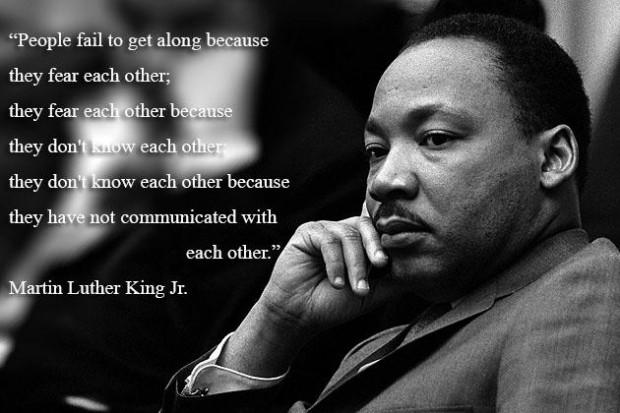 I am confident that if Dr. King were alive today, he would listen to objections to these usages and would not use such a phase, or sexist language. He would have listened. Communication and sharing was something he valued and encouraged. This quote tells me he would have heard valid objections and changed. [As Dr. King says here: “People fail to get along because they fear each other; they fear each other because they don’t know each other; they don’t know each other because they have not communicated with each other.”]
In his 1966 Ware Lecture, he admonished the listeners to counter concepts of racial superiority. Feeling superior to another is believed by most of us to hurt those judged inferior. For me, there is another sad result of segregation and racial stereotyping: the damage done to the oppressing group, who suffer great spiritual, intellectual and emotional losses fostered by their ignorance.
I was in high school and college in the 1960s. The Civil Rights movement was my teacher. I concluded then that if I adopted a white privilege attitude, I was actually cutting myself off. Instead, I studied in-depth the contributions of Africa and African Americans to world culture, moved to integrated cities, and sought out in-depth exchanges with people of various racial and ethnic backgrounds. I found a plethora of earth-centered and woman-honoring aspects in these cultures. Many of these I have included in Rise Up and Call Her Name. These experiences have been among the most enriching of my life.
By eliminating the embedded prejudice in our use of light and dark, then, we can begin to open the door to mutual respect and reciprocal benefits. As a group that is predominately white, UUs stand to benefit greatly from changing our language when needed and interacting with others across racial spectrums, recognizing that we stand to gain significantly by doing so.
As Jacqui James points out: “The words black and dark don’t need to be destroyed or ignored, only balanced and reclaimed in their wholeness. The words white and light don’t need to be destroyed or ignored, only balanced and reclaimed in their wholeness. Imagine a world that has only light….or dark. We need both. Dark and light. Light and dark.”
(I believe UU pagans are uniquely positioned to promote redefinitions of the word dark that are accurate and just, thereby contributing to anti-racist and anti-misogynist efforts. In Part One of this series Honoring the Dark, I explored the true meaning of dark and why celebrating the dark at the Winter Solstice is important. In Part Two, I explored the ways that mis-characterizing dark as evil fosters racism. In Part Three, I will explore how misconceptions about dark contribute to misogyny.)
Previous Post

January 30, 2015
If Unitarian Universalism is so great, Why am I 'still' a Pagan?
Next Post

February 4, 2015 Verified Petrified Gnosis
Browse Our Archives
Select a Category Current Events CUUPS Press Release Interfaith liturgy Media Review podcast Religious Education Seasonal Reflection Spiritual Practice Summary Uncategorized
Select a Month July 2026 June 2026 April 2026 January 2026 December 2025 October 2025 August 2025 July 2025 June 2025 April 2025 March 2025 February 2025 December 2024 November 2024 October 2024 August 2024 July 2024 June 2024 May 2024 April 2024 February 2024 December 2023 November 2023 October 2023 September 2023 August 2023 June 2023 May 2023 April 2023 March 2023 February 2023 January 2023 December 2022 October 2022 September 2022 August 2022 July 2022 June 2022 May 2022 April 2022 March 2022 February 2022 January 2022 December 2021 November 2021 October 2021 September 2021 August 2021 July 2021 June 2021 May 2021 April 2021 March 2021 February 2021 January 2021 December 2020 November 2020 October 2020 September 2020 August 2020 July 2020 June 2020 May 2020 April 2020 March 2020 February 2020 January 2020 December 2019 November 2019 October 2019 September 2019 August 2019 July 2019 June 2019 May 2019 April 2019 March 2019 February 2019 January 2019 December 2018 November 2018 October 2018 September 2018 August 2018 July 2018 June 2018 May 2018 April 2018 March 2018 February 2018 January 2018 December 2017 November 2017 October 2017 September 2017 August 2017 July 2017 June 2017 May 2017 April 2017 March 2017 February 2017 January 2017 December 2016 November 2016 October 2016 September 2016 August 2016 July 2016 June 2016 May 2016 April 2016 March 2016 February 2016 January 2016 December 2015 November 2015 October 2015 September 2015 August 2015 July 2015 June 2015 May 2015 April 2015 March 2015 February 2015 January 2015
Follow Us!
TAKE THE
Religious Wisdom Quiz
To whom did Jesus say, "Today you will be with me in paradise"?
Select your answer to see how you score.
Pilate The repentant thief Nicodemus Peter
Related posts from Nature's Sacred Journey

My story – discovering UU, starting a CUUPs...

Ostara & Commitment; Planting Seeds & Growing With...


TRENDING AT PATHEOS Pagan

I was recently chatting with someone on Instagram. She asked me what...

While there are many people who share their results, the end of...

On July 23, I saw Christopher Nolan's The Odyssey which is Homer’s...

As I write this two big events have just finished up. One...

Restoring the Watershed of Divine Love
Perhaps cooperation is not something we manufacture through legislation, ideology, or moral...

Many UUs don’t pray because of bad experiences in a previous religion,...
view all Pagan blogs
Ad-Free & Subscriber Log-In Subscription Support
- About Us
- 2026 Calendar
- Videos
- Podcasts
- Library of World Religions
- Faith In Media Tracker
- Advertise With Us
- Write for Us
- Privacy Policy
- Terms of Service
- Do Not Sell My Data
- Contact Us
- Radiant Digital
- Manage Newsletter Subscriptions
- Unsubscribe From Notifications
- Sitemap
Copyright 2008-2026, Patheos. All rights reserved.
Subscription Support Ad-Free & Subscriber Log-In
Follow Patheos