
BuddhistCatholicContemplativeEvangelicalGeneral ChristianHinduJewishLatter-day SaintMuslimNew VisionsProgressive Christian
Beliefs
- Buddhist
- Catholic
- Contemplative
- Evangelical
- General Christian
- Hindu
- Jewish
- Latter-day Saint
- More Voices
- Muslim
- New Visions
- Pagan
- Progressive Christian
Topics
- Religion News
- Food and Religion
- Sports and Religion
- Religious Art
- Religious Music and Entertainment
- Religious Events
- History and Religion
- Style and Religion
- Politics and Religion
- Women in Religion
- Recreation Outdoors and Religion
- Business Finance and Religion
- Careers Workplace and Religion
- Education and Religion
- Family Parenting and Religion
- Health Fitness and Religion
- Home and Religion
- Relationships and Religion
- Technology and Religion
- Travel and Religion
Columnists
- Buddhist Columnists
- Business Finance and Religion Columnists
- Careers Workplace and Religion Columnists
- Catholic Columnists
- Contemplative Columnists
- Education and Religion Columnists
- Evangelists Columnists
- Family Parenting and Religion Columnists
- General Christian Columnists
- Health Fitness and Religion Columnists
- Hindu Columnists
- History and Religion Columnists
- Home and Religion Columnists
- Jewish Columnists
- More Voices Columnists
- Latter Day Columnists
- Muslim Columnists
- New Visions Columnists
- Nonreligious Columnists
- Pagan Columnists
- Politics and Religion Columnists
- Progressive Columnists
- Recreation Outdoors and Religion Columnists
- Relationships and Religion Columnists
- Religion News Columnists
- Religious Art Columnists
- Religious Events Columnists
- Religious Music and Entertainment Columnists
- Sports and Religion Columnists
- Style and Religion Columnists
- Technology and Religion Columnists
- Travel and Religion Columnists
- Women in Religion Columnists
Resource Library
- 2026 Calendar
- Library of World Religions
- The 100 Most Holy Places on Earth
- Patheos Answers
- Podcasts
- Videos
- Faith Leaders Database
- Anglican Episcopalian
- Bahai
- Baptist
- Buddhism
- Christianity
- Confucianism
- Eastern Orthodoxy
- Hinduism
- Holiness and Pentecostal
- ISKCON
- Islam
- Judaism
- Lutheran
- Methodist
- The Church of Jesus Christ of Latter-day Saints
- New Age
- Paganism
- Presbytarian and Reformed
- Protestantism
- Religion Behind the Scenes
- Roman Catholic
- Scientology
- Shia Islam
- Sikhism
- Sufism
- Sunni Islam
- Taoism
- Zen
- See all religions
Research Tools
 Ad-Free & Subscriber Log-In Subscription Support
Ad-Free & Subscriber Log-In Subscription Support
Follow Patheos 

- Trending:
- Forgiveness
- |
- Marriage
- |
- Consciousness
- |
- Death Penalty
- |
- Election
- |
- Halloween
 nakedpastor
- Home
- Progressive Christian
- Why Blame Satan For Suicide?
Why Blame Satan For Suicide?
Last updated on: December 13, 2013 at 12:12 pm by David Hayward
Why Blame Satan For Suicide? 2013-12-13T12:12:23-04:00 David Hayward
Patheos Explore the world's faith through different perspectives on religion and spirituality! Patheos has the views of the prevalent religions and spiritualities of the world.
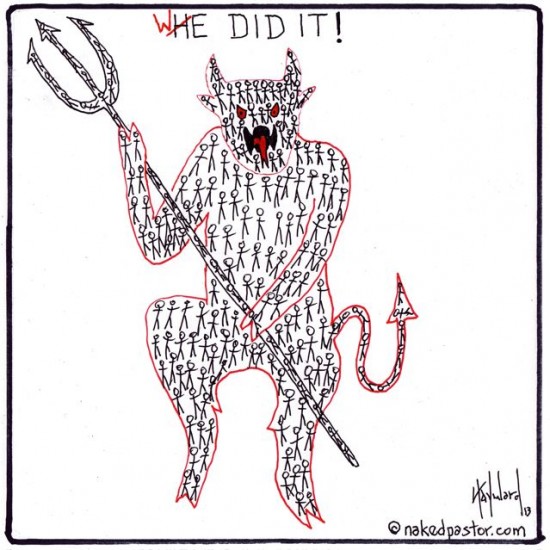
I was saddened yesterday by the news of a young pastor’s suicide. The entire story is very tragic. I was silenced in the face of such terrible news. I can’t imagine what his family and friends are going through. Horrible!
I read Jennifer LeClaire’s opinion in Charisma News, “Why Are So Many Pastors Committing Suicide?”. LeClaire honestly shares her own past struggle with depression, so she can genuinely identify with so many who struggle similarly. She is also concerned about the fate of pastors and has gathered statistics that reveal pastors live difficult lives often burdened with very deep struggles that few know or understand. I know this to be true from experience. The following statement is the core of her post:
“Many of the harmful actions we take originate from the seed of a thought Satan whispers to our souls.”
LeClaire chose to focus on the personal aspect of what goes on in the mind of a suicide. But I suggest this understanding of the demonic no longer suffices. In fact, I fear that promoting this superstitious belief will not only prevent some people from seeking professional help but even provide a culture within which self-harming thoughts and actions are stimulated. As well, her paradigm focuses on the problem as individual rather than communal. I believe in many suicide cases the social problem is the context within which the personal one is exacerbated. I would like to explore this social aspect as sensitively as possible.
Disclaimer: I am not a professional in the mental health field. Even though I’ve dealt with a lot of suicides and their families and friends over the years, I am not an expert. I’ve only been involved with pastoral counseling and the study of theology. So I humbly offer my meagre perspective to hopefully add more to the conversation around this increasing problem. I also want to say that in no way am I blaming the family and friends of suicides. Often suicide occurs to the shock of her loving and supportive families and friends. It makes no sense why some decide to end their lives. So the focus of this post is to offer a social perspective that I hope will make healthier communities within which the option of suicide may be less attractive.
In the story of the Gerasene demoniac in Mark 5, I discern three stages in the sad story that develops around this man:
- Stigmatization: The first stage in the demoniacs journey away from healthy living was that he was marked by something that was different about him. Was he struggling with mental illness? Many scholars suggest that many of the ailments in the bible were blamed on demons. In a culture where these things were considered scary and therefore demonic, the next step was to project these onto the victim: he’s scary and therefore demonic. It’s the same today when someone is considered “not normal” for whatever reason. Sometimes the stigma isn’t even a real one but one that is projected onto them by others. They are stigmatized, marked as different. What often happens in a church is that a person falls and is marked with the label “failure” or “sinner”. This sets the stage for the next step.
- Dehumanization: When someone is considered “not normal”, they are somehow less than human. Heartless or bewildered people around the person can exalt themselves over him and look down on him as less than fully human. The demoniac is described as a wild animal. People around the stigmatized person says things like, “She’s different.” “He’s weird.” “I can’t believe she did that!” “What got into him?” “That was so out of character!” “She’s not herself!” “He’s a monster!” The language betrays the belief that somehow this person is controlled by an inhuman quality. He is no longer a healthy and desired member of society and this sets him up as a candidate for exile. In the church these are members who have sinned or are believed to be sinners and are considered a threat to the community.
- Ostracization: Once a person is considered less than whole, an unhealthy member of the community and perhaps even a danger to it, then the next step is to ostracize him. We see this in the church when the stigmatized person is not allowed in, is invited to leave, forced to leave, excommunicated or made to feel that he has no other choice but to leave. The demoniac was removed from society and living in a graveyard, symbolizing that he was living in the land of the dead rather than the living. Here, self-harm was his daily practice. Many feel that they are already dead inside and suppose they might as well be dead outside. They’ve been marked with a stigma, be it sin or quirk or difference or oddity or illness, and are considered less than human and no longer belong. He is ostracized and banned to outer darkness where he’s lost everything he valued about his life and all that remains to depart this world is his body.
Here are some examples:
- Sarah at high school becomes the focus of the queen bee who is a bully. Sarah is marked as the one to be teased by the other girls. She’s less than the other girls and is not allowed in the clique. She lives in terror every day she gets on the bus or goes to school or shops at the mall.
- John, a college student in a conservative town, is found sleeping with another young man and photographs are posted on Facebook. His family is shocked and non-supportive. The other students call him a faggot and eventually make it impossible for him to stay in school. He leaves friendless and humiliated.
- Jane works in accounting. She is brilliant with numbers. She also suffers with Turrets. Her co-workers laugh about her ticks behind her back. She knows. Her boss recognizes Jane’s talent but also wants to be cool with the other employees, so he laughs along with them. She is never invited to their parties. She is bypassed for promotions. She lives alone.
- The senior pastor finds a Playboy magazine in his assistant pastor’s desk. Luke is fired and kicked out of the church. The reason is announced publicly at church and published in the local newspaper. His wife leaves him and also takes the kids because she leaps to the crazy but damaging conclusion that if he is addicted to porn he is probably a pedophile too. The judge agrees. He gets a minimum wage job and lives alone in a basement apartment.
Again, I want to be a support to the families and friends of those who commit suicide. At the same time I want to help create safe communities where the horrible social practices of stigmatization, dehumanization and ostracization are not employed. Like my cartoon suggests, our social constructs and behaviors may act like demonic powers that can prepare a person for self-harm and suicide. There are many little deaths that happen before the final one… like the death of dignity, the death of emotion, spirit and hope, and the death of our social networks. My hope is that if we stopped practicing these, suicide might be less of a viable option for some.
Like Jesus did in the gospel story of the demoniac, can we appreciate a diversity of people with all our different struggles? Can we treat all people as fully human with dignity and respect? Can we embrace everyone in our communities? Can we create safe communities within which suicide, the desire to radically leave the community, becomes less of a desired option?
I believe so.
Previous Post

December 12, 2013
Jesus as an ugly baby
Next Post

December 14, 2013 Jesus didn't come to bring peace but a question
Browse Our Archives
Select a Category art cartoons cartoons 2 freebie music one minute message podcast Sophia teaching technology thought
Select a Month February 2014 January 2014 December 2013 November 2013 October 2013 September 2013 August 2013 July 2013 June 2013 May 2013 April 2013 March 2013 February 2013 January 2013 December 2012 November 2012 October 2012 September 2012 August 2012 July 2012 June 2012 May 2012 April 2012 March 2012 February 2012 January 2012 December 2011 November 2011 October 2011 September 2011 August 2011 July 2011 June 2011 May 2011 April 2011 March 2011 February 2011 January 2011 December 2010 November 2010 October 2010 September 2010 August 2010 July 2010 June 2010 May 2010 April 2010 March 2010 February 2010 January 2010 December 2009 November 2009 October 2009 September 2009 August 2009 July 2009 June 2009 May 2009 April 2009 March 2009 February 2009 January 2009 December 2008 November 2008 October 2008 September 2008 August 2008 July 2008 June 2008 May 2008 April 2008 March 2008 February 2008 January 2008 December 2007 November 2007 October 2007 September 2007 August 2007 July 2007 June 2007 May 2007 April 2007 March 2007 February 2007 January 2007 December 2006 November 2006 October 2006 September 2006 August 2006 July 2006 June 2006 May 2006 March 2006 February 2006
Follow Us!
TAKE THE
Religious Wisdom Quiz
What was the primary currency in biblical times?
Select your answer to see how you score.
Copper Gold coins Bronze Silver shekels
Related posts from nakedpastor

nakedpastor's goodbye video to patheos
Jesus hearts nakedpastor so much he is helping...

important announcement: nakedpastor is moving!
Uganda sending gays to jail: who are the...
TRENDING AT PATHEOS Progressive Christian

Why Christians Have a Sacred Duty to Vote:...
The Bible offers strong support for the sacred duty to vote. Here...

What Being a Modern-Day Apostle Means to Me
In my last column, I discussed the ins and outs of modern-day...

Did Ancient China Once Worship the God of...
Across human history, a common thread weaves through the origins of the...

Love Your Neighbor – Including Earth-Kin: Lev. 19,...
God’s command to love your neighbor means acting in an ethical and...

Lead a Church Study of “Jesus and Lao...
Guest writer Jack Thomas (The Irreverent Reverend) reflects on leading his church...

Principles for Understanding the Apostolic Ministry Today
Whenever people discover that my formal ministry title is "apostle," as in...
view all Progressive Christian blogs
Ad-Free & Subscriber Log-In Subscription Support
- About Us
- 2026 Calendar
- Videos
- Podcasts
- Library of World Religions
- Faith In Media Tracker
- Advertise With Us
- Write for Us
- Privacy Policy
- Terms of Service
- Do Not Sell My Data
- Contact Us
- Radiant Digital
- Manage Newsletter Subscriptions
- Unsubscribe From Notifications
- Sitemap
Copyright 2008-2026, Patheos. All rights reserved.
Subscription Support Ad-Free & Subscriber Log-In
Follow Patheos