
BuddhistCatholicContemplativeEvangelicalGeneral ChristianHinduJewishLatter-day SaintMuslimNew VisionsProgressive Christian
Beliefs
- Buddhist
- Catholic
- Contemplative
- Evangelical
- General Christian
- Hindu
- Jewish
- Latter-day Saint
- More Voices
- Muslim
- New Visions
- Pagan
- Progressive Christian
Topics
- Religion News
- Food and Religion
- Sports and Religion
- Religious Art
- Religious Music and Entertainment
- Religious Events
- History and Religion
- Style and Religion
- Politics and Religion
- Women in Religion
- Recreation Outdoors and Religion
- Business Finance and Religion
- Careers Workplace and Religion
- Education and Religion
- Family Parenting and Religion
- Health Fitness and Religion
- Home and Religion
- Relationships and Religion
- Technology and Religion
- Travel and Religion
Columnists
- Buddhist Columnists
- Business Finance and Religion Columnists
- Careers Workplace and Religion Columnists
- Catholic Columnists
- Contemplative Columnists
- Education and Religion Columnists
- Evangelists Columnists
- Family Parenting and Religion Columnists
- General Christian Columnists
- Health Fitness and Religion Columnists
- Hindu Columnists
- History and Religion Columnists
- Home and Religion Columnists
- Jewish Columnists
- More Voices Columnists
- Latter Day Columnists
- Muslim Columnists
- New Visions Columnists
- Nonreligious Columnists
- Pagan Columnists
- Politics and Religion Columnists
- Progressive Columnists
- Recreation Outdoors and Religion Columnists
- Relationships and Religion Columnists
- Religion News Columnists
- Religious Art Columnists
- Religious Events Columnists
- Religious Music and Entertainment Columnists
- Sports and Religion Columnists
- Style and Religion Columnists
- Technology and Religion Columnists
- Travel and Religion Columnists
- Women in Religion Columnists
Resource Library
- 2026 Calendar
- Library of World Religions
- The 100 Most Holy Places on Earth
- Patheos Answers
- Podcasts
- Videos
- Faith Leaders Database
- Anglican Episcopalian
- Bahai
- Baptist
- Buddhism
- Christianity
- Confucianism
- Eastern Orthodoxy
- Hinduism
- Holiness and Pentecostal
- ISKCON
- Islam
- Judaism
- Lutheran
- Methodist
- The Church of Jesus Christ of Latter-day Saints
- New Age
- Paganism
- Presbytarian and Reformed
- Protestantism
- Religion Behind the Scenes
- Roman Catholic
- Scientology
- Shia Islam
- Sikhism
- Sufism
- Sunni Islam
- Taoism
- Zen
- See all religions
Research Tools
 Ad-Free & Subscriber Log-In Subscription Support
Ad-Free & Subscriber Log-In Subscription Support
Follow Patheos 

- Trending:
- Forgiveness
- |
- Marriage
- |
- Consciousness
- |
- Death Penalty
- |
- Election
- |
- Halloween
 nakedpastor
- Home
- Progressive Christian
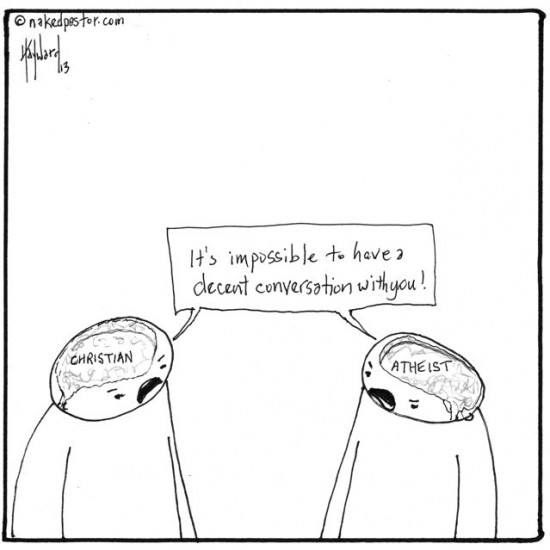
- how an atheist reaches out to a believer
how an atheist reaches out to a believer
Last updated on: May 15, 2013 at 9:24 am by David Hayward
how an atheist reaches out to a believer 2013-05-15T09:24:40-04:00 David Hayward
Patheos Explore the world's faith through different perspectives on religion and spirituality! Patheos has the views of the prevalent religions and spiritualities of the world.
CLICK ON IMAGE TO SHOP FOR DAVID’S ART
I like the writing of Steven Olsen. For example, his recent post, “Gorilla’s, Starship Commanders and Your Brain” is a good read. Interesting and informative. And I like his sense of humor. Olsen writes for the atheist channel at Patheos. I read atheist writers and blogs for many reasons. One of the most important reasons is that I believe many atheists help to keep me honest. I have an inner atheist and so I think it wise to take care of that part of me. They can also teach me how to communicate what I mean more clearly.
He wrote an article a while back, “About That Personal Experience of Yours”. I was smiling as I read it because I felt like I was back in Personal Evangelism class in Central Bible College in Springfield, Missouri… which is where Olsen lives actually. He gives instructions on how to communicate with a believer; how to “debate with a theist”; how to “guide someone out of a belief”; how to “reach” believers effectively. So it’s about evangelism.
Olsen describes for atheists how Christians believe:
- Religion doesn’t have evidence so it relies on experience for validation.
- These experiences, though meaningful to believers, aren’t testable.
- Since they are not testable, they are “indistinguishable from a fabrication”.
- So the believer must demonstrate why God should be more real than Bigfoot.
- Specifically, Christianity’s god is cruel for creating Hell for unbelievers as well as immoral since he hides from them.
- Worse, since Christians believe in the Devil, how do they know their spiritual experience isn’t just a deception?
- No matter how convincing your logic is, they may return to superstition because of the meaningfulness of their experiences.
I’ve never understood how some atheists leap from God to Bigfoot. Some ideas or theories are valid to consider and others are not. I think the possible existence of God, or the idea of God, or the theory of God, is more valid to explore than the possible existence of Bigfoot, or the idea of Bigfoot, or the theory of Bigfoot. Some ideas, some possibilities, have better legs than others. I agree that experiences do not prove the existence of God, but I am not willing to entirely dismiss them as irrelevant to the case, along with all the theories about the idea of God or those that thought or think them.
I also find it curious how quickly and easily some atheists solve the age old problem of evil. The ancient Greek philosopher Epicurus stated the argument this way:
- If an all-powerful and perfectly good god exists, then evil does not.
- There is evil in the world.
- Therefore, an all-powerful and perfectly good god does not exist.
But that isn’t the end of the argument. Epicurus’ is not the only solution on the table. There are all kinds of others theories out there. His argument might appear logical, but many thinkers down through the ages have challenged the first part of the equation and wrestled with the problem of evil along with the possibility of the existence of God. It continues today. If the first part is faulty then the rest of the logic fails. This whole area of thought is called theodicy and has been going on for centuries. We are allowed to ignore all other arguments but Epicurus’, but I think we would be placing unreasonable restrictions on our minds.
G. K. Chesterton had something to say about this:
“Spiritual doctrines do not actually limit the mind as do materialistic denials. Even if I believe in immortality I need not think about it. But if I disbelieve immortality I must not think about it. In the first case the road is open and I can go as far as I like; in the second the road is shut.”
Chesterton’s concern is with free will and freedom of thought. He believed spiritual doctrines opened the mind to a limitless freedom of possibilities, whereas the other is “the worst chain that ever fettered a human being” because without free thought you don’t have free will.
One experiences the Divine one day and experiences evil another. Which is more or less real than the other? How is this testable or measurable? How are these confirmed? Many say there is no Divine. Many say there is no evil. Who judges who is right or wrong? And how?
Anyway, I enjoyed reading the article because, like I said, it was interesting to see how an atheist would try to convert a believer. It reminded me that, in many ways, atheists and believers are the same. Everyone believes their religion, belief or philosophy is the right one or they wouldn’t embrace it, and, therefore, everyone believes that everyone else should subscribe to it or they wouldn’t themselves. But, even though Olsen is obviously trying to be gracious, there is a slight tone of condescension in the article that smells like the condescension some believers have towards atheists. Like some believers talk about atheists, Olsen talks about believers like they have a mental illness and need to be treated with pity. He closes:
“Every single believer is different and you won’t reach them unless you tailor your argument to who they are, and acknowledge that while you have good reasons not to believe, that doesn’t diminish the effect the event had on them. Your logic will have better mileage when you mix it with empathy.”
Previous Post

May 14, 2013
have you lost yourself?
Next Post
May 15, 2013 two rooms, two experiences, two theologies
Browse Our Archives
Select a Category art cartoons cartoons 2 freebie music one minute message podcast Sophia teaching technology thought
Select a Month February 2014 January 2014 December 2013 November 2013 October 2013 September 2013 August 2013 July 2013 June 2013 May 2013 April 2013 March 2013 February 2013 January 2013 December 2012 November 2012 October 2012 September 2012 August 2012 July 2012 June 2012 May 2012 April 2012 March 2012 February 2012 January 2012 December 2011 November 2011 October 2011 September 2011 August 2011 July 2011 June 2011 May 2011 April 2011 March 2011 February 2011 January 2011 December 2010 November 2010 October 2010 September 2010 August 2010 July 2010 June 2010 May 2010 April 2010 March 2010 February 2010 January 2010 December 2009 November 2009 October 2009 September 2009 August 2009 July 2009 June 2009 May 2009 April 2009 March 2009 February 2009 January 2009 December 2008 November 2008 October 2008 September 2008 August 2008 July 2008 June 2008 May 2008 April 2008 March 2008 February 2008 January 2008 December 2007 November 2007 October 2007 September 2007 August 2007 July 2007 June 2007 May 2007 April 2007 March 2007 February 2007 January 2007 December 2006 November 2006 October 2006 September 2006 August 2006 July 2006 June 2006 May 2006 March 2006 February 2006
Follow Us!
TAKE THE
Religious Wisdom Quiz
What was a biblical talent's weight?
Select your answer to see how you score.
40 pounds 75 pounds 50 pounds 60 pounds
Related posts from nakedpastor

nakedpastor's goodbye video to patheos

Jesus hearts nakedpastor so much he is helping...

important announcement: nakedpastor is moving!

Uganda sending gays to jail: who are the...
TRENDING AT PATHEOS Progressive Christian

Why Christians Have a Sacred Duty to Vote:...
The Bible offers strong support for the sacred duty to vote. Here...

What Being a Modern-Day Apostle Means to Me
In my last column, I discussed the ins and outs of modern-day...

Did Ancient China Once Worship the God of...
Across human history, a common thread weaves through the origins of the...

Love Your Neighbor – Including Earth-Kin: Lev. 19,...
God’s command to love your neighbor means acting in an ethical and...

Lead a Church Study of “Jesus and Lao...
Guest writer Jack Thomas (The Irreverent Reverend) reflects on leading his church...

Principles for Understanding the Apostolic Ministry Today
Whenever people discover that my formal ministry title is "apostle," as in...
view all Progressive Christian blogs
Ad-Free & Subscriber Log-In Subscription Support
- About Us
- 2026 Calendar
- Videos
- Podcasts
- Library of World Religions
- Faith In Media Tracker
- Advertise With Us
- Write for Us
- Privacy Policy
- Terms of Service
- Do Not Sell My Data
- Contact Us
- Radiant Digital
- Manage Newsletter Subscriptions
- Unsubscribe From Notifications
- Sitemap
Copyright 2008-2026, Patheos. All rights reserved.
Subscription Support Ad-Free & Subscriber Log-In
Follow Patheos