
BuddhistCatholicContemplativeEvangelicalGeneral ChristianHinduJewishLatter-day SaintMuslimNew VisionsProgressive Christian
Beliefs
- Buddhist
- Catholic
- Contemplative
- Evangelical
- General Christian
- Hindu
- Jewish
- Latter-day Saint
- More Voices
- Muslim
- New Visions
- Pagan
- Progressive Christian
Topics
- Religion News
- Food and Religion
- Sports and Religion
- Religious Art
- Religious Music and Entertainment
- Religious Events
- History and Religion
- Style and Religion
- Politics and Religion
- Women in Religion
- Recreation Outdoors and Religion
- Business Finance and Religion
- Careers Workplace and Religion
- Education and Religion
- Family Parenting and Religion
- Health Fitness and Religion
- Home and Religion
- Relationships and Religion
- Technology and Religion
- Travel and Religion
Columnists
- Buddhist Columnists
- Business Finance and Religion Columnists
- Careers Workplace and Religion Columnists
- Catholic Columnists
- Contemplative Columnists
- Education and Religion Columnists
- Evangelists Columnists
- Family Parenting and Religion Columnists
- General Christian Columnists
- Health Fitness and Religion Columnists
- Hindu Columnists
- History and Religion Columnists
- Home and Religion Columnists
- Jewish Columnists
- More Voices Columnists
- Latter Day Columnists
- Muslim Columnists
- New Visions Columnists
- Nonreligious Columnists
- Pagan Columnists
- Politics and Religion Columnists
- Progressive Columnists
- Recreation Outdoors and Religion Columnists
- Relationships and Religion Columnists
- Religion News Columnists
- Religious Art Columnists
- Religious Events Columnists
- Religious Music and Entertainment Columnists
- Sports and Religion Columnists
- Style and Religion Columnists
- Technology and Religion Columnists
- Travel and Religion Columnists
- Women in Religion Columnists
Resource Library
- 2026 Calendar
- Library of World Religions
- The 100 Most Holy Places on Earth
- Patheos Answers
- Podcasts
- Videos
- Faith Leaders Database
- Anglican Episcopalian
- Bahai
- Baptist
- Buddhism
- Christianity
- Confucianism
- Eastern Orthodoxy
- Hinduism
- Holiness and Pentecostal
- ISKCON
- Islam
- Judaism
- Lutheran
- Methodist
- The Church of Jesus Christ of Latter-day Saints
- New Age
- Paganism
- Presbytarian and Reformed
- Protestantism
- Religion Behind the Scenes
- Roman Catholic
- Scientology
- Shia Islam
- Sikhism
- Sufism
- Sunni Islam
- Taoism
- Zen
- See all religions
Research Tools
 Ad-Free & Subscriber Log-In Subscription Support
Ad-Free & Subscriber Log-In Subscription Support
Follow Patheos 

- Trending:
- Forgiveness
- |
- Marriage
- |
- Consciousness
- |
- Death Penalty
- |
- Election
- |
- Halloween
 Nadia Bolz-Weber
- Home
- Progressive Christian
- Wounds and Wells; A Sermon on The Samaritan Woman
Wounds and Wells; A Sermon on The Samaritan Woman
Last updated on: March 21, 2017 at 4:05 pm by Nadia Bolz Weber
Wounds and Wells; A Sermon on The Samaritan Woman 2017-03-21T16:05:31+00:00 Nadia Bolz Weber
Patheos Explore the world's faith through different perspectives on religion and spirituality! Patheos has the views of the prevalent religions and spiritualities of the world.
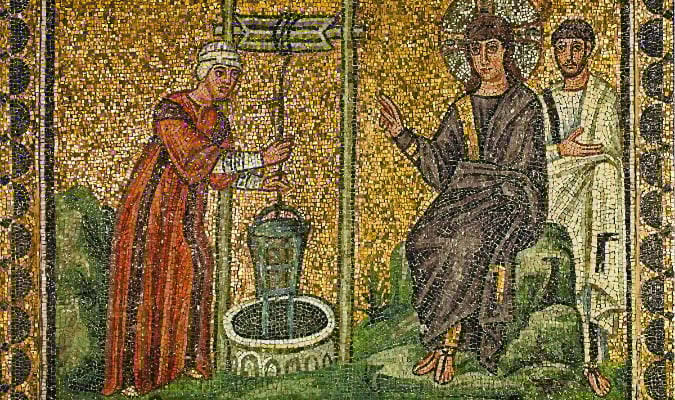
This is one to listen to if you really want to get the meaning – and also a bonus joke from Stuart which made everyone crack up during what was otherwise a serious sermon! Click below.
http://wp.production.patheos.com/blogs/nadiabolzweber/files/2017/03/20170319_Nadia.mp3
Last week I was talking with a friend about the practice of keeping a diary –and I said that, to me, keeping a diary feels way too risky – because I’d always be afraid of someone else getting ahold of it and then knowing the things about myself I would rather keep hidden.
To which she was like, “Are you kidding me? You’ve published way worse things about yourself in your memoirs than I write in my diary – anyone in the whole world can read about your damage”
True. But not the whole truth. I mean that’s the dirty secret of people who are self-revealing – on some level it’s like voluntarily pleading to a misdemeanor so there’s no felony on your record. it’s really just a tightly controlled PR campaign that on the surface looks like it’s the whole truth. But of course it’s not.
So I’ve been thinking about the hidden things in me–– the stuff where I’d rather die than have it come to light….the damage and sin and shame that I can’t admit to – and how that stuff is such a powerful force in my life that it’s like a propeller.
I think I am not alone. I mean, the wounded parts of me –whether those wounds were inflicted by the sin of others or by my own sin, are what keep me in motion – because I have to try and make up for them, or try and convince myself and everyone else that they aren’t there or I have to try and get them healed by the love and attention of other people even though none of that ever works but wow it sure does keep me in motion.
I mean, I think that if shame could be bottled as an energy source it could easily replace fossil fuels.
It’s weird how many novels we can read and films we can watch where a character’s behavior is finally explained by some damage from their past they are trying to make up for and yet it is so hard to admit this in ourselves.
And this is what I was thinking about all week when I thought about the woman at the well. Because I wondered what propelled her toward a well in the heat of the noon sun and not in the cool of the morning which is when women tended to go to the well
Just parenthetically I think it’s important to say that all we know is that she has had 5 husbands and at the time the man she lived with was not her husband. But we don’t know why. Was she a tramp? Was she a victim? The later is so much more likely than the former. And yet the Samaritan woman at the well has been characterized as a whore throughout history. It’s this thing we do with women…they are either virgins or whores and since the Gospels already has Jesus’ mom the virgin role has been cast – so then all the other women must be whores. As a woman, I’m sick to death of it.
[1]Conservative preacher John Piper’s treatment is characteristic. In a sermon on this passage, he describes the woman at the well as “a worldly, sensually-minded, unspiritual harlot from Samaria” but it feels like that kind of detailed assessment of her says so much more about the assessor than the assessed. And I don’t know about you, but if I went the rest of my life without hearing one more woman-hating interpretation of a Bible story I still would have heard too many.
We don’t know why she’d been married so often – maybe she was a teen bride widowed and passed along through a line of her elderly husband’s elderly brothers or maybe she was divorced for being infertile. The least likely thing is if she lured men into her trap, killed them after a year of marriage and just kept getting away with it. But who knows All I know is that no matter if the wound was self-inflicted or inflicted by others or some combination of the two, she had a wound. Like we all do.
And maybe that wound made her want to not be seen by other women.
We don’t know why she was there at noon, but a safe guess is that maybe it’s sort of like why I took my kids to playgrounds at weird off hours. Because while I wanted my kids to be able to play I also very much wanted to avoid the other moms. I would never belong to their club – like I could never relax around them so I thought it best to avoid them. Maybe the Samaritan woman wanted to fill her water jar but also very much wanted to avoid the other women who traditionally would have been there at first light to avoid the heat of the day. Perhaps she couldn’t relax around them. Perhaps she didn’t want to be seen. Because sometimes being seen is painful even if it is also the very thing we really want.
Yet we heard today how the whole plan of not being seen didn’t work out for her. I imagine her lost in her thoughts, the heat of the noon sun pressing down on her, sweat stinging her eyes as she makes out a figure sitting at the well and she takes a deep breath, braces herself, and makes sure to not make eye contact.
Which doesn’t matter because for some reason he starts talking to her. Not only does he chat with a woman (a big no-no) not only does he chat with a woman who is an ethnic outsider (a bigger no-no) not only does he chat with a woman who is an ethnic outsider who has had 5 husbands (there aren’t enough nos for that one) but this is by far the longest conversation Jesus has with anyone in all of the Gospels.
All of that is amazing but what struck me so deeply this week was how when he says to her that he offers her living water that gushes up to eternal life and when she says Give me this water so that I may not thirst he then goes straight for her wound. She says give me this living water and he asks about her husband.
He wasn’t avoiding the subject – he was avoiding the BS.
You want to stop trying to quench your thirst with things that will never satisfy? You want this eternal life then it starts with being seen. It starts with the truth – the naked truth of your original wound and your original beauty and every good and bad thing about you. You have heard it said that water finds it’s lowest point – well**, living water finds your lowest point**
The Living water offered by Jesus Christ finds your lowest point. It flows to your original wound. The thing that you spend so much energy trying to heal through all the insufficient ways – relationships, religion, success, more graduate degrees, more therapy, working out, trying to get your parents to love you more. There are a million ways we try to use substitutes for God to try and make sure our damage is not seen.
I’ve mentioned this several times before but Catholic theologian James Allison describes faith not as intellectually ascending to a set of theological propositions, but he describes faith as relaxing. Relaxing in the love and presence of God in the way we relax in the presence of someone we are certain is fond of us. When we are in the presence of someone we are certain is fond of us, we are funnier, more spontaneous, softer and less defended. If I know for sure someone likes and loves me there is no reason to pretend anything. Allison says faith is relaxing. I think this is what happened to the woman at the well. I think living water found a crack in her defenses and trickled down to her lowest point, her deepest wound, her greatest need and she finally exhaled. In fact, she relaxed so much she totally left her water jar at the well.
I’ve always seen her water jar as a metaphor for what we think will quench our thirst but never does. And Oh my gosh do I have some water jars I need to forget about. Things I think will make me whole, hide my wound, make me loveable – I need those jars to just slip from my hand without even caring they are gone.
Because being known and loved and forgiven in our true form by our true God can quench our spiritual thirst in a way that no amount of success or admiration or romantic love or social justice work ever can. I don’t know why this is God’s economy – that our greatest wound, our deepest shame, our greatest sin is also our greatest gift, our greatest teacher. I just know it is.
This is how seen you are by God, good people: that whatever that lowest point of you is, whatever the deepest wound, the vilest sin, the damaged thing in you is, the living water of Christ’s compassion will find it, can find it, has found it.
You can just leave your jars behind.
Amen.
[1] My thanks to David Lose for this.
Previous Post

January 16, 2017
Sermon on Seeing More Than Just What We Look For
Next Post
August 15, 2017 Lord, Save Me! (A Sermon on Christianity and White Supremacy)
Browse Our Archives
Select a Category Advent baptism Uncategorized
Select a Month January 2018 August 2017 March 2017 January 2017 December 2016 November 2016 October 2016 September 2016 August 2016 July 2016 June 2016 May 2016 April 2016 March 2016 February 2016 January 2016 December 2015 November 2015 September 2015 August 2015 July 2015 June 2015 May 2015 April 2015 March 2015 February 2015 January 2015 December 2014 November 2014 October 2014 September 2014 August 2014 July 2014 May 2014 April 2014 March 2014 February 2014 January 2014 December 2013 November 2013 October 2013 September 2013 August 2013 July 2013 June 2013 May 2013 April 2013 March 2013 February 2013 January 2013 December 2012 November 2012 October 2012 September 2012 August 2012 July 2012 June 2012 May 2012 April 2012 March 2012 February 2012 January 2012 December 2011 August 2011 July 2011
Follow Us!
TAKE THE
Religious Wisdom Quiz
True or False: In John's Gospel, Jesus raises Lazarus from the dead after he had been in the tomb for four days.
Select your answer to see how you score.
TRUE FALSE
Related posts from Nadia Bolz-Weber

My 2018 Speaking Schedule (minus Fall book events)

Lord, Save Me! (A Sermon on Christianity and...
Sermon on Seeing More Than Just What We...
TRENDING AT PATHEOS Progressive Christian

Why Christians Have a Sacred Duty to Vote:...
The Bible offers strong support for the sacred duty to vote. Here...

What Being a Modern-Day Apostle Means to Me
In my last column, I discussed the ins and outs of modern-day...

Did Ancient China Once Worship the God of...
Across human history, a common thread weaves through the origins of the...

Love Your Neighbor – Including Earth-Kin: Lev. 19,...
God’s command to love your neighbor means acting in an ethical and...

Lead a Church Study of “Jesus and Lao...
Guest writer Jack Thomas (The Irreverent Reverend) reflects on leading his church...

Principles for Understanding the Apostolic Ministry Today
Whenever people discover that my formal ministry title is "apostle," as in...
view all Progressive Christian blogs
Ad-Free & Subscriber Log-In Subscription Support
- About Us
- 2026 Calendar
- Videos
- Podcasts
- Library of World Religions
- Faith In Media Tracker
- Advertise With Us
- Write for Us
- Privacy Policy
- Terms of Service
- Do Not Sell My Data
- Contact Us
- Radiant Digital
- Manage Newsletter Subscriptions
- Unsubscribe From Notifications
- Sitemap
Copyright 2008-2026, Patheos. All rights reserved.
Subscription Support Ad-Free & Subscriber Log-In
Follow Patheos