
BuddhistCatholicContemplativeEvangelicalGeneral ChristianHinduJewishLatter-day SaintMuslimNew VisionsProgressive Christian
Beliefs
- Buddhist
- Catholic
- Contemplative
- Evangelical
- General Christian
- Hindu
- Jewish
- Latter-day Saint
- More Voices
- Muslim
- New Visions
- Pagan
- Progressive Christian
Topics
- Religion News
- Food and Religion
- Sports and Religion
- Religious Art
- Religious Music and Entertainment
- Religious Events
- History and Religion
- Style and Religion
- Politics and Religion
- Women in Religion
- Recreation Outdoors and Religion
- Business Finance and Religion
- Careers Workplace and Religion
- Education and Religion
- Family Parenting and Religion
- Health Fitness and Religion
- Home and Religion
- Relationships and Religion
- Technology and Religion
- Travel and Religion
Columnists
- Buddhist Columnists
- Business Finance and Religion Columnists
- Careers Workplace and Religion Columnists
- Catholic Columnists
- Contemplative Columnists
- Education and Religion Columnists
- Evangelists Columnists
- Family Parenting and Religion Columnists
- General Christian Columnists
- Health Fitness and Religion Columnists
- Hindu Columnists
- History and Religion Columnists
- Home and Religion Columnists
- Jewish Columnists
- More Voices Columnists
- Latter Day Columnists
- Muslim Columnists
- New Visions Columnists
- Nonreligious Columnists
- Pagan Columnists
- Politics and Religion Columnists
- Progressive Columnists
- Recreation Outdoors and Religion Columnists
- Relationships and Religion Columnists
- Religion News Columnists
- Religious Art Columnists
- Religious Events Columnists
- Religious Music and Entertainment Columnists
- Sports and Religion Columnists
- Style and Religion Columnists
- Technology and Religion Columnists
- Travel and Religion Columnists
- Women in Religion Columnists
Resource Library
- 2026 Calendar
- Library of World Religions
- The 100 Most Holy Places on Earth
- Patheos Answers
- Podcasts
- Videos
- Faith Leaders Database
- Anglican Episcopalian
- Bahai
- Baptist
- Buddhism
- Christianity
- Confucianism
- Eastern Orthodoxy
- Hinduism
- Holiness and Pentecostal
- ISKCON
- Islam
- Judaism
- Lutheran
- Methodist
- The Church of Jesus Christ of Latter-day Saints
- New Age
- Paganism
- Presbytarian and Reformed
- Protestantism
- Religion Behind the Scenes
- Roman Catholic
- Scientology
- Shia Islam
- Sikhism
- Sufism
- Sunni Islam
- Taoism
- Zen
- See all religions
Research Tools
 Ad-Free & Subscriber Log-In Subscription Support
Ad-Free & Subscriber Log-In Subscription Support
Follow Patheos 

- Trending:
- Forgiveness
- |
- Marriage
- |
- Consciousness
- |
- Death Penalty
- |
- Election
- |
- Halloween

- Home
- General Christian
- Relationships and Religion
- “I Am Going to Do Something New, Now It Will Spring Up!”
“I Am Going to Do Something New, Now It Will Spring Up!”
Last updated on: May 19, 2025 at 7:00 am by Rick Rice
“I Am Going to Do Something New, Now It Will Spring Up!” 2025-05-18T14:58:42-04:00 Rick Rice
Patheos Explore the world's faith through different perspectives on religion and spirituality! Patheos has the views of the prevalent religions and spiritualities of the world.
Part I of “Springtime Scriptures”
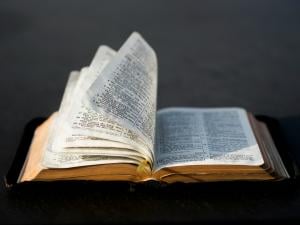
Photo by Aaron Burden on Unsplash
This week, I’m taking a look at some “Springtime Scriptures.” These five passages all deal with different aspects of God’s work of re-creating. Just as Spring brings new life and new hope, so God brings new spiritual life and vitality to those who are open to His work! Today’s passage deals with God’s promise to “do something new” in bringing the Israelites home from exile in Babylon.
This is what the Lord your Redeemer, the Holy One of Israel, says: “For your sake I have sent Babylon, and will bring them all down as fugitives, even the Chaldeans, into ships over which they rejoice. I am the Lord, your Holy One, the Creator of Israel, Your King.”
This is what the Lord says, He who makes a way through the sea and a path through the mighty waters, who brings out the chariot and the horse, the army and the mighty man (they will lie down together and not rise again; they have been extinguished, and have gone out like a wick): “Do not call to mind the former things, or consider things of the past. Behold, I am going to do something new, now it will spring up; will you not be aware of it? I will even make a roadway in the wilderness, rivers in the desert. The animals of the field will glorify Me, the jackals and the ostriches, because I have given waters in the wilderness and rivers in the desert, to give drink to My chosen people. The people whom I formed for Myself will declare My praise.” (Isaiah 43:14-21)
Isaiah’s Prophecies of the Coming Messiah
The book of Isaiah is quoted over forty times in the New Testament. Only the book of Psalms is quoted more often. Most Christians are familiar with the passages from Isaiah that predict the birth of the Messiah, like Isaiah 7:14 (“the virgin will conceive and bear a Son”) or Isaiah 9:6-7 (“unto us a Child is born, unto us a Son is given…He will be called Wonderful Counselor, Mighty God, Everlasting Father, Prince of Peace…”). We also recognize the “Song of the Suffering Servant” (Isaiah 52:13 – 53:12), which predicts the suffering and death of Jesus. Christians should be careful, however, not to limit their study of Isaiah to those particular passages. In truth, the overall message of Isaiah reminds us of God’s love for His people and the ways He works for their good.
The context of the passage I’ve set out above is God’s commentary on the punishment of His people. After the division of the kingdom of Israel following Solomon’s death, the people of Israel and Judah (the two kingdoms) drifted into idolatry. God warned them against that, but they did not listen. Eventually, the northern kingdom fell to the Assyrian Empire around 722 BC. Despite that warning, Judah went down the same path, and fell to Babylon. The conquest of Judah culminated with the fall of Jerusalem in about 586 BC.
Note about Interpretations of Isaiah
Bible scholars have different views on the formation and structure of Isaiah. Some divide the book into “First” [or “Proto”], “Second” [or “Deutero”], and “Third” [“Trito”] Isaiah. These sections are generally held to be chapters 1-39, 40-55, and 56-66. I will not go into the foundations of these positions, nor will I comment on their validity. I generally try to take Scripture as it has come down to us. Because the book of Isaiah is a unity in our Bible, I view it that way.
Something New: A New Kind of Deliverer
Isaiah 43 begins with a reminder that Israel were God’s people. Isaiah uses the familiar phrase “This is what the Lord says” in verse 1 – the first of three occurrences in this chapter. “This is what the Lord says, He who is your Creator, Jacob, and He who formed you, Israel: ‘Do not fear, for I have redeemed you; I have called you by name; you are Mine!’” Isaiah is either looking ahead to God’s redemption of the people from the Exile (if you adopt a traditional view) or recounting how God worked to redeem them (the “Deutero-Isaiah” view). (My comments will adopt the traditional view that Isaiah is prophesying events that had not yet taken place.)
That brings us to the passage at hand, verses 14-21. In verses 14-15, God identifies Himself in several ways:
- “Your Redeemer”
- “The Holy One of Israel”
- “Your Holy One”
- “The Creator of Israel”
- “Your King”
God thus establishes His credibility. Because He created them and redeemed them from bondage in Egypt, they can trust Him.
God then proceeds to remind them of the way that He redeemed them in the past:
- “He who makes a way through the sea and a path through the mighty waters” (parting the Red Sea)
- “Who brings out the chariot and the horse, the army and the mighty man” (leading Pharaoh and his army out to pursue Israel and be destroyed).
From the time of the Exodus, God’s people had remembered the ways that He worked to deliver them from bondage. God is now reminding them of something they already knew.
“Forget the Former Things…I Am Going to Do Something New”
But then God does something remarkable; He tells them to forget about all that! “Do not call to mind the former things, or consider things of the past.” There is a difference between remembering God’s faithfulness and expecting God to “do an encore.” In his book Letters to Malcolm, C. S. Lewis said, “It would be rash to say that there is any prayer that God never grants. But the strongest candidate is the prayer that we might express in the single word encore. And how should the Infinite repeat Himself? All space and time are too little for Him to utter Himself into once.”
Forget the former things; “behold, I am going to do something new.” Their coming deliverance would not be like the Exodus; God would work in a completely different way. Instead of raising up a deliverer like Moses from among them, God would use King Cyrus of Persia to conquer Babylon and allow the Israelites to return to their homeland. And that’s exactly what happened.
Something New: God’s Chosen Servant
But that’s not all that happened. You see, God was also going to “do something new” in sending His Servant. Originally, God had intended that Israel would be His servant, to make Him known among the nations of the world. Unfortunately, Israel did not fulfill that calling. So in Isaiah 40-55, God inspires Isaiah to proclaim four “servant songs” about the One who was to come. The first of those songs, Isaiah 42:1-9, indicates that God has “put My Spirit upon Him” to bring forth justice. “He will not cry out nor raise His voice, nor make His voice heard in the street. A bent reed He will not break off and a dimly burning wick He will not extinguish” (Isaiah 42:2-3). Does that sound familiar? Matthew quotes this passage in reference to Jesus’ ministry (Matthew 12:18-21). Just as Isaiah prophesied, Jesus came to “bring justice to the nations” (Isaiah 42:3) and to be “a light to the nations” (Isaiah 42:6).
The second servant song, Isaiah 49:1-13, specifically talks about the Servant proclaiming and bringing God’s salvation to all people. “It is too small a thing that You should be My Servant to raise up the tribes of Jacob and to restore the protected ones of Israel; I will also make You a light of the nations so that My salvation may reach to the end of the earth” (Isaiah 49:6). Something new, indeed!
The Suffering Servant
The other two servant songs indicate one of the ways that this Servant’s ministry will be a “something new.” Instead of being welcomed and cheered by the people He came to save, He would be rejected:
- “I gave My back to those who strike Me, and My cheeks to those who pull out My beard; I did not hide My face from insults and spitting. For the Lord God helps Me, therefore, I am not disgraced; therefore, I have made My face like flint, and I know that I will not be ashamed” (Isaiah 50:6-7).
- “He was despised and abandoned by men, a man of great pain and familiar with sickness; and like one from whom people hide their faces, He was despised, and we had no regard for Him. However, it was our sicknesses that He Himself bore, and our pains that He carried; yet we ourselves assumed that He had been afflicted, struck down by God, and humiliated. But He was pierced for our offenses, He was crushed for our wrongdoings; the punishment for our well-bring was laid upon Him, and by His wounds we are healed” (Isaiah 53:4-5).
Something New: God’s Son Brings Spiritual Life
God indeed was going to do a something new! The Son of God came as the Suffering Servant. He gave His life for us: “crushed for our wrongdoings…by His wounds we are healed.” No one had ever heard of such a thing! People today still struggle with the idea that God’s Son would come and die for us – or even need to come and die for us. “We’re not that bad! I’m a good person; why would Jesus need to come and die for me?” Isaiah challenges such thinking in the next verse: “All of us, like sheep, have gone astray, each of us has turned to his own way” (Isaiah 53:6).
The New Testament confirms this. Why would John the Baptist have to call people to “repent” if we “aren’t that bad”? If we’re not that bad, why would Jesus proclaim the same message – and then die to make our new life possible? Why would Paul tell us that “all have sinned and fall short of the glory of God” (Romans 3:23) if we “aren’t that bad”?
He wouldn’t; we are that bad. “There is no righteous person, not even one” (Romans 3:10). Every one of us has gone astray; every one of us needs the forgiveness and life that Jesus makes available. In the coming of Jesus, God indeed did “something new” – and He’s still doing it. And it’s the greatest thing ever!
Evangelical
Education and Religion
Previous Post
May 9, 2025
Mom's Influence: Faith Lessons from My Mom
Next Post

May 20, 2025 "If Anyone is in Christ, This Person Is a New Creation"
Recent Comments
"Well constructed thoughts and article, Rick. Unfortunately, it's hard to get found and read without ..."
Is Religious Freedom Necessary for World ..."
"Constantine's conquering in the sign of the Cross is ill-placed on this list as that ..."
Is Religious Freedom Necessary for World ..."
"Excellent thought, read more. The multi-faceted infinite divine includes infinite perspectives. I appreciated the book, ..."
Books Every Christian Should Read
"There are also some good fiction books that I have read that I would recommend. ..."
Books Every Christian Should Read
Browse Our Archives
Select a Category Prayer Spiritual Formation Uncategorized
Select a Month September 2026 August 2026 July 2026 January 2026 December 2025 October 2025 September 2025 August 2025 July 2025 June 2025 May 2025 February 2025 January 2025 December 2024 November 2024 October 2024 September 2024 August 2024 July 2024 June 2024 May 2024 April 2024 February 2024 January 2024 December 2023 November 2023 October 2023 September 2023 August 2023 July 2023 June 2023 May 2023 April 2023 March 2023 February 2023 January 2023 December 2022 November 2022 October 2022 September 2022 August 2022
Follow Us!
TAKE THE
Religious Wisdom Quiz
Who threw Daniel into the lion’s den?
Select your answer to see how you score.
King Darius Pharaoh King Nebuchadnezzar King Saul
Related posts from My Journey

God Makes His Home With Us. We Follow...

God Makes His Home Among His People

What Does It Mean to Say "Home Is...

5 Ways People Misunderstand the Old Testament
TRENDING AT PATHEOS General Christian

57th Dove Awards Honor Dolly Parton, Crown New...
On gospel music’s biggest night, the 57th annual GMA Dove Awards honored...

The First Eucharistic Controversy: Christ’s Real Presence
For Catholics, the Eucharist is the source and summit of the Christian...

What a Stop Sign Can Teach Us About...
How to Make a Decision When You Can't Hear God Main point:...

Archdiocese Hosts Military Marriage Retreat in Germany
RASTATT, Germany — The transient military lifestyle, with its frequent deployments and...

Nearly every morning, I make the drive to Detroit with my high-school-age...

The Real AI Story Is Adoption Without Trust
Artificial intelligence has crossed a political threshold. It is no longer a...
view all General Christian blogs
What Are Your Thoughts?leave a comment
Ad-Free & Subscriber Log-In Subscription Support
- About Us
- 2026 Calendar
- Videos
- Podcasts
- Library of World Religions
- Faith In Media Tracker
- Advertise With Us
- Write for Us
- Privacy Policy
- Terms of Service
- Do Not Sell My Data
- Contact Us
- Radiant Digital
- Manage Newsletter Subscriptions
- Unsubscribe From Notifications
- Sitemap
Copyright 2008-2026, Patheos. All rights reserved.
Subscription Support Ad-Free & Subscriber Log-In
Follow Patheos