
BuddhistCatholicContemplativeEvangelicalGeneral ChristianHinduJewishLatter-day SaintMuslimNew VisionsProgressive Christian
Beliefs
- Buddhist
- Catholic
- Contemplative
- Evangelical
- General Christian
- Hindu
- Jewish
- Latter-day Saint
- More Voices
- Muslim
- New Visions
- Pagan
- Progressive Christian
Topics
- Religion News
- Food and Religion
- Sports and Religion
- Religious Art
- Religious Music and Entertainment
- Religious Events
- History and Religion
- Style and Religion
- Politics and Religion
- Women in Religion
- Recreation Outdoors and Religion
- Business Finance and Religion
- Careers Workplace and Religion
- Education and Religion
- Family Parenting and Religion
- Health Fitness and Religion
- Home and Religion
- Relationships and Religion
- Technology and Religion
- Travel and Religion
Columnists
- Buddhist Columnists
- Business Finance and Religion Columnists
- Careers Workplace and Religion Columnists
- Catholic Columnists
- Contemplative Columnists
- Education and Religion Columnists
- Evangelists Columnists
- Family Parenting and Religion Columnists
- General Christian Columnists
- Health Fitness and Religion Columnists
- Hindu Columnists
- History and Religion Columnists
- Home and Religion Columnists
- Jewish Columnists
- More Voices Columnists
- Latter Day Columnists
- Muslim Columnists
- New Visions Columnists
- Nonreligious Columnists
- Pagan Columnists
- Politics and Religion Columnists
- Progressive Columnists
- Recreation Outdoors and Religion Columnists
- Relationships and Religion Columnists
- Religion News Columnists
- Religious Art Columnists
- Religious Events Columnists
- Religious Music and Entertainment Columnists
- Sports and Religion Columnists
- Style and Religion Columnists
- Technology and Religion Columnists
- Travel and Religion Columnists
- Women in Religion Columnists
Resource Library
- 2026 Calendar
- Library of World Religions
- The 100 Most Holy Places on Earth
- Patheos Answers
- Podcasts
- Videos
- Faith Leaders Database
- Anglican Episcopalian
- Bahai
- Baptist
- Buddhism
- Christianity
- Confucianism
- Eastern Orthodoxy
- Hinduism
- Holiness and Pentecostal
- ISKCON
- Islam
- Judaism
- Lutheran
- Methodist
- The Church of Jesus Christ of Latter-day Saints
- New Age
- Paganism
- Presbytarian and Reformed
- Protestantism
- Religion Behind the Scenes
- Roman Catholic
- Scientology
- Shia Islam
- Sikhism
- Sufism
- Sunni Islam
- Taoism
- Zen
- See all religions
Research Tools
 Ad-Free & Subscriber Log-In Subscription Support
Follow Patheos 

- Trending:
- Advent
- |
- Forgiveness
- |
- Thanksgiving
- |
- Election
- |
- Seasonal Holidays
- |
- Marriage

- Home
- General Christian
- Relationships and Religion
- 5 Observations on Prayer
5 Observations on Prayer
Last updated on: May 4, 2023 at 10:55 am by Rick Rice
5 Observations on Prayer 2023-05-04T10:55:29-04:00 Rick Rice
Patheos Explore the world's faith through different perspectives on religion and spirituality! Patheos has the views of the prevalent religions and spiritualities of the world.
Five Observations on Prayer
Today is the National Day of Prayer. The first Thursday in May has been celebrated as the National Day of Prayer since 1988, when President Ronald Reagan designated that day. However, the tradition of a national call to prayer dates to colonial times. It is customary for the President to issue a proclamation each year recognizing the National Day of Prayer. Consistent with the history of the United States and its constitutional guarantees of freedom of religion, the National Day of Prayer is not limited to any particular faith.
- So what is prayer?
- How many people in the United States actually pray on a regular basis?
- What sort of things do they pray about?
- Why do they pray?
Because I am a Christian pastor and write from the Christian perspective, after addressing these subjects, I’ll conclude with a consideration of what the Bible says about prayer.
1. What is Prayer?
According to www.dictionary.com, prayer is “(1) A devout petition to God or an object or worship. (2) A spiritual communion with God or an object of worship, as in supplication, thanksgiving, adoration, or confession.”
From the Christian perspective, prayer is communication with God. Because it is “communication,” it should involve both speaking and listening. Many examples of prayer in Scripture involve both speaking to and hearing from God. Cite to my article from May 1.
2. How many people engage in prayer?
A recent survey commissioned by Skylight during April 2023 found that 61 percent of Americans reported that they pray. 12-61-percent-americans-pray-SL
(More information relating to this survey is available at https://prayerwrap.skylight.org/) If we use the 2021 U.S. population figure of approximately 332 million, that means just over 200 million people acknowledge that they pray. But what does that mean?
How much do people pray? According to the Skylight survey, the average amount of prayer per day among those who said that they pray was 18 minutes. 07-average-prayer-SL Now, lest we think that this statistic is skewed because it involves people of all faiths, the Pew Research Center survey in 2014 found that only 68% of Christians pray daily (https://www.pewresearch.org/religion/religious-landscape-study/christians/christian/frequency-of-prayer/).
3. What do they pray about?
Interestingly, the top three subjects that people pray for all relate to other people, not themselves. 18-what-americans-pray-for-SL 76% pray for loved ones in crisis; 71% pray for someone else who is ill; and 68% pray for others who are in crisis situations.

This graphic gives further detail about what people pray about. The percentages of people who pray about things for themselves are interesting for several reasons. First, the percentages decline with the perceived severity of the event which prompted the prayer. For example, 56% prayed “when I was ill,” while only 30% prayed “to do well on a test or exam.” (I exclude the prayer “to overcome an addiction” from this assessment. Obviously, addictions are very serious; however, I assume the lower percentage is the result of fewer people who have addictions praying regularly.)
4. Why do people pray?
The next graphic lists reasons why people pray, rather than what they pray about. 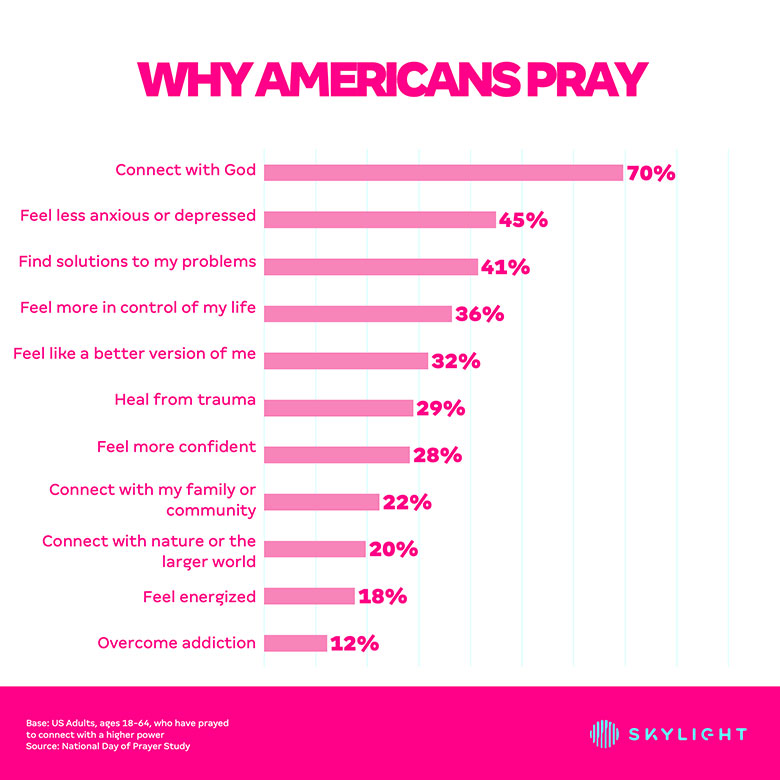
The number one reason people pray is to “connect with God” (70%), which is consistent with a “traditional” view of prayer. Interestingly, the fourth most popular response was “feel more in control of my life” (36%), which seems to me to contradict the whole idea of prayer. If prayer is “a devout petition to God or an object of worship,” that would imply seeking help from someone greater than oneself (a “higher power”). If we need help from a higher power, how does that make us more in control?
I would suggest that this slide really shows the diversity of prayer and belief in our country. Several of these responses reflect what most people would consider “traditional” views of prayer:
- Connect with God
- Find solutions to my problems
- Heal from trauma
- Connect with my family or community
- Overcome addiction
Most traditional religious views of prayer would acknowledge all of these as “good” reasons to pray. The other responses, however, demonstrate a more self-oriented view of prayer. These responses show that people pray to feel:
- Less anxious or depressed
- More in control of my life
- Like a better version of me
- More confident
- More connected with nature or the larger world
- Energized
The common element in all of these is the word “feel.” Rather than seeking direction and help from a higher power, these pray-ers are motivated by how prayer makes them feel about themselves.
Now, there’s nothing wrong with feeling better when we pray; but is that really a proper motivation for our prayers? And is it consistent with the previous data which indicated that the top three things that people pray for are all related to other people?
5. What does the Bible say about prayer?
All of this brings me to the Bible, and what the Bible says about prayer. Now, there’s clearly no way that I can present a comprehensive view of what the Bible says about prayer in one article. However, Scripture teaches some basic principles about prayer – principles which help to explain the Christian view of prayer.
Jesus Expects that We Will Pray
First, Jesus clearly anticipates that his followers will pray. In fact, the most famous prayer in Scripture is the one he taught his disciples – the Lord’s Prayer. We find this prayer in Matthew 6:9-13 (a shorter version is found in Luke 11:2-4): “Pray, then, in this way: Our Father, who is in heaven, hallowed be Your name. Your kingdom come, Your will be done, on earth as it is in heaven. Give us this day our daily bread. And forgive us our debts, as we also have forgiven our debtors. And do not lead us into temptation, but deliver us from evil.” (Matthew 6:9-13, NASB).
As noted, Jesus anticipates that his disciples will pray: Pray, then, in this way is an imperative statement. Prayer is not an option for disciples (even though our practice may indicate otherwise). He also expects that we will pray every day. We are to pray for our “daily bread,” for forgiveness, and for God’s direction and protection. Finally, and perhaps even more importantly, we are to pray each day for God’s will to be done so that His Kingdom will come in its fullness.
Jesus Wants Us to Understand that We’re Praying to Our Heavenly Father
Second, Jesus wants his followers to understand that they are not praying to an impersonal “power”; they are praying to their Heavenly Father. Later in the Sermon on the Mount, Jesus says, “So if you, despite being evil, know how to give good gifts to your children, how much more will your Father in heaven give good things to those who ask Him!” (Matthew 7:11, NASB).
Prayer Is an Ongoing Conversation with God
Third, the apostle Paul encourages us to view prayer as an ongoing conversation with God. In a list of short statements instructing believers how to live, he says: “Rejoice always, pray without ceasing, in everything give thanks; for this is the will of God for you in Christ Jesus” (1 Thessalonians 5:16-18, NASB). “Pray without ceasing” must mean something other than “talk non-stop,” because it would be impossible for us to do that (after all, we have to eat and sleep). Also, a call to “talk non-stop” would be directly in conflict with Jesus’ reminder to not “keep on babbling” when we pray (Matthew 6:7, NIV).
Prayer Is Our Ministry to Each Other
Finally, James calls us to pray for one another, not only for ourselves. “Is anyone among you suffering? Then he must pray. Is anyone cheerful? He is to sing praises. Is anyone among you sick? Then he must call for the elders of the church and they are to pray over him, anointing him with oil in the name of the Lord; and the prayer of faith will restore the one who is sick, and the Lord will raise him up, and if he has committed sins, they will be forgiven him. Therefore confess your sins to one another, and pray for one another so that you may be healed. A prayer of a righteous person, when it is brought about, can accomplish much” (James 5:13-16, NASB).
Conclusion:
So what does all of this tell us? First, that many people of various faiths believe in prayer. One interesting fact that emerged from the Skylight survey is that people prayed more during the COVID lockdowns than before – and they have continued to pray more since the lockdowns ended. During the lockdowns, 82% either prayed the same amount or more; 80% indicated that their spiritual connections either stayed the same or increased following the lockdowns.
Second, the primary reasons that people pray are not selfish; people are praying for others, not themselves. This indicates that most people who pray sense that the focus of true prayer is outward – toward God and others – rather than inward.
Third, for my Christian brothers and sisters, this survey is a wake-up call. We need to devote ourselves to prayer (“pray without ceasing”). Interceding for others is a privilege; God invites us to participate in His Kingdom work by praying for each other. Satan tries to convince us that prayer is a burden, just as he tries to convince us that other gifts from God are burdens (worship, reading Scripture, fellowship, just to name a few). Commitment to prayer will help us to recognize the gifts that God has given us – gifts that “do not lead us into temptation, but deliver us from evil.”
The prayer of a righteous person can accomplish much!
Evangelical
Religious Events
Previous Post

May 3, 2023
How Do We Know When God Is Speaking?
Next Post

May 5, 2023 Making Room for God's Will
Recent Comments
"Well constructed thoughts and article, Rick. Unfortunately, it's hard to get found and read without ..."
Is Religious Freedom Necessary for World ..."
"Constantine's conquering in the sign of the Cross is ill-placed on this list as that ..."
Is Religious Freedom Necessary for World ..."
"Excellent thought, read more. The multi-faceted infinite divine includes infinite perspectives. I appreciated the book, ..."
Books Every Christian Should Read
"There are also some good fiction books that I have read that I would recommend. ..."
Books Every Christian Should Read
Browse Our Archives
Select a Category Prayer Spiritual Formation Uncategorized
Select a Month November 2026 October 2026 September 2026 August 2026 July 2026 January 2026 December 2025 October 2025 September 2025 August 2025 July 2025 June 2025 May 2025 February 2025 January 2025 December 2024 November 2024 October 2024 September 2024 August 2024 July 2024 June 2024 May 2024 April 2024 February 2024 January 2024 December 2023 November 2023 October 2023 September 2023 August 2023 July 2023 June 2023 May 2023 April 2023 March 2023 February 2023 January 2023 December 2022 November 2022 October 2022 September 2022 August 2022
Follow Us!
TAKE THE
Religious Wisdom Quiz
What is the Jewish ritual bath called?
Select your answer to see how you score.
Matzah Mikveh Shofar Mezuzah
Related posts from My Journey

Why Do We Sometimes Feel Forsaken by God?


Is It Okay to Pray for Your Team...

TRENDING AT PATHEOS General Christian
Jesus is Coming with Glory and Power
https://www.youtube.com/watch?v=_lt60EDHOQ4&list=RD_lt60EDHOQ4&start_radio=1

The Late Francis Frangipane & the Failure Too...
I learned today that another one of my heroes has gone to...

Thomas Paine, the Smiths, the apostles in England,...
I'm pleased to announce that the Becoming Brigham Black Friday Sale,...

CatholicTV Series: Six Black Catholics on Path to...
WATERTOWN, Mass., November 9, 2026 – In recognition of Black Catholic History...

New Advent Journal Invites Catholics to Be Pilgrims
Florissant, MO, November 16, 2026— What if Advent were more than a...

INNER CIRCLE: John's Quantum Gospel
INTRODUCTION In this next Inner Circle series, which I anticipate will...
view all General Christian blogs
What Are Your Thoughts?leave a comment
Ad-Free & Subscriber Log-In Subscription Support
- About Us
- 2026 Calendar
- Videos
- Podcasts
- Library of World Religions
- Faith In Media Tracker
- Advertise With Us
- Write for Us
- Privacy Policy
- Terms of Service
- Do Not Sell My Data
- Contact Us
- Radiant Digital
- Manage Newsletter Subscriptions
- Unsubscribe From Notifications
- Sitemap
Copyright 2008-2026, Patheos, part of the Radiant Digital network of media brands. All rights reserved.
Subscription Support Ad-Free & Subscriber Log-In
Follow Patheos