
BuddhistCatholicContemplativeEvangelicalGeneral ChristianHinduJewishLatter-day SaintMuslimNew VisionsProgressive Christian
Beliefs
- Buddhist
- Catholic
- Contemplative
- Evangelical
- General Christian
- Hindu
- Jewish
- Latter-day Saint
- More Voices
- Muslim
- New Visions
- Pagan
- Progressive Christian
Topics
- Religion News
- Food and Religion
- Sports and Religion
- Religious Art
- Religious Music and Entertainment
- Religious Events
- History and Religion
- Style and Religion
- Politics and Religion
- Women in Religion
- Recreation Outdoors and Religion
- Business Finance and Religion
- Careers Workplace and Religion
- Education and Religion
- Family Parenting and Religion
- Health Fitness and Religion
- Home and Religion
- Relationships and Religion
- Technology and Religion
- Travel and Religion
Columnists
- Buddhist Columnists
- Business Finance and Religion Columnists
- Careers Workplace and Religion Columnists
- Catholic Columnists
- Contemplative Columnists
- Education and Religion Columnists
- Evangelists Columnists
- Family Parenting and Religion Columnists
- General Christian Columnists
- Health Fitness and Religion Columnists
- Hindu Columnists
- History and Religion Columnists
- Home and Religion Columnists
- Jewish Columnists
- More Voices Columnists
- Latter Day Columnists
- Muslim Columnists
- New Visions Columnists
- Nonreligious Columnists
- Pagan Columnists
- Politics and Religion Columnists
- Progressive Columnists
- Recreation Outdoors and Religion Columnists
- Relationships and Religion Columnists
- Religion News Columnists
- Religious Art Columnists
- Religious Events Columnists
- Religious Music and Entertainment Columnists
- Sports and Religion Columnists
- Style and Religion Columnists
- Technology and Religion Columnists
- Travel and Religion Columnists
- Women in Religion Columnists
Resource Library
- 2026 Calendar
- Library of World Religions
- The 100 Most Holy Places on Earth
- Patheos Answers
- Podcasts
- Videos
- Faith Leaders Database
- Anglican Episcopalian
- Bahai
- Baptist
- Buddhism
- Christianity
- Confucianism
- Eastern Orthodoxy
- Hinduism
- Holiness and Pentecostal
- ISKCON
- Islam
- Judaism
- Lutheran
- Methodist
- The Church of Jesus Christ of Latter-day Saints
- New Age
- Paganism
- Presbytarian and Reformed
- Protestantism
- Religion Behind the Scenes
- Roman Catholic
- Scientology
- Shia Islam
- Sikhism
- Sufism
- Sunni Islam
- Taoism
- Zen
- See all religions
Research Tools
 Ad-Free & Subscriber Log-In Subscription Support
Ad-Free & Subscriber Log-In Subscription Support
Follow Patheos 

- Trending:
- Forgiveness
- |
- Marriage
- |
- Consciousness
- |
- Death Penalty
- |
- Election
- |
- Halloween
 Muslimah Next Door
- Home
- Muslim
- What Does Being “Unapologetically Muslim” Mean?
What Does Being “Unapologetically Muslim” Mean?
Last updated on: March 27, 2018 at 1:43 pm by Dilshad Ali
What Does Being “Unapologetically Muslim” Mean? 2018-03-27T13:43:28-04:00 Dilshad Ali
Patheos Explore the world's faith through different perspectives on religion and spirituality! Patheos has the views of the prevalent religions and spiritualities of the world.
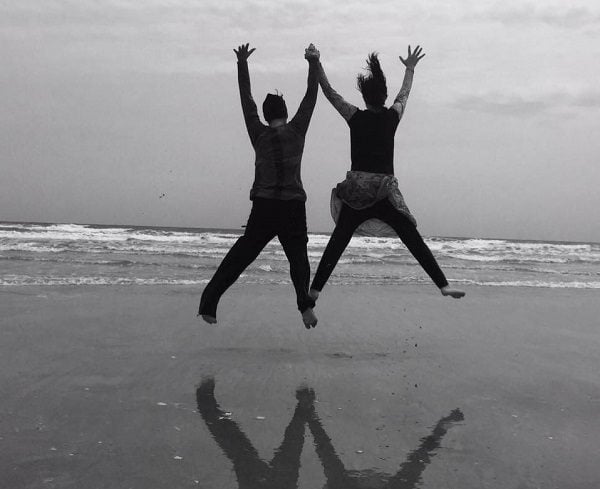
A and I jumping for joy last year at the beach.
What does it mean to be “unapologetically Muslim?” Does it mean to be a loud and proud Muslim in every aspect of one’s life? Does it mean to be publicly Muslim – touting one’s Muslim-ness in every aspect of their life? Isn’t faith something to be practiced privately, between one and one’s God? And, what does it mean to teach one’s children to be unapologetically Muslim? As parents, are we pushing what our belief systems are on our children without leaving room for healthy questioning, choice and growth? Should there be room for healthy questioning, choice and growth?
Last week, an essay I penned for The Atlantic titled “Raising My Kids to be Unapologetic American Muslims” was published as part of their Parenting in an Uncertain Age series. I am proud of the piece and happy with the way it turned out through its editing iterations. As a journalist and editor for nearly two decades, it was refreshing to be back in the writer’s seat being edited by someone else, editors who helped shape my words and flesh out what I wanted to say. Also as a writer, I realized that you cannot say everything you want to say in a freelance piece that leaves questions unanswered and thoughts unexplored.
Luckily, I have this blog where I can delve into things a little deeper.
The first thing I want to mention is when I pitched this piece and wrote it, I added some text in there to remind readers that this is, indeed, a personal narrative and speaking to the stories of immigrant, first generation and second generation Muslims families, predominantly brown. There are so many other challenging American Muslim parenting stories out there that I want the general public to read – especially stories of Black Muslim American families that are unique and so important for us to hear. That part got cut out on the editing room floor.
Secondly, a lot of comments (that didn’t outright tear into me with rude and crude insults and threats of internment camps) posed some interesting questions – mainly about what being “unapologetically Muslim” or a “loud Muslim” means. In the essay I write:
I thought back to what my folks would try and convey to me in how they raised me, encouraged me, and in what they did and didn’t allow me to do. We assimilated wherever my parents felt it appropriate—watching college hockey games on Friday and Saturday nights with the whole of Grand Forks, joining the track team in junior high (still wearing my sweats), playing in band and jazz band. The practice of our faith was also maintained, with (among other things) gathering for our ritual prayers as a family at home and maintaining a halal diet in a landscape where buying halal meat and products was an enormous challenge. But in some ways, our religion was something we did quietly. The hijab was hardly seen back then, at least in the Midwestern communities I frequented. “Be unapologetically Muslim” was not something I heard at all growing up. The message was to be quietly, not loudly, Muslim.
But it’s different today. I am teaching my children to be unapologetically Muslim and American. That they have as much right to be who they are outwardly and inwardly as anyone else in this country. That they are responsible for themselves and to be good citizens and human beings of this country and this earth. That they do not need to be apologetic for whatever evils and transgressions others may commit in their cruel twisting of the Muslim faith.
When I say — regarding what I’m hearing now in my reporting and from American Muslim parents — about the message more so being conveyed to kids is to be loudly, not quietly, Muslim, it’s not a statement of volume, per se. It’s about inner strength and conviction to be true to oneself, not be ashamed of oneself, and — depending on the situation — not hiding any part of oneself. It’s not about touting one’s Muslim-ness in all public spheres.
When I was in school, admittedly I skipped whatever prayers came up during school hours and would either make them up when I got home or just conveniently not do them. (Muslims are to pray five times a day at particular times.) I’ll admit — praying five times a day when I was a kid amid a sea of people who didn’t have the same prayer rituals incorporated into their lives — didn’t have a hold on me. It took time for me to grow closer to my faith and figure out how I wanted my faith to be driving force in my life. It’s a journey I’m still on and will be on until I die.
I am raising my kids within the folds of our Islamic faith, but for them too, it is a journey. But in their journey, I am trying to instill more confidence and self worth. My nieces, mentioned in The Atlantic essay, have joined an MSA (Muslim Student Association) at their high school where they don’t discuss religion in school or do any proselytizing, but it helps them find a place to pray and organize activities where they give back to the community or bring in dynamic speakers. Upon hearing this, my daughter and other nieces decided they wanted to have an MSA at their school and took it up with their guidance counselors.
My daughter, about a week ago, requested a prayer mat from me and took that, and a headscarf (she doesn’t wear one on the regular) and stored it in her guidance counselor’s office, where they can go to pray. I don’t know if she does her prayers all the time — they’re kids, after all — but it warms me to my bones that she felt strong enough about herself to make that private ask in her school.
That’s one thing I mean by raising kids to be unapologetically Muslim.
Other people have asked me about choice versus indoctrination. Inevitably, as parents, we are raising our kids by the social, moral, religious (or non-religious), political and humanity-driven constructs that are important to us. Do children have the freedom to question us or push back against what doesn’t jive with them? That varies from family to family. I can tell you that in our house, we talk about a lot of things, and it’s not always religion. Some of us love cricket, others soccer or NCAA basketball every time March Madness rolls around. I have a soft spot for the grunge rock of the 90s, my daughter is currently in a Taylor Swift-state of mind (don’t ask). We have some shows we like to watch, books we like to read, things we like to do. We eat dinner virtually every night as a family, and I sing songs to the kids every chance I get to embarrass them and make myself laugh.
We talk about current events and politics (as deemed appropriate) in our home and try and instill a good sense of charity and humility. We make sure that our kids know that we don’t have all the answers. And yes, we discuss things about Islam that don’t make sense to us at times. We talk about faith in Allah, what that means, and what do we do with the questions we have. My kids question their father and me a lot, more so then I ever did with my parents. At some point, my kids will be adults and out of my home. How and if they practice their faith will be between them and God. I have my hopes for them and will always be there to advise and guide them, but they will live their lives.
One last thing that hardly got discussed in my essay was autism, which wasn’t the focus of the essay. But, if you are a reader of this blog, you know that pretty much everything in our family’s lives are shaped by our eldest son’s autism living. There are books to write about that. In the virtual pages of this blog, I have written books about it.
So, if you want to get to know us, and me better, it’s all right here. Loud, proud, warts, faith, autism and all.
Previous Post

March 15, 2018
Guardianship and the Rights of Adulthood
Next Post
April 3, 2018 Are We Making "Punish a Muslim" Day Bigger Than it Deserves to Be?
Browse Our Archives
Select a Category A Global Voice for Autism Autism Awareness Month 2016 Autism Awareness Month 2017 Autism Interlude Hajj and Eid ul Adha Jenin Autism Project Ramadan Three Questions Uncategorized WISE Global Conference
Select a Month November 2018 October 2018 August 2018 June 2018 May 2018 April 2018 March 2018 February 2018 January 2018 December 2017 November 2017 October 2017 September 2017 August 2017 July 2017 June 2017 May 2017 April 2017 March 2017 February 2017 January 2017 December 2016 November 2016 October 2016 September 2016 August 2016 July 2016 June 2016 May 2016 April 2016 March 2016 February 2016 January 2016 December 2015 November 2015 October 2015 September 2015 August 2015 July 2015 June 2015 May 2015 April 2015 March 2015 February 2015 January 2015 December 2014 November 2014 October 2014 September 2014 August 2014 July 2014 June 2014 May 2014 April 2014 March 2014 February 2014 January 2014 December 2013 November 2013 October 2013 September 2013 August 2013 July 2013 June 2013 May 2013 April 2013 March 2013 February 2013 January 2013 December 2012 November 2012 October 2012 September 2012 August 2012 July 2012 June 2012 May 2012 April 2012 March 2012 February 2012 January 2012 December 2011 November 2011 October 2011 September 2011
Follow Us!
TAKE THE
Religious Wisdom Quiz
In 2 Thessalonians, what does Paul say the man of lawlessness will proclaim himself to be?
Select your answer to see how you score.
The Messiah A prophet God King of the world
Related posts from Muslimah Next Door
Catholic Sex Abuse Report - Universal Pain, Sorrow,...
Are We Making "Punish a Muslim" Day Bigger...
Guardianship and the Rights of Adulthood

Muslim, Brown and Disabled - A Potential for...
TRENDING AT PATHEOS Muslim

25 Years Later: How Much Has Changed for...
As we approach the 25th anniversary of September 11th, I’ve found myself...

Podcast: Third Spaces & The Rise of Yemeni...
In the latest episode of The Artistic Foodies Podcast, hosts Abbas...

HalalFest Picks: Best 60 Halal Spots for Super...
Back in 2016, I came up with a list of 29...

Unity Is America’s Strength — Division Is Its...
by Hidayatullah Ahsan When Valentina Gomez, a Republican candidate for Congress in...

Zohran Mamdani and New York’s Fight Against Islamophobia
This past June, against all odds, Zohran Mamdani won the Democratic primary...

What the Fourth of July Means to a...
As we mark another Fourth of July, millions of Americans will celebrate...
view all Muslim blogs
Ad-Free & Subscriber Log-In Subscription Support
- About Us
- 2026 Calendar
- Videos
- Podcasts
- Library of World Religions
- Faith In Media Tracker
- Advertise With Us
- Write for Us
- Privacy Policy
- Terms of Service
- Do Not Sell My Data
- Contact Us
- Radiant Digital
- Manage Newsletter Subscriptions
- Unsubscribe From Notifications
- Sitemap
Copyright 2008-2026, Patheos. All rights reserved.
Subscription Support Ad-Free & Subscriber Log-In
Follow Patheos