
BuddhistCatholicContemplativeEvangelicalGeneral ChristianHinduJewishLatter-day SaintMuslimNew VisionsProgressive Christian
Beliefs
- Buddhist
- Catholic
- Contemplative
- Evangelical
- General Christian
- Hindu
- Jewish
- Latter-day Saint
- More Voices
- Muslim
- New Visions
- Pagan
- Progressive Christian
Topics
- Religion News
- Food and Religion
- Sports and Religion
- Religious Art
- Religious Music and Entertainment
- Religious Events
- History and Religion
- Style and Religion
- Politics and Religion
- Women in Religion
- Recreation Outdoors and Religion
- Business Finance and Religion
- Careers Workplace and Religion
- Education and Religion
- Family Parenting and Religion
- Health Fitness and Religion
- Home and Religion
- Relationships and Religion
- Technology and Religion
- Travel and Religion
Columnists
- Buddhist Columnists
- Business Finance and Religion Columnists
- Careers Workplace and Religion Columnists
- Catholic Columnists
- Contemplative Columnists
- Education and Religion Columnists
- Evangelists Columnists
- Family Parenting and Religion Columnists
- General Christian Columnists
- Health Fitness and Religion Columnists
- Hindu Columnists
- History and Religion Columnists
- Home and Religion Columnists
- Jewish Columnists
- More Voices Columnists
- Latter Day Columnists
- Muslim Columnists
- New Visions Columnists
- Nonreligious Columnists
- Pagan Columnists
- Politics and Religion Columnists
- Progressive Columnists
- Recreation Outdoors and Religion Columnists
- Relationships and Religion Columnists
- Religion News Columnists
- Religious Art Columnists
- Religious Events Columnists
- Religious Music and Entertainment Columnists
- Sports and Religion Columnists
- Style and Religion Columnists
- Technology and Religion Columnists
- Travel and Religion Columnists
- Women in Religion Columnists
Resource Library
- 2026 Calendar
- Library of World Religions
- The 100 Most Holy Places on Earth
- Patheos Answers
- Podcasts
- Videos
- Faith Leaders Database
- Anglican Episcopalian
- Bahai
- Baptist
- Buddhism
- Christianity
- Confucianism
- Eastern Orthodoxy
- Hinduism
- Holiness and Pentecostal
- ISKCON
- Islam
- Judaism
- Lutheran
- Methodist
- The Church of Jesus Christ of Latter-day Saints
- New Age
- Paganism
- Presbytarian and Reformed
- Protestantism
- Religion Behind the Scenes
- Roman Catholic
- Scientology
- Shia Islam
- Sikhism
- Sufism
- Sunni Islam
- Taoism
- Zen
- See all religions
Research Tools
 Ad-Free & Subscriber Log-In Subscription Support
Ad-Free & Subscriber Log-In Subscription Support
Follow Patheos 

- Trending:
- Forgiveness
- |
- Marriage
- |
- Consciousness
- |
- Death Penalty
- |
- Election
- |
- Halloween
 Muslimah Next Door
- Home
- Muslim
- A Barbie Like Me
A Barbie Like Me
Last updated on: November 15, 2017 at 10:03 pm by Dilshad Ali
A Barbie Like Me 2017-11-15T22:03:21-04:00 Dilshad Ali
Patheos Explore the world's faith through different perspectives on religion and spirituality! Patheos has the views of the prevalent religions and spiritualities of the world.
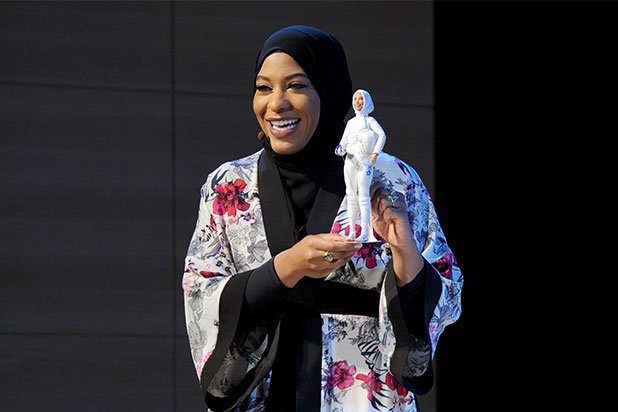
Image source: Twitter
I hadn’t thought about it until today, but now I remember it like it was yesterday.
Fourth grade — my birthday in the mid-1980s. I had invited a bunch of girls from my class over for a birthday party, including the young lady who was the reigning “it girl” in our grade during our elementary school years. I, and my best friend S, were one of the only persons of color in our lily-white small, Midwestern school in North Dakota.
For sure we were the only ones of Indian heritage and the only Muslims. It was quite an experience growing up there, more positive and warm then you’d think expect. But I digress.
Barbie had just come out with a line of “International Barbies,” and Indian Barbie, wearing a sari and the “battu” or “dot” of a Hindu woman, was part of the collection. I was overjoyed. My mom wore saris in family and ethnic gatherings. Heck, my mom had worn saris around the house throughout my toddler years and early childhood before she — as she went back to our local university to get her degree — transitioned to slacks (never jeans) and longer tops (many sewn by herself, as the tunics of now were not really around back then.)
It didn’t matter that the doll was Hindu and not Muslim. My upbringing was Muslim and Indian and American. Her darker skin color shined like a brilliant brown beacon to me. In class, the popular girl told me she was going to get me the doll as a birthday present. When I excitedly told my best friend S, she got upset, saying she had planned to get me the doll as well.
I’d rather have it from you, I told S. We were besties, pushed together by similarities in age, faith and skin color, and we had forged a genuine friendship that began when we were one-years-old that remains to this day. We fasted our first fasts together, which made us even more the outsiders in school, and we were allowed sleepovers at each other’s houses, something both our moms forbid anywhere else. Really, it was a such a blessing, a true miracle that we both happened to be in the same town in the same school — two Muslim brown girls navigating a fun and challenging American upbringing in a hockey-obsessed, winter-laden small town where everybody knew everybody, and thankfully most everybody embraced both our families.
S and I did most everything together — from swimming lessons at the YMCA to playing at each other’s houses to obsessing over Jem and the Holograms (that was her thing, really), to making up stupid games that had us in stitches, to playing Barbies together. For years, S and I had been wrapping our other pale Barbies in long scraps of clothes, fashioning saris for them, or dressing them in the kurta/pyjama sets sewn by our mothers like they sewed for us. (Our moms, especially mine, was none too thrilled by some of the skimpy clothes our Barbies had.)
Now, finally, there was a Barbie with brown skin who was wearing a sari IN THE PACKAGING!
I got that Barbie for my birthday. I couldn’t decide if I should leave her in the box and put her on the shelf for safekeeping, or take her out and arrange her on my dresser for display, or play with her.
Yeah, I played with her.
Representation mattered — and wasn’t seen that much — back then, and it matters now. Barbie continued to come out with other lines of dolls with different skin colors, ethnicities, hailing from other countries, doing other jobs and finally, in recent years, being made in other, more realistic, sizes. Along the way the knock-off Fulla line came out with “Muslim Barbie” dolls (sold at Islamic Society of North America conventions for years) and accessories to appeal to the Muslim girl market, wearing modest clothes and sometimes headscarves. But it wasn’t the same as Barbie.
Of course Barbie is still Barbie — a doll with an impossible figure, overly-huge eyes and an upturned nose who way too many young girls and women emulated over in ways that are unhealthy. But, she’s come a long way from her Malibu-dream house days.
And now, as part of its “Shero” line, Barbie is coming out in 2018 with doll modeled after American Muslim and Olympic medalist fencer Ibtihaj Muhammad – a doll in white fencing gear complete with matching hijab/headscarf. Barbie’s “Shero” line already includes iconic women like Ava DuVernay, Gabby Douglas and Misty Copeland. And, I am excited, just like I was three decades ago when “Indian Barbie” came out. Writes Alana Vagianos in this Huffington Post article:
Muhammad first made headlines during the 2016 Summer Olympics when she became the first Muslim-American woman to wear a hijab while competing for the United States. She was also the first female, Muslim-American athlete to win a medal at the Olympics, bringing home the bronze for sabre fencing.
“Barbie is celebrating Ibtihaj not only for her accolades as an Olympian, but for embracing what makes her stand out,” Vice President of Global Marketing for Barbie Sejal Shah Miller said in a press release. “Ibtihaj is an inspiration to countless girls who never saw themselves represented, and by honoring her story, we hope this doll reminds them that they can be and do anything.”
In 2016, my then 13-year-old and 8-year-old watched Muhammad with great excitement and admiration as she fiercely fenced for America at the Rio de Janeiro Olympic games. We promptly availed a Groupon deal for a month’s worth of introductory fencing lessons, which has now led to more than a year in the sport. Both kids moved on to the intermediate level a few months back, and our Friday nights are now punctuated by lessons at our local fencing club.
My daughter outgrew Barbies a long time ago, but we are both excited to see Muhammad in Barbie form. Yeah, I’ll be buying one. Maybe two. Because representation still matters, especially seeing a strong, proud, athletic, talented Muslimah honored for doing what she does best — slaying.
Previous Post

October 25, 2017
What I Really Want to Say is ...
Next Post

November 28, 2017 Autism, Guardianship and the Words that (Don't) Matter
Browse Our Archives
Select a Category A Global Voice for Autism Autism Awareness Month 2016 Autism Awareness Month 2017 Autism Interlude Hajj and Eid ul Adha Jenin Autism Project Ramadan Three Questions Uncategorized WISE Global Conference
Select a Month November 2018 October 2018 August 2018 June 2018 May 2018 April 2018 March 2018 February 2018 January 2018 December 2017 November 2017 October 2017 September 2017 August 2017 July 2017 June 2017 May 2017 April 2017 March 2017 February 2017 January 2017 December 2016 November 2016 October 2016 September 2016 August 2016 July 2016 June 2016 May 2016 April 2016 March 2016 February 2016 January 2016 December 2015 November 2015 October 2015 September 2015 August 2015 July 2015 June 2015 May 2015 April 2015 March 2015 February 2015 January 2015 December 2014 November 2014 October 2014 September 2014 August 2014 July 2014 June 2014 May 2014 April 2014 March 2014 February 2014 January 2014 December 2013 November 2013 October 2013 September 2013 August 2013 July 2013 June 2013 May 2013 April 2013 March 2013 February 2013 January 2013 December 2012 November 2012 October 2012 September 2012 August 2012 July 2012 June 2012 May 2012 April 2012 March 2012 February 2012 January 2012 December 2011 November 2011 October 2011 September 2011
Follow Us!
TAKE THE
Religious Wisdom Quiz
What does "Jehovah Nissi" mean?
Select your answer to see how you score.
The Lord Saves The Lord is My Banner The Lord is My Provider The Lord is Holy
Related posts from Muslimah Next Door

Enough With the Melania-Headscarf Headlines

Stay Woke: 15 Women and Men on Why...

Burkini Ban has been Overturned in France: 5...

Best Inspirational Moments (IMHO) from First Days of...
TRENDING AT PATHEOS Muslim

25 Years Later: How Much Has Changed for...
As we approach the 25th anniversary of September 11th, I’ve found myself...

Podcast: Third Spaces & The Rise of Yemeni...
In the latest episode of The Artistic Foodies Podcast, hosts Abbas...

HalalFest Picks: Best 60 Halal Spots for Super...
Back in 2016, I came up with a list of 29...

Unity Is America’s Strength — Division Is Its...
by Hidayatullah Ahsan When Valentina Gomez, a Republican candidate for Congress in...

Zohran Mamdani and New York’s Fight Against Islamophobia
This past June, against all odds, Zohran Mamdani won the Democratic primary...

What the Fourth of July Means to a...
As we mark another Fourth of July, millions of Americans will celebrate...
view all Muslim blogs
Ad-Free & Subscriber Log-In Subscription Support
- About Us
- 2026 Calendar
- Videos
- Podcasts
- Library of World Religions
- Faith In Media Tracker
- Advertise With Us
- Write for Us
- Privacy Policy
- Terms of Service
- Do Not Sell My Data
- Contact Us
- Radiant Digital
- Manage Newsletter Subscriptions
- Unsubscribe From Notifications
- Sitemap
Copyright 2008-2026, Patheos. All rights reserved.
Subscription Support Ad-Free & Subscriber Log-In
Follow Patheos