
BuddhistCatholicContemplativeEvangelicalGeneral ChristianHinduJewishLatter-day SaintMuslimNew VisionsProgressive Christian
Beliefs
- Buddhist
- Catholic
- Contemplative
- Evangelical
- General Christian
- Hindu
- Jewish
- Latter-day Saint
- More Voices
- Muslim
- New Visions
- Pagan
- Progressive Christian
Topics
- Religion News
- Food and Religion
- Sports and Religion
- Religious Art
- Religious Music and Entertainment
- Religious Events
- History and Religion
- Style and Religion
- Politics and Religion
- Women in Religion
- Recreation Outdoors and Religion
- Business Finance and Religion
- Careers Workplace and Religion
- Education and Religion
- Family Parenting and Religion
- Health Fitness and Religion
- Home and Religion
- Relationships and Religion
- Technology and Religion
- Travel and Religion
Columnists
- Buddhist Columnists
- Business Finance and Religion Columnists
- Careers Workplace and Religion Columnists
- Catholic Columnists
- Contemplative Columnists
- Education and Religion Columnists
- Evangelists Columnists
- Family Parenting and Religion Columnists
- General Christian Columnists
- Health Fitness and Religion Columnists
- Hindu Columnists
- History and Religion Columnists
- Home and Religion Columnists
- Jewish Columnists
- More Voices Columnists
- Latter Day Columnists
- Muslim Columnists
- New Visions Columnists
- Nonreligious Columnists
- Pagan Columnists
- Politics and Religion Columnists
- Progressive Columnists
- Recreation Outdoors and Religion Columnists
- Relationships and Religion Columnists
- Religion News Columnists
- Religious Art Columnists
- Religious Events Columnists
- Religious Music and Entertainment Columnists
- Sports and Religion Columnists
- Style and Religion Columnists
- Technology and Religion Columnists
- Travel and Religion Columnists
- Women in Religion Columnists
Resource Library
- 2026 Calendar
- Library of World Religions
- The 100 Most Holy Places on Earth
- Patheos Answers
- Podcasts
- Videos
- Faith Leaders Database
- Anglican Episcopalian
- Bahai
- Baptist
- Buddhism
- Christianity
- Confucianism
- Eastern Orthodoxy
- Hinduism
- Holiness and Pentecostal
- ISKCON
- Islam
- Judaism
- Lutheran
- Methodist
- The Church of Jesus Christ of Latter-day Saints
- New Age
- Paganism
- Presbytarian and Reformed
- Protestantism
- Religion Behind the Scenes
- Roman Catholic
- Scientology
- Shia Islam
- Sikhism
- Sufism
- Sunni Islam
- Taoism
- Zen
- See all religions
Research Tools
 Ad-Free & Subscriber Log-In Subscription Support
Ad-Free & Subscriber Log-In Subscription Support
Follow Patheos 

- Trending:
- Forgiveness
- |
- Marriage
- |
- Consciousness
- |
- Death Penalty
- |
- Election
- |
- Halloween
 Muslimah Next Door
- Home
- Muslim
- Reza Aslan’s “Believer” – Seeking Truths & Understandings in an Increasingly Divided World
Reza Aslan’s “Believer” – Seeking Truths & Understandings in an Increasingly Divided World
Last updated on: March 1, 2017 at 1:10 pm by Dilshad Ali
Reza Aslan’s “Believer” – Seeking Truths & Understandings in an Increasingly Divided World 2017-03-01T13:10:12-04:00 Dilshad Ali
Patheos Explore the world's faith through different perspectives on religion and spirituality! Patheos has the views of the prevalent religions and spiritualities of the world.
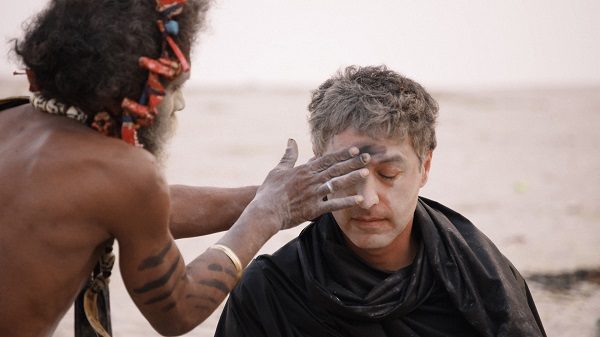
“Believer” with Reza Aslan – Aghori ashes on the forehead.
How do people personally experience religion and faith? Why do they believe what they believe, and is there any way for us to find a connection with people who have vastly different belief systems from our own? Author, scholar and Muslim American Reza Aslan immerses himself into different faiths and faith rituals around the world to explore these and other questions in “Believer,” a new CNN series debuting March 5 at 10 p.m.
In this spiritual adventure series, Aslan dives deep into faiths around the globe, from Scientology in the U.S. to Hindu asceticism in India to Santa Muerte in Mexico to an apocalyptic doomsday cult in Hawaii. By opening himself up to people in these faith traditions and asking them to open themselves up to him, Aslan seeks universal truths that he hopes will help viewers see different people less as “the other” and more as fellow human beings.
I had the pleasure of talking with Aslan about season one of “Believer,” on how this series is different than “faith tourism” and whether acceptance and understanding is possible in an increasingly divided and hostile world.
**********
Why is it most important now to understand belief from a faith perspective? Where has belief led us – people of faith, in what you have seen?
There’s no question that we are in a very divided time, not just in the U.S. but in the world. A lot of that division comes from religious and ethnic bigotry – it has ripped a large swath of our population. It is very easy to point to someone who looks different from us and say they are the “other.” They are not us. In many ways, this show is the antidote to that.
A lot of religions we profile tend to be on the margins, look foreign, exotic and even scary. Hopefully through my immersion, they will start to look a little less scary. Maybe you’ll start to recognize some of your own beliefs. That’s what is really needed most of all — the ability to look beyond the simple labels that separate us into different religions, ethnicities, nationalities.
You have immersed yourself in a variety of faith traditions, from Hindu asceticism in India to a doomsday cult in Hawaii – how did you choose where to go?
We had a long, giant list of religious communities we wanted to explore. — religions that are misunderstood or feared. Other choices were literally what we could get away with. There never has been a show like this before. We didn’t have a template. We figured it out as we were doing it. It was a combination of the things I was interested and the things we could pull off. The hope is that we get a second season, and then the sky’s the limit.
What are you hoping viewers will learn or absorb?
I want the viewer to be entertained. These episodes are fun, emotional and informative. How is religion expressed and understood? The hope is that the audience will start to recognize their own beliefs, the way they think of the world. Once you start to see these individuals as people and less as symbols, they start to make more sense.
The doomsday cult is a perfect example of what we’re talking about. The first time you meet this leader – JeZeus, I would not blame you in thinking this guy is off the clocker. I thought, oh boy, what have I gotten myself into? A few days after being immersed in the group, the second time I was with him I said to him, “No more performing. Just be a person with me.”
He said, “Maybe I’m right, maybe I’m wrong, I don’t know. But I do think that we are on a collision course with catastrophe if we don’t figure out what to do.” Suddenly it doesn’t seem that crazy anymore.
Tell me something that surprised you about yourself as you worked on this series
One of the most surprising aspects for me was when I found myself agreeing intellectually with certain viewpoints, but then struggling when asked to put that belief into some kind of practice. Forcing myself to do these things was quite an emotional thing for me
Do you think it’s possible, though, to really capture the essence of different belief systems by this sort of immersion process? What about those who say it’s like faith tourism?
It’s certainly the case that these experiences are just the beginning. There’s quite a difference from immersing yourself in a community for a couple of weeks and making this your life. I think to the question of is this “religion tourism,” I’d say I’m not there to just observe. I’m there to experience.
These communities, because of what they understood about my desire and my goals, all opened themselves up to me completely. And, some of these communities are completely insular and closed off.
One may say, well, that’s not an authentic experience because you can come home. But the authenticity is not about the length of time one spends, but the connection one has with that community. There was a very real connection between me and the groups that I joined. There was a union. I’m still in touch with them.
Is it possible for viewers completely outside of another’s faith traditions to gain an understanding and appreciation for what another believes? By watching a series like this, can folks move towards that more acceptance of each other?
Not only do I think the case, that is the whole reason I made this series. Through relationships we change our perceptions of each other. Not a lot of people are going to meet the people I met in this series. This will introduce the audience to different faiths and let them experience them through my experience of them. That was the whole point. I do think it happens – a shift in people’s perceptions, changing the way people think. The people who have seen these episodes have all had this experience, coming away thinking, “Ok, that wasn’t as weird as I thought it was. I actually believe a little bit of what they believe.”
What have you learned, or would like us as viewers and seekers to know, about what it means to believe?
This show is for people who have no faith experience as well as people who do. No matter who you are, we all have beliefs. And that those beliefs, despite what a lot of secular minded people would say, shape who we are.
The argument that I have with New Atheist is that atheism is a lack of belief. But atheism is not a lack of belief. It’s a different kind of belief. It’s a belief predicated on an understanding of the nature of the universe. And that understanding is as affected as religious belief is by what tiny bit of knowledge we have about the universe. If we recognize that our beliefs are just as valid as other’s beliefs – they may not be just as rational or based on empirical evidence – but they are just as valid, that is good
Did you discover universal truths in the different belief systems you encountered? Or universal differences?
I don’t think discover is the right word. I’ve been immersed in this search for 20 years. I think the word is “found.” That word is strengthened in my mind. Underneath the different languages and metaphors we use to express our desire for transcendence, it is the same desire. It starts with a recognition that we are whatever else we are – eternal beings. There is something that is about us that goes beyond the material world. That we’re more than just the sum of our bodies. There’s more to it than that.
The single most unifying idea throughout the history of religion is that there is more. There is something beyond. And, certainly in these fixed religious traditions that I focused on, this is an integral part of their belief systems.
They all have this desire to connect with something beyond. A belief that there is more to them, more to this life then something we can experience with our senses.
Previous Post

February 27, 2017
Muslims (Depending on Who You Ask) at Oscars 2017

Browse Our Archives
Select a Category A Global Voice for Autism Autism Awareness Month 2016 Autism Awareness Month 2017 Autism Interlude Hajj and Eid ul Adha Jenin Autism Project Ramadan Three Questions Uncategorized WISE Global Conference
Select a Month November 2018 October 2018 August 2018 June 2018 May 2018 April 2018 March 2018 February 2018 January 2018 December 2017 November 2017 October 2017 September 2017 August 2017 July 2017 June 2017 May 2017 April 2017 March 2017 February 2017 January 2017 December 2016 November 2016 October 2016 September 2016 August 2016 July 2016 June 2016 May 2016 April 2016 March 2016 February 2016 January 2016 December 2015 November 2015 October 2015 September 2015 August 2015 July 2015 June 2015 May 2015 April 2015 March 2015 February 2015 January 2015 December 2014 November 2014 October 2014 September 2014 August 2014 July 2014 June 2014 May 2014 April 2014 March 2014 February 2014 January 2014 December 2013 November 2013 October 2013 September 2013 August 2013 July 2013 June 2013 May 2013 April 2013 March 2013 February 2013 January 2013 December 2012 November 2012 October 2012 September 2012 August 2012 July 2012 June 2012 May 2012 April 2012 March 2012 February 2012 January 2012 December 2011 November 2011 October 2011 September 2011
Follow Us!
TAKE THE
Religious Wisdom Quiz
What was the name of the disciple in Damascus who was sent to pray for Saul after his conversion?
Select your answer to see how you score.
Barnabas Silas Philip Ananias
Related posts from Muslimah Next Door
Catholic Sex Abuse Report - Universal Pain, Sorrow,...

What Does Being "Unapologetically Muslim" Mean?

A Trump Presidency - Conversations with our Children
TRENDING AT PATHEOS Muslim

25 Years Later: How Much Has Changed for...
As we approach the 25th anniversary of September 11th, I’ve found myself...

Podcast: Third Spaces & The Rise of Yemeni...
In the latest episode of The Artistic Foodies Podcast, hosts Abbas...

HalalFest Picks: Best 60 Halal Spots for Super...
Back in 2016, I came up with a list of 29...

Unity Is America’s Strength — Division Is Its...
by Hidayatullah Ahsan When Valentina Gomez, a Republican candidate for Congress in...

Zohran Mamdani and New York’s Fight Against Islamophobia
This past June, against all odds, Zohran Mamdani won the Democratic primary...

What the Fourth of July Means to a...
As we mark another Fourth of July, millions of Americans will celebrate...
view all Muslim blogs
Ad-Free & Subscriber Log-In Subscription Support
- About Us
- 2026 Calendar
- Videos
- Podcasts
- Library of World Religions
- Faith In Media Tracker
- Advertise With Us
- Write for Us
- Privacy Policy
- Terms of Service
- Do Not Sell My Data
- Contact Us
- Radiant Digital
- Manage Newsletter Subscriptions
- Unsubscribe From Notifications
- Sitemap
Copyright 2008-2026, Patheos. All rights reserved.
Subscription Support Ad-Free & Subscriber Log-In
Follow Patheos