
BuddhistCatholicContemplativeEvangelicalGeneral ChristianHinduJewishLatter-day SaintMuslimNew VisionsProgressive Christian
Beliefs
- Buddhist
- Catholic
- Contemplative
- Evangelical
- General Christian
- Hindu
- Jewish
- Latter-day Saint
- More Voices
- Muslim
- New Visions
- Pagan
- Progressive Christian
Topics
- Religion News
- Food and Religion
- Sports and Religion
- Religious Art
- Religious Music and Entertainment
- Religious Events
- History and Religion
- Style and Religion
- Politics and Religion
- Women in Religion
- Recreation Outdoors and Religion
- Business Finance and Religion
- Careers Workplace and Religion
- Education and Religion
- Family Parenting and Religion
- Health Fitness and Religion
- Home and Religion
- Relationships and Religion
- Technology and Religion
- Travel and Religion
Columnists
- Buddhist Columnists
- Business Finance and Religion Columnists
- Careers Workplace and Religion Columnists
- Catholic Columnists
- Contemplative Columnists
- Education and Religion Columnists
- Evangelists Columnists
- Family Parenting and Religion Columnists
- General Christian Columnists
- Health Fitness and Religion Columnists
- Hindu Columnists
- History and Religion Columnists
- Home and Religion Columnists
- Jewish Columnists
- More Voices Columnists
- Latter Day Columnists
- Muslim Columnists
- New Visions Columnists
- Nonreligious Columnists
- Pagan Columnists
- Politics and Religion Columnists
- Progressive Columnists
- Recreation Outdoors and Religion Columnists
- Relationships and Religion Columnists
- Religion News Columnists
- Religious Art Columnists
- Religious Events Columnists
- Religious Music and Entertainment Columnists
- Sports and Religion Columnists
- Style and Religion Columnists
- Technology and Religion Columnists
- Travel and Religion Columnists
- Women in Religion Columnists
Resource Library
- 2026 Calendar
- Library of World Religions
- The 100 Most Holy Places on Earth
- Patheos Answers
- Podcasts
- Videos
- Faith Leaders Database
- Anglican Episcopalian
- Bahai
- Baptist
- Buddhism
- Christianity
- Confucianism
- Eastern Orthodoxy
- Hinduism
- Holiness and Pentecostal
- ISKCON
- Islam
- Judaism
- Lutheran
- Methodist
- The Church of Jesus Christ of Latter-day Saints
- New Age
- Paganism
- Presbytarian and Reformed
- Protestantism
- Religion Behind the Scenes
- Roman Catholic
- Scientology
- Shia Islam
- Sikhism
- Sufism
- Sunni Islam
- Taoism
- Zen
- See all religions
Research Tools
 Ad-Free & Subscriber Log-In Subscription Support
Ad-Free & Subscriber Log-In Subscription Support
Follow Patheos 

- Trending:
- Forgiveness
- |
- Marriage
- |
- Consciousness
- |
- Death Penalty
- |
- Election
- |
- Halloween
 Muslimah Next Door
- Home
- Muslim
- Why We Share – The Power of Our Disability/Different-Ability Narratives
Why We Share – The Power of Our Disability/Different-Ability Narratives
Last updated on: September 9, 2015 at 4:01 pm by Dilshad Ali
Why We Share – The Power of Our Disability/Different-Ability Narratives 2015-09-09T16:01:52-04:00 Dilshad Ali
Patheos Explore the world's faith through different perspectives on religion and spirituality! Patheos has the views of the prevalent religions and spiritualities of the world.
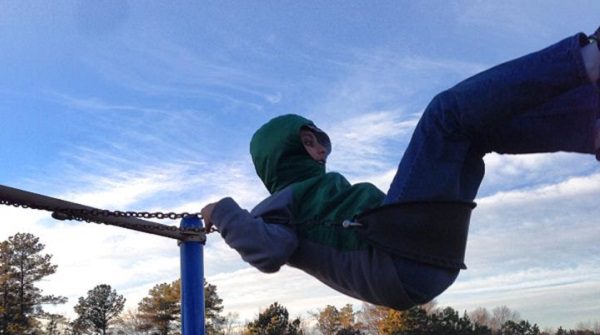
D swinging with all his might.
This past weekend I had the honor of moderating what I thought was the most important panel at the 52nd Annual Islamic Society of North American convention. Our panel was title “Finding Our Voice: Sharing our Disability Experiences to Seek Empowerment and Affect Change,” and featured Inshirah Aleem, an author and woman living with bipolar disorder, Safiyyah Amina Muhammad, a mom to five and fierce autism advocate/community leader, Sara Minkara, founder of Empowerment Through Integration, an international non-profit that integrates blind youth in developing countries into society, who has been blind since the age of seven and renowned scholar Sheikh Omar Suleiman, a co-founder of MUHSEN.
Here is an extended version of my opening remarks about why it’s so important for those living with special needs as well as their loved ones to share our stories, to be public, to no longer hide and to demand the support and respect we deserve.
The truth of it is – it’s very hard to tell the truth of your own story. To share the private details of your life in order to maybe find a little cathartic cleansing, or reach out to others who are feeling alone in their struggles, or to affect change. Living with special needs or disabilities is a special kind of living – more challenging and more real, forcing us to confront hard truths about ourselves and about the world we live in. And, when we then choose to share our stories, we become vulnerable to what the world may think about us.
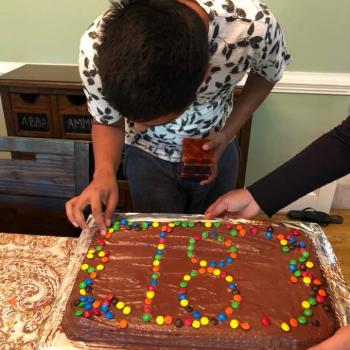
And yet we do it. We must do it. Because in four years of sharing my son’s story and our family’s story, as hard and tricky and difficult as it is, the biggest thing I’ve learned that there is power and beauty in honest and careful sharing. People feel less alone. People learn how to cope and make things better. And powerful change can occur. My 15 year old son D is profoundly autistic. But he has a story to tell and has difficulty telling it himself. And so I will help to tell it.
Some of us who are living with special needs or disabilities share our own stories. We are the owners of what we say, and we fight to see that change happen that needs to happen. Others, caregivers of those lovely souls who have difficulty speaking for themselves, become ghost writers. Our job is even more delicate – because while we cannot truly speak FOR another, we can try and share their stories in a dignified, real, honest and respectful way.
I want you to meet four remarkable individuals, some living with disabilities, or different-abilities, some working to help the special needs community. Some of us own our own stories, others among us are ghostwriters.
And although disability awareness has grown in the Muslim community in the past five years, many Muslim families and individuals living with disabilities still report feeling silenced and unwelcoming, facing stigma, shame and exclusion. In a time when the mantra of the American Muslim community is owning our own narratives and amplifying our concerns to affect change, how do we encourage those with disabilities to raise their voices, and others to listen?
Why is it so important for our voices to be heard? Because there is power and honesty in the sharing of our stories. Because change won’t occur in how we are treated and how our masjids, communities, friends and families see us unless we speak up.
Four years ago, after working as a journalist/editor at the time for a decade, I wrote a very private, very personal essay for Wajahat Ali’s “Spiritual Appetite” Ramadan guest blog on Patheos. It was the first time I had ever written so personally about my son and autism. I wrote these words:
When I see D beating himself, wailing and crying for hours on end, when he exhausts himself to sleep only to wake up and start it all over again, when I see him work so hard to manage his autism, when I see his frustration because I cannot understand him, when I, his mother, cannot fix his problems, then the struggle overwhelms me, and I question Allah. I question my prayers. I question what my fasting means. I question why I cannot seem to give more to Allah.
I ask this question: Is D suffering because I am not good enough in Allah’s eyes?
And it was like opening Pandora’s box. I do not ask that question (well, hardly) anymore. The past four years has been as much about how far D, our family and myself have come in our autism journey as it has been about how far the Muslim community has come.
The other night, while cooking dinner, my husband asked me if I knew anyone through my connections who could give advice about adopting orphans from Syria, that his friend was seriously interested in doing so. I told him I’d have to think and see who could help. We remarked to each other how much we’d like to adopt/take in an orphan as well, if we weren’t so fully engaged and taken up in our parenting responsibilities for D and our other two kids. And my husband said,
That’s what D has taught us, you know? I think that if D wasn’t autistic, if he didn’t have all the challenges and things he has to live with and go through, we wouldn’t be as compassionate as we are now. I mean, I think we’re pretty nice to begin with, but the level of compassion we feel and help we want to give everyone – D taught me that. D taught you that. I think D has taught so many that – how important it is to treat everyone with dignity and respect. How important it is to be compassionate and caring and to help others as much as possible.
It’s true. I really believe it’s true. And, while the struggle has been so much for D and he’s endured so much pain, this has been one of the biggest life lessons. Would I call autism a gift? No. And that’s an entirely separate and complicated post that I may never write. But sharing D’s autism, with his permission (as best as I can get it) has had a profound affect I believe on us and on many others.
And that’s why we share.
That’s why, when Sara said in her talk at the panel, that she has always prayed to God to give to her that which will bring her closer to Him, that her blindness has done that — there was not a dry eye in the audience.
That’s why when Sheikh Omar, who lost his words after hearing Sara speak, said, I would argue that our sister, despite losing her vision, can see a lot better than the rest of us, we all wholeheartedly agreed.
That’s why, when Inshirah said that being vocal and public about her struggle with bipolar disorder has led others who also have bipolar to reach out to her and feel less alone, that the audience nodded in collective agreement.
That’s why when Safiyyah Amina advised the parents and caregivers in the audience to rise up and become advocates for their children and to demand what their children deserve from the school system, from government agencies and from our religious community, so many were nodding.
We will get nowhere unless we share our stories. Because it is through this sharing that we make connections, which leads to thinking, which leads to organizing, which leads to, inshaAllah, positive change.
I share our joys, our daily happiness and our triumphs. I also share (as respectfully as possible because this is D’s story first), the dark days, the hard times, the questions, the struggles and the challenges.
Because it is all real. It is all valid.
And you need to hear it.
To learn more about or to get involved with MUHSEN, click here00000. To learn more about or get involve with Enabled Muslim, click here.
Islamic Society of North America
Previous Post

September 1, 2015
ISNA Disability Narratives - Being a Voice for Advocacy and Change
Browse Our Archives
Select a Category A Global Voice for Autism Autism Awareness Month 2016 Autism Awareness Month 2017 Autism Interlude Hajj and Eid ul Adha Jenin Autism Project Ramadan Three Questions Uncategorized WISE Global Conference
Select a Month November 2018 October 2018 August 2018 June 2018 May 2018 April 2018 March 2018 February 2018 January 2018 December 2017 November 2017 October 2017 September 2017 August 2017 July 2017 June 2017 May 2017 April 2017 March 2017 February 2017 January 2017 December 2016 November 2016 October 2016 September 2016 August 2016 July 2016 June 2016 May 2016 April 2016 March 2016 February 2016 January 2016 December 2015 November 2015 October 2015 September 2015 August 2015 July 2015 June 2015 May 2015 April 2015 March 2015 February 2015 January 2015 December 2014 November 2014 October 2014 September 2014 August 2014 July 2014 June 2014 May 2014 April 2014 March 2014 February 2014 January 2014 December 2013 November 2013 October 2013 September 2013 August 2013 July 2013 June 2013 May 2013 April 2013 March 2013 February 2013 January 2013 December 2012 November 2012 October 2012 September 2012 August 2012 July 2012 June 2012 May 2012 April 2012 March 2012 February 2012 January 2012 December 2011 November 2011 October 2011 September 2011
Follow Us!
TAKE THE
Religious Wisdom Quiz
I found the Book of the Law in the temple during repairs and wept when it was read to me. Who am I?
Select your answer to see how you score.
Josiah Asa Hezekiah Joash
Related posts from Muslimah Next Door
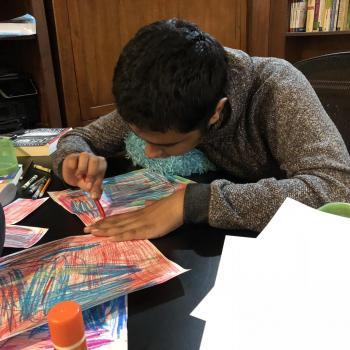
Derailed by My Memories in Autism Land
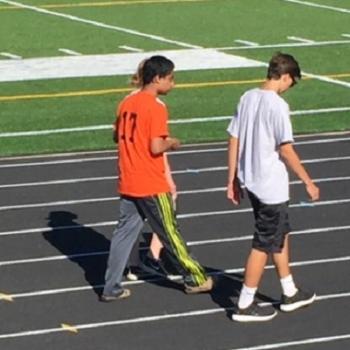
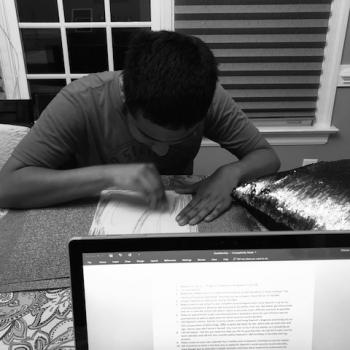
The Year of 25 (Give or Take) Steps...
TRENDING AT PATHEOS Muslim

25 Years Later: How Much Has Changed for...
As we approach the 25th anniversary of September 11th, I’ve found myself...

Podcast: Third Spaces & The Rise of Yemeni...
In the latest episode of The Artistic Foodies Podcast, hosts Abbas...

HalalFest Picks: Best 60 Halal Spots for Super...
Back in 2016, I came up with a list of 29...

Unity Is America’s Strength — Division Is Its...
by Hidayatullah Ahsan When Valentina Gomez, a Republican candidate for Congress in...

Zohran Mamdani and New York’s Fight Against Islamophobia
This past June, against all odds, Zohran Mamdani won the Democratic primary...

What the Fourth of July Means to a...
As we mark another Fourth of July, millions of Americans will celebrate...
view all Muslim blogs
Ad-Free & Subscriber Log-In Subscription Support
- About Us
- 2026 Calendar
- Videos
- Podcasts
- Library of World Religions
- Faith In Media Tracker
- Advertise With Us
- Write for Us
- Privacy Policy
- Terms of Service
- Do Not Sell My Data
- Contact Us
- Radiant Digital
- Manage Newsletter Subscriptions
- Unsubscribe From Notifications
- Sitemap
Copyright 2008-2026, Patheos. All rights reserved.
Subscription Support Ad-Free & Subscriber Log-In
Follow Patheos