
BuddhistCatholicContemplativeEvangelicalGeneral ChristianHinduJewishLatter-day SaintMuslimNew VisionsProgressive Christian
Beliefs
- Buddhist
- Catholic
- Contemplative
- Evangelical
- General Christian
- Hindu
- Jewish
- Latter-day Saint
- More Voices
- Muslim
- New Visions
- Pagan
- Progressive Christian
Topics
- Religion News
- Food and Religion
- Sports and Religion
- Religious Art
- Religious Music and Entertainment
- Religious Events
- History and Religion
- Style and Religion
- Politics and Religion
- Women in Religion
- Recreation Outdoors and Religion
- Business Finance and Religion
- Careers Workplace and Religion
- Education and Religion
- Family Parenting and Religion
- Health Fitness and Religion
- Home and Religion
- Relationships and Religion
- Technology and Religion
- Travel and Religion
Columnists
- Buddhist Columnists
- Business Finance and Religion Columnists
- Careers Workplace and Religion Columnists
- Catholic Columnists
- Contemplative Columnists
- Education and Religion Columnists
- Evangelists Columnists
- Family Parenting and Religion Columnists
- General Christian Columnists
- Health Fitness and Religion Columnists
- Hindu Columnists
- History and Religion Columnists
- Home and Religion Columnists
- Jewish Columnists
- More Voices Columnists
- Latter Day Columnists
- Muslim Columnists
- New Visions Columnists
- Nonreligious Columnists
- Pagan Columnists
- Politics and Religion Columnists
- Progressive Columnists
- Recreation Outdoors and Religion Columnists
- Relationships and Religion Columnists
- Religion News Columnists
- Religious Art Columnists
- Religious Events Columnists
- Religious Music and Entertainment Columnists
- Sports and Religion Columnists
- Style and Religion Columnists
- Technology and Religion Columnists
- Travel and Religion Columnists
- Women in Religion Columnists
Resource Library
- 2026 Calendar
- Library of World Religions
- The 100 Most Holy Places on Earth
- Patheos Answers
- Podcasts
- Videos
- Faith Leaders Database
- Anglican Episcopalian
- Bahai
- Baptist
- Buddhism
- Christianity
- Confucianism
- Eastern Orthodoxy
- Hinduism
- Holiness and Pentecostal
- ISKCON
- Islam
- Judaism
- Lutheran
- Methodist
- The Church of Jesus Christ of Latter-day Saints
- New Age
- Paganism
- Presbytarian and Reformed
- Protestantism
- Religion Behind the Scenes
- Roman Catholic
- Scientology
- Shia Islam
- Sikhism
- Sufism
- Sunni Islam
- Taoism
- Zen
- See all religions
Research Tools
 Ad-Free & Subscriber Log-In Subscription Support
Ad-Free & Subscriber Log-In Subscription Support
Follow Patheos 

- Trending:
- Forgiveness
- |
- Marriage
- |
- Consciousness
- |
- Death Penalty
- |
- Election
- |
- Halloween
 Muslimah Next Door
- Home
- Muslim
- The Srebrenica Genocide and the Bosnian War – Never Forget
The Srebrenica Genocide and the Bosnian War – Never Forget
Last updated on: July 11, 2015 at 3:44 pm by Dilshad Ali
The Srebrenica Genocide and the Bosnian War – Never Forget 2015-07-11T15:44:54-04:00 Dilshad Ali
Patheos Explore the world's faith through different perspectives on religion and spirituality! Patheos has the views of the prevalent religions and spiritualities of the world.
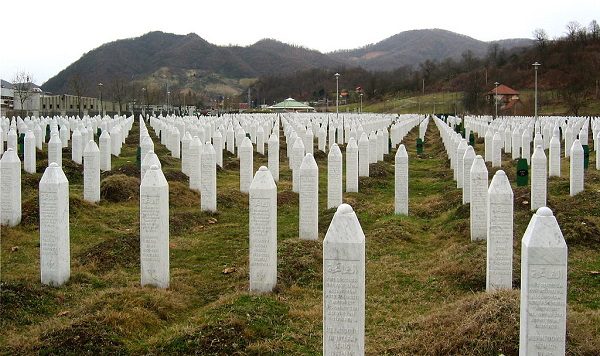
“Srebrenica massacre memorial gravestones 2009 1” by Michael Büker – Own work. Licensed under CC BY-SA 3.0 via Wikimedia Commons
To God we belong and to God we return. Please take the time to say a prayer, for these men and boys, and also for the survivors. So many lives cut short (in the span of 3 days). It’s especially breathtaking (as in, I can’t breathe) when I see DOBs so close to my own. While I was taking exams and learning how to drive, they were murdered in cold blood, a deliberate genocide. Inna lillahi wa inna ilayhi rajioon. – Hind Makki, Patheos Muslim blogger at Hindtrospectives
Twenty years ago, like Hind, I was taking exams and navigating college life. It was a very good, carefree time for me, outside of collegiate, work and academic responsibilities. I had a roof over my head, food to eat, a car to drive and was getting an education. I was enjoying an easy Ramadan in the wintertime, breaking fast on campus with friends, driving home to pray Taraweeh with my parents. We would turn on the news post-Taraweeh to see the horror that was happening across the ocean to fellow Muslims.
Thousands of miles away, 8,000 Muslim men and boys were brutally killed in a horrible genocide, shattering the mantra of “Never Again,” which had been emphatically uttered by so many after genocides before.
I remember vividly my heart breaking 20 years ago. I was studying the Holocaust in my history class at school. At night, we would watch the news and I would see the nearly identical images of emaciated men behind barbed wire, penned in concentration camps bc [sic] of their religious identities. Only what I saw in the news wasn’t history. I vividly remember seeing footage of some of our brothers who escaped the massacre at Srebrenica by hiding in a forest and making their way toward another UN “safe zone.” I vividly remember thinking that “never again” is a lie. – Hind Makki, Facebook status update
Remembering is so, so crucial to our humanity. Remember the cruelties, horrors, genocides of the past. “Never Again” is a lie, because the Holocaust happened. Then a genocide happened in Srebrenica. And others have happened again in other parts of the world.
But “Never Forget” is something we must hold onto tight – digging our nails into a past that must not be forgotten in hopes that we can somehow do better, be better, think better, live better. And even when we fail to do that again and again, we must dig our nails in deeper.
The 20 year “anniversary” coverage of the genocide in Srebrenica (yes, I will call it a genocide) has offered many perspectives and stories worth reading, digesting, understanding and reflecting upon.
From the New York Times, this piece on “Srebrenica Revisited” tells the stories of survivors, of loved ones massacred and of horrible times, like the story of Mr. Avdic:
First, they hid in bushes as Serb paramilitaries marched another group of Muslims to slaughter. Then they resumed their flight, hiding in burned-out houses, even sleeping in a graveyard. After four days, Mr. Avdic’s wounds were infected and he could no longer even crawl. His companion carried him until, at last, they reached Tuzla.
Only a few thousand survived the “death march.” Many were killed by land mines or attacks by Serb forces. Some died of dehydration and sheer exhaustion. A few committed suicide rather than face capture by Serb forces.
To this day, there are many in Bosnia — teachers, municipal officials, police officers — who played a dark part in the mass killings of 1995. Until recently, Serb-dominated schools still proudly displayed pictures of indicted war criminals, including the Bosnian Serb politician Radovan Karadzic and the commander of the Army of Republika Srpska, Gen. Ratko Mladic. Both men are on trial in The Hague for war crimes related to the Srebrenica genocide.
Mr. Avdic lost his father, four uncles, six cousins and at least 20 other relatives in the war. Despite the horrors of Srebrenica, it was also his home, he said, and he refused to be driven from it. He returned to live there in 2007 and is now the father of two girls, ages 3 and 5.
“What kind of future do we have,” he asked, “when my children are taught by people who participated in the massacre itself?”
This article in The Guardian discusses the West’s involvement in the lead-up to the fall of Srebrenica, revealing classified documents and research showing British, American and French governments negotiating to “cede ‘safe area’ town to Serbs.”
Eight thousand Bosnian Muslim men and boys were killed over four days in July 1995 by Bosnian Serb death squads after they took the besieged town, which had been designated a “safe area” under the protection of UN troops. The act has been declared a genocide by the war crimes tribunal in The Hague, and the Bosnian Serb leaders Radovan Karadžic and General Ratko Mladic await verdicts in trials for directing genocide.
Blame has also been placed on Dutch troops, who evicted thousands seeking refuge in their headquarters, and watched while the Serbs separated women and young children from their male quarry.
But a new investigation of the mass of evidence documenting the siege suggests much wider involvement in the events leading to the fall of Srebrenica. Declassified cables, exclusive interviews and testimony to the tribunal show that the British, American and French governments accepted – and sometimes argued – that Srebrenica and two other UN-protected safe areas were “untenable” long before Mladic took the town, and were ready to cede Srebrenica to the Serbs in pursuit of a map acceptable to the Serbian president, Slobodan Miloševic, for peace at any price.
This sobering infographic shows the faces of thousands who died. As you scroll over the faces, you can click to see the victim’s names and ages.
And finally, the Day 24 post by Arnesa Buljusmic-Kustura for the “Hindtrospectives” series on women’s mosque and Ramadan experiences talks about a Ramadan of war – Arnesa’s first time fasting in Bosnia in the winter of 1995, when the war had reached its. Peak. Please stop a minute and read this short and powerful reflection:
That month, I prayed my first taraweeh in the cold basement of a building that before the war might have been a store. It was converted by the people in my neighborhood into a masjid for the month of Ramadan. The building was cold and damp and the people were crowded together for taraweeh and being the only child, I stood out like a sore thumb. My grandmother, who would bring me with her, would receive a scolding from the elders each night for bringing me during such a dangerous time.
But, I did not fear. I figured if I was to be killed it may as well be in a masjid. Besides, I found solace in the way the imam’s prayers echoed throughout the building, growing louder with each word, almost fighting against the shelling. There was something peaceful in the imam’s recitation of the adhan in the midst of the misery that was Sarajevo in 1995. It was during these nights in our little masjid that I found hope.
After every taraweeh, I would make a dua for the shelling and the snipers to stop. I would picture my life as it should have been for a child; carefree with chocolates, toys, and Disney movies and I would beg God to end our suffering. My little masjid became my sanctuary and every step I took towards it and away from the sound of shelling was a step towards sanity.
These are horrible times in our history that we must not forget. Out of them comes stories of utter horror, despair and death, as well as stories of hope, resistance determination and faith. In these last ten days of Ramadan, please pray for our world’s humanity, for “Never Forget” and “Never Again.” If you are of a different faith or not of any faith at all, please still join in these thoughts.
Previous Post

June 16, 2015
How Young is Too Young to Fast?
Browse Our Archives
Select a Category A Global Voice for Autism Autism Awareness Month 2016 Autism Awareness Month 2017 Autism Interlude Hajj and Eid ul Adha Jenin Autism Project Ramadan Three Questions Uncategorized WISE Global Conference
Select a Month November 2018 October 2018 August 2018 June 2018 May 2018 April 2018 March 2018 February 2018 January 2018 December 2017 November 2017 October 2017 September 2017 August 2017 July 2017 June 2017 May 2017 April 2017 March 2017 February 2017 January 2017 December 2016 November 2016 October 2016 September 2016 August 2016 July 2016 June 2016 May 2016 April 2016 March 2016 February 2016 January 2016 December 2015 November 2015 October 2015 September 2015 August 2015 July 2015 June 2015 May 2015 April 2015 March 2015 February 2015 January 2015 December 2014 November 2014 October 2014 September 2014 August 2014 July 2014 June 2014 May 2014 April 2014 March 2014 February 2014 January 2014 December 2013 November 2013 October 2013 September 2013 August 2013 July 2013 June 2013 May 2013 April 2013 March 2013 February 2013 January 2013 December 2012 November 2012 October 2012 September 2012 August 2012 July 2012 June 2012 May 2012 April 2012 March 2012 February 2012 January 2012 December 2011 November 2011 October 2011 September 2011
Follow Us!
TAKE THE
Religious Wisdom Quiz
Who said, "The Spirit of the Lord is upon me"?
Select your answer to see how you score.
Paul Elijah Jesus Isaiah
Related posts from Muslimah Next Door
Supreme Court Ruling Upholds #MuslimBan, but for Muslims,...
An Autistic Ramadan - Dhikr in the Dark,...
On Fighting for #DACA, Migrants, Immigrants, Refugees &...
6 Ways to Connect With the Hajj
TRENDING AT PATHEOS Muslim

25 Years Later: How Much Has Changed for...
As we approach the 25th anniversary of September 11th, I’ve found myself...

Podcast: Third Spaces & The Rise of Yemeni...
In the latest episode of The Artistic Foodies Podcast, hosts Abbas...

HalalFest Picks: Best 60 Halal Spots for Super...
Back in 2016, I came up with a list of 29...

Unity Is America’s Strength — Division Is Its...
by Hidayatullah Ahsan When Valentina Gomez, a Republican candidate for Congress in...

Zohran Mamdani and New York’s Fight Against Islamophobia
This past June, against all odds, Zohran Mamdani won the Democratic primary...

What the Fourth of July Means to a...
As we mark another Fourth of July, millions of Americans will celebrate...
view all Muslim blogs
Ad-Free & Subscriber Log-In Subscription Support
- About Us
- 2026 Calendar
- Videos
- Podcasts
- Library of World Religions
- Faith In Media Tracker
- Advertise With Us
- Write for Us
- Privacy Policy
- Terms of Service
- Do Not Sell My Data
- Contact Us
- Radiant Digital
- Manage Newsletter Subscriptions
- Unsubscribe From Notifications
- Sitemap
Copyright 2008-2026, Patheos. All rights reserved.
Subscription Support Ad-Free & Subscriber Log-In
Follow Patheos