
BuddhistCatholicContemplativeEvangelicalGeneral ChristianHinduJewishLatter-day SaintMuslimNew VisionsProgressive Christian
Beliefs
- Buddhist
- Catholic
- Contemplative
- Evangelical
- General Christian
- Hindu
- Jewish
- Latter-day Saint
- More Voices
- Muslim
- New Visions
- Pagan
- Progressive Christian
Topics
- Religion News
- Food and Religion
- Sports and Religion
- Religious Art
- Religious Music and Entertainment
- Religious Events
- History and Religion
- Style and Religion
- Politics and Religion
- Women in Religion
- Recreation Outdoors and Religion
- Business Finance and Religion
- Careers Workplace and Religion
- Education and Religion
- Family Parenting and Religion
- Health Fitness and Religion
- Home and Religion
- Relationships and Religion
- Technology and Religion
- Travel and Religion
Columnists
- Buddhist Columnists
- Business Finance and Religion Columnists
- Careers Workplace and Religion Columnists
- Catholic Columnists
- Contemplative Columnists
- Education and Religion Columnists
- Evangelists Columnists
- Family Parenting and Religion Columnists
- General Christian Columnists
- Health Fitness and Religion Columnists
- Hindu Columnists
- History and Religion Columnists
- Home and Religion Columnists
- Jewish Columnists
- More Voices Columnists
- Latter Day Columnists
- Muslim Columnists
- New Visions Columnists
- Nonreligious Columnists
- Pagan Columnists
- Politics and Religion Columnists
- Progressive Columnists
- Recreation Outdoors and Religion Columnists
- Relationships and Religion Columnists
- Religion News Columnists
- Religious Art Columnists
- Religious Events Columnists
- Religious Music and Entertainment Columnists
- Sports and Religion Columnists
- Style and Religion Columnists
- Technology and Religion Columnists
- Travel and Religion Columnists
- Women in Religion Columnists
Resource Library
- 2026 Calendar
- Library of World Religions
- The 100 Most Holy Places on Earth
- Patheos Answers
- Podcasts
- Videos
- Faith Leaders Database
- Anglican Episcopalian
- Bahai
- Baptist
- Buddhism
- Christianity
- Confucianism
- Eastern Orthodoxy
- Hinduism
- Holiness and Pentecostal
- ISKCON
- Islam
- Judaism
- Lutheran
- Methodist
- The Church of Jesus Christ of Latter-day Saints
- New Age
- Paganism
- Presbytarian and Reformed
- Protestantism
- Religion Behind the Scenes
- Roman Catholic
- Scientology
- Shia Islam
- Sikhism
- Sufism
- Sunni Islam
- Taoism
- Zen
- See all religions
Research Tools
 Ad-Free & Subscriber Log-In Subscription Support
Ad-Free & Subscriber Log-In Subscription Support
Follow Patheos 

- Trending:
- Forgiveness
- |
- Marriage
- |
- Consciousness
- |
- Death Penalty
- |
- Election
- |
- Halloween
 Muslimah Next Door
- Home
- Muslim
- From Access to Belonging – On the ADA and the Muslim Special Needs and Disability Community’s Journey
From Access to Belonging – On the ADA and the Muslim Special Needs and Disability Community’s Journey
Last updated on: July 28, 2015 at 1:13 pm by Dilshad Ali
From Access to Belonging – On the ADA and the Muslim Special Needs and Disability Community’s Journey 2015-07-28T13:13:43-04:00 Dilshad Ali
Patheos Explore the world's faith through different perspectives on religion and spirituality! Patheos has the views of the prevalent religions and spiritualities of the world.
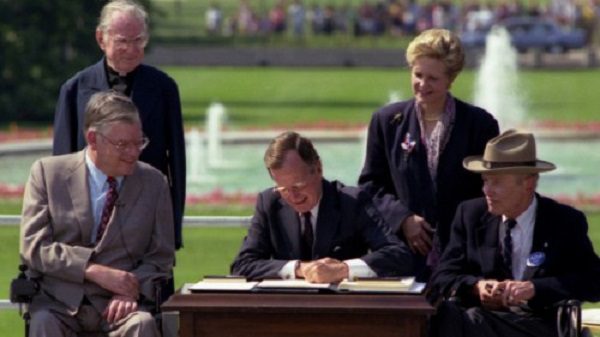
President George H.W. Bush signing the American Disabilities Act into law 25 years ago.
This weekend I was honored to participate and speak at an event organized by the Interfaith Disability Advocacy Coalition — “From Access to Belonging: An Interfaith Service Celebrating the Progress and Promise of the ADA.” It is part of several events happening in Washington D.C. and around the country to honor the 25th anniversary of the signing of the Americans with Disability Act, a landmark piece of legislation. It’s interesting that the ADA, which holds most of our public life accountable to equal treatment, support and access for those with disabilities, is exempt for Houses of Worship, except in the state of California.
I was asked to provide a Muslim perspective on the journey from access to belonging for those with special needs and disabilities. And so that’s what I tried to do, with the following personal reflection I read at the event. I wish it could’ve been my son, D, who spoke. And though I can’t purport to speak entirely for him or the thousands of Muslims living with special needs and disabilities, I can offer this perspective.
I spent a lot of time, when my eldest son was younger, to try and find our place in our local mosque. My son, who is now on the cusp of turning 15, is autistic, nonverbal, though not non-communicative, and has some really profound challenges. It wasn’t that I thought he would benefit from being at the mosque or included in mosque activities – though I know better than to presume I definitively know what he will or will not benefit from – but I felt strongly that he has a right to be there.
And by him being included, by us as a family feeling welcome, I knew that would facilitate my feeling like we could go to the mosque on a regular basis. Because I wanted my other children to find their place there, to become regular attendants of services and programs held at our mosque. I wanted us to be able to go as a family.
I wanted us to be included.
But that wasn’t to be.
And, it’s not that D needs the mosque. In a series of 30 posts I wrote in April for Autism Awareness Month this year, I wrote this:
This I know about D – he is more Muslim, more perfectly human, more true than anyone else I know. He is beyond the rituals of Islam. Without putting his forehead once on the prayer mat, without ever feeling once the pangs of hunger of a Ramadan fast, without giving a penny in zakat (charity), without ever reading one word of the Quran and without ever enduring the hardships of the Hajj pilgrimage – he is the embodiment of the best of Islam, the best of faith, the best of humanity.
D doesn’t need the mosque. But the mosque needs him. The mosque needs everyone like him – anyone with any type of special need or disability and their whole family. To teach our Muslim community that we all belong. We deserve to be included.
Moving from Access to Belonging – the Americans with Disabilities Act
When the American Disabilities Act was signed into law by President George H.W. Bush in 1990, I was beginning high school. Thinking about disabilities and the lives lived by those with special needs or disabilities was the furthest thing from my mind. My only experiences was with the kids from the self-contained special education class in my junior high, in that there was no shared experiences. They were self-contained, we were regular students, and never the twain shall meet.
It was only when I had my first child, and that child at the age of three was diagnosed with autism, that things got very real all of a sudden. And the harder we strove as a family to find our path, find our way forward, the more we realized what we were up against within our own cultural and faith community.
We’re here today to talk about, among other things, how we’ve moved from access to belonging as different faith communities in the 25 years since the American Disabilities Act became law. But I feel for the Muslim community, we are just now moving past the on-ramp into the highway of movement. For us, it started with acceptance, it started with the sharing of our narratives, it started with working to dismantle stigmas and stereotypes surrounding disabilities and special needs.
Nearly five years ago, I started writing about our autism journey, chronicling my son’s story as well as ours as a family. The premise was that I needed to speak. I needed to know that we were not alone in this as a Muslim family living with special needs. I needed others to know it was ok to be real, to be honest, to demand change, to push for our rights of accessibility in our lives as well as in our faith community, and to feel like we belonged – just as much as any other family.
From that time, I’ve seen a change start to grow. In looking back at my own writing in chronicling how the Muslim community is supporting, or failing to include those with special needs and disabilities, I can see the slow evolution of change. In April of 2013, during Autism Awareness Month, I wrote:
I saw a growing sentiment amongst members of my autism tribe – that Autism Awareness Month is a has-been. If 1 in 50 school age kids have ASD, then we are well past the stage of making people aware of autism and must focus on acceptance and action.
That’s great. I’m all for that. Except that when it comes to the American Muslim community and beyond, we are nowhere near action. We are light years behind action. We are in the beginning stages of awareness. For a community well versed in fighting against Islamophobia, in running sophisticated campaigns to combat NYPD surveillance of Muslims or to reclaim the meaning of the word “Jihad,” engaging in social and political activism, hotly debating topics like homosexuality in Islam, equality in marriage, providing better space for women in our mosques, even whether “breathable” nail polish really is *wudu-*friendly – what are we doing for our Muslim families dealing with special needs?
We are committed to owning our own narratives and taking action in many worthy arenas. But what about the most vulnerable in our communities? What of their families? What about the spiritual struggles of families with special needs — embracing them, including them, connecting them to resources, helping them in the myriad of ways that they need help? What are we doing for Muslims dealing with special needs?
Several months later, following the first time I was honored with speaking at the Islamic Society of North America in a panel discussion about disability inclusion, I wrote this:
This needs to change: Attitudes – of those at the masjids in their acceptance of special needs families and individuals as well as attitudes of our imams, sheikhs, muftis and other religious leaders. I recall listening to a lecture once by Imam Khalid Latif about counseling people who come to him with tough issues and problems – how to answer those “Why me? Why us? Why did this happen? What is God’s plan?” type of questions. He related the story of a young women who came to him telling of abuse she had endured.
And he didn’t know what to say. He had to be careful of what he said.
This is so true. There are times when I am approaching rock bottom in my faith practices, and when I seek help, the last thing I want to hear is “God only put as much burden upon you as you can handle.” Or, “God has a reason, a plan for everything.” Or, “special kids for special people.” Or, “Trust in Allah.” Or even that Quranic phrase that normally provides me with such comfort: “Verily with hardship there is ease. Verily with hardship there is ease.”
There are days those work – those ayats and phrases are exactly what we need. Then there are days those words will just push me over the edge. Our imams and religious leaders and scholars, those who lead our masjids and communities, are taking steps to better counsel and help their community members. Please learn more and make these efforts for special needs families and individuals, too. And please don’t tell us autism or whatever disability (intellectual or otherwise) we (or our loved one) are dealing with is because of some evil or a jinn or something. Advising us of prayers to read or Quranic verses to recite is good and needed, but please don’t infer that a disability is somehow coming from something bad.
From that point, as the awareness grew and more Muslim families began publically sharing their experiences, many of us realized that while we were helping each other find acceptance and know our rights regarding special education, IEPs, Medicaid waivers and disability access, we needed to figure out ways to reach out to more Muslims with disabilities and their families.
Comprehensive Efforts for Disability Inclusion and Awareness in the Muslim Community
Some groups were leading the way with special events geared towards the Muslim disabled and special needs population – like the Muslim American Society DC chapter’s special needs Eid events, which have been going on for about four years. Global Deaf Muslims is another group that made great inroads to bringing about awareness and inclusion for those in the deaf community. But we were lacking a real comprehensive effort to push for a large-scale changing of attitudes and priorities as well as supports, mentoring and services.
One year ago at the 2014 ISNA convention, I saw a real turning point for us as a Muslim community, a community so far behind our faithful counterparts in this area. Two new Muslim-led organizations were launched to specifically address the needs of Muslims with disabilities and special needs and facilitate ways to push inclusion and build support and mentoring networks. This was our push towards accessibility and belonging.
Enabled Muslim, an online portal of spiritual and community support that was spearheaded by my friend Maggie Siddiqui and is a project of American Muslim Health Professionals, was launched after months of research, surveying and consulting. For the first time there is now an online gathering spot for services, support networks and mentor across the U.S. and across disabilities/special needs. At the same time, MUHSEN, which stands for Muslims Understanding and Helping Special Education Needs, was also launched with a focus on creating pilot programs of inclusion for mosques. They made some great headway this past Ramadan, putting together a special option for Eid prayers for those with special needs in the Chicago area, as well as offering a “MUHSEN fast pass” to help those with disabilities attending a major Chicago-area Eid festival.
In the year since these groups launched, there has been a flurry of movement and activity, as we sprint to catch up to those of us ahead in this journey of access to belonging.
Because really, those two points – the starting point and the finishing point – if there can ever be a finishing point in this story, are interwoven for us as a Muslim community, and for all of us as an interfaith community.
If the spirit of the American Disabilities Act is to provide the legal rights and backing for those with special needs and disabilities to have equal access and the same opportunities, as the ADA website says, “to participate in the mainstream of American life – to enjoy employment opportunities, to purchase goods and services and to participate in State and local government programs and services,” then that spirit holds for what we must be doing as a Muslim community, as an entire faith community.
We have a long way to go and a lot of work ahead of us to make this a priority among the many goals we have and challenges our community faces. But making sure that Muslims with disabilities and special needs have access to mosques, programs and events and a sense of belonging is something that is as important to our Ummah and our spiritual health as anything else.
My son doesn’t need the mosque or the Muslim community.
But the mosque and community need him. And that will be our way forward.
Americans with Disabilities Act
Previous Post

July 11, 2015
The Srebrenica Genocide and the Bosnian War - Never Forget
Next Post
August 3, 2015 Islam, Therapy Dogs and Autism - In Search of a Constant Companion
Browse Our Archives
Select a Category A Global Voice for Autism Autism Awareness Month 2016 Autism Awareness Month 2017 Autism Interlude Hajj and Eid ul Adha Jenin Autism Project Ramadan Three Questions Uncategorized WISE Global Conference
Select a Month November 2018 October 2018 August 2018 June 2018 May 2018 April 2018 March 2018 February 2018 January 2018 December 2017 November 2017 October 2017 September 2017 August 2017 July 2017 June 2017 May 2017 April 2017 March 2017 February 2017 January 2017 December 2016 November 2016 October 2016 September 2016 August 2016 July 2016 June 2016 May 2016 April 2016 March 2016 February 2016 January 2016 December 2015 November 2015 October 2015 September 2015 August 2015 July 2015 June 2015 May 2015 April 2015 March 2015 February 2015 January 2015 December 2014 November 2014 October 2014 September 2014 August 2014 July 2014 June 2014 May 2014 April 2014 March 2014 February 2014 January 2014 December 2013 November 2013 October 2013 September 2013 August 2013 July 2013 June 2013 May 2013 April 2013 March 2013 February 2013 January 2013 December 2012 November 2012 October 2012 September 2012 August 2012 July 2012 June 2012 May 2012 April 2012 March 2012 February 2012 January 2012 December 2011 November 2011 October 2011 September 2011
Follow Us!
TAKE THE
Religious Wisdom Quiz
True or False: Joseph's brothers sold him to traders for thirty pieces of silver.
Select your answer to see how you score.
TRUE FALSE
Related posts from Muslimah Next Door
Derailed by My Memories in Autism Land
The Year of 25 (Give or Take) Steps...
TRENDING AT PATHEOS Muslim

25 Years Later: How Much Has Changed for...
As we approach the 25th anniversary of September 11th, I’ve found myself...

Podcast: Third Spaces & The Rise of Yemeni...
In the latest episode of The Artistic Foodies Podcast, hosts Abbas...

HalalFest Picks: Best 60 Halal Spots for Super...
Back in 2016, I came up with a list of 29...

Unity Is America’s Strength — Division Is Its...
by Hidayatullah Ahsan When Valentina Gomez, a Republican candidate for Congress in...

Zohran Mamdani and New York’s Fight Against Islamophobia
This past June, against all odds, Zohran Mamdani won the Democratic primary...

What the Fourth of July Means to a...
As we mark another Fourth of July, millions of Americans will celebrate...
view all Muslim blogs
Ad-Free & Subscriber Log-In Subscription Support
- About Us
- 2026 Calendar
- Videos
- Podcasts
- Library of World Religions
- Faith In Media Tracker
- Advertise With Us
- Write for Us
- Privacy Policy
- Terms of Service
- Do Not Sell My Data
- Contact Us
- Radiant Digital
- Manage Newsletter Subscriptions
- Unsubscribe From Notifications
- Sitemap
Copyright 2008-2026, Patheos. All rights reserved.
Subscription Support Ad-Free & Subscriber Log-In
Follow Patheos