
BuddhistCatholicContemplativeEvangelicalGeneral ChristianHinduJewishLatter-day SaintMuslimNew VisionsProgressive Christian
Beliefs
- Buddhist
- Catholic
- Contemplative
- Evangelical
- General Christian
- Hindu
- Jewish
- Latter-day Saint
- More Voices
- Muslim
- New Visions
- Pagan
- Progressive Christian
Topics
- Religion News
- Food and Religion
- Sports and Religion
- Religious Art
- Religious Music and Entertainment
- Religious Events
- History and Religion
- Style and Religion
- Politics and Religion
- Women in Religion
- Recreation Outdoors and Religion
- Business Finance and Religion
- Careers Workplace and Religion
- Education and Religion
- Family Parenting and Religion
- Health Fitness and Religion
- Home and Religion
- Relationships and Religion
- Technology and Religion
- Travel and Religion
Columnists
- Buddhist Columnists
- Business Finance and Religion Columnists
- Careers Workplace and Religion Columnists
- Catholic Columnists
- Contemplative Columnists
- Education and Religion Columnists
- Evangelists Columnists
- Family Parenting and Religion Columnists
- General Christian Columnists
- Health Fitness and Religion Columnists
- Hindu Columnists
- History and Religion Columnists
- Home and Religion Columnists
- Jewish Columnists
- More Voices Columnists
- Latter Day Columnists
- Muslim Columnists
- New Visions Columnists
- Nonreligious Columnists
- Pagan Columnists
- Politics and Religion Columnists
- Progressive Columnists
- Recreation Outdoors and Religion Columnists
- Relationships and Religion Columnists
- Religion News Columnists
- Religious Art Columnists
- Religious Events Columnists
- Religious Music and Entertainment Columnists
- Sports and Religion Columnists
- Style and Religion Columnists
- Technology and Religion Columnists
- Travel and Religion Columnists
- Women in Religion Columnists
Resource Library
- 2026 Calendar
- Library of World Religions
- The 100 Most Holy Places on Earth
- Patheos Answers
- Podcasts
- Videos
- Faith Leaders Database
- Anglican Episcopalian
- Bahai
- Baptist
- Buddhism
- Christianity
- Confucianism
- Eastern Orthodoxy
- Hinduism
- Holiness and Pentecostal
- ISKCON
- Islam
- Judaism
- Lutheran
- Methodist
- The Church of Jesus Christ of Latter-day Saints
- New Age
- Paganism
- Presbytarian and Reformed
- Protestantism
- Religion Behind the Scenes
- Roman Catholic
- Scientology
- Shia Islam
- Sikhism
- Sufism
- Sunni Islam
- Taoism
- Zen
- See all religions
Research Tools
 Ad-Free & Subscriber Log-In Subscription Support
Ad-Free & Subscriber Log-In Subscription Support
Follow Patheos 

- Trending:
- Forgiveness
- |
- Marriage
- |
- Consciousness
- |
- Death Penalty
- |
- Election
- |
- Halloween
 Muslimah Next Door
- Home
- Muslim
- The Red Plastic Table
The Red Plastic Table
Last updated on: December 9, 2013 at 4:36 pm by Dilshad Ali
The Red Plastic Table 2013-12-09T16:36:18-04:00 Dilshad Ali
Patheos Explore the world's faith through different perspectives on religion and spirituality! Patheos has the views of the prevalent religions and spiritualities of the world.
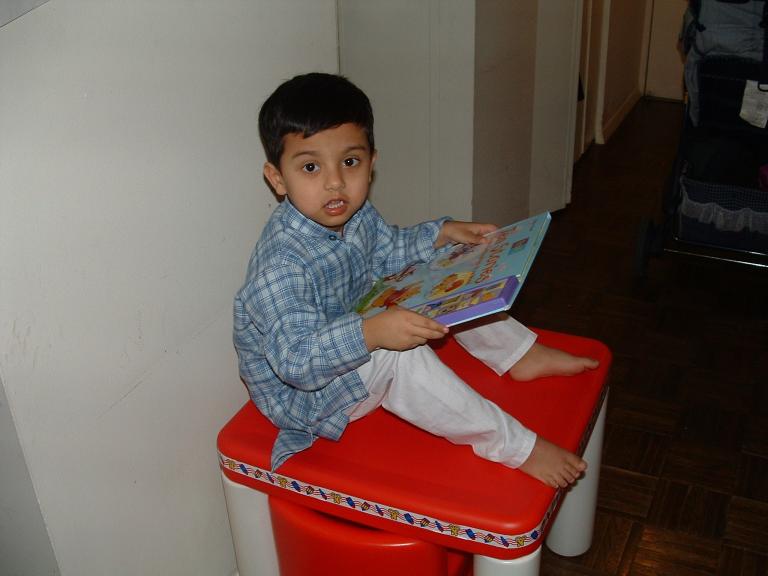
Lil D and how he first sat at the red table
The small plastic red table and two red chairs was the first purchase we made after Lil D was diagnosed with PDD-NOS (otherwise known as autism spectrum disorder) in 2003. Back then it was all a swirl of terminology, research and advice thrown at me while I stumbled around in a fog, head drowning in the torrent of what was to come.
I had been swimming in deep and dark waters alone with Lil D and the knowledge of his autism for a year before that. And now everyone was thrown into the water with us – his dad, his baby sister and his grandparents. And the life preservers seemed so far off into the distance.
You need to ask the state of New York to provide 30-plus hours of ABA, our diagnosing behavioral pediatrician told us. Your son needs intensive speech and occupational therapy. You need to get that set up for him. You should set up an after-school program for him. He needs to learn to work at a table. He has to learn to mimic speech. He needs to pattern sounds. Start with ABA before anything else. Your best time to make progress and help him is these next few years when he is young.
Wait, wait, wait. What?
I came home, nursed the baby, and decided on three concrete things I could do: Get Lil D into the best school possible for children with autism, hire a speech therapist and buy a kids’ table and chair set so that he would have a place to do his therapy, whatever that may be, at home.
I didn’t know how this therapy would work. I didn’t know if it would help him. I didn’t know what Applied Behavior Analysis was. I didn’t know what schools were available to us in New York City. I didn’t know who the good speech therapists were. I didn’t know how the heck we’d be able to afford this when my husband was doing his medical fellowship and we were living paycheck to paycheck in a one-bedroom-apartment. I didn’t know how I would bear sending my three-year-old nonverbal-lost-in-his-autism-world son to a school into the care of somebody else other than me. I didn’t know how any of this was going to work.
I didn’t know jack squat.
But I knew how to buy a kids’ table and chair set. That, I could do.
Lil D spent countless hours at that red plastic table with speech therapists, home therapists, his sister and me. He learned to eat at that table before we transitioned him to the “big” dining table. (God, how many hours I spent sitting with him, his chair strategically placed backed into a corner so he couldn’t bolt away.) His sister and he sat at that table together while a therapist worked at games they could play together.
He worked on matching programs, play skills, bead lacing, speech programs and yes, tons of ABA trials at that table. The table followed us through New York apartments to our move to Virginia to the home where we currently live now.
He outgrew it years ago, and Amal, Hamza and their cousins and friends used it in their games and crafts, with lines of marker and half-ripped out Dora the Explorer stickers telling its worn history.
Home therapy looks very different now. I’ve learned to trust my judgment and to listen – really listen – to what works for him, what works in our home environment, what works for our life.
Table work has been largely abandoned. Whereas Lil D and his home therapists used to head upstairs to the third floor (in our old house) or downstairs to the basement (in our current home) to do therapy based on things he was learning in school, now therapy occurs all over the house in a variety of ways. He’s learning self-care skills, how to do chores around the house, heading out several times a week for CBIs (community-based instruction) and a variety of other things that I hope will help him gain more independence and the ability to handle himself with minimal support in our local community.
It’s been a hard lesson for me, but I’ve learned to adjust things on the fly — keep our goals in sight but shape the daily work around how he is feeling, how tired he is, what he is able to manage that day. The first question the therapists ask now when they enter our home is how is he doing today? How has his day been so far?
Then, before they move to do anything with him, he gets choices. Like my other kids, there are certain things he needs to complete (call it homework, call it whatever you want) – but also like my other kids, we change things up depending on how he is feeling.
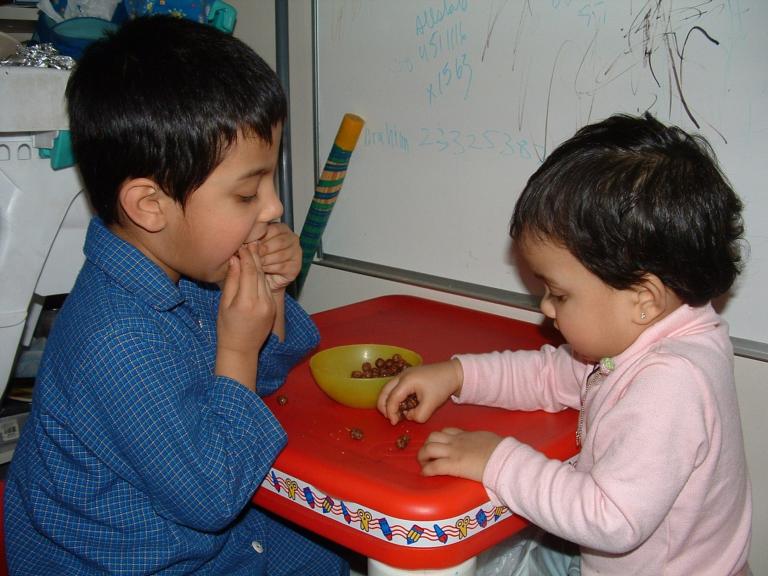
Lil D, age 4.5 and Amal, age 18 months.
I was thinking about all of this – how things have evolved with Lil D and his autism, with our whole family over the years. What our goals were back them — our hopes and dreams — and what they are now. I thought about all the battles fought, tears cried, high fives slapped, smiles shared, tickles given and deep breaths taken around the perimeters of that little red plastic table.
Of countless frustrating hours working with our first speech therapist only to learn that the way she worked wasn’t working for Lil D. Or the love surge that occurred when I saw Lil D and Amal sit there, ages four-and-half and 18 months, sharing a bowl of Cocoa Puffs. Or wanting to throw that table out of our 14th-floor apartment window after I tried to get him to copy me in stacking some blocks, and he just didn’t understand me.
And in my epic clean-up and de-cluttering of our playroom this past weekend, I looked at that red plastic table and chairs, still a part of our lives after all these years.
And I let it go. Put it in the donation pile.
Our victories and failures are different now. Much bigger and also much more intimate then the scope of that little red plastic table. What I want, want I hope and pray for so desperately for Lil D is different now.
Let it go.
Previous Post

December 5, 2013
The Unbearable Lightness of Being
Next Post

December 12, 2013 The Covenants of the Prophet Muhammad with the Christians of the World
Browse Our Archives
Select a Category A Global Voice for Autism Autism Awareness Month 2016 Autism Awareness Month 2017 Autism Interlude Hajj and Eid ul Adha Jenin Autism Project Ramadan Three Questions Uncategorized WISE Global Conference
Select a Month November 2018 October 2018 August 2018 June 2018 May 2018 April 2018 March 2018 February 2018 January 2018 December 2017 November 2017 October 2017 September 2017 August 2017 July 2017 June 2017 May 2017 April 2017 March 2017 February 2017 January 2017 December 2016 November 2016 October 2016 September 2016 August 2016 July 2016 June 2016 May 2016 April 2016 March 2016 February 2016 January 2016 December 2015 November 2015 October 2015 September 2015 August 2015 July 2015 June 2015 May 2015 April 2015 March 2015 February 2015 January 2015 December 2014 November 2014 October 2014 September 2014 August 2014 July 2014 June 2014 May 2014 April 2014 March 2014 February 2014 January 2014 December 2013 November 2013 October 2013 September 2013 August 2013 July 2013 June 2013 May 2013 April 2013 March 2013 February 2013 January 2013 December 2012 November 2012 October 2012 September 2012 August 2012 July 2012 June 2012 May 2012 April 2012 March 2012 February 2012 January 2012 December 2011 November 2011 October 2011 September 2011
Follow Us!
TAKE THE
Religious Wisdom Quiz
What does James say someone who doubts is like?
Select your answer to see how you score.
A house built on sand A wave of the sea, blown and tossed by the wind A sheep without a shepherd A leaf falling from a tree
Related posts from Muslimah Next Door
Derailed by My Memories in Autism Land

The Year of 25 (Give or Take) Steps...
TRENDING AT PATHEOS Muslim

25 Years Later: How Much Has Changed for...
As we approach the 25th anniversary of September 11th, I’ve found myself...

Podcast: Third Spaces & The Rise of Yemeni...
In the latest episode of The Artistic Foodies Podcast, hosts Abbas...

HalalFest Picks: Best 60 Halal Spots for Super...
Back in 2016, I came up with a list of 29...

Unity Is America’s Strength — Division Is Its...
by Hidayatullah Ahsan When Valentina Gomez, a Republican candidate for Congress in...

Zohran Mamdani and New York’s Fight Against Islamophobia
This past June, against all odds, Zohran Mamdani won the Democratic primary...

What the Fourth of July Means to a...
As we mark another Fourth of July, millions of Americans will celebrate...
view all Muslim blogs
Ad-Free & Subscriber Log-In Subscription Support
- About Us
- 2026 Calendar
- Videos
- Podcasts
- Library of World Religions
- Faith In Media Tracker
- Advertise With Us
- Write for Us
- Privacy Policy
- Terms of Service
- Do Not Sell My Data
- Contact Us
- Radiant Digital
- Manage Newsletter Subscriptions
- Unsubscribe From Notifications
- Sitemap
Copyright 2008-2026, Patheos. All rights reserved.
Subscription Support Ad-Free & Subscriber Log-In
Follow Patheos