
BuddhistCatholicContemplativeEvangelicalGeneral ChristianHinduJewishLatter-day SaintMuslimNew VisionsProgressive Christian
Beliefs
- Buddhist
- Catholic
- Contemplative
- Evangelical
- General Christian
- Hindu
- Jewish
- Latter-day Saint
- More Voices
- Muslim
- New Visions
- Pagan
- Progressive Christian
Topics
- Religion News
- Food and Religion
- Sports and Religion
- Religious Art
- Religious Music and Entertainment
- Religious Events
- History and Religion
- Style and Religion
- Politics and Religion
- Women in Religion
- Recreation Outdoors and Religion
- Business Finance and Religion
- Careers Workplace and Religion
- Education and Religion
- Family Parenting and Religion
- Health Fitness and Religion
- Home and Religion
- Relationships and Religion
- Technology and Religion
- Travel and Religion
Columnists
- Buddhist Columnists
- Business Finance and Religion Columnists
- Careers Workplace and Religion Columnists
- Catholic Columnists
- Contemplative Columnists
- Education and Religion Columnists
- Evangelists Columnists
- Family Parenting and Religion Columnists
- General Christian Columnists
- Health Fitness and Religion Columnists
- Hindu Columnists
- History and Religion Columnists
- Home and Religion Columnists
- Jewish Columnists
- More Voices Columnists
- Latter Day Columnists
- Muslim Columnists
- New Visions Columnists
- Nonreligious Columnists
- Pagan Columnists
- Politics and Religion Columnists
- Progressive Columnists
- Recreation Outdoors and Religion Columnists
- Relationships and Religion Columnists
- Religion News Columnists
- Religious Art Columnists
- Religious Events Columnists
- Religious Music and Entertainment Columnists
- Sports and Religion Columnists
- Style and Religion Columnists
- Technology and Religion Columnists
- Travel and Religion Columnists
- Women in Religion Columnists
Resource Library
- 2026 Calendar
- Library of World Religions
- The 100 Most Holy Places on Earth
- Patheos Answers
- Podcasts
- Videos
- Faith Leaders Database
- Anglican Episcopalian
- Bahai
- Baptist
- Buddhism
- Christianity
- Confucianism
- Eastern Orthodoxy
- Hinduism
- Holiness and Pentecostal
- ISKCON
- Islam
- Judaism
- Lutheran
- Methodist
- The Church of Jesus Christ of Latter-day Saints
- New Age
- Paganism
- Presbytarian and Reformed
- Protestantism
- Religion Behind the Scenes
- Roman Catholic
- Scientology
- Shia Islam
- Sikhism
- Sufism
- Sunni Islam
- Taoism
- Zen
- See all religions
Research Tools
 Ad-Free & Subscriber Log-In Subscription Support
Ad-Free & Subscriber Log-In Subscription Support
Follow Patheos 

- Trending:
- Forgiveness
- |
- Marriage
- |
- Consciousness
- |
- Death Penalty
- |
- Election
- |
- Halloween
 Muslimah Next Door
- Home
- Muslim
- I Hit (and Scream, Pinch, Bite, Kick, Cry or Drop) for a Reason
I Hit (and Scream, Pinch, Bite, Kick, Cry or Drop) for a Reason
Last updated on: February 8, 2013 at 2:27 pm by Dilshad Ali
I Hit (and Scream, Pinch, Bite, Kick, Cry or Drop) for a Reason 2013-02-08T14:27:08-04:00 Dilshad Ali
Patheos Explore the world's faith through different perspectives on religion and spirituality! Patheos has the views of the prevalent religions and spiritualities of the world.
 I am often stressed by the sheer number of decisions I make for Lil D; making educated guesses at what he wants, what he likes, what he needs, when he must follow through on a something or endure a situation, and when we should cut him some slack. What therapies we try, what treatments we pursue, which doctors we see and when we let things ride.
Two articles I recently read have burrowed their way into my head, one from an adult with autism and one from a special education consultant. Both made different points, but what’s keeping me up at night are the thoughts both share on the function of an autistic child’s behavior and why the emphasis on compliance may become detrimental in certain situations for our children as they grow (to be addressed in a different post).
In “Scream Louder, I Can’t Hear You,” Trisa Harris writes on functional behavior analysis (FBAs) and Behavior Intervention Plans (BIPs) – both things I’m very familiar with and which are in place for Lil D at school. These are analysis done by behavior therapists and interventionists when a child engages in aggression, self-injurious behaviors and/or other behaviors that seriously impede his ability to learn (or conduct themselves in a safe manner).
Lil D has had FBAs done, redone and done again for at least three years now. Based on his FBAs, he has a BIP in place that has been fine-tooth combed by me at every turn. It has been useful in decreasing some of his behaviors, but at times I’ve been frustrated by its very specific language, which leaves little leeway for adjustments on the fly. But it has to be that way because these plans are serious business – the schools can’t be changing things in how they handle his behavior without my authorization. Call it a catch-22.
We take his BIP and use it as a guideline for how his home therapists address behavior problems here. But one huge thing I’ve learned over the years is that home is home, and school is school. Every therapist who walks into our house learns that I don’t want things being run in a strict fashion. We adjust things to Lil D’s day, his moods, what he feels like doing, what he should be doing, how far he should be pushed, and when his feelings and moods should be honored.
They walk in the door at 4:30 and the first question is – how has Lil D’s day been? How’s he doing? When we were living our year of autism hell last year, my answer was nearly always a version of “Not good. Bad day.” We ratcheted down home therapy during those months to behavior management and showing him affection and attention. It was all about let’s keep Lil D from hurting himself. After endless discussions about, “Do we ignore the SiBs because he is seeking attention?” We all came to the conclusion that determining the function of his self-injurious behavior was near impossible.
We just couldn’t figure it out. It happened so often, and in so many instances, that we didn’t know if it was to seek attention, avoid attention, get out of a demand, because things were too loud, or whatever the hell it was.
I just knew that this was not normal. Behaviors and Lil D and autism have been synonymous for longer than I care to remember. But this, this was not Lil D. I knew he wasn’t feeling well. This wasn’t a cry for attention or to avoid attention. This was a cry for help.
Haris makes this point as well in her post, saying that there is often an underlying need for a child’s behavior:
I can’t begin to tell you how many FBAs and BIPs that I’ve read that point to the underlying cause of a student’s behavior as a means for gaining attention. The suggested response is to ignore the behavior because giving attention may reinforce the inappropriate behavior. While I understand the reasons for this approach and I have seen when ignoring may be an effective strategy, I feel that ignoring is often misapplied or over-used and in some cases it becomes an excuse for professionals or parents to stop thinking or pursuing the underlying need that is driving the behavior.
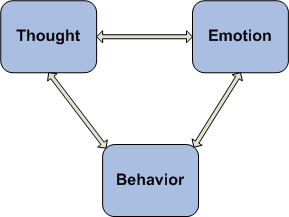 I think that’s it right there. Behavior therapy and interventions are certainly helpful and has made a lot of difference with Lil D in the past. But our special needs kids don’t just get upset because they are trying to get our attention, or want us to go away, or they do or don’t want to do something. There’s way more involved than that.
Imagine, if you will, a fairly typical day I have with Lil D. He pushes his food away, and I have to make a motherly-informed decision whether to push him to finish his meal because he is just being stubborn, or to let him go because maybe he is too full or his tummy is unsettled. (This on top of my decision about whether he should sit at the dinner table and eat because that’s the general rule, or can we take things easy and let him eat on the sofa.)
He goes and lies on the sofa and after a few minutes of quiet play, he suddenly grabs his leg and pulls it backwards, moves his hat over his eyes and begins crying, eventually banging his head on the arm of the sofa.
I can choose to ignore – oh, he is seeking attention and if I go over and ask what’s wrong, he’ll learn that to get my attention, he should engage in SiBs and crying. Or, I can choose to go over and see what’s amiss. My mother-in-law’s go-to question for Lil D is – are you hungry? You want something to eat? (To which I silently fume – it’s not always about food! Sometimes it is, but not always!)
If I think he’s hungry, I offer him his iPad or instruct him to get his iPad to show me what he wants to eat. I may ask if he wants a shower, if I think he’s seeking some sensory input. And if he does, I make him ask for it on the iPad before taking him up, just so he gets the idea that he doesn’t have to scream and cry to get a shower. Sometimes he just wants his feet rubbed, or us to sit close, but not touching him.
Sometimes it’s none of the above.
I take it on a case by case basis, and I make lots of mistakes. The times I have ignored his behavior out of deference to what I know about behavior therapy or because I, too, am frustrated with him – later on I sometimes regret my decision. Because maybe he was sick. Maybe something was off inside. Maybe I need to test him for something. The other kids recently had colds and the stomach flu. Maybe he’s coming down with something, and that will blow up into something else.
Maybe, maybe, maybe. The maybes can just kill you.
Writes Haris:
Am I saying that adults should let go of all expectations and appease every desire? Absolutely not. But I think we must never ignore a child in distress and we must demonstrate empathy so that students begin to feel heard. This begins with moving past ignoring and opening our eyes and ears to hear the message.
Giving students a voice and the skills to advocate for their needs is perhaps the most important aspect of their development. If students have to scream in order to be heard, then maybe we’re missing the most obvious clue of all. Screaming is a flashing red light indicating that there’s an important message worth listening to. We must rid ourselves of the assumptions and beliefs that hinder our ability to do so.
When we choose to ignore a student in distress, I wonder what gets reinforced. Are we teaching kids that what they think or feel doesn’t matter… that they have to scream louder and longer in order to be heard… or that it’s better to be compliant or quiet than to have a voice that allows them to say what they really need?
And is that what it is all about? Teaching children with autism to have a voice? To be able to express themselves, somehow, someway – with appropriate behavior, yes? It’s all I’ve ever wanted for Lil D – to be able to let me know what he wants, needs, doesn’t want. When he wants to be left alone, when he isn’t feeling well, when he needs some lovin’ and when he – as 12-year-old boys are wont to do – has had enough of us.
Don’t get me wrong, I do think behavior therapy plays an important part in Lil D’s life. But it’s all a part of a whole-body approach to how we are raising him with his autism, in efforts to reduce the hold autism has on him. It’s why my nonstop prayer to Allah is to make me a better mother, to be able to understand him better, to be able to make better what may be hurting him inside, to be able to help him find his independence and his voice, and for him to forgive me for all the mistakes I’ve made along the way.
The other night, after Lil D and his therapist came back from a Community-Based Instruction (CBI) outing, his therapist showed Lil D three options for chores we are working on at home – sorting clothes, emptying the dish washer, and vacuuming. Lil D chose vacuuming, but quickly started hyperventilating and crying. He threw himself into his Dadima’s (grandmother) arms and pulled her to the stove, which is usually an indication that he is hungry and wants to eat.
I was in the other room, overhearing all of this. You want to eat? Come here. I will give you, my mother-in-law said. His therapist stood by, wanting to enforce the last task asked of Lil D – to vacuum, but unable to intervene in front of Dadima.
I was pretty sure Lil D wasn’t hungry, that this was all a ruse to get out of work. That he just didn’t feel like vacuuming. That he knew if he latched on to Dadima, no one could intervene. Let’s just end therapy, I told our therapist. You can’t win when Lil D has Dadima in his corner.
He laughed, said his goodbyes, and headed out. Sure enough, after he left, Lil D refused dinner and went upstairs to play. I knew he wasn’t hungry. He got what he wanted. He didn’t use the right behavior to express himself, but like I have come to learn – you have to let things slide sometimes and roll with the punches. Like Amal and Hamza, he too gets to use that age-old grandchild’s tactic of latching onto grandparents to get out of something — against the better judgment of the parent.
Well played, Lil D.
behavior intervention functional behavior analysis
Next Post

February 11, 2013 Lessons from the Pope's Resignation - None of Us are Indispensable
Browse Our Archives
Select a Category A Global Voice for Autism Autism Awareness Month 2016 Autism Awareness Month 2017 Autism Interlude Hajj and Eid ul Adha Jenin Autism Project Ramadan Three Questions Uncategorized WISE Global Conference
Select a Month November 2018 October 2018 August 2018 June 2018 May 2018 April 2018 March 2018 February 2018 January 2018 December 2017 November 2017 October 2017 September 2017 August 2017 July 2017 June 2017 May 2017 April 2017 March 2017 February 2017 January 2017 December 2016 November 2016 October 2016 September 2016 August 2016 July 2016 June 2016 May 2016 April 2016 March 2016 February 2016 January 2016 December 2015 November 2015 October 2015 September 2015 August 2015 July 2015 June 2015 May 2015 April 2015 March 2015 February 2015 January 2015 December 2014 November 2014 October 2014 September 2014 August 2014 July 2014 June 2014 May 2014 April 2014 March 2014 February 2014 January 2014 December 2013 November 2013 October 2013 September 2013 August 2013 July 2013 June 2013 May 2013 April 2013 March 2013 February 2013 January 2013 December 2012 November 2012 October 2012 September 2012 August 2012 July 2012 June 2012 May 2012 April 2012 March 2012 February 2012 January 2012 December 2011 November 2011 October 2011 September 2011
Follow Us!
TAKE THE
Religious Wisdom Quiz
What African country is known for its ancient Coptic Christian Church?
Select your answer to see how you score.
Egypt South Africa Nigeria Ghana
Related posts from Muslimah Next Door

Derailed by My Memories in Autism Land

The Year of 25 (Give or Take) Steps...

TRENDING AT PATHEOS Muslim

25 Years Later: How Much Has Changed for...
As we approach the 25th anniversary of September 11th, I’ve found myself...

Podcast: Third Spaces & The Rise of Yemeni...
In the latest episode of The Artistic Foodies Podcast, hosts Abbas...

HalalFest Picks: Best 60 Halal Spots for Super...
Back in 2016, I came up with a list of 29...

Unity Is America’s Strength — Division Is Its...
by Hidayatullah Ahsan When Valentina Gomez, a Republican candidate for Congress in...

Zohran Mamdani and New York’s Fight Against Islamophobia
This past June, against all odds, Zohran Mamdani won the Democratic primary...

What the Fourth of July Means to a...
As we mark another Fourth of July, millions of Americans will celebrate...
view all Muslim blogs
Ad-Free & Subscriber Log-In Subscription Support
- About Us
- 2026 Calendar
- Videos
- Podcasts
- Library of World Religions
- Faith In Media Tracker
- Advertise With Us
- Write for Us
- Privacy Policy
- Terms of Service
- Do Not Sell My Data
- Contact Us
- Radiant Digital
- Manage Newsletter Subscriptions
- Unsubscribe From Notifications
- Sitemap
Copyright 2008-2026, Patheos. All rights reserved.
Subscription Support Ad-Free & Subscriber Log-In
Follow Patheos