
BuddhistCatholicContemplativeEvangelicalGeneral ChristianHinduJewishLatter-day SaintMuslimNew VisionsProgressive Christian
Beliefs
- Buddhist
- Catholic
- Contemplative
- Evangelical
- General Christian
- Hindu
- Jewish
- Latter-day Saint
- More Voices
- Muslim
- New Visions
- Pagan
- Progressive Christian
Topics
- Religion News
- Food and Religion
- Sports and Religion
- Religious Art
- Religious Music and Entertainment
- Religious Events
- History and Religion
- Style and Religion
- Politics and Religion
- Women in Religion
- Recreation Outdoors and Religion
- Business Finance and Religion
- Careers Workplace and Religion
- Education and Religion
- Family Parenting and Religion
- Health Fitness and Religion
- Home and Religion
- Relationships and Religion
- Technology and Religion
- Travel and Religion
Columnists
- Buddhist Columnists
- Business Finance and Religion Columnists
- Careers Workplace and Religion Columnists
- Catholic Columnists
- Contemplative Columnists
- Education and Religion Columnists
- Evangelists Columnists
- Family Parenting and Religion Columnists
- General Christian Columnists
- Health Fitness and Religion Columnists
- Hindu Columnists
- History and Religion Columnists
- Home and Religion Columnists
- Jewish Columnists
- More Voices Columnists
- Latter Day Columnists
- Muslim Columnists
- New Visions Columnists
- Nonreligious Columnists
- Pagan Columnists
- Politics and Religion Columnists
- Progressive Columnists
- Recreation Outdoors and Religion Columnists
- Relationships and Religion Columnists
- Religion News Columnists
- Religious Art Columnists
- Religious Events Columnists
- Religious Music and Entertainment Columnists
- Sports and Religion Columnists
- Style and Religion Columnists
- Technology and Religion Columnists
- Travel and Religion Columnists
- Women in Religion Columnists
Resource Library
- 2026 Calendar
- Library of World Religions
- The 100 Most Holy Places on Earth
- Patheos Answers
- Podcasts
- Videos
- Faith Leaders Database
- Anglican Episcopalian
- Bahai
- Baptist
- Buddhism
- Christianity
- Confucianism
- Eastern Orthodoxy
- Hinduism
- Holiness and Pentecostal
- ISKCON
- Islam
- Judaism
- Lutheran
- Methodist
- The Church of Jesus Christ of Latter-day Saints
- New Age
- Paganism
- Presbytarian and Reformed
- Protestantism
- Religion Behind the Scenes
- Roman Catholic
- Scientology
- Shia Islam
- Sikhism
- Sufism
- Sunni Islam
- Taoism
- Zen
- See all religions
Research Tools
 Ad-Free & Subscriber Log-In Subscription Support
Ad-Free & Subscriber Log-In Subscription Support
Follow Patheos 

- Trending:
- Forgiveness
- |
- Marriage
- |
- Consciousness
- |
- Death Penalty
- |
- Election
- |
- Halloween

- Home
- Catholic
- Women in Religion
- Witness to History: the Donkey
Witness to History: the Donkey
Last updated on: April 6, 2024 at 4:40 pm by Lois Kerschen
Witness to History: the Donkey 2024-04-06T16:40:15-07:00 Lois Kerschen
Patheos Explore the world's faith through different perspectives on religion and spirituality! Patheos has the views of the prevalent religions and spiritualities of the world.
Did you know that the Bible refers to a donkey 74 times? Compare that to 14 for a dog, 36 for a horse, 55 for an ox, and 82 for a lion. Sheep get 195 mentions but considering that many of the important figures in the Bible were either literally or figuratively shepherds, that’s understandable.
So, the donkey has a prominent position among animals in the Bible. It rates far higher than its fellow working animal, the ox, and comes close to the lofty stature of the lion whose prowess is much admired.
What causes the donkey to be this important? Well, it was a standard beast of burden and means of transportation throughout ancient times, so naturally, the stories of the Jewish people would mention using or riding the donkey. For example, Moses returned to Egypt on a donkey; also, when David came to Saul, and when Abigail came to David, they rode a donkey.
A Talking Animal
However, one time, the donkey’s ability went beyond carrying people and supplies and gained the animal fame among Bible readers. There are only two talking animals in the Bible: the serpent in the Garden of Eden and Balaam’s donkey (Numbers 22: 21-29).

MrBibleHead.blogspot.com
God sent Balaam as a messenger, instructed to say exactly what God told him. Balaam made the mistake of thinking about betraying God, so an angel with a drawn sword appeared to him on his way.
His donkey could see the angel and cowered against a wall, but Balaam could not see the angel and beat the donkey for stopping. This happened three times, and then the donkey asked, “Why are you beating me? Am I not your own beast, and have you not always ridden upon me until now? Have I been in the habit of treating you this way before?”
At that point, God removed the veil from Balaam’s eyes, and he saw the angel, who admonished Balaam. He said that if the donkey had not turned away from the sword, he would have killed Balaam. Chastised, Balaam followed God’s instructions, and we assume, never beat his donkey again.
With the Holy Family
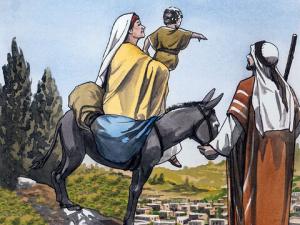
As a witness to history, donkeys have been ever-present in the Judeo/Christian saga. Mary rode a donkey to Bethlehem, so there is seldom a nativity scene without a donkey nearby.
Good News Productions International and College Press Publishing.
That donkey also carried Mary and the baby Jesus on the trip to Egypt with Joseph walking alongside. Since donkeys can live 27-40 years, it is possible that this same donkey was with them when they went to Jerusalem to present the child Jesus at the Temple, and when Mary and Joseph lost Jesus at the Temple years later.
Palm Sunday
It was a different donkey, however, that carried Jesus into Jerusalem on Palm Sunday. Another distinction for the donkey is that this honor was mentioned in the prophecy about Christ’s entrance into Jerusalem for his final days:
“See, your king shall come to you, a just savior is he; Meek, and riding on an ass (donkey) on a colt, the foal of an ass” (Zechariah 9:9). Matthew acknowledged in his gospel account of Palm Sunday that “This came about to fulfill what was said through the prophet.” (Matthew 21:4)
Note that the prophecy describes the king and savior as “meek.” He is riding a common donkey instead of a stately horse, like an earthly king or a centurion, because he has not come as a warrior but as the Lord of Peace.
Did you ever wonder how Christ’s disciples were able to so easily acquire a donkey for his ride on Palm Sunday? According to legend, a farmer near Jerusalem had planned to kill his donkey because it was too small to do much work. His children pleaded with him to tie the donkey to a tree near the road, hoping that someone would take it.
Sure enough, Christ’s disciples came and said their master was in need of a donkey, so the farmer gladly gave him away. (God works in mysterious ways!)

by jesusjnr2020(m): 8:11am On Jan 28
Marked with a Cross
Donkeys have markings like a cross on their backs. It is caused by a dark line of hair (the list) that runs down the spine and, usually, across the shoulders. It is a natural marking—or is it?
Another story attributes the donkey’s cross to the Passion of Christ. The donkey wanted to carry Christ’s cross for him but was not allowed. In reward for his loyalty and love, Jesus caused the shadow of the cross to fall upon the donkey’s back, and the animal has carried the symbol ever since.
So, not only does God take care of His little sparrows, but He also assigns important roles to lowly creatures like the donkey. Donkeys are not handsome or mighty, but they have a Biblical lineage that rivals the House of David, and as children of God, so do we.
General Christian
History and Religion
Previous Post

March 11, 2024
Maslow's Hierarchy Applied to Unplanned Pregnancies
Next Post
April 16, 2024 Doubting Thomas and Absent Thomas
Browse Our Archives
Select a Category Patheos Catholic Uncategorized
Select a Month October 2026 September 2026 July 2026 May 2026 December 2025 November 2025 September 2025 August 2025 July 2025 June 2025 May 2025 April 2025 March 2025 February 2025 August 2024 July 2024 June 2024 May 2024 April 2024 March 2024 February 2024 January 2024 November 2023 September 2023 July 2023 June 2023 February 2023 September 2022 August 2022 July 2022 June 2022 May 2022 April 2022 March 2022 February 2022 January 2022 December 2021 November 2021 October 2021 September 2021 August 2021
Follow Us!
TAKE THE
Religious Wisdom Quiz
What did Jesus do right after being baptized?
Select your answer to see how you score.
Returned to Galilee Started preaching Visited the temple Went into the wilderness
Related posts from Musings From the Pew
Why I Choose the Eucharist Over the Sermon

Changing the Culture's View of Motherhood
Abortion in the Didache: forbidden by the Apostles

Introducing the Consistent Life Ethic at Your Church
TRENDING AT PATHEOS Catholic

Rejecting Doom: Christian Hope And Human Action
Christianity is a religion of hope. We are to have hope and...

It’s What Comes From Within Which Matters
One of the most difficult things for us to understand is why...

Why I Choose the Eucharist Over the Sermon
Choose the Eucharist, Not the Sermon What are we supposed to get...

5 Design Elements Found in Spiritually Rooted Homes
Putting Spirituality Into Home Decor Our homes are more than our living...

Credo: A Story of God Told with the...
About 10 years ago, I began to imagine a personal "Credo" that...

The Anatomy of Divine Revelation in Catholic Thought
The claim that God has made Himself known to human beings is...
view all Catholic blogs
Ad-Free & Subscriber Log-In Subscription Support
- About Us
- 2026 Calendar
- Videos
- Podcasts
- Library of World Religions
- Faith In Media Tracker
- Advertise With Us
- Write for Us
- Privacy Policy
- Terms of Service
- Do Not Sell My Data
- Contact Us
- Radiant Digital
- Manage Newsletter Subscriptions
- Unsubscribe From Notifications
- Sitemap
Copyright 2008-2026, Patheos. All rights reserved.
Subscription Support Ad-Free & Subscriber Log-In
Follow Patheos