
BuddhistCatholicContemplativeEvangelicalGeneral ChristianHinduJewishLatter-day SaintMuslimNew VisionsProgressive Christian
Beliefs
- Buddhist
- Catholic
- Contemplative
- Evangelical
- General Christian
- Hindu
- Jewish
- Latter-day Saint
- More Voices
- Muslim
- New Visions
- Pagan
- Progressive Christian
Topics
- Religion News
- Food and Religion
- Sports and Religion
- Religious Art
- Religious Music and Entertainment
- Religious Events
- History and Religion
- Style and Religion
- Politics and Religion
- Women in Religion
- Recreation Outdoors and Religion
- Business Finance and Religion
- Careers Workplace and Religion
- Education and Religion
- Family Parenting and Religion
- Health Fitness and Religion
- Home and Religion
- Relationships and Religion
- Technology and Religion
- Travel and Religion
Columnists
- Buddhist Columnists
- Business Finance and Religion Columnists
- Careers Workplace and Religion Columnists
- Catholic Columnists
- Contemplative Columnists
- Education and Religion Columnists
- Evangelists Columnists
- Family Parenting and Religion Columnists
- General Christian Columnists
- Health Fitness and Religion Columnists
- Hindu Columnists
- History and Religion Columnists
- Home and Religion Columnists
- Jewish Columnists
- More Voices Columnists
- Latter Day Columnists
- Muslim Columnists
- New Visions Columnists
- Nonreligious Columnists
- Pagan Columnists
- Politics and Religion Columnists
- Progressive Columnists
- Recreation Outdoors and Religion Columnists
- Relationships and Religion Columnists
- Religion News Columnists
- Religious Art Columnists
- Religious Events Columnists
- Religious Music and Entertainment Columnists
- Sports and Religion Columnists
- Style and Religion Columnists
- Technology and Religion Columnists
- Travel and Religion Columnists
- Women in Religion Columnists
Resource Library
- 2026 Calendar
- Library of World Religions
- The 100 Most Holy Places on Earth
- Patheos Answers
- Podcasts
- Videos
- Faith Leaders Database
- Anglican Episcopalian
- Bahai
- Baptist
- Buddhism
- Christianity
- Confucianism
- Eastern Orthodoxy
- Hinduism
- Holiness and Pentecostal
- ISKCON
- Islam
- Judaism
- Lutheran
- Methodist
- The Church of Jesus Christ of Latter-day Saints
- New Age
- Paganism
- Presbytarian and Reformed
- Protestantism
- Religion Behind the Scenes
- Roman Catholic
- Scientology
- Shia Islam
- Sikhism
- Sufism
- Sunni Islam
- Taoism
- Zen
- See all religions
Research Tools
 Ad-Free & Subscriber Log-In Subscription Support
Ad-Free & Subscriber Log-In Subscription Support
Follow Patheos 

- Trending:
- Forgiveness
- |
- Marriage
- |
- Consciousness
- |
- Death Penalty
- |
- Election
- |
- Halloween

- Home
- Catholic
- Women in Religion
- Free Will and Choices
Free Will and Choices
Last updated on: August 12, 2022 at 8:29 pm by Lois Kerschen
Free Will and Choices 2022-08-12T20:29:31-07:00 Lois Kerschen
Patheos Explore the world's faith through different perspectives on religion and spirituality! Patheos has the views of the prevalent religions and spiritualities of the world.
Free will was granted to every human because The Creator didn’t desire automatons but a people who would choose to love God freely—or not. After all, you can’t force someone to love you. Love must be freely given, or it is not love at all.
Free will means that humans have the power to make their own choices between good and evil. However, that does not mean that choosing sin is okay just because you have the right to choose it. Adam and Eve found that out in the Garden of Eden.
Since the “First Lesson” was about the appropriate use of free will, you’d think that people would have a solid understanding of the concept. Nonetheless, Speaker Nancy Pelosi has long excused her position on “a woman’s choice” as an exercise in free will.
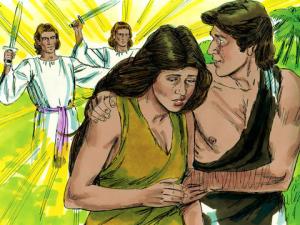
Adam and Eve learn the consequences of choosing sin. FreeBibleimages.com
This convoluted line of reasoning appeared again in an August 3, 2022, interview with Stacey Abrams, a candidate for Governor of Georgia. She said too that a woman’s right to make her own decision about abortion results from the free will that God gave us.
These two prominent women, and all those who eagerly snatch at this excuse to justify the unjustifiable act of abortion, are grossly misinterpreting the purpose of free will. They seem to think that free will means you can determine your own morality.
Logically, legally and theologically, this twisted mentality makes no sense and just shows the contortions people will use in an attempt to assuage their conscience and give themselves permission to sin.
The Bible and St. Augustine on Choices
To repeat: we can choose good or evil but choosing evil does not make it good. If you choose evil, you must accept what you have chosen for what it truly is and for how it will impact other people, like the unborn child.
There is an applicable passage from Deuteronomy (30:19-20):
“This day I call the heavens and the earth as witnesses against you that I have set before you life and death, blessings and curses. Now choose life, so that you and your children may live and that you may love the Lord your God, listen to His voice, and hold fast to Him.”
Could it be clearer? “Now choose life, so that you and your children may live.”
St. Augustine taught that, if we have free will, then we also have a duty to make decisions in alignment with a well-formed conscience, based on truth and God’s law, about what is good and evil. A further duty is to let our conscience rule our life.
What determines whether a particular action is good does not depend on one’s own judgment, on whether “it feels good” or the assumption that it does not hurt anyone.
We should submit to our conscience and be passionately committed to letting it rule our decisions. That’s what’s called living by your convictions. It indicates courage and character.
Archbishop Niederauer on Free Will
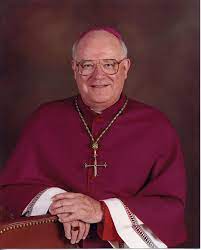
The late Archbishop George H. Niederauer
In 2010, then Archbishop of San Francisco George H. Niederauer responded to Pelosi’s free will argument with an explanation of what the Catholic Church actually teaches as opposed to what she claims her beliefs have taught her. https://www.catholic.org/news/hf/faith/story.php?id=35186
The archbishop said that Pelosi’s statements showed “some fundamental misconceptions about Catholic teaching. Human freedom does not legitimate bad moral choices, nor does it justify a stance that all moral choices are good if they are free.”
Niederauer continued: “It is entirely incompatible with Catholic teaching to conclude that our freedom of will justifies choices that are radically contrary to the Gospel. Freedom of will is the capacity to act with moral responsibility; it is not the ability to determine arbitrarily what constitutes moral right.”
Echoing St. Augustine, Niederauer explained: “Conscience, then, is the judgment of reason whereby the human person, guided by God’s grace, recognizes the moral quality of a concrete act. In all we say and do, we are obliged to follow faithfully what we know to be just and right.”
Catholic citizens need to follow our consciences and not be swayed by political or social pressures. Respecting the freedom of others does not mean anything goes. That is anarchy.
Archbishop Niederauer made clear that a choice is no longer moral if it strikes at the most fundamental rights of others. Since the right to life is the most fundamental of rights, it “cannot be justified by any Catholic notion of freedom.”
The temptation to grab at any excuse for our bad choices is strong. Our culture condemns “judgment” as offensive and tells people they can do whatever they want and need not feel guilty.
However, if we are to be prepared for God’s judgment, perhaps we need to seriously examine our reasoning for phoniness. Did we choose simply because we could or because it was good?
Politics and Religion
Previous Post

August 8, 2022
The Truth about Prenatal Care
Next Post
August 18, 2022 Backyard Mary: Comfort and Inspiration
Browse Our Archives
Select a Category Patheos Catholic Uncategorized
Select a Month October 2026 September 2026 July 2026 May 2026 December 2025 November 2025 September 2025 August 2025 July 2025 June 2025 May 2025 April 2025 March 2025 February 2025 August 2024 July 2024 June 2024 May 2024 April 2024 March 2024 February 2024 January 2024 November 2023 September 2023 July 2023 June 2023 February 2023 September 2022 August 2022 July 2022 June 2022 May 2022 April 2022 March 2022 February 2022 January 2022 December 2021 November 2021 October 2021 September 2021 August 2021
Follow Us!
TAKE THE
Religious Wisdom Quiz
What king of Judah found the Book of the Law during Temple repairs?
Select your answer to see how you score.
Manasseh Josiah Jehoshaphat Hezekiah
Related posts from Musings From the Pew
Why I Choose the Eucharist Over the Sermon

Changing the Culture's View of Motherhood
Abortion in the Didache: forbidden by the Apostles

Introducing the Consistent Life Ethic at Your Church
TRENDING AT PATHEOS Catholic

Rejecting Doom: Christian Hope And Human Action
Christianity is a religion of hope. We are to have hope and...

It’s What Comes From Within Which Matters
One of the most difficult things for us to understand is why...

Why I Choose the Eucharist Over the Sermon
Choose the Eucharist, Not the Sermon What are we supposed to get...

5 Design Elements Found in Spiritually Rooted Homes
Putting Spirituality Into Home Decor Our homes are more than our living...

Credo: A Story of God Told with the...
About 10 years ago, I began to imagine a personal "Credo" that...

The Anatomy of Divine Revelation in Catholic Thought
The claim that God has made Himself known to human beings is...
view all Catholic blogs
Ad-Free & Subscriber Log-In Subscription Support
- About Us
- 2026 Calendar
- Videos
- Podcasts
- Library of World Religions
- Faith In Media Tracker
- Advertise With Us
- Write for Us
- Privacy Policy
- Terms of Service
- Do Not Sell My Data
- Contact Us
- Radiant Digital
- Manage Newsletter Subscriptions
- Unsubscribe From Notifications
- Sitemap
Copyright 2008-2026, Patheos. All rights reserved.
Subscription Support Ad-Free & Subscriber Log-In
Follow Patheos