
BuddhistCatholicContemplativeEvangelicalGeneral ChristianHinduJewishLatter-day SaintMuslimNew VisionsProgressive Christian
Beliefs
- Buddhist
- Catholic
- Contemplative
- Evangelical
- General Christian
- Hindu
- Jewish
- Latter-day Saint
- More Voices
- Muslim
- New Visions
- Pagan
- Progressive Christian
Topics
- Religion News
- Food and Religion
- Sports and Religion
- Religious Art
- Religious Music and Entertainment
- Religious Events
- History and Religion
- Style and Religion
- Politics and Religion
- Women in Religion
- Recreation Outdoors and Religion
- Business Finance and Religion
- Careers Workplace and Religion
- Education and Religion
- Family Parenting and Religion
- Health Fitness and Religion
- Home and Religion
- Relationships and Religion
- Technology and Religion
- Travel and Religion
Columnists
- Buddhist Columnists
- Business Finance and Religion Columnists
- Careers Workplace and Religion Columnists
- Catholic Columnists
- Contemplative Columnists
- Education and Religion Columnists
- Evangelists Columnists
- Family Parenting and Religion Columnists
- General Christian Columnists
- Health Fitness and Religion Columnists
- Hindu Columnists
- History and Religion Columnists
- Home and Religion Columnists
- Jewish Columnists
- More Voices Columnists
- Latter Day Columnists
- Muslim Columnists
- New Visions Columnists
- Nonreligious Columnists
- Pagan Columnists
- Politics and Religion Columnists
- Progressive Columnists
- Recreation Outdoors and Religion Columnists
- Relationships and Religion Columnists
- Religion News Columnists
- Religious Art Columnists
- Religious Events Columnists
- Religious Music and Entertainment Columnists
- Sports and Religion Columnists
- Style and Religion Columnists
- Technology and Religion Columnists
- Travel and Religion Columnists
- Women in Religion Columnists
Resource Library
- 2026 Calendar
- Library of World Religions
- The 100 Most Holy Places on Earth
- Patheos Answers
- Podcasts
- Videos
- Faith Leaders Database
- Anglican Episcopalian
- Bahai
- Baptist
- Buddhism
- Christianity
- Confucianism
- Eastern Orthodoxy
- Hinduism
- Holiness and Pentecostal
- ISKCON
- Islam
- Judaism
- Lutheran
- Methodist
- The Church of Jesus Christ of Latter-day Saints
- New Age
- Paganism
- Presbytarian and Reformed
- Protestantism
- Religion Behind the Scenes
- Roman Catholic
- Scientology
- Shia Islam
- Sikhism
- Sufism
- Sunni Islam
- Taoism
- Zen
- See all religions
Research Tools
 Ad-Free & Subscriber Log-In Subscription Support
Ad-Free & Subscriber Log-In Subscription Support
Follow Patheos 

- Trending:
- Forgiveness
- |
- Marriage
- |
- Consciousness
- |
- Death Penalty
- |
- Election
- |
- Halloween

- Home
- Catholic
- Women in Religion
- The Value of Silence
The Value of Silence
Last updated on: April 29, 2022 at 9:54 pm by Lois Kerschen
The Value of Silence 2022-04-29T21:54:16-07:00 Lois Kerschen
Patheos Explore the world's faith through different perspectives on religion and spirituality! Patheos has the views of the prevalent religions and spiritualities of the world.
Catholicism values silence. While we have magnificent music for our liturgies, awesome homilies, prayers we say out loud at Mass or together in the recitation of the rosary and so on, we also place importance on a tradition of silence.
There is a hauntingly beautiful and ancient hymn called “Let All Mortal Flesh Keep Silence.” It is derived from the “Prayer of the Cherubic Hymn” from the Litany of St. James, written in the 4th Century. It’s first verse says:
“Let all mortal flesh keep silence/ And with fear and trembling stand/ Ponder nothing earthly-minded/ For with blessing in his hand/ Christ our God to earth descendeth/ Our full homage to demand.”
The hymn advises silence in the presence of the Lord, who brings us blessings but rightfully demands that we give Him our full attention and respect when we pray. As every teacher has admonished her students, “You can’t listen while you talk!”
God’s Voice
In 1 Kings 19:12, we are told that God speaks quietly, in a “tiny whisper” or a “still small voice.” Therefore, we must listen carefully and attentively to discern God’s message. We might not be able to hear if we are surrounded by the clamoring of a noisy world.

Photo by Guillaume de Germain on Unsplash
Silence is thus integral to Catholic life. We cannot afford to be too busy or distracted by problems to hear the advice of the Holy Spirit. Listening to God requires a stillness of body and mind.
Meditation requires that we empty our thoughts so that the mind is open and receptive. As we meditate, our feelings open up to a spiritual connection with God, to love and healing.
Expert Advice
An article on “The Practice of Silence for Lay People” provides three examples of learned advice on silence:
“In silence and quiet the devout soul advances in virtue and learns the hidden truths of Scripture,” said Thomas a Kempis, the 15th century monk and author of The Imitation of Christ, one of the most famous devotional books of all time.
“Guard against much talking,” admonished St. Dorotheus of Gaza, “for it puts to flight devout thoughts and recollection in God.”
St. Maximilian Kolbe declared that “Silence is necessary, and even absolutely necessary. If silence is lacking, then grace is lacking.”
The article further explained that “Through the centuries, many religious orders have put this advice into practice, with not a few prescribing silence to various degrees in their rules.
“Perhaps the most famous and strict of these orders is the Carthusians. Their disciplined quiet is so well known that a documentary film about them was entitled, Into Great Silence.” https://catholicgentleman.com/2016/07/practice-silence-lay-people/
Adoration
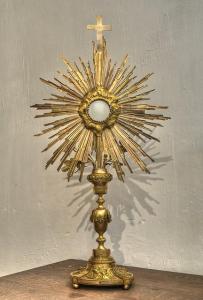
Image by Christel SAGNIEZ from Pixabay
A discussion of sacred silence probably means Benediction and Perpetual Adoration to most Catholics. In nearly every parish, there is a Perpetual Adoration chapel or a “Holy Hour” for Benediction and silent adoration.
These are opportunities to spend time in prayer or quiet thought while in the actual presence of Christ. It is a special time for “breathing in” Christ and quietly working on our communication and relationship with God.
Often, I’ve found, adoration chapels are particularly beautiful or inspirational. They remind me of the “Holy of Holies,” the sacred ground of the Ark of the Covenant. After all, it is the residence of the living God.
The most awesome, in my opinion, was the Eucharistic Chapel in the appropriately named Cathedral of the Blessed Sacrament in Sacramento, California. The chapel is in the space where the original altars were located before being moved to comply with Vatican II.
Since the main altar was moved very far forward, the large space between the altar and the tabernacle was converted into a chapel surrounded by widely open lattice-work walls. The effect is so much a “Holy of Holies” that you want to fall to your knees.
Body and Soul
I read recently that the brain needs a period of silence every day to get itself in order. No wonder that studies show silence gives us the clarity to gather our thoughts and a sense of calm.
Silence also helps us to channel our energies. It relaxes the body and brain, which lowers our blood pressure and increases blood flow to the brain. Silence also, unsurprisingly, lessens insomnia and enhances sleep.
If ordinary silence is that beneficial, think of what a silent period spent in prayer and meditation can do for body and soul. Pity the people who go around with earphones all day. Their minds are clogged with destructive noise instead of constructive silence.
The old idiom says, “Speech is silver, but silence is golden” meaning that while words can be important, it is better to say nothing—and listen to God.
Previous Post

April 24, 2022
The Evils of IVF
Next Post
May 4, 2022 Post-Roe: The Work Goes On
Browse Our Archives
Select a Category Patheos Catholic Uncategorized
Select a Month October 2026 September 2026 July 2026 May 2026 December 2025 November 2025 September 2025 August 2025 July 2025 June 2025 May 2025 April 2025 March 2025 February 2025 August 2024 July 2024 June 2024 May 2024 April 2024 March 2024 February 2024 January 2024 November 2023 September 2023 July 2023 June 2023 February 2023 September 2022 August 2022 July 2022 June 2022 May 2022 April 2022 March 2022 February 2022 January 2022 December 2021 November 2021 October 2021 September 2021 August 2021
Follow Us!
TAKE THE
Religious Wisdom Quiz
What qualification does Paul give for elders, saying they must be the husband of how many wives?
Select your answer to see how you score.
As many as he can support No more than three wives Two wives One wife
Related posts from Musings From the Pew
Why I Choose the Eucharist Over the Sermon

Changing the Culture's View of Motherhood
Abortion in the Didache: forbidden by the Apostles

Introducing the Consistent Life Ethic at Your Church
TRENDING AT PATHEOS Catholic

Rejecting Doom: Christian Hope And Human Action
Christianity is a religion of hope. We are to have hope and...

It’s What Comes From Within Which Matters
One of the most difficult things for us to understand is why...

Why I Choose the Eucharist Over the Sermon
Choose the Eucharist, Not the Sermon What are we supposed to get...

5 Design Elements Found in Spiritually Rooted Homes
Putting Spirituality Into Home Decor Our homes are more than our living...

Credo: A Story of God Told with the...
About 10 years ago, I began to imagine a personal "Credo" that...

The Anatomy of Divine Revelation in Catholic Thought
The claim that God has made Himself known to human beings is...
view all Catholic blogs
Ad-Free & Subscriber Log-In Subscription Support
- About Us
- 2026 Calendar
- Videos
- Podcasts
- Library of World Religions
- Faith In Media Tracker
- Advertise With Us
- Write for Us
- Privacy Policy
- Terms of Service
- Do Not Sell My Data
- Contact Us
- Radiant Digital
- Manage Newsletter Subscriptions
- Unsubscribe From Notifications
- Sitemap
Copyright 2008-2026, Patheos. All rights reserved.
Subscription Support Ad-Free & Subscriber Log-In
Follow Patheos