
BuddhistCatholicContemplativeEvangelicalGeneral ChristianHinduJewishLatter-day SaintMuslimNew VisionsProgressive Christian
Beliefs
- Buddhist
- Catholic
- Contemplative
- Evangelical
- General Christian
- Hindu
- Jewish
- Latter-day Saint
- More Voices
- Muslim
- New Visions
- Pagan
- Progressive Christian
Topics
- Religion News
- Food and Religion
- Sports and Religion
- Religious Art
- Religious Music and Entertainment
- Religious Events
- History and Religion
- Style and Religion
- Politics and Religion
- Women in Religion
- Recreation Outdoors and Religion
- Business Finance and Religion
- Careers Workplace and Religion
- Education and Religion
- Family Parenting and Religion
- Health Fitness and Religion
- Home and Religion
- Relationships and Religion
- Technology and Religion
- Travel and Religion
Columnists
- Buddhist Columnists
- Business Finance and Religion Columnists
- Careers Workplace and Religion Columnists
- Catholic Columnists
- Contemplative Columnists
- Education and Religion Columnists
- Evangelists Columnists
- Family Parenting and Religion Columnists
- General Christian Columnists
- Health Fitness and Religion Columnists
- Hindu Columnists
- History and Religion Columnists
- Home and Religion Columnists
- Jewish Columnists
- More Voices Columnists
- Latter Day Columnists
- Muslim Columnists
- New Visions Columnists
- Nonreligious Columnists
- Pagan Columnists
- Politics and Religion Columnists
- Progressive Columnists
- Recreation Outdoors and Religion Columnists
- Relationships and Religion Columnists
- Religion News Columnists
- Religious Art Columnists
- Religious Events Columnists
- Religious Music and Entertainment Columnists
- Sports and Religion Columnists
- Style and Religion Columnists
- Technology and Religion Columnists
- Travel and Religion Columnists
- Women in Religion Columnists
Resource Library
- 2026 Calendar
- Library of World Religions
- The 100 Most Holy Places on Earth
- Patheos Answers
- Podcasts
- Videos
- Faith Leaders Database
- Anglican Episcopalian
- Bahai
- Baptist
- Buddhism
- Christianity
- Confucianism
- Eastern Orthodoxy
- Hinduism
- Holiness and Pentecostal
- ISKCON
- Islam
- Judaism
- Lutheran
- Methodist
- The Church of Jesus Christ of Latter-day Saints
- New Age
- Paganism
- Presbytarian and Reformed
- Protestantism
- Religion Behind the Scenes
- Roman Catholic
- Scientology
- Shia Islam
- Sikhism
- Sufism
- Sunni Islam
- Taoism
- Zen
- See all religions
Research Tools
 Ad-Free & Subscriber Log-In Subscription Support
Follow Patheos 

- Trending:
- Advent
- |
- Forgiveness
- |
- Thanksgiving
- |
- Election
- |
- Seasonal Holidays
- |
- Marriage

- Home
- Catholic
- Women in Religion
- Kneeling: An Act of Humility and Adoration
Kneeling: An Act of Humility and Adoration
Last updated on: February 1, 2022 at 9:29 pm by Lois Kerschen
Kneeling: An Act of Humility and Adoration 2022-02-01T21:29:51-08:00 Lois Kerschen
Patheos Explore the world's faith through different perspectives on religion and spirituality! Patheos has the views of the prevalent religions and spiritualities of the world.
Kneeling during a Catholic Mass has always seemed to me to be an important act of worship. I always wondered why Protestants didn’t kneel, and after researching the question, I am more convinced that kneeling is a needed act of humility.
History of Kneeling in Church
There is actually a lot of history, and perhaps myth, behind the practice of kneeling. For starters, there are 23 references to kneeling in the Bible. The instances all deal with respect, worship, supplication or penance.
Vatican II eliminated some of the kneeling in church. The reason given was that kneeling during Mass was something that started around the 7th century in reflection of the subservience given to feudal lords that should then also be given to the Lord God.
That may not have been the real reason. Coincidental, perhaps, to feudal subservience was the belief among Catholic theologians of the time that kneeling was appropriate at points in the Mass when the divine Christ is present.
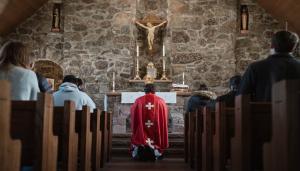
Photo by Josh Applegate on Unsplash
After Vatican II, it was felt that modern Catholics should not kneel like peons but stand to express their equality as brothers and sisters of the human Christ, all made in the image and likeness of God. Standing also emphasized that we concelebrate the Mass with the priest.
The thinking was that standing would be a return to the practices of the early Church, which was a continuation of the Jewish practice of standing while praying. The Old Testament references to kneeling were considered extreme cases of supplication or penitence, yet Daniel prayed on his knees three times a day (Daniel 6:10).
Protestant View
So Vatican II sent us closer to the Protestant interpretation of what is appropriate in a service, that is, more individual responsibility and elevated humanity. However, for the Protestants, there was more involved in the change away from kneeling.
The Reformation was also a great rebellion against anything Catholic, so eliminating kneeling was a way to reject a Catholic practice. There are still some Protestant churches that have instances of kneeling, but it is limited.
Criticism of kneeling contends that it is a sign of penitence or supplication not appropriate for the celebration that is a church service. If you want to be positive and rejoice, you don’t fall down on your knees like a beggar or a cowed sinner.
While I understand what they are saying about a celebration, I believe that if we are going to a “worship service” we should worship, that is, give adoration to God in a respectful manner. How can we say “Jesus, I adore You” if standing at equal height, so to speak?
As St. Paul wrote in Philippians 2:10: At the name of Jesus, every knee should bend.” In fact, according to St. Luke, as a human praying to God, Jesus knelt (22:41): “And He withdrew from them about a stone’s throw and knelt down and prayed.”
 Purposes of Kneeling
We too are often supplicants in our prayers, so isn’t it appropriate to kneel while praying as a sign of humble submission? Psalm 95:6 entreats us: “Oh come, let us worship and bow down; let us kneel before the Lord, our Maker!”
Kneeling represents a form of penance too, and not just of the spiritual kind, as any of us with decrepit knees can tell you. There are some poorly padded or even wooden kneelers that can leave you in literal pain.
Our (my husband and I) favorite church is an historic one with pews and kneelers that were made for a smaller people in the 19th century. There, kneeling can involve a bit of contortion, but we don’t make excuses and beg off—not in front of Christ on the cross!
To me, the most important purpose of kneeling is as an act of humility, a virtue that seems in short supply today. Demonstrating awe in the presence of God is a reminder of our place and mission in the world.
Further, kneeling isn’t necessarily subservience; it is homage. After all, we are not equal to God and should look up to Him. Isn’t that the term that the Magi used—”We have come to pay Him homage”?
It seems odd to me that Queen Elizabeth II would kneel to say her bedtime prayers, but not kneel in church. Some Catholics kneel to pray the rosary but think we should stand throughout Mass. If kneeling is appropriate to other prayer, isn’t it imperative for Mass?
Kneeling is undoubtedly an act of adoration, and that’s why we go to church—to adore. Kneeling, including genuflecting, acknowledges that God is real and present in the tabernacle, deserving of our humble sign of respect.
Previous Post

January 29, 2022
St. Joseph: A Real Man
Next Post
February 4, 2022 Meaningful Music at Mass
Browse Our Archives
Select a Category Patheos Catholic Uncategorized
Select a Month November 2026 October 2026 September 2026 July 2026 May 2026 December 2025 November 2025 September 2025 August 2025 July 2025 June 2025 May 2025 April 2025 March 2025 February 2025 August 2024 July 2024 June 2024 May 2024 April 2024 March 2024 February 2024 January 2024 November 2023 September 2023 July 2023 June 2023 February 2023 September 2022 August 2022 July 2022 June 2022 May 2022 April 2022 March 2022 February 2022 January 2022 December 2021 November 2021 October 2021 September 2021 August 2021
Follow Us!
TAKE THE
Religious Wisdom Quiz
I am a day when tongues of fire appeared and people spoke in languages they had never learned. Three thousand believed that day. What am I?
Select your answer to see how you score.
Easter The Day of Atonement Pentecost Passover
Related posts from Musings From the Pew
The Power of Setting a Good Example
Why I Choose the Eucharist Over the Sermon

Changing the Culture's View of Motherhood
Abortion in the Didache: forbidden by the Apostles
TRENDING AT PATHEOS Catholic

The Kingdom Of God In Ordinary Life And...
The kingdom of God is all around us; it is in us...

How Discretion Guides Us Away From Extremes
Prudence is an important virtue for all of us. While we should...

If Baptism Washes Away Sin, Why Do Catholics...
The seven sacraments stand as the foundation of Catholic ecclesial life. The...

The Power of Setting a Good Example
Remember last August when the Chicago White Sox hosted a "Pope Hat...

A Catholic Critique of Biblical Unitarianism
If the statistics are to be believed, Unitarianism is rising worldwide. Although...

How Grandma Tourism Helps Grandparents Live Their Vocation
Grandma, The New Travel Influencer What started as a nostalgia-inspired social media...
view all Catholic blogs
Ad-Free & Subscriber Log-In Subscription Support
- About Us
- 2026 Calendar
- Videos
- Podcasts
- Library of World Religions
- Faith In Media Tracker
- Advertise With Us
- Write for Us
- Privacy Policy
- Terms of Service
- Do Not Sell My Data
- Contact Us
- Radiant Digital
- Manage Newsletter Subscriptions
- Unsubscribe From Notifications
- Sitemap
Copyright 2008-2026, Patheos, part of the Radiant Digital network of media brands. All rights reserved.
Subscription Support Ad-Free & Subscriber Log-In
Follow Patheos