
BuddhistCatholicContemplativeEvangelicalGeneral ChristianHinduJewishLatter-day SaintMuslimNew VisionsProgressive Christian
Beliefs
- Buddhist
- Catholic
- Contemplative
- Evangelical
- General Christian
- Hindu
- Jewish
- Latter-day Saint
- More Voices
- Muslim
- New Visions
- Pagan
- Progressive Christian
Topics
- Religion News
- Food and Religion
- Sports and Religion
- Religious Art
- Religious Music and Entertainment
- Religious Events
- History and Religion
- Style and Religion
- Politics and Religion
- Women in Religion
- Recreation Outdoors and Religion
- Business Finance and Religion
- Careers Workplace and Religion
- Education and Religion
- Family Parenting and Religion
- Health Fitness and Religion
- Home and Religion
- Relationships and Religion
- Technology and Religion
- Travel and Religion
Columnists
- Buddhist Columnists
- Business Finance and Religion Columnists
- Careers Workplace and Religion Columnists
- Catholic Columnists
- Contemplative Columnists
- Education and Religion Columnists
- Evangelists Columnists
- Family Parenting and Religion Columnists
- General Christian Columnists
- Health Fitness and Religion Columnists
- Hindu Columnists
- History and Religion Columnists
- Home and Religion Columnists
- Jewish Columnists
- More Voices Columnists
- Latter Day Columnists
- Muslim Columnists
- New Visions Columnists
- Nonreligious Columnists
- Pagan Columnists
- Politics and Religion Columnists
- Progressive Columnists
- Recreation Outdoors and Religion Columnists
- Relationships and Religion Columnists
- Religion News Columnists
- Religious Art Columnists
- Religious Events Columnists
- Religious Music and Entertainment Columnists
- Sports and Religion Columnists
- Style and Religion Columnists
- Technology and Religion Columnists
- Travel and Religion Columnists
- Women in Religion Columnists
Resource Library
- 2026 Calendar
- Library of World Religions
- The 100 Most Holy Places on Earth
- Patheos Answers
- Podcasts
- Videos
- Faith Leaders Database
- Anglican Episcopalian
- Bahai
- Baptist
- Buddhism
- Christianity
- Confucianism
- Eastern Orthodoxy
- Hinduism
- Holiness and Pentecostal
- ISKCON
- Islam
- Judaism
- Lutheran
- Methodist
- The Church of Jesus Christ of Latter-day Saints
- New Age
- Paganism
- Presbytarian and Reformed
- Protestantism
- Religion Behind the Scenes
- Roman Catholic
- Scientology
- Shia Islam
- Sikhism
- Sufism
- Sunni Islam
- Taoism
- Zen
- See all religions
Research Tools
 Ad-Free & Subscriber Log-In Subscription Support
Ad-Free & Subscriber Log-In Subscription Support
Follow Patheos 

- Trending:
- Forgiveness
- |
- Marriage
- |
- Consciousness
- |
- Death Penalty
- |
- Election
- |
- Halloween

- Home
- Catholic
- Women in Religion
- Wake Up and Smell the Incense
Wake Up and Smell the Incense
Last updated on: December 11, 2021 at 9:01 pm by Lois Kerschen
Wake Up and Smell the Incense 2021-12-11T21:01:46-08:00 Lois Kerschen
Patheos Explore the world's faith through different perspectives on religion and spirituality! Patheos has the views of the prevalent religions and spiritualities of the world.
“Why do Catholics do that?” is a question often asked. I think we could say in return: “Why don’t other Christians do that?” For example, Catholics are known for using incense, but why don’t Protestants use it as well?
Old Testament Use of Incense
The Biblical significance and symbolism of incense warrants its place in worship. In Psalm 141:2 we have the plea: “Let my prayer come like incense before you.” Revelation 8:4 says: “From the angel’s hand the smoke of the incense went up before God, and with it the prayers of God’s people.”
The use of incense comes from our Old Testament roots. In Exodus, the Lord actually gives Moses a recipe for the incense to be used at the Tabernacle. According to one source, incense is mentioned a total of 121 times in the Bible in 18 different books. Seems to me that frequency ought to catch every Christian’s attention.
In ancient cultures, pagans also employed incense in ceremonies to their gods. The rising smoke of burning incense naturally symbolizes prayer rising to heaven. Similarly, Tibetan prayer flags send the petitions of believers out on the winds to the benefit of all.
Incense was a highly prized, expensive substance traded across the Near East. It was the reason for the great wealth of Sheba and the rest of Arabia. Consequently, the burning of incense was a fitting way to honor kings, including the Roman Emperors.
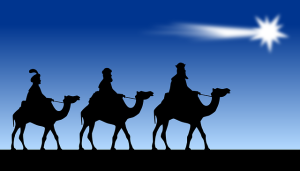
Image by OpenClipart-Vectors from Pixabay
It is no surprise then that the Magi brought frankincense to the newborn King. They also brought myrrh, which is an anointing oil but also used in the making of incense.
In many cultures, incense is burnt for its perfume. Since Old Testament use of incense was often in connection with the burnt offerings of animals, the incense might have been doing double duty to convey prayers upward and to mask the burnt flesh odor.
New Testament Use of Incense
The relationship between incense and a sacrificial offering connects incense to the death of Christ.
Some may think that incense went out of style when we ceased to sacrifice animals. Instead, it remains significance because it is both a precious substance worthy of Christ the King and, as a (thankfully bloodless) burnt offering, a remembrance of Christ’s sacrifice for our sins.
Early Christians certainly appreciated the symbolism of incense. I have previously referred to Revelation 8:4; in addition, John’s vision, as described in Revelation 5:8, foresaw 24 elders holding gold bowls filled with incense.
In Second Corinthians, Paul uses the image of incense to illustrate the mission of a Christian: “Thanks be to God who . . . employs us to diffuse the fragrance of His knowledge everywhere! We are an aroma of Christ for God’s sake.” (2 Cor 2:14-15)
Catholic Use of Incense
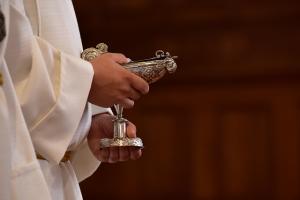
Image by piundco from Pixabay
In the Catholic Church, burning incense is therefore used as a sign of reverence and dedication. It is a sacramental like holy water or the sign of the cross.
For example, we incense the altar, which represents Christ’s sacrifice, as a sign of respect for His suffering and death on our behalf.
We also incense other objects that have symbolic significance such as the Easter candle that represents Christ as the Light of the World. At a solemn Mass, we incense the Missal in reverence for the Word of God and Christ, the Word Incarnate.
We incense the Blessed Sacrament at Benediction as a means of adoration in Christ’s presence. Once again, we are honoring God with the gift fit for a king.
At a funeral Mass, we incense the body as a sign of respect because it was once a temple of God.
Surely Protestants could find it appropriate as well to use incense. Before the preacher gives his/her sermon, wouldn’t it be fitting for him/her to incense the Bible?
Since incense is apparently so important to God (after all, He dictated a recipe to make sure it was made right), may I suggest that Protestants consider adding incense back into their practice of Christianity? It would be a way to renew and strengthen their connection to a long Judeo-Christian heritage.
The celebrant at our Mass last Sunday said we need to “Wake up and smell the incense!” Indeed, for Catholics too, a return to using incense more often might increase our sense of reverence and awe and wake us up to a renewed dedication to our faith.
Previous Post

December 8, 2021
Our Lady of La Leche: A Needed Image for Women
Next Post
December 14, 2021 The Catholic Church and Galileo: Truth or Myth?
Browse Our Archives
Select a Category Patheos Catholic Uncategorized
Select a Month October 2026 September 2026 July 2026 May 2026 December 2025 November 2025 September 2025 August 2025 July 2025 June 2025 May 2025 April 2025 March 2025 February 2025 August 2024 July 2024 June 2024 May 2024 April 2024 March 2024 February 2024 January 2024 November 2023 September 2023 July 2023 June 2023 February 2023 September 2022 August 2022 July 2022 June 2022 May 2022 April 2022 March 2022 February 2022 January 2022 December 2021 November 2021 October 2021 September 2021 August 2021
Follow Us!
TAKE THE
Religious Wisdom Quiz
In which Psalm do we find "Your word is a lamp to my feet..."?
Select your answer to see how you score.
Psalm 90 Psalm 27 Psalm 119 Psalm 23
Related posts from Musings From the Pew
Why I Choose the Eucharist Over the Sermon

Changing the Culture's View of Motherhood
Abortion in the Didache: forbidden by the Apostles

Introducing the Consistent Life Ethic at Your Church
TRENDING AT PATHEOS Catholic

Rejecting Doom: Christian Hope And Human Action
Christianity is a religion of hope. We are to have hope and...

It’s What Comes From Within Which Matters
One of the most difficult things for us to understand is why...

Why I Choose the Eucharist Over the Sermon
Choose the Eucharist, Not the Sermon What are we supposed to get...

5 Design Elements Found in Spiritually Rooted Homes
Putting Spirituality Into Home Decor Our homes are more than our living...

Credo: A Story of God Told with the...
About 10 years ago, I began to imagine a personal "Credo" that...

The Anatomy of Divine Revelation in Catholic Thought
The claim that God has made Himself known to human beings is...
view all Catholic blogs
Ad-Free & Subscriber Log-In Subscription Support
- About Us
- 2026 Calendar
- Videos
- Podcasts
- Library of World Religions
- Faith In Media Tracker
- Advertise With Us
- Write for Us
- Privacy Policy
- Terms of Service
- Do Not Sell My Data
- Contact Us
- Radiant Digital
- Manage Newsletter Subscriptions
- Unsubscribe From Notifications
- Sitemap
Copyright 2008-2026, Patheos. All rights reserved.
Subscription Support Ad-Free & Subscriber Log-In
Follow Patheos