
BuddhistCatholicContemplativeEvangelicalGeneral ChristianHinduJewishLatter-day SaintMuslimNew VisionsProgressive Christian
Beliefs
- Buddhist
- Catholic
- Contemplative
- Evangelical
- General Christian
- Hindu
- Jewish
- Latter-day Saint
- More Voices
- Muslim
- New Visions
- Pagan
- Progressive Christian
Topics
- Religion News
- Food and Religion
- Sports and Religion
- Religious Art
- Religious Music and Entertainment
- Religious Events
- History and Religion
- Style and Religion
- Politics and Religion
- Women in Religion
- Recreation Outdoors and Religion
- Business Finance and Religion
- Careers Workplace and Religion
- Education and Religion
- Family Parenting and Religion
- Health Fitness and Religion
- Home and Religion
- Relationships and Religion
- Technology and Religion
- Travel and Religion
Columnists
- Buddhist Columnists
- Business Finance and Religion Columnists
- Careers Workplace and Religion Columnists
- Catholic Columnists
- Contemplative Columnists
- Education and Religion Columnists
- Evangelists Columnists
- Family Parenting and Religion Columnists
- General Christian Columnists
- Health Fitness and Religion Columnists
- Hindu Columnists
- History and Religion Columnists
- Home and Religion Columnists
- Jewish Columnists
- More Voices Columnists
- Latter Day Columnists
- Muslim Columnists
- New Visions Columnists
- Nonreligious Columnists
- Pagan Columnists
- Politics and Religion Columnists
- Progressive Columnists
- Recreation Outdoors and Religion Columnists
- Relationships and Religion Columnists
- Religion News Columnists
- Religious Art Columnists
- Religious Events Columnists
- Religious Music and Entertainment Columnists
- Sports and Religion Columnists
- Style and Religion Columnists
- Technology and Religion Columnists
- Travel and Religion Columnists
- Women in Religion Columnists
Resource Library
- 2026 Calendar
- Library of World Religions
- The 100 Most Holy Places on Earth
- Patheos Answers
- Podcasts
- Videos
- Faith Leaders Database
- Anglican Episcopalian
- Bahai
- Baptist
- Buddhism
- Christianity
- Confucianism
- Eastern Orthodoxy
- Hinduism
- Holiness and Pentecostal
- ISKCON
- Islam
- Judaism
- Lutheran
- Methodist
- The Church of Jesus Christ of Latter-day Saints
- New Age
- Paganism
- Presbytarian and Reformed
- Protestantism
- Religion Behind the Scenes
- Roman Catholic
- Scientology
- Shia Islam
- Sikhism
- Sufism
- Sunni Islam
- Taoism
- Zen
- See all religions
Research Tools
 Ad-Free & Subscriber Log-In Subscription Support
Ad-Free & Subscriber Log-In Subscription Support
Follow Patheos 

- Trending:
- Forgiveness
- |
- Marriage
- |
- Consciousness
- |
- Death Penalty
- |
- Election
- |
- Halloween

- Home
- Catholic
Calendar (Anglican Use)
Here continueth the Fourth Part of TRINITYTIDE, also called “Hallowtide”
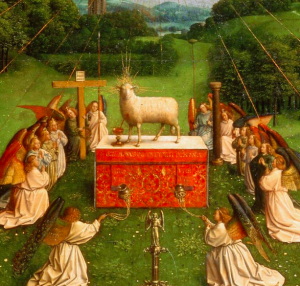
Part of the Ghent Altarpiece (c. 1427)
by Jan van Eyck.
13 Oct. St. Edward the Confessor (c. 1003-1066) | found incorruptible when his body was translated on this date, 1163; patron for difficult marriages
15. St. Teresa of Jesus (1515-1582), OCD,* Virgin and Doctor | foundress of the Discalced Carmelites; author of Camino de Perfección [The Way of Perfection], El Castillo Interior [The Interior Castle], etc.; patroness of the sick, religious, chess, and people ridiculed for piety
16. St. Margaret Mary Alacoque (1647-1690), VSM,* Virgin | author of La Devotion au Sacré-Coeur de Jesus [Devotion to the Sacred Heart of Jesus]
17. St. Ignatius of Antioch (c. 30?-108?), Bishop and Martyr | third Bishop of Antioch (in succession from St. Peter as the first); author of Epistles to the Ephesians, Magnesians, Trallians, Romans, Philadelphians, Smyrnæans, and Polycarp
18. Twentieth Sunday after Trinity (Feast of St. Luke the Evangelist suppressed for MMXXVI)
19. SS. Jean de Brébeuf (1593-1649), SJ,* and Isaac Jogues (1607-1646), SJ,* Priests and Martyrs | patrons of Canada
25. Twenty-first Sunday after Trinity
28. SS. Simon and Jude Thaddæus, Apostles and Martyrs | patrons of tanners (Simon) and of desperate cases and lost causes (Jude)
31. Hallowmas Eve
1 Nov. Allhallowmas, or the Solemnity of All Saints
Here beginneth the Last Part of TRINITYTIDE, also called “Doomtide”
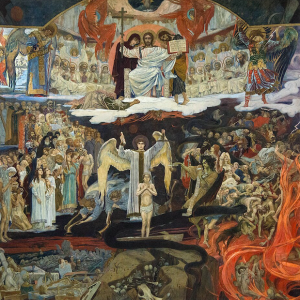
The Last Judgment (1904), by Viktor Vasnetsov.
2. All Souls’ Day, or the Day of the Dead
3. St. Martín de Porres (1579-1639), OP* | patron of public education and of black and mixed-race people
4. St. Charles Borromeo (1538-1584) | patron of catechists and catechumens, seminaries, cardinals and bishops, and against stomach and intestinal ailments
8. Twenty-third Sunday after Trinity
9. Dedication of St. John Lateran | mother-basilica of the Roman Church
10. St. Leo the Great (c. 391-461), Pope and Doctor | contributor to the Council of Chalcedon
11. St. Martin of Tours (336 [?]-397), Bishop | patron of beggars, soldiers, hoteliers, and alcoholics
12. St. Josaphat Kuntsevych (c. 1580-1623), OSBM,* Bishop and Martyr | hieromonk of the Ruthenian Greek Catholic Church
13. St. Frances Xavier Cabrini (1850-1917), MSC* | foundress of the Missionaries of the Sacred Heart, patroness of immigrants
15. Twenty-fourth Sunday after Trinity
16. St. Margaret of Wessex (c. 1045-1093) | queen and patroness of Scotland
17. St. Elizabeth of Hungary (1207-1231), TOSF* | queen of Hungary, patroness of Hungary, Franciscan tertiaries, hospitals, widows, exiles, and the falsely accused
20. St. Edmund the Martyr (?-869) | king of East Anglia, martyred by the Mycel Hæþen (the “Great Heathen Army” that invaded Britain from Denmark in 865)
22. Solemnity of Christ, King of the Universe
23. St. Columban (543-615), Abbot [n/a]*; Bl. Miguel Pro (1891-1927), SJ,* Priest and Martyr | author (Columban) of the Rule of St. Columban*, founder of Bobbio Abbey; served (Miguel) the underground Church in Mexico during the Cristero persecution (1924-1934)*
24. St. Andrew Dũng-Lạc (c. 1795-1839) and Companions, Priest and Martyrs | patron of the Diocese of Orange, CA
25. St. Catherine of Alexandria (c. 287?-c. 305), Virgin and Martyr | martyr of the Diocletianic persecution (303-311), patroness of unmarried girls, apologists and preachers, all who work with wheels, and jurists
26. Thanksgiving Day
28. Last day of liturgical year MMXXVI
Hereafter beginneth the ADVENT of Liturgical Year MMXXVII
*Religious order abbreviations (“families” indicate the rule each society follows):
CO: Oratorians (Nerian family)
MSC: Missionaries of the Sacred Heart (Cabrinian family)
OCD: Discalced Carmelites (Carmelite family)
OP: Dominican friars (Augustinian family)
OSBM: Basilians (Basilian family)
SJ: Jesuits (Ignatian family)
TOSF: Franciscan Tertiaries (Franciscan family)
VSM: Visitandines (Salesian family)
[n/a]: monastics of the “Celtic Church,” no defined order (Columbanian family—now defunct)
NOTES ON THE CALENDAR
I. The Anglican Use

The Canterbury Cross, a design associated
with the English Christian tradition.
Image design by Life of Riley,
used via a CC BY-SA 4.0 license (source).

The calendar here is that of the Ordinariate of the Chair of Peter, the North American branch of what’s informally called the “Anglican Use.” Most Ordinariate members are Catholics with an Anglican or Episcopal background, now in full communion with the Pope. However, we retain a ritual and spiritual inheritance from the Church of England, known as the “Anglican patrimony”—our cultural expression of the faith, which affects aspects of our liturgy. (Since we are fully united with Rome, any properly-disposed Catholic is welcome to receive the sacraments at an “Anglican Use” parish, whether members of one or not—just like you don’t need to be a Franciscan yourself to go to a parish run by them.) An Ordinariate is structurally similar to a diocese, but its organizing principle is common heritage rather than geography alone. We have two sister Ordinariates, named for Our Lady of Walsingham (which serves the British Isles) and Our Lady of the Southern Cross (chiefly serving Australia). On the calendar above and in the guide below:
- Seasons (both formal and informal) are given section headings, in red.
- Sundays, solemnities, feasts, and major feriæ are marked in boldface. (Memorials are also listed, but not in bold.)
- Customs and duties specific to the Anglican patrimony are in blue (e.g., the duty of abstinence on 18th Sept. binds only us, not Catholics in general).
- Important American secular observances appear in green.
In the Anglican Use, Sundays outside Advent, Christmastide, Lent, and Eastertide are measured not according to Ordinary Time, but as they occur after Epiphany and after Trinity. This year, after Trinity Sunday (31st May), adding nine to the number of the Sunday after Trinity will give the equivalent Sunday in Ordinary Time: e.g., the Fifteenth Sunday after Trinity (13th September MMXXVI/2026) is the Twenty-Fourth Sunday in Ordinary Time. (There are also a selection of saints in our calendar not typically commemorated in the US, or observances changed in rank—e.g., the Feast of the Chair of Peter on 22nd February is kept in the Ordinariate as a solemnity instead.)
II. General Rules
Catholics normally must attend Mass on all Sundays and on all Holy Days of Obligation.* These Holy Days are set in most countries by their national bishops’ conference, which chooses them from among the solemnities of the Church’s calendar. In the US, Holy Days of Obligation are as follows:
- The Immaculate Conception of the Mother of God, 8th Dec.
- The Nativity of the Lord, 25th Dec.
- The Solemnity of the Mother of God, 1st Jan.
- The Ascension of the Lord, ten days before Pentecost.**
- The Assumption of the Mother of God, 15th Aug.
- The Solemnity of Allhallowmas, 1st Nov.
Catholics must also do some form of penance on all Fridays of the year. In Lent and on the Ember Fridays of September and Advent, abstinence from meat (which for ritual purposes does not include fish or shellfish) is the obligatory form of Friday penance; the rest of the year, the form of penance is a matter of personal discretion, though abstinence is traditional. Further general information on the calendar can be found in this post; sections III and IV below explore the current and immediately approaching months and seasons (and are therefore often updated).
*This duty is always waived for those with serious cause to omit it (such as illness, lack of transport, etc). It is also usually waived for the faithful in general when the day falls on a Saturday or Monday, so as not to overburden them with two consecutive days on which they must attend Mass. However, Immaculate Conception and Christmas Day always carry the duty to attend Mass in the US. (The former honors our national patroness, and the latter is one of the three greatest feasts of the Church, alongside Easter and Pentecost.)
**This description reflects the traditional date for Ascension (the fortieth day of Easter, which is always a Thursday), as this date is usually kept in the Ordinariate. However, in most US dioceses, Ascension is transferred to the following Sunday.
III. The Month: October
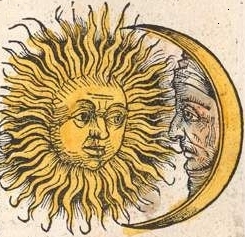
October was the eighth month in the Roman calendar. In the Judaic calendar, the end of September or the beginning of October is about when Sukkot falls (sometimes translated “the Feast of Tabernacles”), which marked the final fruit harvest of the year, and was sometimes associated with the last judgment. Among Latin-rite Catholics, October has been linked with the rosary since the feast of Our Lady of Victory, a.k.a. Our Lady of the Rosary, was instituted after the Battle of Lepanto in 1571. It also happens that all of October, plus the last and first days of the months on either side of it, fall within the fourth part of Trinitytide, so its monthly themes are largely subsumed into those of the sub-season.
Three of the saints commemorated in October are specially important or peculiar to the Anglican Use within Catholicism. St. John Henry Newman is the famous one, the most prominent of the converts associated with the Oxford Movement in the Church of England (which was the historical beginning of what we today call Anglo-Catholicism or “high church” Anglicanism, of which the Anglican Use liturgy and the Ordinariates are ourselves fruit). Promptly following his memorial, we also find St. Wilfrid, Bishop of York—the see was not elevated to the status of an archbishopric until 735, a quarter century after the saint’s death. Fittingly enough for his proximity to J. H. Newman in the calendar, Wilfrid was a champion of union with the Roman cause at the Synod of Whitby, held in Northumbria in 664, which helped decide the future complexion of Christianity throughout the British Isles. Finally, on 13th October, we commemorate the translation of St. Edward the Confessor, England’s last-but-one Anglo-Saxon king, and a saint of whom I’m particularly fond. He is an early instance of the phenomenon, rare even among canonized saints, of being incorruptible (a technical term indicating that part or all of the body of the saint either decays unnaturally slowly or simply doesn’t decay—St. Francis Xavier, St. Teresa of Ávila, St. Catherine Labouré, and Bl. Karl of Austria are also examples of miraculous incorruptibility).
IV. The Season: “Hallowtide” (the Fourth Part of Trinitytide)
Hallowtide is part of a kind of focusing movement we can observe across the last three of the five sections of Trinitytide. Its first, “Apostletide,” immediately succeeds the Octave of Pentecost and faces backward, looking to the descent of the Holy Ghost from whom the Church is what she is; the second, “Assumptiontide,” culminates in the departure of the Mother of God—and there in high summer, as with the feast of Candlemas in the depth of winter, our gaze turns in the other direction. At Assumption, we were looking heavenward, into the eternity to which the body of the Theotokos has been drawn.
Yet the Lord’s promise when he ascended, even behind Pentecost, was that he will come back—that eternity will again appear to finish, reconcile, and transcend time. Michaelmas honored the holy angels, and Hallowtide is littered with saints’ days, all building up to the great solemnity of All Hallows, which was originally instituted in honor of all the unknown, nameless martyrs. This naturally draws our mind toward the last things: death; judgment; hell; heaven. Thus we will begin All Souls’ Day, which marks where the year will take its final turn before MMXXVI, or liturgical year 2026, draws to a close.
Ad-Free & Subscriber Log-In Subscription Support
- About Us
- 2026 Calendar
- Videos
- Podcasts
- Library of World Religions
- Faith In Media Tracker
- Advertise With Us
- Write for Us
- Privacy Policy
- Terms of Service
- Do Not Sell My Data
- Contact Us
- Radiant Digital
- Manage Newsletter Subscriptions
- Unsubscribe From Notifications
- Sitemap
Copyright 2008-2026, Patheos. All rights reserved.
Subscription Support Ad-Free & Subscriber Log-In
Follow Patheos