
BuddhistCatholicContemplativeEvangelicalGeneral ChristianHinduJewishLatter-day SaintMuslimNew VisionsProgressive Christian
Beliefs
- Buddhist
- Catholic
- Contemplative
- Evangelical
- General Christian
- Hindu
- Jewish
- Latter-day Saint
- More Voices
- Muslim
- New Visions
- Pagan
- Progressive Christian
Topics
- Religion News
- Food and Religion
- Sports and Religion
- Religious Art
- Religious Music and Entertainment
- Religious Events
- History and Religion
- Style and Religion
- Politics and Religion
- Women in Religion
- Recreation Outdoors and Religion
- Business Finance and Religion
- Careers Workplace and Religion
- Education and Religion
- Family Parenting and Religion
- Health Fitness and Religion
- Home and Religion
- Relationships and Religion
- Technology and Religion
- Travel and Religion
Columnists
- Buddhist Columnists
- Business Finance and Religion Columnists
- Careers Workplace and Religion Columnists
- Catholic Columnists
- Contemplative Columnists
- Education and Religion Columnists
- Evangelists Columnists
- Family Parenting and Religion Columnists
- General Christian Columnists
- Health Fitness and Religion Columnists
- Hindu Columnists
- History and Religion Columnists
- Home and Religion Columnists
- Jewish Columnists
- More Voices Columnists
- Latter Day Columnists
- Muslim Columnists
- New Visions Columnists
- Nonreligious Columnists
- Pagan Columnists
- Politics and Religion Columnists
- Progressive Columnists
- Recreation Outdoors and Religion Columnists
- Relationships and Religion Columnists
- Religion News Columnists
- Religious Art Columnists
- Religious Events Columnists
- Religious Music and Entertainment Columnists
- Sports and Religion Columnists
- Style and Religion Columnists
- Technology and Religion Columnists
- Travel and Religion Columnists
- Women in Religion Columnists
Resource Library
- 2026 Calendar
- Library of World Religions
- The 100 Most Holy Places on Earth
- Patheos Answers
- Podcasts
- Videos
- Faith Leaders Database
- Anglican Episcopalian
- Bahai
- Baptist
- Buddhism
- Christianity
- Confucianism
- Eastern Orthodoxy
- Hinduism
- Holiness and Pentecostal
- ISKCON
- Islam
- Judaism
- Lutheran
- Methodist
- The Church of Jesus Christ of Latter-day Saints
- New Age
- Paganism
- Presbytarian and Reformed
- Protestantism
- Religion Behind the Scenes
- Roman Catholic
- Scientology
- Shia Islam
- Sikhism
- Sufism
- Sunni Islam
- Taoism
- Zen
- See all religions
Research Tools
 Ad-Free & Subscriber Log-In Subscription Support
Follow Patheos 

- Trending:
- Advent
- |
- Forgiveness
- |
- Thanksgiving
- |
- Election
- |
- Seasonal Holidays
- |
- Marriage

- Home
- Catholic
- Book III, Chapter 3: Christ “Classic” (Matt. 9:9-34)
Book III, Chapter 3: Christ “Classic” (Matt. 9:9-34)
Last updated on: November 25, 2026 at 7:16 pm by Gabriel Blanchard
Book III, Chapter 3: Christ “Classic” (Matt. 9:9-34) 2026-11-25T19:16:53-04:00 Gabriel Blanchard
Patheos Explore the world's faith through different perspectives on religion and spirituality! Patheos has the views of the prevalent religions and spiritualities of the world.
Book III, Chapter 3: Christ “Classic” (Matt. 9:9-34)
In honor of tomorrow’s holiday, we have an early posting! Here, we enter on a handful of maxims and miracles that show Yeshua at his most familiar. I have written about the events middle chunk, vv. 18-26, before; however, that was when I was working with the Marcan parallel, which is strikingly different (much richer in detail, for one thing—Matthew‘s author is terse*). If you don’t feel like or don’t have time to read that whole business, I would nonetheless recommend having a look at its textual notes g and i, as they provide some valuable background on the two young ladies whose stories of healing were so entangled, they fused into a single pericope.*
Synoptic parallels:
- Matthew *9:9-17—*Mark 2:13-22, Luke 5:27-39
- Matthew *9:18-26—*Mark 5:21-43, Luke 8:40-56
- Matthew *9:27-31—*Mark 10:46-52?, Luke *18:35-43?*1
- Matthew *9:32-33—*Luke 11:14
- Matthew *9:34—*Mark 3:22-30, Luke 11:15-26
Matthew 9:9-34, RSV-CE
As Jesus passed on from there, he saw a man called Matthewa sitting at the tax office; and he said to him, “Follow me.” And he rose and followed him.
And as he sat at table in the house, behold, many tax collectors and sinnersb came and sat down with Jesus and his disciples. And when the Pharisees saw this, they said to his disciples, “Why does your teacher eat with tax collectors and sinners?” But when he heard it, he said, “Those who are well have no need of a physician, but those who are sick. Go and learn what this means, ‘I desire mercy, and not sacrifice.’c For I came not to call the righteous, but sinners.”
Then the disciples of John came to him, saying, “Why do we and the Pharisees fast, but your disciples do not fast?” And Jesus said to them, “Can the wedding guests mourn as long as the bridegroom is with them? The days will come, when the bridegroom is taken away from them, and then they will fast. And no one puts a piece of unshrunk cloth on an old garment, for the patch tears away from the garment, and a worse tear is made. Neither is new wine put into old wineskins; if it is, the skins burst,d and the wine is spilled, and the skins are destroyed; but new wine is put into fresh wineskins, and so both are preserved.”
While he was thus speaking to them, behold, a ruler came in and knelt before him, saying, “My daughter has just died; but come and lay your hand on her, and she will live.” And Jesus rose and followed him, with his disciples. And behold, a woman who had suffered from a hemorrhage for twelve years came up behind him and touched the fringe of his garment;e for she said to herself, “If I only touch his garment, I shall be made well.” Jesus turned, and seeing her he said, “Take heart, daughter; your faith has made you well.” And instantly the woman was made well. And when Jesus came to the ruler’s house, and saw the flute players, and the crowd making a tumult, he said, “Depart; for the girlf is not dead but sleeping.” And they laughed at him. But when the crowd had been put outside, he went in and took her by the hand,g and the girl arose. And the report of this went through all that district.
hAnd as Jesus passed on from there, two blind men followed him, crying aloud, “Have mercy on us, Son of David.” When he entered the house, the blind men came to him; and Jesus said to them, “Do you believe that I am able to do this?” They said to him, “Yes, Lord.” Then he touched their eyes, saying, “According to your faith be it done to you.” And their eyes were opened. And Jesus sternly charged them, “See that no one knows it.” But they went away and spread his fame through all that district.h
As they were going away, behold, a dumb demoniac was brought to him. And when the demon had been cast out, the dumb man spoke; and the crowds marveled, saying, “Never was anything like this seen in Israel.” But the Pharisees said, “He casts out demons by the prince of demons.”
Matthew 9:9-34, my translation
And Yeshua, going along there, saw a person sitting at the tax-office called Mattai,a and says to him, “Follow me”; and he got up [and] followed him.
And it happened, while he was sitting in the household, behold, many tax officials and sinnersb had also come to sit with Yeshua and his students. And seeing [this], the Pryshaya said to his students: “For what [reason] does your teacher eat with tax officials and sinners?”
Hearing it, he said, “The strong have no use for a doctor, but those who are doing badly. [When you] have gone, learn what this is: ‘I want pity and not sacrifice’;c for I did not come to call the just, but sinners.”
Then students of Yochanan came to him, saying, “For what [reason] do we and the Pryshaya fast [at] many [times], but your students do not fast?”
And Yeshua told them, “The sons of the bridal-chamber cannot mourn as long as the bridegroom is with them, [can they]? The days will come, whenever the bridegroom is taken away from them, and then they will fast. No one puts a patch of unshrunk cloth onto an old mantle; for its fullness pulls away from the mantle, and the tear becomes worse. Nor do they throw new wine into old skin-bottles: lest, if they do, the skin-bottles are burst,d and the wine is spilled and the skin-bottles are destroyed; but they throw new wine into new skin-bottles, and both are preserved.”

An illustration of Aglianico grapes,
an Italian wine grape variety.
While he was saying these things to them, behold, one prince came, made prostration to him, [and] said that “My daughter has at this moment ended; but come and lay your hand on her, and she will live.” And Yeshua, rising, followed him, and his students.
And behold, a woman who had had a flow of blood twelve years came forward behind him and grasped the tassel of his mantle;e for she said to herself, “If only I can touch his mantle, I will be healed.”
But Yeshua, turning and beholding her, said: “Cheer up, daughter; your faith has healed you.” And the woman was healed from that hour.
And Yeshua came into the prince’s household, and, seeing the flutists and the wailing crowd, began saying: “Draw back, for the young ladyf has not died, but is sleeping”—and they jeered at him. But when the crowd had been thrown out, he came in [and] seized her hand,g and roused the young lady; and this report went out into that whole land.
hAnd as he was going by there, two blind men followed Yeshua, crying out and saying, “Take pity on us, Son of David.”
The blind men came to him when he had entered the household, and Yeshua says to them: “Do you have faith that I can do this?”
They tell him, “Yes, sir.”
Then he touched their eyes, saying, “According to your faith, so be it for you.” And their eyes were opened. And being impassioned, Yeshua says to them: “See that no one knows this”; yet when they went out, they spread the report of him in that whole land.h
As they were going out, behold, they brought him a person who was dumb, demon-possessed; and once the demon was thrown out, the dumb [person] spoke. And the crowds were amazed, saying: “It has never appeared like this in Yisroel.”
Yet the Pryshaya began saying, “By the prince of demons he throws demons out.”
Textual Notes
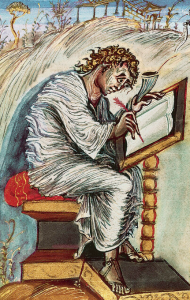
Portrait of St. Matthew from the Ebbo Gospels
(c. 820-840), a Carolingian evangeliary.
a. Matthew/Mattai | Μαθθαῖον [Matthaion]: Μαθθαῖος [Matthaios], or Ματθαῖος [Mat’thaios], is an adaptation to Greek of the Aramaic name מַתַּי [Matay], which in turn simplifies a Hebrew name, מַתִּתְיָהוּ [Matith’yåhúw]; its meaning is “gift of [TETRAGRAMMATON].” (If you were around in the mid-to-late Bush years and are wondering, yes, this is the same name as Matisyahu. If you weren’t, but you happen to like reggæ music, it turns out that genre mixes as well with Hasidic Judaism as it did with Rastafarianism. So that question is settled, finally.)
b. sinners | ἁμαρτωλοὶ [hamartōloi]: This word is often taken by modern readers as a euphemistic allusion to sexual sin—thus, the primary significance would be prostitutes (and, maybe, johns). This is possible, but as far as I can tell, Tannaitic Judaism2 didn’t have the same bee in its bonnet about specifically sexual immorality that twentieth and twenty-first century Christianity do. On the other hand, given the immense emphasis Judaism lays on studying the Law (cf. John 7:49, in which some Pryshaya state that “this crowd, which do not know the Law, are damned”), I wonder whether ἁμαρτωλοὶ might have been euphemistically extended from violators of this mitzvah or that—prostitutes would be one example, but so equally would be Jews who habitually dabbled in magic, or broke kosher (out of gluttony or for convenience), or transgressed the sabbath (from economic anxiety or a lack of reverence), etc.—to people who were merely ignorant about the Torah.
c. Go and learn what this means, “I desire mercy, and not sacrifice”/[When you] have gone, learn what this is: “I want pity and not sacrifice” | πορευθέντες δὲ μάθετε τί ἐστιν· Ἔλεος θέλω καὶ οὐ θυσίαν [poreuthentes de mathete ti estin: «eleos thelō kai ou thüsian»]: The passage which the Lord Yeshua is quoting comes from Hosea, the first and longest of the Twelve Prophets (whom Anglophone Christians typically call the Minor Prophets).
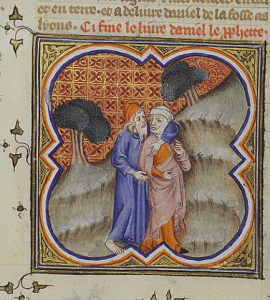
An illumination of Hosea with his wife, Gomer,
from the 1372 Bible Historiale, a translation of
selections of the Bible into Old French.
I know Ephraim,
——and Israel is not hid from me;
… For the spirit of harlotry is within them,
——and they know not the Lord. …
I will return again to my place,
until they acknowledge their guilt and seek my face,
——and in their distress they seek me, saying,
“Come, let us return to the Lord;
for he has torn, that he may heal us;
——he has stricken, and he will bind us up.
After two days he will revive us;
——on the third day he will raise us up …
——his going forth is sure as the dawn;
he will come to us as the showers,
——as the spring rains that water the earth.”
What shall I do with you, O Ephraim?
——What shall I do with you, O Judah?
Your love is like a morning cloud,
——like the dew that goes early away.
Therefore I have hewn them by the prophets,
——I have slain them by the words of my mouth,
——and my judgment goes forth as the light.
For I desire steadfast love and not sacrifice,
——the knowledge of God, rather than burnt offerings.
But at Adam they transgressed the covenant;
——there they dealt faithlessly with me.
Gilead is a city of evildoers …
—Hosea 5:3-4, 5:15-6:8
d. the skins burst/the skin-bottles are burst | ῥήγνυνται οἱ ἀσκοί [rhēgnüntai hoi askoi]: New wine, which is still fermenting, releases gases that stretch the material of a freshly-made leather bottle without breaking it. Do the same thing with an old bottle (which got stretched back when it was a new one), and the second stretch strains the leather too much, so it simply breaks.

A pair of modern tzitziyot. Photo by TShilo12,
used via a CC BY-SA 3.0 license (source).

e. the fringe of his garment/the tassel of his mantle | τοῦ κρασπέδου τοῦ ἱματίου αὐτοῦ [tou kraspedou tou himatiou autou]: In my translation of the Marcan parallel a few years ago, I pointed out that, although this is the kind of romantic detail that a certain kind of preacher likes, that text does not actually specify that this woman caught hold of Christ’s צִיצִיּוֹת [tziytziyyowth], the tassels which hang from a correctly-made tallit, or prayer shawl (a garment still worn daily by observant Jews). That was correct. However, it was also about a different word than the key one in this text: all the Second Gospel notes is that she touched his ἱμάτιον [himation], what I normally render as “mantle,” which has no specific textual implication of being a tallit. Here, by contrast, we have specific mention of the κράσπεδον [kraspedon], meaning “hem, edge, fringe,” and which was in fact used to cover the “tassels” mandated in the Law.
Speak to the people of Israel, and bid them to make tassels on the corners of their garments throughout their generations, and to put upon the tassel of each corner a cord of blue;3 and it shall be to you a tassel to look upon and remember all the commandments of the LORD, to do them, not to follow after your own heart and your own eyes, which you are inclined to go after wantonly. So you shall remember and do all my commandments, and be holy to your God.
—Numbers 15:38-40
That said, I must in fairness add that κράσπεδον does not necessarily indicate a tzitzit. It really could just mean the hem, even if that interpretation is more boring.
f. girl/young lady | κοράσιον [korasion]: I went with a slightly more formal-sounding rendering here because of the etymology of κοράσιον. It is an elaborated form of κόρη [korē], the literal meaning of which is simply “girl, maiden.” However, Κόρη was also used (in a manner rather similar to the use in English of the expression the Virgin) to denote Persephone, the goddess of spring flowers as the daughter of Demeter, the maternal grain-goddess. (Persephone was the goddess of the dead as Hades’ wife, but, if I’m correctly informed, the title Κόρη was not used for Persephone in netherworld contexts.) Obviously we’re dealing with a culture who were not steeped in Greek mythology!—but linguistic connotations can have a surprising tenacity, even when the cause that conjured them has been banished. I’m therefore comfortable putting forward the conjecture that κοράσιον might have had a vibe closer to “mademoiselle” than “chick.”
g. took her by the hand/seized her hand | ἐκράτησεν τῆς χειρὸς αὐτῆς [ekratēsen tēs cheiros autēs]: This is a surprisingly assertive verb. Κρατέω [krateō] derives from κράτος [kratos], which means “force, power, strength”; the Koiné word typically translated “self-control” is ἐγκράτεια [enkrateia], literally “in-force.” As a rule, descriptions in the First Gospel are less colorful than those of Mark; this bucks that trend a little.
h. And as Jesus passed … through all that district/And as he was … in that whole land | Καὶ παράγοντι ἐκεῖθεν … ἐν ὅλῃ τῇ γῇ ἐκείνῃ [kai paragonti ekeithen … en holē tē gē ekeinē]: If my judgment about this passage is correct, then this pericope seems to be unique to Matthew. However, I feel it’s my duty to advise readers of a broader context surrounding said judgment. I gather that most Biblical scholars, if not more, would greet my views with laughter; somebody who was feeling really sarcastic might even call up the Classics Department at College Park to find out whether I in fact left Maryland with a degree, or just left. (Joke’s on them, though, my alma mater has been trying to kill my major for years, almost as frequently as they ask me for money.) So, I want to make it clear that (a) my judgment diverges from most scholars on this point, as I feel readers have a right to know things like that (or at least that I have a duty to inform readers of things like that),4 and (b) lay out my case for why it does so.
The more mainstream theory—at any rate, mainstream enough that it’s asserted by Dr. Harrington SJ in Sacra Pagina‘s volume on Matthew as unqualified fact—is that this is a reproduction of St. Mark’s account of the healing blind Bartimæus. The parallel texts I gave in the preface’s list above, although I marked them as uncertain, are the passages from the other two Synoptic Gospels that certainly do relate that story, complete with the name of the healed man. The claim that they are (and that the author of Matthew has invented a second blind man to go with Bartimæus, an assumption of which I was grumbling in textual note d on last week’s passage) is a commonplace among Biblical scholars, so it’s mere fairness to point out that it has respectable academics who vouch for it.
My reservations here are four.
- It seems to begin with the view that the author is tampering with his material, and as far as I can see, the case for that view is mostly if not entirely that Matthew sometimes reports two people where Mark and/or Luke report only one. I don’t find this view compelling, as I groused about in textual note d on last week’s passage. To my mind, there’s nothing terribly implausible about the following scenario: Of the sources the various evangelists were relying on, on any given occasion, all were sure that one man had been healed or exorcized or what have you, but only some were confident they recalled more than one—so most of them played it safe by only mentioning one; then, the other two Synoptic authors either followed suit for similar reasons, or only heard the final result anyway, but the author of Matthew heard more and chose to record it. (This point applies more properly to a different part of Matthew, as we’ll see momentarily.)
- Curing blindness is, let us say, not unique to the Bartimæus pericope! The assertion of identity between this pericope in the First Gospel and that one in the Second and Third, then, seems to rest on the strength of the blind men addressing Yeshua as “Son of Dawid.” Now, it must be granted that this is not a very frequent device in the Gospels; but still, it was a normal title in messianic discourse. This isn’t the invention of calculus, it’s not difficult to credit at least two blind men with independently having this same idea.
- In addition to lacking the name Bartimæus, the setting of the miracle described here is quite different. It takes place indoors, and is succeeded by a stern admonition not to publicize their cure. In Mark and Luke, the Bartimæus story takes place outside, in the environs of Yericho, immediately before the Triumphal Entry.
- Finally, Matthew does have a parallel to the Bartimæus pericope: it’s in ch. 20. (This version also has two guys rather than one, and also lacks the name Bartimæus—facts which are consistent with the mainstream scholarly opinion of this passage, just as they are with mine—but the setting in Matthew 20 aligns with the settings described in Mark 10 and Luke 18.) Why would the author relate the same story again? Apart from anything else, what a waste of papyrus! I’m not saying such clumsy narration is impossible, far from it. But it suggests a writer who is artless and easily confused. That’s not the impression I take away from any part of the New Testament, certainly not from the presumed redactor of the Sermon on the Mount.
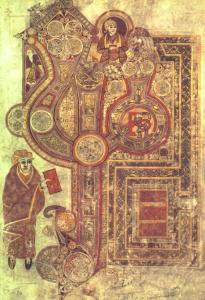
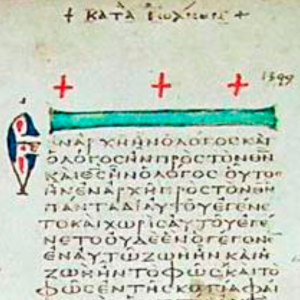
The beginning of Matthew
from the Book of Kells (c. 800).5
Footnotes
1The possibly-parallel Marcan and Lucan passages relate the story of Bartimæus, whose name is explicitly included in both. I’ve marked these parallels as uncertain because I’m far from convinced they are parallels; see textual note g for details.
2The Tannaitic period of Judaism lasted from the death of Hillel the Elder (9 CE) until the composition of the Mishnah (c. 220 CE), a codification of the Oral Torah. It is named from the Hebrew-Aramaic term תַּנָּא [tannå’] “teacher,” which received the specialized sense of the rabbis of this era.
3This particular blue dye was known as tekhelet; however, where it came from and what exactly it was is disputed, and most Jews consider the knowledge lost. A few branches of the faith, such as the Karaites, continue to incorporate the blue thread (based either on the belief that they preserved or recovered tekhelet blue, or that the dye, although mentioned, is not a binding aspect of this mitzvah); however, my understanding is that on tallithim today, tzitziyot are typically all white.
4This is not because I am shy or nervous about disagreeing with mainstream scholarship—I flatter myself that anybody who’s read more than one or two of my posts already knows that isn’t the case! However, people can “disagree with mainstream scholarship” in handful of different ways: some are trivial; a handful are good and productive; some are irresponsible or contemptible, often by encouraging a spiritually and socially destructive scorn for scholarship as such, which I don’t want to contribute to: I think New Testament scholars have become habituated to a number of poorly-reasoned views (for a long list of dull reasons), but the appropriate solution to a problem of that kind is to argue the point, not sneer at scholarship. Moreover, when I claim that my disagreements fall under the “good and productive” category, most readers are only really getting my word for it. That can be fine, because no one has time to do everything, but I’d prefer to place the power of judging whether they think my arguments for a minority view are good into the hands of my readers, because my whole project here is trying to implement St. Jerome’s maxim: “Ignorance of the Scriptures is ignorance of Christ.” I therefore want to put you as close to the text as I can. Getting you to agree with me about the text isn’t the same thing. (Besides, getting you to agree with me about the text would merely make you correct, when I’m already correct; I have no objection to other people redundantly being correct, but we don’t need to have a whole thing about it.)
5If you look quite closely, you can pick out the Latin word liber “book,” which you may recall is the first word of this Gospel: “A book of the birth of Yeshua Anointed, son of Dawid, son of Avraham.” (The l and i of “liber” form most of what looks like a capital ψ, while the b is slightly oddly shaped, its stem rising out of the middle of the bow; the e and r, which are far smaller, are placed within the bow of the b.)
Previous Post
November 19, 2026
What Kind of Man Do Wind and Sea Obey?
Recent Comments
"That is indeed a lovely version of "Idumea."For a different effect, (with additional verses) can ..."
"This Mudblood Catholic post examines why Jesus avoids giving direct answers to questions like whether ..."
Why Won’t Jesus Give Us a ..."
"On the contrary, such a proclamation, among the Aztecs or Maya, would be disastrously misunderstood. ..."
The Gospel of John: The Bread ..."
"Many thanks for your scholarly study on the Cleansing of the Ten Lepers in the ..."
The Cleansing of the Ten Lepers
Browse Our Archives
Select a Category abuse antifascism art bad Catholic celibacy chastity Church crucifixion culture war eros forgiveness gay gender homophobia ikons language liturgy peace poems politics Pope Francis prayer pro-life race recommendations reform repentance review sacraments saints satire scandal schism scripture sex suffering theology Uncategorized violence
Select a Month November 2026 October 2026 September 2026 August 2026 July 2026 June 2026 May 2026 April 2026 March 2026 February 2026 January 2026 December 2025 November 2025 October 2025 September 2025 August 2025 July 2025 June 2025 May 2025 April 2025 March 2025 February 2025 January 2025 December 2024 November 2024 October 2024 September 2024 August 2024 July 2024 June 2024 May 2024 April 2024 March 2024 February 2024 January 2024 December 2023 November 2023 October 2023 September 2023 August 2023 July 2023 June 2023 May 2023 April 2023 March 2023 February 2023 January 2023 December 2022 November 2022 October 2022 September 2022 August 2022 July 2022 June 2022 May 2022 April 2022 March 2022 February 2022 January 2022 December 2021 November 2021 October 2021 September 2021 August 2021 July 2021 June 2021 May 2021 April 2021 March 2021 February 2021 January 2021 December 2020 November 2020 October 2020 September 2020 August 2020 July 2020 June 2020 May 2020 April 2020 March 2020 February 2020 January 2020 December 2019 November 2019 October 2019 September 2019 August 2019 July 2019
Follow Us!
TAKE THE
Religious Wisdom Quiz
Who was the brother of Moses and helped him confront Pharaoh?
Select your answer to see how you score.
David Aaron Joshua Joseph
Related posts from Mudblood Catholic
What Kind of Man Do Wind and Sea...
The Sermon on the Mount, Part IV: Matthew...
The Sermon on the Mount, Part III: Matthew...
TRENDING AT PATHEOS Catholic

Jesus explicitly mentions the book of Jonah twice, but he retells the...

Peggy Sue Got Married: Coppola’s Always Been Like...
I enjoyed Megalopolis (2024). It’s a mess, but I enjoyed it. The...

My dissertation The Place of Mysticism in the Late Middle Ages concerns...

God and the Contingency of This World
The great Catholic philosopher Aquinas and the great Lutheran philosopher Leibniz developed...

Pope Francis and The Devil – A Pagan...
According to his private diaries, Pope Francis saw visions of the devil...

Rock N' Roll-- Morphing into/for a New Generation...
Well, should we be grateful, or is rock n' roll just dead? ...
view all Catholic blogs
What Are Your Thoughts?leave a comment
Ad-Free & Subscriber Log-In Subscription Support
- About Us
- 2026 Calendar
- Videos
- Podcasts
- Library of World Religions
- Faith In Media Tracker
- Advertise With Us
- Write for Us
- Privacy Policy
- Terms of Service
- Do Not Sell My Data
- Contact Us
- Radiant Digital
- Manage Newsletter Subscriptions
- Unsubscribe From Notifications
- Sitemap
Copyright 2008-2026, Patheos, part of the Radiant Digital network of media brands. All rights reserved.
Subscription Support Ad-Free & Subscriber Log-In
Follow Patheos