
BuddhistCatholicContemplativeEvangelicalGeneral ChristianHinduJewishLatter-day SaintMuslimNew VisionsProgressive Christian
Beliefs
- Buddhist
- Catholic
- Contemplative
- Evangelical
- General Christian
- Hindu
- Jewish
- Latter-day Saint
- More Voices
- Muslim
- New Visions
- Pagan
- Progressive Christian
Topics
- Religion News
- Food and Religion
- Sports and Religion
- Religious Art
- Religious Music and Entertainment
- Religious Events
- History and Religion
- Style and Religion
- Politics and Religion
- Women in Religion
- Recreation Outdoors and Religion
- Business Finance and Religion
- Careers Workplace and Religion
- Education and Religion
- Family Parenting and Religion
- Health Fitness and Religion
- Home and Religion
- Relationships and Religion
- Technology and Religion
- Travel and Religion
Columnists
- Buddhist Columnists
- Business Finance and Religion Columnists
- Careers Workplace and Religion Columnists
- Catholic Columnists
- Contemplative Columnists
- Education and Religion Columnists
- Evangelists Columnists
- Family Parenting and Religion Columnists
- General Christian Columnists
- Health Fitness and Religion Columnists
- Hindu Columnists
- History and Religion Columnists
- Home and Religion Columnists
- Jewish Columnists
- More Voices Columnists
- Latter Day Columnists
- Muslim Columnists
- New Visions Columnists
- Nonreligious Columnists
- Pagan Columnists
- Politics and Religion Columnists
- Progressive Columnists
- Recreation Outdoors and Religion Columnists
- Relationships and Religion Columnists
- Religion News Columnists
- Religious Art Columnists
- Religious Events Columnists
- Religious Music and Entertainment Columnists
- Sports and Religion Columnists
- Style and Religion Columnists
- Technology and Religion Columnists
- Travel and Religion Columnists
- Women in Religion Columnists
Resource Library
- 2026 Calendar
- Library of World Religions
- The 100 Most Holy Places on Earth
- Patheos Answers
- Podcasts
- Videos
- Faith Leaders Database
- Anglican Episcopalian
- Bahai
- Baptist
- Buddhism
- Christianity
- Confucianism
- Eastern Orthodoxy
- Hinduism
- Holiness and Pentecostal
- ISKCON
- Islam
- Judaism
- Lutheran
- Methodist
- The Church of Jesus Christ of Latter-day Saints
- New Age
- Paganism
- Presbytarian and Reformed
- Protestantism
- Religion Behind the Scenes
- Roman Catholic
- Scientology
- Shia Islam
- Sikhism
- Sufism
- Sunni Islam
- Taoism
- Zen
- See all religions
Research Tools
 Ad-Free & Subscriber Log-In Subscription Support
Ad-Free & Subscriber Log-In Subscription Support
Follow Patheos 

- Trending:
- Forgiveness
- |
- Marriage
- |
- Consciousness
- |
- Death Penalty
- |
- Election
- |
- Halloween

- Home
- Catholic
- The Sermon on the Mount, Part I: Matthew 4:12-5:12
The Sermon on the Mount, Part I: Matthew 4:12-5:12
Last updated on: October 16, 2026 at 10:02 am by Gabriel Blanchard
The Sermon on the Mount, Part I: Matthew 4:12-5:12 2026-10-16T10:02:32-04:00 Gabriel Blanchard
Patheos Explore the world's faith through different perspectives on religion and spirituality! Patheos has the views of the prevalent religions and spiritualities of the world.
The Sermon on the Mount, Part I (Matthew 4:12-5:12)
St. Matthew moves from Christ’s temptation to his active ministry.1 We receive abbreviated descriptions of the calling of the two pairs of brothers who form the earliest and most intimate core of the Twelve: the bar-Yonah brothers, Rocky and Andre (or Peter and Andrew bar-Jonah), and then the bar-Zevadyah “sons of thunder,” Yakov and Yochanan (or James and John bar-Zebedee). There follows a generic description of his early career as a faith healer—contrast this with the very concrete introductions that appear in the Gospels of Mark and Luke, for instance—and almost before we know it, we are entering the first and longest of the sermons that give Matthew its principal structure.
As mentioned in the introductory material, there are five of these sermons:
- The Sermon on the Mount, chs. 5-7
- The Mission Discourse, ch. 10
- The Parables Discourse, ch. 13
- The Church Discourse, ch. 18
- The Olivet Discourse, chs. 24-25
These aren’t just a commentator’s convention, by the way: the author himself signals the close of each of the five great discourses with a verbal tag, ὅτε ἐτέλεσεν ὁ Ἰησοῦς τοὺς λόγους τούτους [hote etelesen ho Iēsous tous logous toutous] or “when Yeshua ended these words”.
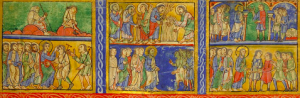
Selected illuminations of scenes from the life
of Christ in the Eadwine Psalter (12th c.)
The Torah*, although conceptually a single work, was already long since divided into five parts, known to us as the individual books of the Pentateuch:* Genesis*,* Exodus*,* Leviticus*,* Numbers*, and* Deuteronomy*. (It’s possible that this five-fold division reflects a numerological tradition that associated the number five with the sacred, magic, intermediaries, etc.; I explore this idea in a little more detail in this post.) The Lord’s decision to deliver this discourse on a mountainside faintly suggests Sinai, where the* Torah was first given, fifty days after the Exodus itself was effected—especially since the Lord’s interpretation of and remarks on several mitzvot promptly follow. These details are what make me think that the forty-day fast the Lord undertook is evoking the counting of the omer—the period between Passover and Pentecost, during which the freed Israelites made their way to Mount Sinai following the Exodus—as much as, or more than, the forty years spent in the wilderness between the Exodus and the entry into the Holy Land.
Incidentally, while Matthew does not seem to share the strong “creation” theme of John*, this text reminded me of a favorite poetic line about creation from Charles Williams’ poem “The Death of Palomides.”*2 Its subject reminisces briefly about a night he spent, back in his native al-Andalus, lodging with a pair of Jews while they were either casting a kabbalistic spell or praying (or possibly both).
——————————… the hut shook,
the air span, with titles of cherubim and seraphim;
the voices rose into clearness; they pronounced Netzach.
Sharply I shouted into the sound: Netzach?
What is Neztach? Together and deeply they answered:
Netzach is the name of the Victory in the Blessing:
*For the Lord created all things by means of his Blessing.*2
I don’t know what, if any, authentic background the phrase may have in Judaic literature, but it becomes a refrain for the poem: “The Lord created all things by means of his Blessing.”
Matthew 4:12-5:12, RSV-CE
Now when he heard that John had been arrested, he withdrew into Galilee; and leaving Nazareth he went and dwelt in Capernauma by the sea, in the territory of Zebulun and Naphtali, that what was spoken by the prophet Isaiah might be fulfilled:
“The land of Zebulun and the land of Naphtali,
toward the sea, across the Jordan,
Galilee of the Gentiles—
the people who sat in darkness
have seen a great light,
and for those who sat in the region and shadow of death
light has dawned.”b
From that time Jesus began to preach, saying, “Repent, for the kingdom of heaven is at hand.”
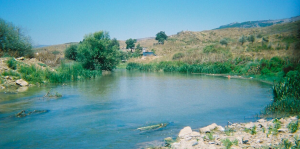
The Litani River, the northern boundary of
the Galilee region.
As he walked by the Sea of Galilee, he saw two brothers, Simon who is called Peterc and Andrew his brother, casting a net into the sea; for they were fishermen.d And he said to them, “Follow me, and I will make you fishers of men.” Immediately they left their nets and followed him. And going on from there he saw two other brothers, James the son of Zebedee and John his brother, in the boat with Zebedee their father, mending their nets, and he called them. Immediately they left the boat and their father, and followed him.
And he went about all Galilee, teaching in their synagogues and preaching the gospel of the kingdom and healing every disease and every infirmity among the people. So his fame spread throughout all Syria,e and they brought him all the sick, those afflicted with various diseases and pains, demoniacs, epileptics, and paralytics, and he healed them. And great crowds followed him from Galilee and the Decapolis and Jerusalem and Judea and from beyond the Jordan.
Seeing the crowds, he went up on the mountain, and when he sat down his disciples came to him. And he opened his mouth and taught them, saying:
f, g“Blessed are the poor in spirit, for theirs is the kingdom of heaven.
Blessed are those who mourn, for they shall be comforted.
Blessed are the meek, for they shall inherit the earth.
Blessed are those who hunger and thirst for righteousness, for they shall be satisfied.
Blessed are the merciful, for they shall obtain mercy.
Blessed are the pure in heart, for they shall see God.
Blessed are the peacemakers, for they shall be called sons of God.
Blessed are those who are persecuted for righteousness’ sake, for theirs is the kingdom of heaven.
“Blessed are you when men revile you and persecute you and utter all kinds of evil against you falsely on my account. Rejoice and be glad, for your reward is great in heaven, for so men persecuted the prophets who were before you.”f, g
Matthew 4:12-5:12, my translation
When he heard that Yochanan had been handed over, he withdrew into the Galyl. And leaving Natz’rath behind, he came and resided in K’far-Nachuma by the sea, in the mountains of Zevulun and Naftaly; in order that the message of Yshaya the prophet would be fulfilled, saying:
The land of Zevulun and the land of Naftaly,
the way of sea, across the Yarden, the Galyl of the nations—
the people which sat in the dark saw a great light,
and to them who sat in a region and shadow of death, light rose upon them.b
From then, Yeshua began to proclaim and say: “Have a change of heart; for the kingship of the heavens is near.”
Walking around by the Sea of the Galyl, he saw two brothers, Shimun (the one called Rocky)c and Andre his brother, throwing a dragnet into the sea, for they were watermen;d and he tells them: “Come after me, and I will make you watermen for people.” Straightaway, they quit their nets and followed him. And having gone on from there, he saw two other brothers, Yakov son of Zevadyah and Yochanan his brother, in the boat with Zevadyah their father knitting up their nets, and he called them. Straightaway, quitting the boat and their father, they followed him.
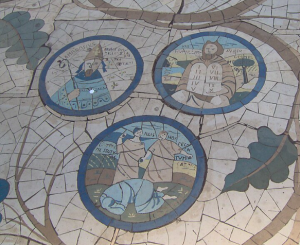
Mosaic from the Church of the Beatitudes
in Israel. Photo believed to be by
Amoruso~commonswiki, used via
a CC BY-SA 2.5 license (source).

And he went around in the whole Galyl, teaching in their assemblies and proclaiming the good news of the kingship and healing every sickness and every debility among the people. And the rumor of him went out into the whole of Syria;e and they brought before him everyone who was doing badly with motley sicknesses or constrained by torments, demoniacs and lunatics and paralytics, and he healed them. And many crowds followed him from the Galyl and Tenboroughs and Yrushalem and Yehud and across the Yarden.
Seeing the crowds, he went up onto a mountain; and when he had seated himself, his students came to him; and he opened his mouth and taught them, saying:
f, g“Blessed are beggars in the spirit, because theirs is the kingship of the heavens.
Blessed are mourners, because they will be aided.
Blessed are the gentle, because they will inherit the land.
Blessed are those who are hungry and thirsty for justice, because they will be filled up.
Blessed are those who have pity, because they will receive pity.
Blessed are those who are clean in heart, because they will see God.
Blessed are peacemakers, because they will be called sons of God.
Blessed are those who are hunted for the sake of justice, because theirs is the kingship of the heavens.
Blessed are you whenever you are insulted and hunted, and liars say everything evil about you for my sake; rejoice and be glad, because your reward in the heavens is much; for thus they hunted the prophets, who were before you.”f, g
Textual Notes
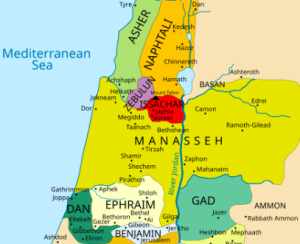
Part of a map of the territories of the Twelve
Tribes showing “the land of Zebulun and the
land of Naphtali“. Original apparently by
Janz, used via a CC BY-SA 3.0 license (source).

a. Now when he heard that John had been arrested, he withdrew into Galilee; and leaving Nazareth he went and dwelt in Capernaum/When he heard that Yochanan had been handed over, he withdrew into the Galyl. And leaving Natz’rath behind, he came and resided in K’far-Nachum | Ἀκούσας δὲ ὅτι Ἰωάννης παρεδόθη ἀνεχώρησεν εἰς τὴν Γαλιλαίαν. καὶ καταλιπὼν τὴν Ναζαρὰ ἐλθὼν κατῴκησεν εἰς Καφαρναοὺμ [akousas de hoti Iōannēs paredothē anechōrēsen eis tēn Galilaian. kai katalipōn tēn Nazara elthōn katōkēsen eis Kafarnaoum]: This is an extremely puzzling sequence of actions, or at least a puzzling way to talk about them. The verb ἀνεχώρησεν, “withdrew,” suggests a movement toward safety, or at least a “stepping aside” out of harm’s way or out of the center of attention—the evangelist has already used it four times in chapter 2, describing the movements of the astrologers and St. Yosef while avoiding the Herods. However, the Palestinian tetrarch who arrested the Baptist was Herod Antipas, and his principal territory was the Galyl. What’s more, Natz’rath was an inconspicuous backwater even for the Holy Land, whereas K’far-Nachum (roughly, “Nahum Town,” as in the prophet Nahum) was a fair-sized fishing village within a few miles of the city of Tiberias; and Tiberias was not just a regional metropole, it was the new capital Herod Antipas had just built himself! This is a deliberate step into the spotlight, and is suitably followed by the dramatic quotation from Isaiah that accompanies it.
b. The land of Zebulun and the land of Naphtali, · toward the sea, across the Jordan, · Galilee of the Gentiles— · the people who sat in darkness · have seen a great light, · and for those who sat in the region and shadow of death · light has dawned/The land of Zevulun and the land of Naftaly, · the way of sea, across the Yarden, the Galyl of the nations— · the people which sat in the dark saw a great light, · and to them who sat in a region and shadow of death, light rose upon them | Γῆ Ζαβουλὼν καὶ γῆ Νεφθαλίμ, ὁδὸν θαλάσσης, πέραν τοῦ Ἰορδάνου, Γαλιλαία τῶν ἐθνῶν, ὁ λαὸς ὁ καθήμενος ἐν σκοτίᾳ φῶς εἶδεν μέγα, καὶ τοῖς καθημένοις ἐν χώρᾳ καὶ σκιᾷ θανάτου φῶς ἀνέτειλεν αὐτοῖς [gē Zaboulōn kai gē Nefthalim, hodon thalassēs, peran tou Iordanou, Galilaia tōn ethnōn, ho laos ho kathēmenos en skotia fōs eiden mega, kai tois kathēmenois en chōra kai skia thanatou fōs aneteilen autois]: The reference here is to Isaiah 9, parts of which were made (more) famous by their use in G. F. Handel’s Messiah.
Nevertheless the dimness shall not be such as was in her vexation, when at the first he lightly afflicted the land of Zebulun and the land of Naphtali, and afterward did more grievously afflict her by the way of the sea, beyond Jordan, in Galilee of the nations.
The people that walked in darkness——————————Wonderful,
——have seen a great light:——————————————……Counselor,
they that dwell in the land of the shadow of death,——..The mighty God,
——upon them hath the light shined. …————————……The everlasting Father,
For thou hast broken the yoke of his burden,——————…The Prince of Peace.
——and the staff of his shoulder,————————————Of the increase of his government and
the rod of his oppressor,————————————————.peace
——as in the day of Midian.————————————————.there shall be no end,
For every battle of the warrior is with confused noise,—..upon the throne of David,
——and garments rolled in blood;————————————…..and upon his kingdom
but this shall be with burning——————————————.to order it,
——and fuel of fire.————————————————————…and to establish it with judgment
For unto us a child is born,———————————————…and with justice from henceforth
——unto us a son is given:————————————————…..even for ever.
and the government shall be upon his shoulder:
——and his name shall be called
The zeal of the LORD of hosts will perform this.
—Isaiah 9:1-7
As for “Galilee of the Gentiles” or “the Galyl of the nations.” There are basically two important land routes into Canaan, the southern and the northern. (It’s technically possible to come over the Yarden from the east, but you won’t want to: it means going all the way down into the rift the river is at the bottom of, and then coming all the way back up out of it,3 and also there’s not a lot on the eastern bank except a large swath of desert. Similarly, while you can sail over the Mediterranean to the Holy Land from the west, try not to be too invested in little things like “having anywhere to lay anchor.”) The southern way in and out is, broadly, from and to familiar turf. Remotely to the south lies Egypt, a realm which Canaan is tied to—culturally, historically, even geologically.4 Closer at hand, the Sinai Peninsula and northern Arabia are so arid that only one people made their home there, namely the Edomites, who as of the first century BCE were converts to Judaism: according to Josephus, forcible converts, though they had in turn obligingly provided Yehud with a fresh Herodian dynasty to usurp the throne from the Chashmonai family. The point is, traffic along the southward road was traffic through lands which were familiar on the whole.
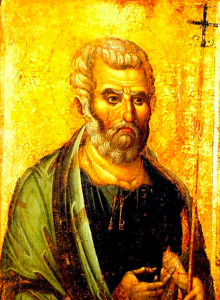
Russian ikon of St. Peter (13th c.)
Northward, on the other hand, you’re right near the fattened middle of the Fertile Crescent. A few mountain ranges divide up spacious riverine plains, making good land for either agriculture or pastoralism; lots of nations settled here. Just north of Palestine you’ve got the native lands of the Amorites, Arameans, Assyrians, Hittites, Medes, and Phoenicians, to which the last several centuries have added waves of Armenians, Babylonians, Iranians, and Macedonians, to say nothing of everyone else who’s coming through, at those empires’ behest or not. “The Galyl of the goys” was surely an apt nickname.
c. he saw two brothers, Simon who is called Peter/he saw two brothers, Shimun (the one called Rocky) | εἶδεν δύο ἀδελφούς, Σίμωνα τὸν λεγόμενον Πέτρον [eiden düo adelfous, Simōna ton legomenon Petron]: This is, by a hair, the briefest account of the calling of Simon Peter. Luke includes a pretty and very funny story of the saint’s moment of “locking in” as one of the Lord’s disciples—which is intriguing, since neither Matthew nor Mark do so. We’d expect Matthew to relate it, given his interest in St. Peter (cf. §III.3.b of the Introduction); we’d also expect Mark to include it if it is, as has traditionally been maintained, Peter’s unofficial memoirs. I can offer only speculations about this inter-Synoptic discrepancy. It’d be a little surprising, but only a little, if the author of Matthew simply didn’t know the story that St. Luke relates of this event.
d. fishermen/watermen | ἁλιεῖς [halieis]: Hyper-literally, this word means “salties,” which will become a pun in another twenty verses. The Greek term could apply to those who made their living on the water in general: primarily fishermen, but also ferrymen, professional sailors, etc. (It’s a slight misnomer here, given that the “Sea” of Galilee is in fact a freshwater lake.)
e. throughout all Syria/into the whole of Syria | εἰς ὅλην τὴν Συρίαν [eis holēn tēn Sürian]: St. Matthew’s choice of wording here is again slightly odd. The Romans did sometimes use the name Syria for the whole Levant, but the narrower sense, in which Syria denoted only the northern Levant, was more usual. The south was normally Jūdæa in Latin, even as the region shifted back and forth between being a Roman province and being an autonomous client kingdom over the first sixty years of the first century.5
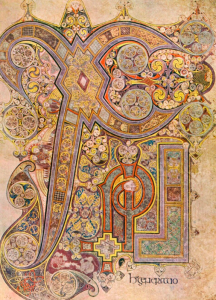
A Chi-Rho page from the Book of Lindisfarne.
Now, perhaps this term is simply an instance of broad-sense-Syria. However, the evangelist chose a pretty specific passage to adorn the inauguration of Christ’s public ministry. Dozens of texts were available (even just within Isaiah!) for the purpose, but—whether this was the reason he wanted it or not—he specifically wanted the one that contained the expression “Galilee of the Gentiles.” That phrase occurs in only two verses in the Bible, the one from Isaiah and this New Testament quotation of Isaiah. And it seems to align with a theme in the First Gospel that’s getting stronger as it progresses: we opened on the strongly Hebrew genealogy that invokes the ancient names of Avraham, Yosef, Miriam, and Dawid, yet as soon as the second chapter began, we were confronted with an Edomite king hosting astrologers from Persia or Chaldæa or Babylon. Yochanan the Immerser, however eccentric his style or doctrine or both might be, is quite distinctively Jewish, but after he has baptized Yeshua and the tempter comes to the latter as he fasts, the lure offered to him is not merely his rightful throne, but “all the kingdoms of the world, and the glory of them.” Matthew shows no sign of being confused about the difference between Gentiles and Jews, but he also seems to view the Lord Yeshua as being somehow interwoven with “the nations.”
f. Blessed are the poor … who were before you/Blessed are beggars … who were before you | Μακάριοι οἱ πτωχοὶ … τοὺς πρὸ ὑμῶν [makarioi hoi ptōchoi … tous pro hümōn]: I’ve translated the Beatitudes a couple of times already—once late last year, once about a year before (this is the proper Gospel6 for Hallowmas, the solemnity Halloween is the “e’en” of). They form a strong opening for the Sermon on the Mount—a set of pithy, striking sayings that all have the same format: “Blessed are [group of people], for [future].” Let’s start with the front halves. The sequence of recipients of blessing is:
- Beggars in the spirit.
- Mourners.
- The gentle.
- Those who are hungry and thirsty for justice.
- Those who show pity.
- The clean in heart.
- Peacemakers.
- Those who are hunted for the sake of their justice.
Note how the first, third, fifth, and seventh are what we might colloquially call “soft” virtues like gentleness and mercy, while the second, fourth, sixth, and eighth are “hard” virtues like penitence and purity. With this mutual interweaving in mind, we’re in a better position to appreciate the form taken by this sequence: it’s simultaneously a zig-zag (soft and hard virtues alternating), and a straight line (each virtue building on the previous)—which, when you come to think of it, is the shape of a staircase, one of the most ancient and traditional ways of going up.
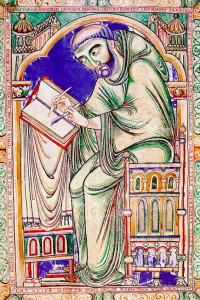
Portrait of Eadwine, probably the principal
author of the Eadwine Psalter (see above).
So that’s the zig-zag; the straight line lies in how each of the Beatitudes builds on the previous. Beggars in spirit implies an embrace of our total dependence on God. Mourners has long been associated with repentance for sin—a natural thing for one who is thus consciously relying on God to do. Someone who has experienced this kind of beggary and mourning might thereafter be especially sensitive to the pain they involve, and therefore specially careful to be gentle; as the remembered shame that tends to go with repentance fades, they are also likely increasingly to want to live up to the standard they fell short of, which we might poetically call a hunger and thirst for justice. This allows the gentleness they had to become something bolder, an active and intentional pity—not in the contemptuous sense, but along Tolkien’s lines.7 Meanwhile, perseverance in the attempt to become just, especially together with the pity for others that (if it’s doing it’s job) drives out hypocrisy, will result in being clean in heart. All these virtues together make for someone with both the desire to see their neighbors reconciled to one another, and the skills of humble, patient understanding that help them really to become peacemakers.
That makes seven total steps of growth within; but interior development isn’t the only thing going on here. People who behave like this are not convenient for a certain kind of leader or authority figure (or for those who aspire to be such): the kind whose power, whether religious or secular, thrives on conflict. Regardless of their rationalization, that sort of leader will be sure to persecute peacemakers. We’ve thus passed through the “front halves” of all eight Beatitudes.
g. In note f, I repeated an analysis of the virtues the Beatitudes commend; this is an analysis I’ve offered in earlier posts. What I haven’t done in my previous translations is look at the eight blessings. This is partly because I’m far less sure I have a handle on these and how they relate to each other! They proceed as follows:
- The kingship of the heavens is theirs.
- They will be aided.
- They will inherit the land.
- They will be filled up.
- They will receive pity.
- They will see God.
- They will be called God’s sons.
- The kingship of the heavens is theirs (same as 1 above).
The second and fourth blessings seem, at a glance, intuitive enough, and digging into the text from a strictly linguistic angle didn’t illuminate it much further for me, so I’m going to skip those two; blessings one, three, five, six, and seven each call for a little further comment. Let’s go through them one at a time.
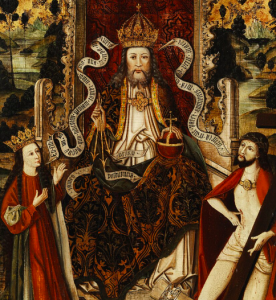
God the Father on a Throne, With the Virgin
Mary and Jesus (late 15th c.)—anonymous.
• The kingship of the heavens is my translation of ἡ βασιλεία τῶν οὐρανῶν [hē basileia tōn ouranōn], more conventionally rendered “the kingdom of heaven.” This is what the Lord has just begun saying has “drawn near.” Why have I preferred kingship to kingdom? The explanation is slightly time-consuming, but not inherently difficult.
Greek has a few different endings for turning words into nouns, and those endings have different associations. In this, it’s quite like English, where endings like –ship, –dom, –ness, –ment, and –er all make the root you’re dealing with into a noun, but make various kinds of noun. Some of these kinds are highly distinctive (like –er being used exclusively for agents), others less so. Obviously, the English kingdom derives from king; originally, the word’s meaning was more strongly attached to the person of a monarch. It tended to mean the time during which a given monarch ruled, or his possession of the office—i.e., an abstract state of affairs, rather than something concrete. Today, if I’m not mistaken, kingdom does normally bear a concrete sense, suggesting the turf over which a king ruled: it is now not reign, but realm, that the word “kingdom” mainly points to.8 Returning to Koiné Greek, the suffix -ία, like you see there on βασιλεία, was one which normally made abstract nouns. Calling kingdom a mistranslation of βασιλεία would be excessive; still, it is apt to produce a (mildly) flawed mental picture: something like a Crusaders’ principality comes to mind, when what the Lord’s words imply is not a place, but a condition or quality.
• Inheriting of the land is not a novelty of the Beatitudes: it comes from Psalm 37:7-11.
Rest in the LORD, and wait patiently for him:
——fret not thyself because of him
who prospereth in his way,
——because of the man who bringeth wicked devices to pass.
Cease from anger, and forsake wrath:
——fret not thyself in any wise to do evil.
For evildoers shall be cut off:
——but those that wait upon the LORD, they shall inherit the earth.
For yet a little while, and the wicked shall not be:
——yea, thou shalt diligently consider his place, and it shall not be.
But the meek shall inherit the earth;
——and shall delight themselves in the abundance of peace.
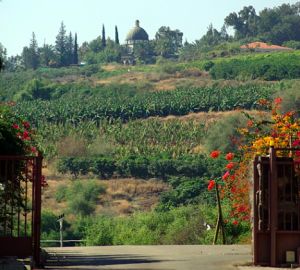
A view of the Mount of the Beatitudes from
Capernaum. Photo by Berthold Werner.
• Pity for pity, or (by a different rendering) mercy for mercy, is an intuitive recompense. I feel it is especially worth highlighting this one, just because of how pitiless American society has grown over the last couple decades.
• The promise of seeing God once again evokes Moshe. God’s transcendence, his invisibility, is firmly asserted throughout the Hebrew Bible, whose strict prohibition upon images was a rarity among ancient religions. The Veil of the Temple had images of the cherubim, attendants upon God and therefore symbols of his presence; the Ark of the Covenant was considered his throne; but there was no image of him in the Holy of Holies—not even a bætyl,9 which would have been unusual but not unheard of in the Near East. After the fall of mankind in Eden, only one person in the Tanakh is said to have seen God, and that person is Moshe. Exodus recounts the exchange, immediately following the episode of the Golden Calf:
As Moses entered into the tabernacle, the cloudy pillar descended, and stood at the door of the tabernacle, and the LORD talked with Moses. … And the LORD spake unto Moses face to face, as a man speaketh unto his friend. … And Moses said unto the LORD, “See, thou sayest unto me, Bring up this people: and thou hast not let me know whom thou wilt send with me. Yet thou hast said, ‘I know thee by name, and thou hast also found grace in my sight.’ Now therefore, I pray thee, if I have found grace in thy sight, shew me now thy way, that I may know thee, that I may find grace in thy sight: and consider that this nation is thy people. … If thy presence go not with me, carry us not up hence. …”
And the LORD said unto Moses, “I will do this thing also that thou hast spoken: for thou hast found grace in my sight, and I know thee by name.”
And he said, “I beseech thee, shew me thy glory.”
And he said, “I will make all my goodness pass before thee, and I will proclaim the name of the LORD before thee; and will be gracious to whom I will be gracious, and will shew mercy on whom I will shew mercy.” And he said, “Thou canst not see my face: for there shall no man see me, and live.” And the LORD said, “Behold, there is a place by me, and thou shalt stand upon a rock: and it shall come to pass, while my glory passeth by, that I will put thee in a cleft of the rock, and will cover thee with my hand while I pass by: and I will take away mine hand, and thou shalt see my back parts: but my face shall not be seen.” … And the LORD passed by before him, and proclaimed, “The LORD, The LORD God, merciful and gracious, longsuffering, and abundant in goodness and truth, keeping mercy for thousands, forgiving iniquity and transgression and sin, and that will by no means clear the guilty; visiting the iniquity of the fathers upon the children, and upon the children’s children, unto the third and to the fourth generation.” And Moses made haste, and bowed his head toward the earth, and worshipped.
—Exodus 33:9-23, 34:6-9
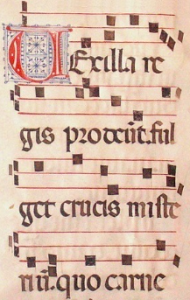
Opening lines of the Vexilla Regis Prodeunt,
a 6th-c. hymn composed by Venantius
Fortunatus for the Triumph of the Cross.
This had been one of the most distinctive aspects of Judaism for over a thousand years already in the time of Jesus. And here he is promising that it will be undone for those who are “clean in heart.”
• Being called sons of God could be evoking at least two things, perhaps three. One is the exaltation of the House of Dawid. Psalm 2, which was used at coronations in Iron Age Judah, describes the new monarch as “the Son” (i.e., of God); so does Psalm 45, a royal wedding hymn. Alternatively, this could be representing the expression בְנֵי־הָאֱלֹהִים [b’nêy hå-‘elohym], “sons of God” or “sons of the gods,” held by Jews to be an order of angelic beings. Given what Matthew has already told us, there is now a third possible reference too: namely, the Lord’s own baptism, where he too, in the midst of a theophany no less, has been called God’s “beloved Son.”
Footnotes
1I haven’t noticed any other writers take note of this detail, but there is a little-recognized point of agreement with the Fourth Gospel here: he did not set out from, but “withdrew into,” Galilee, apparently meaning that he went there from Judea (that being where the Baptist was exercising his own ministry).
2This poem (of which I’ve quoted ll. 18-24) was part of Williams’ first volume of Arthurian poetry, Taliessin Through Logres. Taliessin, more usually spelled Taliesin, was a historical Welsh poet of post-Roman Britain. Williams makes him the court poet of King Arthur, for whose realm he uses the name Logres; this name is derived from Welsh, and is related to the modern Welsh term for England, Lloegyr. Sir Palomides (or Palamedes) is an oddity in the Arthurian cycle, as he is supposed to come from the Middle East, and in most tellings he is a pagan when he arrives, consenting to be baptized only after serving Arthur for many years. (Williams, following Malory, makes Palomides a Muslim instead; this is anachronistic, since the ostensible Arthurian period falls in the fifth century CE and sometimes the early sixth, but it suits Williams’ desired themes quite well.)
3Even at its source up north, this means a descent to nearly 700′ below sea level, and then of course a reäscent of the same magnitude on the far side. By the time you get south to the Dead Sea, the depth has increased to around 1300′ below sea level.
4In terms of plate tectonics, the modern territories of Israel, Lebanon, and Palestine sit on the African Plate, while the adjacent parts of Jordan, Saudi Arabia, and Syria are on the Arabian Plate. The fault between the two plates is visible on the earth’s surface in the form of a gigantic gorge spanning the Jordan River Valley, the Wadi Arabah, and the Red Sea. (The reason that this fault, unlike the infamous San Andreas fault, does not render the Holy Land prone to frequent earthquakes is that the African and Arabian plates are both moving northward.) As for culture and history, while Ancient Egyptian was not a Semitic language per se, it forms another branch of the Afroasiatic language family, and Egypt was the dominant power in the Levant during almost the whole of the Bronze Age, and then intermittently throughout Classical Antiquity; the ethos of Egyptian society likely differed little from that of ancient Canaan.
5Most of the region was taken under direct imperial control from the year 6 CE, when the Romans deposed Herod Archelaus. The realm became strongly autonomous again (albeit still entwined with Rome) about halfway through the reign (37-44) of King Herod Agrippa I, to whom the Emperors Caligula and Claudius both showed favor; this national reassertion collapsed when Agrippa abruptly died in 44, and the government was handed over to a string of Roman procurators. These men were, for the most part, midwits: the seventh, a certain Gessius Florus, managed to provoke the first of the Jewish Wars before leaving office. The Jewish Wars, of which there were either two or three (depending on whether the historian you’re reading counts the Diaspora Revolt of 115-117 among them), began in the year 66; the Bar Kochba Revolt ended in 136. Thereafter, Jūdæa was renamed Syria Palæstīna, as contrasted with Syria Phoenīcē in the middle of the Levantine coast, and Syria Coelē to the north around Antioch.
6The phrase “proper Gospel” is a technical expression. The propers of a given observance in the Church’s calendar, usually solemnities, are those texts—Scripture readings, collect, communion antiphon, etc.—which are specifically chosen to suit that observance. That said, propers may be appointed for multiple observances: e.g., more than one Marian solemnity uses the Annunciation for its proper Gospel; however, propers contrast with commons. Commons denote the same sets of texts, but they are used for whole classes of observances: for example, there are many doctors of the Church, and any of them may be celebrated by using the commons for doctors of the Church. If the Gospel text for the common of doctors were changed, the memorial of every doctor of the Church would switch from the old text to the new one, but if the Gospel for a single solemnity were altered, nothing else would be affected.
7“What a pity Bilbo did not stab that vile creature, when he had a chance!”
“Pity? It was Pity that stayed his hand. Pity, and Mercy: not to strike without need. And he has been well rewarded, Frodo. Be sure that he took so little hurt from the evil, and escaped in the end, because he began his ownership of the Ring so. With Pity.”
“I am sorry,” said Frodo. “But I am frightened; and I do not feel any pity for Gollum. … He deserves death.”
“Deserves it! I daresay he does. Many that live deserve death. And some that die deserve life. Can you give it to them? Then do not be too eager to deal out death in judgment. For even the very wise cannot see all ends. … [T]he pity of Bilbo may rule the fate of many—yours not least.” —The Lord of the Rings, “The Fellowship of the Ring,” Ch. 2: The Shadow of the Past. (Sorry to be cliché, but this passage is famous for a reason.)
8This is an instructive example of one of the ways words change meanings over time. The “reign/time” meaning and the “realm/turf” meaning, while plainly distinct, are applicable in so many of the same circumstances that you’d hardly ever need to clarify which one you meant, today. Most of our noun-making suffixes besides the agentic suffix –er no longer confer a strongly distinctive quality, but they sometimes did at first. To an Anglo-Saxon, ᚳᚣᚾᛁᛝᛞᚩᛗ [cyningdom] was obviously an abstract noun: the suffix was related to ᛞᚩᛗ “judgement, law, jurisdiction,” and applying the word to the land itself would have been perceived as either an error or a poetic device. Only as the associations of –dom became fainter in the Middle English period would the “realm/turf” sense have started to, heh, gain ground. Moreover, between the time when the Anglo-Saxon was coined and the time when it reached its modern English form, we’ve also seen a civilization-wide political shift, occurring over multiple centuries and affecting the entire Anglophone world: we’ve gone from a system defined mainly in terms of monarchs’ personal sovereignty, to one defined mainly in terms of nation-states’ territorial sovereignty. That change, happening at the same time as the dilution of the nominalizing suffix -dom, thus pulled the word kingdom through its increased Middle English ambiguity toward its modern “turf-forwards” meaning.
9A bætyl was an unworked stone worshiped as a god or as the image of a god; bætyls are generally thought by modern scholars to have been meteorites in most cases. The Syrian solar deity Elagabal was represented with a bætyl.
Previous Post
October 8, 2026
The Gospel of Matthew: Christ and Antichrist
Recent Comments
"On the contrary, such a proclamation, among the Aztecs or Maya, would be disastrously misunderstood. ..."
The Gospel of John: The Bread ..."
"Many thanks for your scholarly study on the Cleansing of the Ten Lepers in the ..."
The Cleansing of the Ten Lepers
"Four Last Things: not the video game, but Death, Judgment, Heaven and Hell.Momento mori. Remember, ..."
"I am going by the time that these sayings began to be converted into written ..."
Are Our Bibles in the Wrong ..."
Browse Our Archives
Select a Category abuse antifascism art bad Catholic celibacy chastity Church crucifixion culture war eros forgiveness gay gender homophobia ikons language liturgy peace poems politics Pope Francis prayer pro-life race recommendations reform repentance review sacraments saints satire scandal schism scripture sex suffering theology Uncategorized violence
Select a Month October 2026 September 2026 August 2026 July 2026 June 2026 May 2026 April 2026 March 2026 February 2026 January 2026 December 2025 November 2025 October 2025 September 2025 August 2025 July 2025 June 2025 May 2025 April 2025 March 2025 February 2025 January 2025 December 2024 November 2024 October 2024 September 2024 August 2024 July 2024 June 2024 May 2024 April 2024 March 2024 February 2024 January 2024 December 2023 November 2023 October 2023 September 2023 August 2023 July 2023 June 2023 May 2023 April 2023 March 2023 February 2023 January 2023 December 2022 November 2022 October 2022 September 2022 August 2022 July 2022 June 2022 May 2022 April 2022 March 2022 February 2022 January 2022 December 2021 November 2021 October 2021 September 2021 August 2021 July 2021 June 2021 May 2021 April 2021 March 2021 February 2021 January 2021 December 2020 November 2020 October 2020 September 2020 August 2020 July 2020 June 2020 May 2020 April 2020 March 2020 February 2020 January 2020 December 2019 November 2019 October 2019 September 2019 August 2019 July 2019
Follow Us!
TAKE THE
Religious Wisdom Quiz
Who killed his own brother out of jealousy and became the first murderer in the Bible?
Select your answer to see how you score.
Esau Jacob Ishmael Cain
Related posts from Mudblood Catholic

The Gospel of Matthew: Christ and Antichrist

John the Baptist and the Winnowing Fork: Matthew...

The Gospel of Matthew: The Coventry Carol
The Gospel of Matthew: Midnight Epiphanies
TRENDING AT PATHEOS Catholic

Janie Learns the Way of the Cross: A...
Teaching children about Jesus' Passion can be challenging. Many parents and educators...

Looking For Good Catholic Writing - October 2026
He alone extends the heavens, and he walks upon the waves of...

In "Irreplaceable," our book on vocation and technology, Trevor Sutton and I...

I was strolling through the top floor of the brand new Parthenon...

What Does Gêvâh Mean For Kimberley Guifoyle &...
This week, a lot of the news is focused on Kimberly Guilfoyle....

INNER CIRCLE: Profound Mystery (Of Christ In All...
Ephesians 5:31-32 “For this reason, a man will leave his father and...
view all Catholic blogs
What Are Your Thoughts?leave a comment
Ad-Free & Subscriber Log-In Subscription Support
- About Us
- 2026 Calendar
- Videos
- Podcasts
- Library of World Religions
- Faith In Media Tracker
- Advertise With Us
- Write for Us
- Privacy Policy
- Terms of Service
- Do Not Sell My Data
- Contact Us
- Radiant Digital
- Manage Newsletter Subscriptions
- Unsubscribe From Notifications
- Sitemap
Copyright 2008-2026, Patheos. All rights reserved.
Subscription Support Ad-Free & Subscriber Log-In
Follow Patheos