
BuddhistCatholicContemplativeEvangelicalGeneral ChristianHinduJewishLatter-day SaintMuslimNew VisionsProgressive Christian
Beliefs
- Buddhist
- Catholic
- Contemplative
- Evangelical
- General Christian
- Hindu
- Jewish
- Latter-day Saint
- More Voices
- Muslim
- New Visions
- Pagan
- Progressive Christian
Topics
- Religion News
- Food and Religion
- Sports and Religion
- Religious Art
- Religious Music and Entertainment
- Religious Events
- History and Religion
- Style and Religion
- Politics and Religion
- Women in Religion
- Recreation Outdoors and Religion
- Business Finance and Religion
- Careers Workplace and Religion
- Education and Religion
- Family Parenting and Religion
- Health Fitness and Religion
- Home and Religion
- Relationships and Religion
- Technology and Religion
- Travel and Religion
Columnists
- Buddhist Columnists
- Business Finance and Religion Columnists
- Careers Workplace and Religion Columnists
- Catholic Columnists
- Contemplative Columnists
- Education and Religion Columnists
- Evangelists Columnists
- Family Parenting and Religion Columnists
- General Christian Columnists
- Health Fitness and Religion Columnists
- Hindu Columnists
- History and Religion Columnists
- Home and Religion Columnists
- Jewish Columnists
- More Voices Columnists
- Latter Day Columnists
- Muslim Columnists
- New Visions Columnists
- Nonreligious Columnists
- Pagan Columnists
- Politics and Religion Columnists
- Progressive Columnists
- Recreation Outdoors and Religion Columnists
- Relationships and Religion Columnists
- Religion News Columnists
- Religious Art Columnists
- Religious Events Columnists
- Religious Music and Entertainment Columnists
- Sports and Religion Columnists
- Style and Religion Columnists
- Technology and Religion Columnists
- Travel and Religion Columnists
- Women in Religion Columnists
Resource Library
- 2026 Calendar
- Library of World Religions
- The 100 Most Holy Places on Earth
- Patheos Answers
- Podcasts
- Videos
- Faith Leaders Database
- Anglican Episcopalian
- Bahai
- Baptist
- Buddhism
- Christianity
- Confucianism
- Eastern Orthodoxy
- Hinduism
- Holiness and Pentecostal
- ISKCON
- Islam
- Judaism
- Lutheran
- Methodist
- The Church of Jesus Christ of Latter-day Saints
- New Age
- Paganism
- Presbytarian and Reformed
- Protestantism
- Religion Behind the Scenes
- Roman Catholic
- Scientology
- Shia Islam
- Sikhism
- Sufism
- Sunni Islam
- Taoism
- Zen
- See all religions
Research Tools
 Ad-Free & Subscriber Log-In Subscription Support
Ad-Free & Subscriber Log-In Subscription Support
Follow Patheos 

- Trending:
- Forgiveness
- |
- Marriage
- |
- Consciousness
- |
- Death Penalty
- |
- Election
- |
- Halloween

- Home
- Catholic
- John the Baptist and the Winnowing Fork: Matthew 3:1-12
John the Baptist and the Winnowing Fork: Matthew 3:1-12
Last updated on: October 2, 2026 at 6:40 am by Gabriel Blanchard
John the Baptist and the Winnowing Fork: Matthew 3:1-12 2026-10-02T06:40:10-04:00 Gabriel Blanchard
Patheos Explore the world's faith through different perspectives on religion and spirituality! Patheos has the views of the prevalent religions and spiritualities of the world.
The Winnowing Fork (Matthew 3:1-12)
At this point, the Gospel of Matthew gets going in earnest: if you refer back to our outline from the introductory post, we have completed Book Alef and made our entry into Book Beyt, which will culminate in the Sermon on the Mount. But before we get to that mountain—an echo, arguably, of Sinai—we must pass through two ordeals, one from above and one from below. The first is the Lord’s Baptism, and the fact that this is*, ritually, an ordeal is made a little clearer if we attend to the message of Yochanan the Immerser. The second will be his temptation by the devil. Yet, after (no pun intended) an extremely pregnant beginning and a dramatic but very secret confrontation in the wilderness, Christ’s inauguration of this apocalypse is puzzlingly slow and low-key. A passage by Charles Williams (a friend of C. S. Lewis) from his book* He Came Down From Heaven sets the tone nicely.
The weakness, credulity, and folly of all the early disciples, may have altered the original truth of the vagrant provincial professor of ethical beauty into something more closely corresponding to their romantic needs. Saint Mark may be dogmatically asserted to have been an intentional or unintentional liar. But at least we have to admit his lies for the purpose of explaining that they are lies. They are our only evidence for whatever it was he was lying about.
Our contemporary pseudo-acquaintance with the Christian idea has misled us in another point. It is generally supposed that his lies (if lies) are simple and easy. It is only by reading Saint Mark that one discovers they are by no means simple or easy. It is very difficult to make out what is supposed to be happening. His book slides into an account of a certain John who came as the precursor of this Divine Hero. He has in Saint Mark no other business. But in Saint Luke there is something more. It is recorded that certain groups came to the Precursor. He answers them with instructions which amount very nearly to a gospel of temporal justice. All men are to share their goods freely and equally. The revenue officers are to make no personal profit out of their business. The soldiers are not to make their duties an excuse for outrage or violence; they (again) are to make no personal gain beyond their government pay. Share everything; neither by fraud nor by force let yourself be unfair to anyone; be content with your own proper pay. He prolongs the concern of the prophets with social injustice.
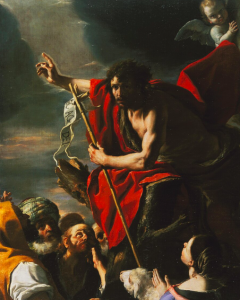
San Giovanni Battista Predicazione [St. John
the Baptist Preaching] (c. 1665), by Mattia Preti.
At this moment the Divine Thing appears (it will be remembered that Saint Matthew uses the neuter—”that holy thing”). The account of his coming is purely apocalyptic. Witness is borne out of heaven and on earth and from hell. He begins his own activities. He calls disciples; he works miracles of healing; he controls spirits; he teaches with authority. What does he teach? “The time is fulfilled, and the kingdom of God is at hand; repent ye and believe the gospel.”
Yes, but what gospel? what kind of kingdom? The Precursor had said almost the same thing. In some expectation one turns the page … several pages. The works of healing continue swiftly, interspersed with the Divine Thing’s comments on himself, and his reasons for existing. They are still not very clear.
—Chapter IV: The Precursor and the Incarnation of the Kingdom1
Matthew 3:1-12, RSV-CE
In those days came John the Baptist, preaching in the wilderness of Judea, “Repent,a for the kingdom of heavenb is at hand.” For this is he who was spoken of by the prophet Isaiah when he said,
“The voice of one crying in the wilderness:
Prepare the way of the Lord,
make his paths straight.”c
Now John wore a garment of camel’s hair, and a leather girdle around his waist; and his food was locustsd and wild honey. Then went out to him Jerusalem and all Judea and all the region about the Jordan, and they were baptized by him in the river Jordan,e confessingf their sins.
But when he saw many of the Pharisees and Sadduceesg coming for baptism, he said to them, “You brood of vipers!h Who warned you to flee from the wrath to come? Bear fruit that befits repentance, and do not presume to say to yourselves, ‘We have Abraham as our father’; for I tell you, God is able from these stones to raise up children to Abraham. Even now the axe is laid to the root of the trees; every tree therefore that does not bear good fruit is cut down and thrown into the fire.
“I baptize you with water for repentance, but he who is coming after me is mightier than I, whose sandals I am not worthy to carry; he will baptize you with the Holy Spirit and with fire. His winnowing forki is in his hand, and he will clear his threshing floor and gather his wheat into the granary, but the chaff he will burn with unquenchable fire.”
Matthew 3:1-12, my translation
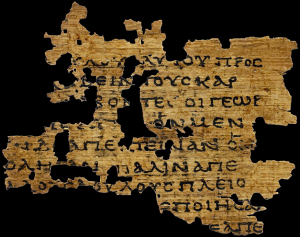
Recto side of a fragment of Papyrus 104,
bearing parts of Matthew 21:34-37.
In those days, Yochanan the Immerser appeared, heralding in the desert of Yehud and saying: “Change your hearts,a for the kingship of the heavensb has drawn near.” For this is he who was spoken about by Yshaya the prophet, saying, “A voice shouting in the desert, ‘Get the Lord’s path ready; make a straight track for him.'”c This Yochanan had a coat of camel’s hair and a leather belt around his waist; his rations were locustsd and wild honey. Then Yrushalem and all Yehud were journeying out, and all the region around the Yarden, and were being immersed in the Yarden river by him,e affirmingf their errors.
Seeing many of the Pryshaya and Tzaduking coming for his immersion, he told them, “Offspring of vipersh—who forewarned you [all] to flee from the anger which is about to come? Then produce fruit worthy of a change of heart, and do not presume to tell yourselves, ‘We have Avraham for our father,’ for I tell you that, from these stones, God can raise children to Avraham. Already the axe is lying at the root of the trees; for every tree [that] does not produce fair fruit will be cut down and thrown into fire. Indeed, I immerse you in water for a change of heart; one is coming behind me who is stronger than I am, whose sandals I am not adequate to carry: he will immerse you in a holy spirit and in fire; his winnowing forki is in his hand, and he will purge his threshing-floor and gather his grain into the repository, but he will burn up the chaff with inextinguishable fire.”
Textual Notes
a. Repent/Change your hearts | Μετανοεῖτε [metanoeite]: The exact role played by the “heart” in modern idiom is not well-defined, but it is typically treated as the seat of the emotions, with a few exceptions. One such exception is the expression change of heart, which normally points to a more total change of disposition. This means much the same thing as the verb μετανοέω [metanoeō], which derives from the noun νοῦς [nous], meaning “mind.”
b. the kingdom of heaven/the kingship of the heavens | ἡ βασιλεία τῶν οὐρανῶν [hē basileia tōn ouranōn]: The idea of the “kingdom of heaven” or “of God” conveys something slightly different in the original Greek than it does in English. We tend—maybe thanks to our centuries’ experience thereafter with the Westphalian nation-state—to think of a kingdom primarily as a given, well-defined place. This isn’t quite the drift of the term βασιλεία: like many other Ancient Greek nouns that use the nominalizing suffix -ια (such as ἐπιθυμία [epithümia] “craving,” ἀμνηστία [amnēstia] “forgetfulness,” or σκοτία [skotia] “darkness”), the suggestion was of a quality, state of affairs, or condition, rather than a place.
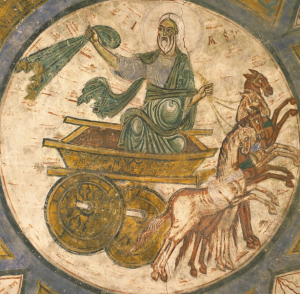
Fresco (c. 1250) of Eliya (Elijah) the Prophet
from Anagni Cathedral in central Italy.
c. The voice of one crying in the wilderness, “Prepare the way of the Lord, make his path straight”/A voice shouting in the desert, “Get the Lord’s path ready; make a straight track for him” | Φωνὴ βοῶντος ἐν τῇ ἐρήμῳ· Ἑτοιμάσατε τὴν ὁδὸν κυρίου, εὐθείας ποιεῖτε τὰς τρίβους αὐτοῦ [fōnē boōntos en tē erēmō: hetoimasate tēn hodon küriou, eutheias poieite tas tribous autou]: This text—made famous by Handel’s Messiah (well, and by being in the Bible and stuff)—comes from the opening chapter of what is sometimes called “Second Isaiah.”2 This is a cycle consisting in chapters 40 through 55 inclusive, composed partly in praise of the founding shah of the Hachamanishya dynasty of Iran: Kurush, alias Cyrus, the Great. Kurush conquered Babylon and allowed the exiled Judahite aristocracy to return to their native land; in the Isaian cycle, Kurush was honored with the title of מָשִׁיחַ [måshiyach], “Anointed,” a title usually accorded only to the heirs of the House of Dawid. Here’s the reference in Matthew with a little extra context:
“Comfort ye, comfort ye my people,” saith your God.
——“Speak ye comfortably to Jerusalem,
and cry unto her, that her warfare is accomplished,
——that her iniquity is pardoned:
for she hath received of the Lord’s hand double
——for all her sins.
The voice of him that crieth in the wilderness,
——‘Prepare ye the way of the Lord,
——make straight in the desert a highway for our God.
Every valley shall be exalted,
——and every mountain and hill shall be made low:
and the crooked shall be made straight,
——and the rough places plain:
and the glory of the Lord shall be revealed,
——and all flesh shall see it together:
——for the mouth of the Lord hath spoken it.'”
—Isaiah 40:1-5
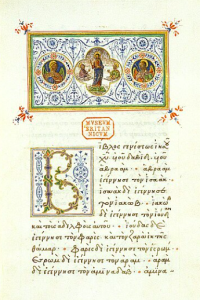
The beginning of the Gospel of Matthew in
Minuscule 448, a manuscript dating to 1478.
The principal prophet associated with the advent of the Messiah was Eliya, or Elijah. Eliya was supposed to return as the Messiah’s herald, according to the closing chapter of Malachi:
Unto you that fear my name shall the Sun of righteousness arise
——with healing in his wings …
Remember ye the law of Moses my servant …
Behold, I will send you Elijah the prophet
——before the coming of the great and dreadful day of the Lord:
And he shall turn the heart of the fathers to the children,
——and the heart of the children to their fathers,
——lest I come and smite the earth with a curse.
—Malachi 4:2-6
d. locusts | ἀκρίδες [akrides]: Although the vast majority of insects are not kosher, there were four exceptions from the suborder Cælifera (which includes grasshoppers, locusts, and crickets). By the time the Mishnah was written down (c. 200), the knowledge of which four species these were had been lost, and rabbinic Jews since have eschewed all insects without exception.
e. they were baptized by him in the river Jordan/were being immersed in the Yarden river by him | ἐβαπτίζοντο ἐν τῷ Ἰορδάνῃ ποταμῷ ὑπ’ αὐτοῦ [ebaptizonto en tō Iordanē potamō hüp’ autou]: Both the ritual of baptism and the choice to perform it in the Jordan River are noteworthy. We discussed the origins of baptism way back in January, when dealing with the Johannine treatment of the Baptist; for anyone who didn’t see that post or needs a refresher, I’ll take the tasteless liberty of quoting myself.
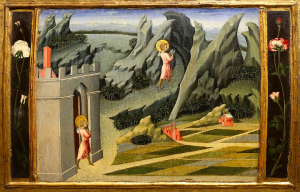
St. John the Baptist Retiring to the Desert
(1454), by Giovanni di Paolo. Photo by Sailko,
used via a CC BY-SA 3.0 license (source).

As his moniker suggests, the fact that this apocalyptic preacher was proclaiming a “baptism of repentance” is what was so eye-catching about him. (Well, the camel-skin and the unkempt hair were probably the eye-catching thing about him; the baptisms would have been more ear-catching.) This is because, in a sense, baptism already existed in Judaism; and still does.
What I’m talking about is ritual immersion in a mikveh (מִקְוֶה [miqhweh]). A mikveh can just be a natural body of water, but it is normally found in the form of a vat-like pool, built into the ground (generally as part of a synagogue), containing enough natural spring water, river water, or rainwater8 for an adult to be fully immersed in it. The Torah requires purification by washing with water, involving either partial or full immersion of both people and objects, for a variety of causes (new dishes and utensils are immersed in a mikveh before they begin to be used, for example). Priests who were assigned to offer sacrifices in the Temple would immerse themselves in a mikveh in the morning; Jewish women would normally immerse themselves every month, due to the impurity associated with menstruation. However, probably the most famous use of the mikveh was and is as part of the process of converting to Judaism. Besides circumcision—which of course only affects males—Gentile converts of both sexes must be immersed as part of their conversion, ritually washing away the impurities of the Gentile way of life.
It seems to have been this, the proselytic use of the mikveh, that St. John the Baptist was alluding to in summoning people to be baptized. This might mean that he was, so to speak, calling the Jews of his day “no better than Gentiles,” in whatever sense and for whatever reason. On the other hand, the significance assigned to baptism by Christians had been more dramatic since decades before the Gospel of John was written: the Paulines repeatedly link baptism with death and rebirth, and St. Peter connects it to the Flood of Noah. (Moreover, though this is far from certain, it’s possible that Luke 3:14 indicates the Baptist admitted Gentiles as well as Jews to his baptism, which would make a message that implicitly insulted Gentiles as such rather unlikely.) I’m therefore inclined to think that the Baptist’s message was something more to the effect of: That is coming which none of you, Gentile or Jew, are ready for—the Holy One of God. Though no preparation can be enough, nevertheless, prepare to receive It; you must prepare to receive It.
—From “The Beginning of the New Cosmos, Part I,” discussing John 1:19-28; full post at this link.
And the Yarden, or Jordan, River? This is—say it with me, anthropology students—a liminal place; the Yarden forms the boundary between the land of Canaan proper and the adjoining regions of Moab, Gilead, and Bashan (moving south to north); or, to give them their first-century Hellenized names, the regions of Perea, the Decapolis, and Iturea. This river has two pertinent associations.
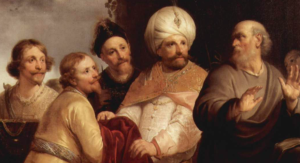
Elisa Verweigert die Annahme der Geschenke
Naemans [Elisha Refuses the Gifts of Naaman]
(1637), by Pieter de Grebber.
The first is the story of Naaman the Syrian, which appears in II Kings 5. He came to Eliya’s successor, Elisha, to be cured of leprosy; he was instructed by the prophet to immerse himself in the Yarden seven times, he (eventually) obeyed, and poof, no more leprosy. This would make it quite a natural symbol of purification, even if there were no other meaning attached to this river. All the same, there are some oddities about this story. For example, the very idea that Naaman the Syrian had leprosy, or more precisely tzaraath (צָרַעַת [tzåraɜath]) doesn’t make sense, because according to the rabbinic interpretation of this disease, it was a strictly supernatural affliction that could only apply to the possessions and persons of Jews. The story also shows us something quite unusual in the Hebrew Bible: a proselyte to Judaism. Not just a resident alien who converted to Judaism, the way Ruth did; we do find those here and there in the Old Testament. I mean someone of alien nationality, who does not join himself to the Jewish people—on the contrary, he asks to bring home a couple of mule-loads of earth3 as a memento because he’s planning to go back home to Syria—who yet does adopt Judaic monotheism.4 I think the nearest parallel to this which I can come up with, and it’s not particularly near, is the story of the Queen of Sheba visiting Solomon? Point is, it’s not a frequent trope, anywhere in the Old Testament!
I think St. Matthew is hinting, more and more, that the line between Gentile and Jew is something he’s prepared to play with and complicate. The Epiphany story (what are presumably Iranian maguša doing paying homage to someone who is, on any account, a Jewish prince?) is right there in what I’ve dubbed “Book Alef.” Even his reference to Bathsheba in the genealogy suggested this, as he calls her “the wife of Uriyah,” and the famous thing about him (outside being, uh, betrayed and murdered by his best friend) was that he was Uriyah the Hittite.
The other, and much greater, symbolic association of the Yarden River is simply that it was the last boundary the Israelites crossed (according to the Torah and the book of Joshua) on their journey from the wilderness into the Promised Land to, at long last, claim their inheritance. This redoubles the solemnity of the claim that “the kingship of the heavens has drawn near.”
f. confessing/affirming | ἐξομολογούμενοι [exomologoumenoi]: This is a slightly tricky word to translate, because its usage in Koiné Greek is much broader than any of its English equivalents. The word ἐξομολογέω [exomologeō] at base means “to say the same as, agree”; contextually, it can mean “to confess” (as in a confession of sins), “to confess, profess” (as in a confession of faith), “to praise,” or “to assent.”
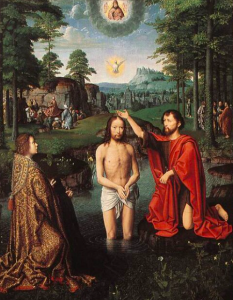
The Baptism of Christ (1505), by Gerard David.
g. many of the Pharisees and Sadducees/many of the Pryshaya and Tzadukin | πολλοὺς τῶν Φαρισαίων καὶ Σαδδουκαίων [pollous tōn Farisaiōn kai Saddoukaiōn]: In our study of the Fourth Gospel, we found a good deal about the Pryshaya, the Pharisees; however, the Tzadukin, the Sadducees, were among the items which that evangelist entirely omitted (at least by name—one individual Tzaduk, the high priest Yosef ben Qayafa, features prominently in John). They are more of a presence in Mark than in Matthew, but a quick profile is in order.
They had come into existence no later than the reign of John Hyrcanus I over Yehud, which lasted from 134-104 BCE; we know this because Josephus informs us that, although he had begun as a Prysha, Hyrcanus defected to the Tzadukin by the end of his reign. According to legend, their beliefs arose from a misunderstanding of a moral maxim. An ancient sage said something to the effect that those who kept the Torah should do so disinterestedly, rather than like those who expect a reward. The legend goes that the Tzadukin deduced from this that there was, in fact, no reward: no afterlife, no Last Day, no resurrection; correspondingly, no authority in the second or third divisions of the Tanakh, the Prophets and the Writings—which, especially in the most recent layer of books, gave increasing credit to the eschatological, millenarian, and messianic leanings of the Pryshaya, who represented the doctrinal mainstream. To the Tzadukin, only the Law itself was truly of God.
All this suited the Tzadukin perfectly well. They were Levitic aristocrats: everything they needed to do their jobs and maintain their hold on both religious and political power could be found in the Pentateuch. They took their name from Tzaduk, the ancestor of an illustrious lineage of priests. Not all priests were Tzadukin by any means, but pretty much all Tzadukin were priests—they were the only class such an ideology could really appeal to. Furthermore, the Tzadukin were mainly collaborators with both the Herodian and Roman regimes, leading unashamedly opulent lives, and opportunistically sniping at the Pryshaya when they got the chance. (Incidentally, the Pryshaya being the mainstream meant that they filled most of the seats on the Sanhedrin. The Tzadukin had a fairly reliable hold on the high priesthood, simply because the families who were eligible to hold it were mostly aligned that way, but they remained a theological minority.)
h. vipers | ἐχιδνῶν [echidnōn]: The word ἔχιδνα [echidna] primarily meant a venomous snake, of any species; English doesn’t have a completely exact equivalent, although the word adder was once pretty close. (Coïncidentally, all vipers, members of the taxonomic family Viperidæ, are in fact venomous. In North America, rattlesnakes are likely the best-known kind of viper.)

An Arabian horned viper. Photo by Broobas,
used via a CC BY-SA 4.0 license (source).

i. winnowing fork | πτύον [ptüon]: A winnowing fork, visually identical to a pitchfork, was used to separate cereal seeds (barley and wheat particularly) from the chaff, or husks, by tossing them in the air; a little bit of breeze would be enough to pull the chaff away from the seeds. This chaff could then either be fed to domestic animals or, more probably, burned for fuel.
Footnotes
1This passage has been lightly edited without marking (ellipses, etc.); I decided on this because Williams uses an ellipsis to rhetorical effect in the passage itself, and I didn’t want to deprive this of its significance.
2This portion of the book is referred to as “Second” because it is not thought to be by the same author or of the same date as the bulk of the book, or “First” Isaiah (chapters 1-39); the same is true of “Third” Isaiah, or chapters 56-66. Why, if so, were these two novelties put in alongside the authentic work of Yshayah ben Amotz, a.k.a. the historical prophet Isaiah? As far as I know, there are basically two explanations, of which I find the second more credible.
i) Forgery. Somebody wrote this stuff and then tried, apparently with success, to pass it off as really written by Yshayah ben Amotz, presumably shortly after they composed it in the sixth century BCE, a couple hundred years after the real Yshayah’s floruit. (My own personal confidence that Isaiah 40-66 date to a later period than the first part of the book is actually tied to the explicit naming of Cyrus in chapter 45: while foretelling a name obviously does not exceed the power of the Almighty, it is uncharacteristic of Biblical prophecies elsewhere to offer this as a miraculous sign, and it is not in fact put forward as a sign in Isaiah 45. That, in my opinion, sounds more like the present scholarly consensus that this was roughly contemporary with Cyrus’s reign [559-530 BCE].)
ii) Continuity of the “school” of Yshayah. Prophets did not typically operate alone in ancient Yisroel and Yehudhah. A few did; however, most had some sort of connection with “schools” of prophets. Information about these schools can be gleaned from the text of Scripture, even without the benefit of contextualizing rabbinic commentary (as discussed in this short review by Ira Price, a Professor of Semitic Languages from the University of Chicago around the turn of the last century). There appear to have been perhaps half a dozen prophetic schools tied to cities—Bethel, Gilgal, Shomron (Samaria), Yericho (Jericho); another seems to have existed on Mount Karmel, which the Carmelite Orders profess to derive from. Not much seems to be known about these schools directly, but given their “line of work,” they presumably studied whatever edition of the Torah they possessed, as well as those psalms and other Hebrew poetry that had been composed by their time (future literature was unavailable at the time). They also studied music, the tradition of which was complex and thriving in the Holy Land during the Early Iron Age; judging from passages like I Samuel 19:20-24, there may have been a tradition of ecstatic music, perhaps associated with ecstatic dance, and if so, any techniques used to reach these ecstatic states would presumably have been taught in these schools. However, besides the locally-based schools, less official quasi-schools could also cluster around individual seers. Yshayah was a long-lived prophet of immense rhetorical gifts and power, one who enjoyed royal favor under Kings Huzziyah, Yotham, and Chizkiyah (plus royal toleration under King Achaz between Yotham and Chizkiyah); it’s credible that he attracted just such a following. If that community lasted, it might easily have produced another poetic genius or two who composed the latter half of the book, which might very naturally be filed with the rest of the material that, in general, belonged to the “school of Yshayah.” All that said, if there is hard evidence for this idea, I don’t know about it. I think it’s a plausible theory, but still, it’s a theory.
3So, probably something close to a couple hundred pounds, total.
4Or henotheism, if you simply must. (I’m a great simply-must-er myself, so, if you must, I get it.)
Previous Post
September 25, 2026
The Gospel of Matthew: The Coventry Carol
Next Post
October 8, 2026 The Gospel of Matthew: Christ and Antichrist
Recent Comments
"On the contrary, such a proclamation, among the Aztecs or Maya, would be disastrously misunderstood. ..."
The Gospel of John: The Bread ..."
"Many thanks for your scholarly study on the Cleansing of the Ten Lepers in the ..."
The Cleansing of the Ten Lepers
"Four Last Things: not the video game, but Death, Judgment, Heaven and Hell.Momento mori. Remember, ..."
"I am going by the time that these sayings began to be converted into written ..."
Are Our Bibles in the Wrong ..."
Browse Our Archives
Select a Category abuse antifascism art bad Catholic celibacy chastity Church crucifixion culture war eros forgiveness gay gender homophobia ikons language liturgy peace poems politics Pope Francis prayer pro-life race recommendations reform repentance review sacraments saints satire scandal schism scripture sex suffering theology Uncategorized violence
Select a Month October 2026 September 2026 August 2026 July 2026 June 2026 May 2026 April 2026 March 2026 February 2026 January 2026 December 2025 November 2025 October 2025 September 2025 August 2025 July 2025 June 2025 May 2025 April 2025 March 2025 February 2025 January 2025 December 2024 November 2024 October 2024 September 2024 August 2024 July 2024 June 2024 May 2024 April 2024 March 2024 February 2024 January 2024 December 2023 November 2023 October 2023 September 2023 August 2023 July 2023 June 2023 May 2023 April 2023 March 2023 February 2023 January 2023 December 2022 November 2022 October 2022 September 2022 August 2022 July 2022 June 2022 May 2022 April 2022 March 2022 February 2022 January 2022 December 2021 November 2021 October 2021 September 2021 August 2021 July 2021 June 2021 May 2021 April 2021 March 2021 February 2021 January 2021 December 2020 November 2020 October 2020 September 2020 August 2020 July 2020 June 2020 May 2020 April 2020 March 2020 February 2020 January 2020 December 2019 November 2019 October 2019 September 2019 August 2019 July 2019
Follow Us!
TAKE THE
Religious Wisdom Quiz
Who was the king of Babylon during the exile of the Israelites?
Select your answer to see how you score.
Belshazzar Cyrus Darius Nebuchadnezzar
Related posts from Mudblood Catholic

The Gospel of Matthew: Christ and Antichrist

The Gospel of Matthew: The Coventry Carol
The Gospel of Matthew: Midnight Epiphanies
The Gospel of Matthew: The House of Yosef
TRENDING AT PATHEOS Catholic

I was strolling through the top floor of the brand new Parthenon...

What Does Gêvâh Mean For Kimberley Guifoyle &...
This week, a lot of the news is focused on Kimberly Guilfoyle....

INNER CIRCLE: Profound Mystery (Of Christ In All...
Ephesians 5:31-32 “For this reason, a man will leave his father and...

Do Not Rejoice When Your Enemy Falls: The...
Turning an execution into a public spectacle is a disturbing expression of...

'The Chosen' S6 Trailer: The Passion Gets Very...
Not many watching 'The Chosen' worry about spoilers, but just because they...

The purpose-driven labor priest
A labor activist reads Rick Warren and it gets me wondering about...
view all Catholic blogs
What Are Your Thoughts?leave a comment
Ad-Free & Subscriber Log-In Subscription Support
- About Us
- 2026 Calendar
- Videos
- Podcasts
- Library of World Religions
- Faith In Media Tracker
- Advertise With Us
- Write for Us
- Privacy Policy
- Terms of Service
- Do Not Sell My Data
- Contact Us
- Radiant Digital
- Manage Newsletter Subscriptions
- Unsubscribe From Notifications
- Sitemap
Copyright 2008-2026, Patheos. All rights reserved.
Subscription Support Ad-Free & Subscriber Log-In
Follow Patheos