
BuddhistCatholicContemplativeEvangelicalGeneral ChristianHinduJewishLatter-day SaintMuslimNew VisionsProgressive Christian
Beliefs
- Buddhist
- Catholic
- Contemplative
- Evangelical
- General Christian
- Hindu
- Jewish
- Latter-day Saint
- More Voices
- Muslim
- New Visions
- Pagan
- Progressive Christian
Topics
- Religion News
- Food and Religion
- Sports and Religion
- Religious Art
- Religious Music and Entertainment
- Religious Events
- History and Religion
- Style and Religion
- Politics and Religion
- Women in Religion
- Recreation Outdoors and Religion
- Business Finance and Religion
- Careers Workplace and Religion
- Education and Religion
- Family Parenting and Religion
- Health Fitness and Religion
- Home and Religion
- Relationships and Religion
- Technology and Religion
- Travel and Religion
Columnists
- Buddhist Columnists
- Business Finance and Religion Columnists
- Careers Workplace and Religion Columnists
- Catholic Columnists
- Contemplative Columnists
- Education and Religion Columnists
- Evangelists Columnists
- Family Parenting and Religion Columnists
- General Christian Columnists
- Health Fitness and Religion Columnists
- Hindu Columnists
- History and Religion Columnists
- Home and Religion Columnists
- Jewish Columnists
- More Voices Columnists
- Latter Day Columnists
- Muslim Columnists
- New Visions Columnists
- Nonreligious Columnists
- Pagan Columnists
- Politics and Religion Columnists
- Progressive Columnists
- Recreation Outdoors and Religion Columnists
- Relationships and Religion Columnists
- Religion News Columnists
- Religious Art Columnists
- Religious Events Columnists
- Religious Music and Entertainment Columnists
- Sports and Religion Columnists
- Style and Religion Columnists
- Technology and Religion Columnists
- Travel and Religion Columnists
- Women in Religion Columnists
Resource Library
- 2026 Calendar
- Library of World Religions
- The 100 Most Holy Places on Earth
- Patheos Answers
- Podcasts
- Videos
- Faith Leaders Database
- Anglican Episcopalian
- Bahai
- Baptist
- Buddhism
- Christianity
- Confucianism
- Eastern Orthodoxy
- Hinduism
- Holiness and Pentecostal
- ISKCON
- Islam
- Judaism
- Lutheran
- Methodist
- The Church of Jesus Christ of Latter-day Saints
- New Age
- Paganism
- Presbytarian and Reformed
- Protestantism
- Religion Behind the Scenes
- Roman Catholic
- Scientology
- Shia Islam
- Sikhism
- Sufism
- Sunni Islam
- Taoism
- Zen
- See all religions
Research Tools
 Ad-Free & Subscriber Log-In Subscription Support
Follow Patheos 

- Trending:
- Advent
- |
- Forgiveness
- |
- Thanksgiving
- |
- Election
- |
- Seasonal Holidays
- |
- Marriage

- Home
- Catholic
- The Gospel of Matthew: Christ and Antichrist
The Gospel of Matthew: Christ and Antichrist
Last updated on: October 8, 2026 at 5:23 am by Gabriel Blanchard
The Gospel of Matthew: Christ and Antichrist 2026-10-08T05:23:08-04:00 Gabriel Blanchard
Patheos Explore the world's faith through different perspectives on religion and spirituality! Patheos has the views of the prevalent religions and spiritualities of the world.
Christ and Antichrist (Matthew 3:13-4:11)
St. Matthew quoted “Out of Egypt I called my son” in chapter 2, aligning Christ’s story with that of Yisroel in general and Moshe specifically; in that light, we now come to Christ’s baptism and his forty-day fast in the wilderness. The baptism, since it took place in the River Yarden, could be analogized with the Hebrews’ initial entry into the Promised Land, which itself took place under the leadership of Moshe’s heir Yehoshuah, who bore the classical form of a name that had been worn down to Yeshua by the late Second Temple period. In this case, the Lord’s forty-day fast and defeat of the tempter would parallel the conquest of Canaan and its idolatrous inhabitants.
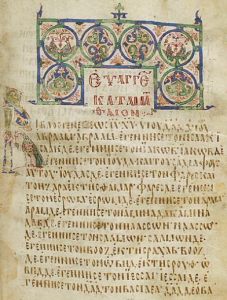
The first folio of the Gospel of Matthew
from the 9th-c. Codex Cyprius.
However, we’re told by St. Paul in I Corinthians 10 that “all our fathers passed through the sea, and were all baptized unto Moses in the sea”: this makes the parting of the Red Sea, rather than the passage of the Yarden, the chief baptismal analogue. This would put the forty-day fast in parallel to either or both of two other events in Yisroel’s primitive history:
- The forty years spent wandering in the desert, after the people’s refusal to trust that God would help them take possession of Canaan. As a penalty for this distrust, the freed people of Yisroel had to remain in the wastes in and around the Sinai Peninsula for forty years, until the distrustful generation had mostly died out. (Yehoshuah, a member of the tribe of Efraim, and his Yudahite friend Kalev, were some of the few who saw both the Exodus from Egypt and the entry into Canaan.
- The other parallel, which at first glance may seem like it doesn’t fit as well, would be the counting of the omer*—the fifty-day period following Passover that falls between it and Pentecost (a.k.a.* Shavuot or the Feast of Weeks), during which the Hebrews under Moshe’s leadership made their way from the Red Sea crossing to Mount Sinai: it was on this mountain at Pentecost that the Torah *was originally given.*1
I’ll discuss my reasons why next week, but I think the latter association is uppermost in the evangelist’s mind here.
Matthew 3:13-4:11, RSV-CE
Then Jesus came from Galilee to the Jordan to John, to be baptized by him. John would have prevented him, saying, “I need to be baptized by you, and do you come to me?” But Jesus answered him, “Let it be so now; for thus it is fitting for us to fulfill all righteousness.” Then he consented. And when Jesus was baptized, he went up immediately from the water, and behold, the heavens were opened and he saw the Spirit of God descending like a dove, and alighting on him; and lo, a voice from heaven, saying, “This is my beloved Son, with whom I am well pleased.”
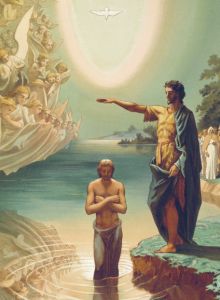
The Baptism of Christ (c. 1845),
by Gregory Gagarin.
Then Jesus was led up by the Spirit into the wilderness to be tempted by the devil. And he fasted forty days and forty nights, and afterward he was hungry. And the tempter came and said to him, “If you are the Son of God, command these stones to become loaves of bread.” But he answered, “It is written,
‘Man shall not live by bread alone,
but by every word that proceeds from the mouth of God.’”
Then the devil took him to the holy city, and set him on the pinnacle of the temple, and said to him, “If you are the Son of God, throw yourself down; for it is written,
‘He will give his angels charge of you,’
and
‘On their hands they will bear you up,
lest you strike your foot against a stone.’”
Jesus said to him, “Again it is written, ‘You shall not tempt the Lord your God.’” Again, the devil took him to a very high mountain, and showed him all the kingdoms of the world and the glory of them; and he said to him, “All these I will give you, if you will fall down and worship me.” Then Jesus said to him, “Begone, Satan! for it is written,
‘You shall worship the Lord your God
and him only shall you serve.’”
Then the devil left him, and behold, angels came and ministered to him.
Matthew 3:13-4:11, my translation
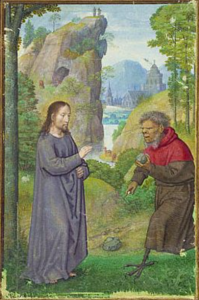
The Temptation of Christ (c. 1550),
by Simon Bening.
Then Yeshua from the Galyl appeared by the Yarden to Yochanan in the [place where one] is immersed by him. But Yochanan was prohibiting him, saying, “It is my part to be immersed by you, and do you come to me?”
Yeshua said to him in response: “Permit it for the moment, for thus it is befitting to us to fulfill all justice.”
Then, he permitted him. Having been immersed, Yeshua straightaway rose up from the water; and behold, the heavens were opened, and he saw a spirit of God coming down like a dove, coming upon him; and behold, a voice from the heavens said: “This is my beloved Son—with him, I am well-pleased.”
Then Yeshua was led out into the desert by the spirit, to be tried by the accuser. And, having fasted forty days and forty nights, at last, he was hungry. And the trier came and said to him: “If you are God’s Son, say that these stones should become bread.”
Yet Yeshua said in response, “It is written, ‘Man will not live only on bread, but on every message coming forth from God’s mouth.'”
Then the accuser took him up into the holy city, and stood him on a finial of the Temple, and says to him, “If you are God’s Son, throw yourself down; for it is written that ‘He will charge his messengers about you and they will lift you in their hands, lest your foot stumble against a stone.'”
Yeshua tells him, “Again it is written: ‘You will not test out the Lord your God.'”
Again the accuser took him up onto an exceedingly high mountain, and showed him all the kingships of the world and their glory, and says to him, “I will give you all these things, if you fall prostrate to me.”
Then Yeshua says to him: “Go, Šaṭan—for it is written, ‘You will prostrate yourself to the Lord God, and you will minister only to him.'” Then the accuser quit him, and behold, messengers came and served him.
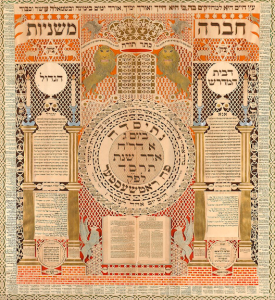
An Omer calendar (1904) created by Litvak artist
Baruch Zvi Ring—see my introductory remarks, as
well as footnote 1, for a little more on its possible
significance for our text here.
Textual Notes
a. Galilee/the Galyl | τῆς Γαλιλαίας [tēs Galilaias]: The name “Galilee” originated as a transcription of the Hebrew name הַגָּלִיל [ha-Gålyl], “the Wheel,” in reference to a ring of mountains between the Lake of Tiberias and the Jezreel Valley. My “the Galyl” is an attempt to more closely represent or suggest how this name would have looked and sounded to a Greek-speaker, at the time when the Gospels were written. According to the schema laid out in Joshua, the Galyl was divided among the tribes of Naftaly, Zevulun, and Yssakhar.2 However, it was always adjacent to the Phoenician city-states in the region of modern Lebanon, and, following the incursions of the Assyrian, Babylonian, Persian, Macedonian, Ptolemaic, Seleucid, and Roman Empires, the region had even earned the nickname “the Galyl of the goys,” as we’ll be seeing next week. In the first century CE, it was a relatively new addition to the Herodian tetrarchy; its populace was a mix of Jews and Græco-Syrian Gentiles.
b. John would have prevented him/But Yochanan was prohibiting him | ὁ δὲ Ἰωάννης διεκώλυεν αὐτὸν [ho de Iōannēs diekōlüen auton]: The verb here, διακωλύω [diakōlüō], is a somewhat stronger verb in Greek than “would have prevented” perhaps makes it sound in English. The English of the RSV, at least to my ear, gives the impression that the Baptist was expressing a preference which he agreed to forego: the Greek sounds more like he gave a ruling (so to speak), which he was then persuaded to withdraw.
c. let … left/Permit … quit | Ἄφες … ἀφίησιν [afes … afiēsin]: I have written before now of my arch-nemesis, the evil verb ἀφίημι [afiēmi]. Its base meaning is something like “to let go of,” with as much breadth as you can imagine in metaphorical applications. (Greek even uses a form of this verb as a word for saying things, because of course you do, because every verb has to also mean “to talk”! This is an intervention, Greek: you’re an addict; get help. Ideally without starting to use “help” as another discourse verb.) Usually, I’m able to cram the meaning that appears in whichever New Testament text I’m translating into some English verb or other that derives ultimately from the Latin mittere, “to send”: emit, remit, and permit all fit this pattern (ēmittere “send out,” remittere “send back,” permittere “send through”). When ἀφίημι means “leave, depart,” the best I’ve been able to manage is “quit,” on the sad, flimsy grounds that it sort of sounds like the rest. That doesn’t suit my preferred technique of translation well, but I’ve found no better solution.
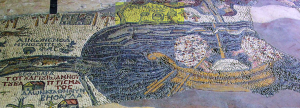
Part of the Dead Sea on the 6th-c. Madaba Map;
note the tiny label ΒΕΘΑΒΑΡΑ [Bethabara], the site
of Christ’s baptism, by the river. Photo by Berthold
Werner, used via a CC BY-SA 3.0 license (source).

d. for thus it is fitting for us to fulfill all righteousness/for thus it is befitting to us to fulfill all justice | οὕτως γὰρ πρέπον ἐστὶν ἡμῖν πληρῶσαι πᾶσαν δικαιοσύνην [houtōs gar prepon estin hēmin plērōmai pasan dikaiosünēn]: This is a rather, eh, non-transparent explanation. The only interpretation I could think of was that this was meant to “set a good example,” but that probably runs aground on the Immerser’s own objection: submitting to this baptism implied a submission on Yeshua’s part to Yochanan, which according to Matthew was considered an inversion of their proper hierarchy by both men. Daniel Harrington, S.J., the author of the Sacra Pagina commentary on St. Matthew’s Gospel, states that
The phrase is best not taken as referring to Christian baptism … or to the economy of the Old Covenant … Rather it probably alludes to the way of life appropriate to one baptized by John (“producing good fruit”). Recognizing the superiority of his own baptism, Jesus nevertheless pledges to act in accord with John’s baptism. (S.P. vol. 1, Matthew, p. 62; see the Outline for full bibliographical details.)
This, then, would implicitly align with the institution of the New Law in John 13, something effected only once the first Law, the Torah, had been decreed for centuries (and was therefore available as an intellectual framework by which to understand this New Law). John the Baptist represents the zenith of the Mosaic Covenant that, in Jesus, is to be transcended: the latter must (so to speak) show that he is equal to the requirements of the former before the transcendence can be “allowed”—otherwise, the story would read like one of evasion rather than transcendence.
e. the Spirit of God/a spirit of God | πνεῦμα θεοῦ [pneuma Theou]: Here, the discrepancy between the RSV’s rendering and mine is a function of translation philosophy, or method (i.e., this isn’t one of those cases where I find an alternative Greek text more convincing than the one the RSV opted for). As I’ve explained elsewhere, both punctuation marks and capitalization are in general of significantly later date than the composition of the Gospels—there may have been a little bit of punctuation in the first century CE, but nothing else. Hence, distinctions between things like “the Spirit” and “a spirit” in English Bibles are interpretive decisions, made by the translators, as distinct from something conveyed by the text. Now, sometimes the content of the text makes it clear that the capitalized “Spirit” is meant, i.e. the Third Person of the Trinity; and to be clear, I’m not disputing any particular case where the translators of the RSV went with “Spirit” (on the contrary, I would expect them to be correct in most, probably all, cases). Rather, in cases that seem to me like they would have allowed a relatively ambiguous reading at the time—without the benefit of twenty centuries of hindsight, as it were—I generally use the lower-case form to represent that ambiguity.

“Touchdown,” showing a collared dove alighting
on a patch of gravel. Photo by Flickr user
Transport Pixels, used via a CC BY 2.0 license
(source).

f. my beloved Son | ὁ υἱός μου ὁ ἀγαπητός [ho Huios mou ho agapētos]: This title is intriguing. It’s arguably Davidic: certain texts, like Psalm 2, that were used for coronations in the Kingdom of Yehudah before the Babylonian Exile, refer to the royal heir as “the son of the LORD“:
Yet have I set my king
——upon my holy hill of Zion.
I will declare the decree:
——the LORD hath said unto me,
Thou art my Son;
——this day have I begotten thee.
Ask of me, and I shall give thee
——the heathen for thine inheritance,
——and the uttermost parts of the earth for thy possession.
—Psalm 2:6-8
It is important to note that “Son of God” is therefore not, in itself, a claim or appellation of deity, like calling him the Logos was in the opening chapter of John.3 Such appellations are not absent from Matthew: the fact that Yeshua and Immanu’el are treated in chapter 1 as if they are the same name points in exactly this direction (and other suggestions of divinity are not far off). My point here is only that the specific title “Son of God” is not doing that; it’s messianic, but not necessarily deifying.
g. the wilderness/the desert | τὴν ἔρημον [tēn erēmon]: Obviously, our text does not specify which desert this was, and there are many deserts available for such a use. West of the Lake of Tiberias lies the Black Desert, a sub-region of the Syrian Desert. The Syrian Desert is an area of hamada, also known as desert pavement, or a desert consisting mainly of bare rocks, which may be packed together, comparatively free of sand. (Hamada contrasts with erg, or sand dune fields, such as we see in much of the Sahara.) The Black Desert in particular is a desert pavement composed mostly of basalt, the remains of ancient volcanic activity. We aren’t told whether the Lord wandered the wilderness he was in or stayed mostly in one place, but, if he wanted somewhere from which it was convenient to return into the Galyl, he could have come through the Black Desert at some point.
However, because of its associations, and because it would be a little easier to get to from the (probable) site of his baptism, I think he went south into the Desert of Zin, roughly equivalent to the modern Negev.4 This region lies in the south of the modern state of Israel, south or southwest of the Dead Sea and west of the Wadi Aravah, the valley that runs from the Dead Sea to the Gulf of Aqaba (which itself is an inlet connecting to the Red Sea). This is the region in which, according to the book of Numbers, the Israelites spent the bulk of their forty years in the wilderness, after they refused at first to trust that God would help them conquer the land of Canaan after their deliverance from Egypt and departure from Sinai.
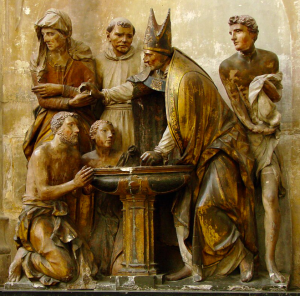
A sculpture (1549) from the Cathédrale
St.-Pierre-et-St.-Paul at Troyes, France,
depicting the baptism of St. Augustine
of Hippo by St. Ambrose of Milan.5
h. If you are the Son of God/If you are God’s Son | Εἰ υἱὸς εἶ τοῦ θεοῦ [ei Huios ei tou Theou]: It’s not uncommon for prophets and sages to encounter some kind of trial; this is standard hero’s-journey type stuff. The temptations themselves can probably be classified in various ways. I’m struck by their alignment with the old anti-trinity of the Flesh, the World, and the Devil. These three may be usefully understood like this:
- The Flesh: “Tell these stones to become bread.” Temptations that arise from our mere natural inclinations. These are actually not restricted to bodily appetites for things like food, sex, or rest; any natural inclination can be a means for “the flesh” to work. The point of this kind of temptation being “flesh” is just that it comes from within, from what Freud called the id, and that—perhaps only by an accident of circumstance—it is in fact urging us to move away from God.
- The World: “Cast yourself from the pinnacle of the Temple.” Temptations that arise from our interactions with others, especially the temptation to go along with the characteristic flaws of our social group. I say “our social group” and not “our age” because, among ourselves, lots of Christians are very well-practiced at not going along with the flaws we have been taught to think typify “our age” (an alternative to God whose approval we don’t value and therefore find it easy to go without), but are positively frightened even to openly name the characteristic flaws of our social group (an alternative to God which is easily confused with him on an emotional level and is, in that sense, by far the more powerfully dangerous idol).
- The Devil: “I will give you everything if you worship me.” Temptations that arise as corruptions on the way of the spirit. Everybody has a spirit, of course, but this is about the deliberate effort to pursue the “kingdom of heaven.” The ways this can go wrong far exceed our mere natural selfishness or even our mere instincts of people-pleasing and other-people-defiance. The most blatant example is devil-worship, but that is an extraordinarily rare perversion; most signs of the devil are much more humdrum. E.g., making religion into an instrument of something else (often a social cause or political program) is a very common shape taken by the devil.
But there is a common thread running through them also—the covert focus of every temptation: “If you are God’s Son …” This phrase explicitly introduces the first two temptations. It is left unsaid in the third, but there, the temptation itself, in its very phrasing, is a blasphemous inversion of Psalm 2: “Ask of me, and I shall give thee the heathen for thine inheritance, and the uttermost parts of the earth” vs. “I will give you all the kingships of the world and their glory.” In each of the three temptations, Satan scorns the revelation given at Christ’s baptism, invites doubt and disbelief in the proclamation that he is the Father’s “beloved Son, with whom” he “is well-pleased.” In this respect (despite some caveats we’ll touch on in textual note m), this accuser’s voice sounds very like the voice of the adversary in Job.
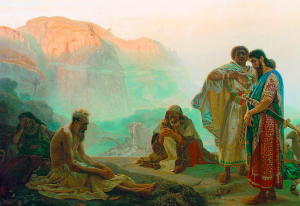
Job and His Friends (1869), by Ilya Repin.
And the LORD said unto Satan, “Hast thou considered my servant Job, that there is none like him in the earth, a perfect and an upright man, one that feareth God, and escheweth evil?”
Then Satan answered the LORD, and said, “Doth Job fear God for nought? … thou hast blessed the work of his hands, and his substance is increased in the land. But put forth thine hand now, and touch all that he hath, and he will curse thee to thy face.”
… And the LORD said unto Satan, “Hast thou considered my servant Job, that there is none like him in the earth, a perfect and an upright man, one that feareth God, and escheweth evil? and still he holdeth fast his integrity, although thou movedst me against him, to destroy him without cause.”
And Satan answered the LORD, and said, “Skin for skin, yea, all that a man hath will he give for his life. But put forth thine hand now, and touch his bone and his flesh, and he will curse thee to thy face.”
—Job 1:8-11, 2:3-5
In both cases, the overt attack is against the person being tried—Job in one case, Jesus in the other. But there is at the same time a covert attack against God’s goodness, the exact same attack the tempter has been selling since the Garden. God wouldn’t give you all these kingdoms, whatever he may have said. But I’m not stingy like he is; you can have them, and as a gift—from me*. The LORD your God isn’t the sort of person you adore just because he’s* himself*, is he! You do it because* you get something out of it, right? But look at this lovely fruit. There’s nothing wrong with it, he’s holding out on you! for God knoweth that if you eat of this, your eyes shall be opened, and ye shall be as gods …
i. It is written … for it is written … Again it is written … for it is written | Γέγραπται … γέγραπται γὰρ … Πάλιν γέγραπται … γέγραπται γάρ [gegraptai … gegraptai gar … palin gegraptai … gegraptai gar]: The texts quoted by Christ all come from the book of Deuteronomy.
- He humbled thee, and suffered thee to hunger, and fed thee with manna, which thou knewest not, neither did thy fathers know; that he might make thee know that man doth not live by bread only, but by every word that proceedeth out of the mouth of the LORD doth man live. (8:3)
- Ye shall not tempt the LORD your God, as ye tempted him in Massah. (6:16)
- Thou shalt fear the LORD thy God, and serve him, and shalt swear by his name. Ye shall not go after other gods, of the gods of the people which are round about you; (for the LORD thy God is a jealous God among you) … (6:13-15a)
The devil, by contrast, quotes only one passage of Scripture, from Psalms—specifically, Psalm 91 (still used in the Liturgy of the Hours as part of the prayers before bed), verses 11-12:
He shall give his angels charge over thee,
——to keep thee in all thy ways.
They shall bear thee up in their hands,
——lest thou dash thy foot against a stone.

Jebel Musa in the South Sinai governorate of
Egypt, traditionally identified by Christians as
Mount Sinai.
I personally find it rather amusing that the devil, for some reason, chose not to allude to verse 13:
Thou shalt tread upon the lion and adder:
——the young lion and the dragon shalt thou trample under feet.
j. the pinnacle of the Temple/a finial of the temple | τὸ πτερύγιον τοῦ ἱεροῦ [to pterügion tou Hierou]: What exactly this referred to is not known for certain—there is not an obvious answer. (Even whether this “pinnacle/finial” was on the central body of the Temple, the part containing the Holy of Holies, or somewhere on its outer perimeter, is not clear.) The word πτερύγιον literally means “winglet,” a diminutive derived from πτέρυξ [pterüx] “wing”: when πτέρυξ was used architecturally, it tended to mean the same thing that “wing” does in architectural contexts in English, i.e. a large subdivision of a building. This might suggest a meaning like “out-jutting” or “small prominence”—one of the Temple’s gates might fit the bill, and the translation “parapet” or “battlement” has also been suggested.
On the other hand, it may be an allusion to the same Psalm quoted by the tempter. The first couplet of its fourth verse says “He shall cover thee with his feathers, and under his wings shalt thou trust”.
k. a very high mountain/an exceedingly high mountain | ὄρος ὑψηλὸν λίαν [oros hüpsēlon lian]: Though its identity is scarcely necessary to the story, there is a site Christians have traditionally identified as the “mount of the temptation”: Mount Quruntul in the West Bank, convenient to the city of Yericho. (The name apparently derives from what the Crusaders called it, Mōns Quarentena [or some variant like Quarantana], “the Mountain of the Forty Days.”) A monastery was built there in the sixth century, and there were apparently still a few Orthodox monks there as recently as 2002.
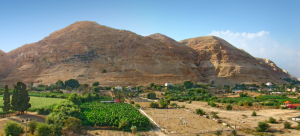
Mount Quruntul. Photo by Tango7174, used
via a CC BY-SA 4.0 license (source).

l. All these I will give you, if you will fall down and worship me/I will give you all these things, if you fall prostrate to me | Ταῦτά σοι πάντα δώσω, ἐὰν πεσὼν προσκυνήσῃς μοι [a]: This is, of course, the codifying example of the “devil’s bargain” trope—in theory, anyway. Really, old story of the deal struck between Faust and Mephistopheles probably plays a bigger role, imaginatively speaking, in our idea of bargains with the devil—a story defined largely by Goethe’s two operas on him, with maybe a dash of the Christopher Marlowe play. This, in my opinion, is a great pity. The Biblical version is a great deal more sensible.
For one thing, the devil of the opera and the play upholds his end of the bargain. Artistically satisfying though this is (I mean, it’d be a pretty weak a story if Mephistopheles just immediately reneged?), that artistic satisfaction is the only reason to write it this way, because theologically it borders on nonsense. There is absolutely no reason to think that, if the Lord really had bowed down to the devil, it really would have followed through and given him “all these things”! The very consistent message of Scripture about Satan is that he is a liar. He can never be trusted; even when he tells the truth, it is for a deceitful reason—so just don’t listen to him at all.
Secondly, this text prompts a question: Since when does the devil possess “all these things”? How are they his to give?
Who hath directed the Spirit of the LORD,
——or being his counsellor hath taught him?
With whom took he counsel,
——and who instructed him …?
Behold, the nations are as a drop of a bucket,
——and are counted as the small dust of the balance:
——behold, he taketh up the isles as a very little thing. …
All nations before him are as nothing;
——and they are counted to him less than nothing, and vanity. …
It is he that sitteth upon the circle of the earth,
——and the inhabitants thereof are as grasshoppers;
that stretcheth out the heavens as a curtain,
——and spreadeth them out as a tent to dwell in:
That bringeth the princes to nothing;
——he maketh the judges of the earth as vanity.
—Isaiah 40:13-23
Both Goethe’s devil and Marlowe’s really do possess the gifts they give their dupes. In Marlowe at least, the gifts prove to be a petty thing when set beside eternity under damnation, yet Faustus really does receive them.6 By contrast, when dealing with real devils, there is no more reason to think they even have the rewards they promise than there is to rely on their promises! They are liars. Don’t listen to them.
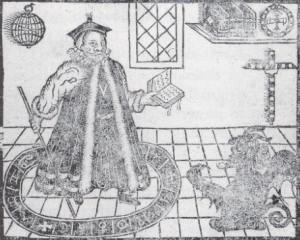
Image from the frontispiece of a 1620 edition
of Marlowe’s Tragicall History of the Life
and Death of Doctor Faustus.
Finally, we have a point neglected surprisingly often by artists who use this device, despite the obvious artistic power available to those who remember it (indeed, it is not just neglected but ignored completely by Goethe; points for this once again go only to Marlowe). What happens when you worship something? Of Them, the worshiped being, and you, their worshiper, who’s in control in that relationship? Do you think it’s you, for some reason? Because—and please pay attention, because this is extremely important—it’s not. This is at its clearest in the versions where the bargain is “selling your soul.” Your soul is what you care about, how you enjoy anything, what priorities you set: let someone else possess it, and all those things are subject now to the choices of that someone else. The obvious artistic move here is to have the someone else ruin your soul, at least as regards the thing you sold it for; voilà, tragic irony for days. Endless days. In hell. (A few years ago I tried to get at this idea in a poem I wrote, “The Nativity of Antichrist”; I still rather like it, though I’ve no idea how effective it was.)
m. Satan/Šaṭan | Σατανᾶ [Satana]: Though we habitually treat this as a proper name in English, the original Hebrew term שָׂטָן [šåṭån] simply meant “adversary, opponent”; the book of Jubilees, likely composed in the second century BCE, assigns this being the name מַשְׂטֵמָה [maš’ṭêmåh], “animosity” or “hostility.”7 Interestingly, and although most Christians don’t fully realize this, we here hit upon a point where Judaism and Christianity move, on the whole, in very different directions.
Mainstream Judaic theology (both in the first century and to this day) neither assigns this being great importance nor has a single unified account of him, or it.8 At most, “the satan” is a sort of heavenly court prosecutor, i.e. a being fulfilling a positive and divinely-willed function—certainly not a small-g god of evil, rarely even a fallen superhuman intelligence. Even its cameos in Job are typically interpreted in Judaic theology as appearances of an allegory: the personified abstraction of the יֵצֶר הַרַע [yêtzer haraɜ] or “urge to evil,” a quality similar in function (and universality) to the Christian idea of original sin, but—very unlike the Christian doctrine—understood to be a natural aspect of creation. The יֵצֶר הַרַע in Judaism requires correction through psychological maturity: our peccātum orīgināle in Christianity requires cancellation bestowed by divine grace alone, normally given through baptism.
The theology which treats “the satan” as not only an intelligent being, but a malevolent one—a kind of “semi-dualist” schema, dividing the angelic powers between those which imitated him in rebellion and the loyalists emblematized by St. Michael—may be a topic on which the doctrine of “Beyt Yeshua,” and of Yochanan the Immerser before it, displayed influence from the Essenes. I’ve speculated elsewhere that, considering the dedication of both the Mother of God and young Yochanan to celibacy, as well as the latter’s other ascetic practices and principal area of activity, there may have been some Essene influence upon or connection within the Holy Kinship.
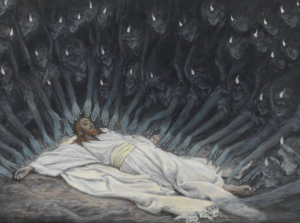
Jésus Assisté par les Anges [Jesus Ministered
to by Angels] (c. 1890-1900), by James Tissot.
Footnotes
1When we were studying the Gospel of John, we had several occasions to note that in the agricultural year of the Holy Land, Passover and Pentecost align with the barley and wheat harvests respectively—barley being the coarser, more fiber-heavy cereal, while wheat makes a higher-protein bread with a finer, more pleasing texture. A standard rabbinic interpretation of this first counting of the omer, between the Red Sea and Mount Sinai, is that it was a seven-week time of preparation before the children of Yisroel received the Law.
2More traditionally transliterated Naphtali, Zebulun, and Issachar; the Hebrew forms are נַפְתָּלִי [Naf’tåly] (“my striving”), זְבוּלוּן [Z’vúlún] (possibly meaning “honor”), and יִשָּׂשכָר [Yššåkhår]7 (“there is reward”). I know little of any particular reputation enjoyed by the tribe of Naphtali among ancient Jews; however, the book of Tobit making its hero a Naphtalite may suggest that they were more amenable than most of the northern kingdom to be reconciled to the House of David and the authentic Temple. Similarly, the “Song of Devorah” in Judges 5 praises both the Naphtalites and Zebulunites for risking their lives in battle against Sisera. The Issacharites had a long-lasting reputation as experts in the Torah. Intriguingly, Judges 5:14 alludes to the Zebulunites also as being scholars or poets: “out of Zebulun they that handle the pen of the writer.” The bulk of all three tribes were deported in the Assyrian conquest of the eighth century BCE.
3Well, and also throughout the rest of John.
4I say “roughly” because the two are different. A little. Maybe. There’s a lot we don’t know about the Bible’s geography!
5St. Augustine is presumably the larger of the two kneeling figures; the other, who appears to be not only smaller but depicted as younger, is likely his son, Adeodatus, who entered the faith with him. The woman standing behind Augustine is most likely his mother, St. Monica.
6By contrast, every time I think about the plot of von Goethe’s Faust: The Second Part, it makes me a little bit madder, because in the end, its message basically seems to be “Make a deal with the devil, it’ll be fine!” Its eponymous hero gets all the (public-spirited!) stuff he wants, but understands at the end that all this is worth less than love—romantic love, not divine love—and so he is snatched from the jaws of hell at the last moment. The snatching-from-the-jaws-of-hell part, I’m fine with; it’s extremely appropriate, both artistically and theologically, for a play to be about how the devil is bad at everything and a loser who gets foiled, look, here it is happening again, everyone point at him and laugh. But for that to happen for the rock-stupid reasons it happens in von Goethe is … I’m looking for a different term that means “unacceptable,” because that isn’t strong enough. “Ridiculame”? “Incromulable”? “Horkworthy”?
7You may notice that both שָׂטָן and מַשְׂטֵמָה, as well as the name יִשָּׂשכָר, use the form of the letter shin (pronounced “sheen”) with a dot over the left-hand side of the letter. The more usual form, if the dot is explicitly marked, has it on the right. The dot-on-the-left kind is often called the letter sin (“seen”), and in Modern Hebrew, the simple s-sound is used to pronounce it. In Classical Hebrew, this may have represented what linguists call the voiceless alveolar lateral fricative—a pretty rare sound in the world’s languages, though one perfectly familiar to speakers of Welsh (which spells it ll, as in names like Lloyd). You can get pretty close to making this sound if you hold your tongue as if you’re going to say an l, but then instead breath out like you would to make an sh.
8I say “mainstream” advisedly. To the best of my knowledge, the allegorical interpretation of “the satan” that I offer above is the most usual notion among not only Masorti (a.k.a. Conservative) and Reform Jews, but also Orthodox Jews, whether they be modern Orthodox or Haredim (the “ultra-orthodox”). I gather that some interpretations of Hasidic Judaism, a mystical variety of Haredi Orthodoxy, affirm something more like the conventional Christian system of demonology, which is of course—albeit in a degraded, often quite silly, form—the basis of the pop culture notion of demons you find in movies and books in the horror genre.
Previous Post
October 1, 2026
John the Baptist and the Winnowing Fork: Matthew 3:1-12
Next Post

October 16, 2026 The Sermon on the Mount, Part I: Matthew 4:12-5:12
Recent Comments
"That is indeed a lovely version of "Idumea."For a different effect, (with additional verses) can ..."
"This Mudblood Catholic post examines why Jesus avoids giving direct answers to questions like whether ..."
Why Won’t Jesus Give Us a ..."
"On the contrary, such a proclamation, among the Aztecs or Maya, would be disastrously misunderstood. ..."
The Gospel of John: The Bread ..."
"Many thanks for your scholarly study on the Cleansing of the Ten Lepers in the ..."
The Cleansing of the Ten Lepers
Browse Our Archives
Select a Category abuse antifascism art bad Catholic celibacy chastity Church crucifixion culture war eros forgiveness gay gender homophobia ikons language liturgy peace poems politics Pope Francis prayer pro-life race recommendations reform repentance review sacraments saints satire scandal schism scripture sex suffering theology Uncategorized violence
Select a Month November 2026 October 2026 September 2026 August 2026 July 2026 June 2026 May 2026 April 2026 March 2026 February 2026 January 2026 December 2025 November 2025 October 2025 September 2025 August 2025 July 2025 June 2025 May 2025 April 2025 March 2025 February 2025 January 2025 December 2024 November 2024 October 2024 September 2024 August 2024 July 2024 June 2024 May 2024 April 2024 March 2024 February 2024 January 2024 December 2023 November 2023 October 2023 September 2023 August 2023 July 2023 June 2023 May 2023 April 2023 March 2023 February 2023 January 2023 December 2022 November 2022 October 2022 September 2022 August 2022 July 2022 June 2022 May 2022 April 2022 March 2022 February 2022 January 2022 December 2021 November 2021 October 2021 September 2021 August 2021 July 2021 June 2021 May 2021 April 2021 March 2021 February 2021 January 2021 December 2020 November 2020 October 2020 September 2020 August 2020 July 2020 June 2020 May 2020 April 2020 March 2020 February 2020 January 2020 December 2019 November 2019 October 2019 September 2019 August 2019 July 2019
Follow Us!
TAKE THE
Religious Wisdom Quiz
Which short letter urges forgiveness for a runaway slave named Onesimus?
Select your answer to see how you score.
Titus Philemon 2 Timothy Jude
Related posts from Mudblood Catholic
What Kind of Man Do Wind and Sea...
The Sermon on the Mount, Part IV: Matthew...
The Sermon on the Mount, Part III: Matthew...
TRENDING AT PATHEOS Catholic

I published this column for Thanksgiving 2012 in the Deseret News....

For many years, Catholicism has been caught up in division over the...

'Statements of Faith' never get shorter
Nothing demonstrates a conservative commitment to faith and faithfulness like a "statement...

Michele's Reviews - Future Grace by John Piper
In God's Place, at God's Pace, by Future Grace Impatience is...

Bama Gramma's Blackout Christmas: the Power of Light...
Another Christmas Skit: I have an alter ego: Bama Gramma. She shows...

Thanksgiving as a Way of Life: A Christian...
Each year, Thanksgiving brings families and friends together to share meals, stories,...
view all Catholic blogs
What Are Your Thoughts?leave a comment
Ad-Free & Subscriber Log-In Subscription Support
- About Us
- 2026 Calendar
- Videos
- Podcasts
- Library of World Religions
- Faith In Media Tracker
- Advertise With Us
- Write for Us
- Privacy Policy
- Terms of Service
- Do Not Sell My Data
- Contact Us
- Radiant Digital
- Manage Newsletter Subscriptions
- Unsubscribe From Notifications
- Sitemap
Copyright 2008-2026, Patheos, part of the Radiant Digital network of media brands. All rights reserved.
Subscription Support Ad-Free & Subscriber Log-In
Follow Patheos