
BuddhistCatholicContemplativeEvangelicalGeneral ChristianHinduJewishLatter-day SaintMuslimNew VisionsProgressive Christian
Beliefs
- Buddhist
- Catholic
- Contemplative
- Evangelical
- General Christian
- Hindu
- Jewish
- Latter-day Saint
- More Voices
- Muslim
- New Visions
- Pagan
- Progressive Christian
Topics
- Religion News
- Food and Religion
- Sports and Religion
- Religious Art
- Religious Music and Entertainment
- Religious Events
- History and Religion
- Style and Religion
- Politics and Religion
- Women in Religion
- Recreation Outdoors and Religion
- Business Finance and Religion
- Careers Workplace and Religion
- Education and Religion
- Family Parenting and Religion
- Health Fitness and Religion
- Home and Religion
- Relationships and Religion
- Technology and Religion
- Travel and Religion
Columnists
- Buddhist Columnists
- Business Finance and Religion Columnists
- Careers Workplace and Religion Columnists
- Catholic Columnists
- Contemplative Columnists
- Education and Religion Columnists
- Evangelists Columnists
- Family Parenting and Religion Columnists
- General Christian Columnists
- Health Fitness and Religion Columnists
- Hindu Columnists
- History and Religion Columnists
- Home and Religion Columnists
- Jewish Columnists
- More Voices Columnists
- Latter Day Columnists
- Muslim Columnists
- New Visions Columnists
- Nonreligious Columnists
- Pagan Columnists
- Politics and Religion Columnists
- Progressive Columnists
- Recreation Outdoors and Religion Columnists
- Relationships and Religion Columnists
- Religion News Columnists
- Religious Art Columnists
- Religious Events Columnists
- Religious Music and Entertainment Columnists
- Sports and Religion Columnists
- Style and Religion Columnists
- Technology and Religion Columnists
- Travel and Religion Columnists
- Women in Religion Columnists
Resource Library
- 2026 Calendar
- Library of World Religions
- The 100 Most Holy Places on Earth
- Patheos Answers
- Podcasts
- Videos
- Faith Leaders Database
- Anglican Episcopalian
- Bahai
- Baptist
- Buddhism
- Christianity
- Confucianism
- Eastern Orthodoxy
- Hinduism
- Holiness and Pentecostal
- ISKCON
- Islam
- Judaism
- Lutheran
- Methodist
- The Church of Jesus Christ of Latter-day Saints
- New Age
- Paganism
- Presbytarian and Reformed
- Protestantism
- Religion Behind the Scenes
- Roman Catholic
- Scientology
- Shia Islam
- Sikhism
- Sufism
- Sunni Islam
- Taoism
- Zen
- See all religions
Research Tools
 Ad-Free & Subscriber Log-In Subscription Support
Ad-Free & Subscriber Log-In Subscription Support
Follow Patheos 

- Trending:
- Forgiveness
- |
- Marriage
- |
- Consciousness
- |
- Death Penalty
- |
- Election
- |
- Halloween

- Home
- Catholic
- History and Religion
- How Did the Risen Jesus Get Through Locked Doors?
How Did the Risen Jesus Get Through Locked Doors?
Last updated on: August 10, 2026 at 1:09 pm by Gabriel Blanchard
How Did the Risen Jesus Get Through Locked Doors? 2026-08-10T13:09:12-04:00 Gabriel Blanchard
Patheos Explore the world's faith through different perspectives on religion and spirituality! Patheos has the views of the prevalent religions and spiritualities of the world.
The Gospel of John: The Exaltation, Part III (John 20:19-31)
Appearances confirming the Resurrection continue. The scene now passes from the Holy Sepulcher to the Upper Room, and the focus changes from the Myrrh-bearers (emblematized in the person of St. Miriam of Migdal) to the Eleven.
John 20:19-31, RSV-CE
On the evening of that day, the first day of the week, the doors being shut where the disciples were, for fear of the Jews,a Jesus came and stood among themb and said to them, “Peace be with you.”c When he had said this, he showed them his hands and his side. Then the disciples were glad when they saw the Lord. Jesus said to them again, “Peace be with you. As the Father has sent me, even so I send you.” And when he had said this, he breathed on them, and said to them, “Receive the Holy Spirit. If you forgive the sins of any, they are forgiven; if you retain the sins of any, they are retained.”d
Now Thomas, one of the twelve, called the Twin, was not with them when Jesus came. So the other disciples told him, “We have seen the Lord.” But he said to them, “Unless I see in his hands the print of the nails, and placee my finger in the mark of the nails, and place my hand in his side, I will not believe.”f
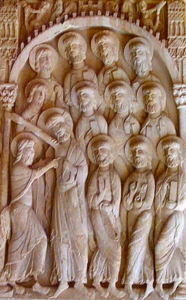
Relief of the incredulity of St. Thomas (c.
1150) from the Abbey of Santo Domingo
de Silos in Burgos, Spain.
Eight days later, his disciples were again in the house, and Thomas was with them. The doors were shut, but Jesus came and stood among them, and said, “Peace be with you.” Then he said to Thomas, “Put your finger here, and see my hands; and put out your hand, and place it in my side; do not be faithless, but believing.” Thomas answered him, “My Lord and my God!” Jesus said to him, “Have you believed because you have seen me? Blessed are those who have not seen and yet believe.”
Now Jesus did many other signs in the presence of the disciples, which are not written in this book; but these are written that you may believeg that Jesus is the Christ, the Son of God, and that believing you may have life in his name.
John 20:19-31, my translation
Then, when it was evening on that first day of the week, and the doors were closed where his students were, on account of their fear of the Jews,a Yeshua came and stands in the midst [of them],b and tells them: “Peace [be] upon you.”c And, having said this, he showed them his hands and his side. Then his students rejoiced, seeing the lord. Then Yeshua said further, “Peace [be] upon you; just as the Father has sent me, I too dispatch you.” And having said this, he breathed on them and says to them, “Take Holy Spirit: if you remit someone’s sins, they are remitted to them; if you seize [them], they have been seized.”d
Toma—one of the Twelve, called Twin—was not with them when Yeshua came. So the other students began telling him, “We have seen the lord.”
Yet he said to them: “Unless I see in those hands the print of the nails and shovee my finger into the print of the nails and shove my hand into his side, I will not have no faith.”f
And when it was eight days further, his students were inside, and Toma was with them. Yeshua came when the doors were closed, and stands in the midst [of them] and said, “Peace [be] upon you.” Next, he says to Toma, “Bear your finger in here, and look at my hands, and bear your hand and shove [it] into my side, and become not faithless, but faithful.”
Toma responds and said to him, “My lord and my God.”
Yeshua says to him: “Because you have seen me, you have faith? Happy are those who do not see and have faith.”
And indeed, Yeshua did many other signs before the face of his students, which are not written in this book; but these have been written in order that you might have faithg that Yeshua is the Anointed, the Son of God, and in order that, having faith, you should have life in his name.
Textual Notes
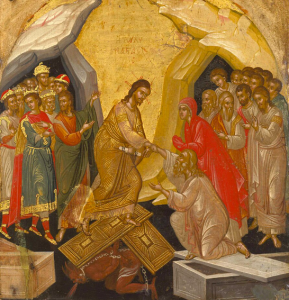
Ikon of the harrowing of hell (16th c.)
written by Markos Bathas.
a. the doors being shut where the disciples were, for fear of the Jews/the doors were closed where his students were, on account of their fear of the Jews | τῶν θυρῶν κεκλεισμένων ὅπου ἦσαν οἱ μαθηταὶ διὰ τὸν φόβον τῶν Ἰουδαίων [tōn thürōn kekleismenōn hopou ēsan hoi mathētai dia ton fobon tōn Ioudaiōn]: According to tradition, this location was the Upper Room in the house of John Mark’s mother, also known as the Cenacle (from the Latin cēnāculum “dining room”). It seems plausible—though as far as I know this isn’t attested particularly—that she had undertaken to host the group for their paschal stay in the holy city, which would likely embrace both Passover proper and the ensuing week-long observance of Matzot, “Unleavened Bread.” This was technically a distinct holiday; it was always intimately linked with Paskha, but Matzot also had a harvest-time character, as it took place when the barley harvest occurred (see IV.2.a.ה of the Outroduction for a brief summary of the Hebrew calendar).
These are the feasts of the Lord, even holy convocations, which ye shall proclaim in their seasons.
In the fourteenth day of the first month at even is the Lord’s passover.
And on the fifteenth day of the same month is the feast of unleavened bread unto the Lord: seven days ye must eat unleavened bread. In the first day ye shall have an holy convocation: ye shall do no servile work therein. But ye shall offer an offering made by fire unto the Lord seven days: in the seventh day is an holy convocation: … When ye be come into the land which I give unto you, and shall reap the harvest thereof, then ye shall bring a sheaf of the first-fruits of your harvest unto the priest: and he shall wave the sheaf before the Lord, to be accepted for you: on the morrow after the sabbath the priest shall wave it. … And ye shall eat neither bread, nor parched corn, nor green ears, until the selfsame day that ye have brought an offering unto your God: it shall be a statute for ever …
—Leviticus 23:4-11, 14
The “fear of the Jews” here probably relies on the “Judeans” meaning of the term (note e in this post discusses the matter further; the pertinent sense of the word Ἰουδαῖοι [Ioudaioi] in the list given there would be sense 5). Notably, the only one of the Twelve who was not a Galilean was Judas Iscariot.
This is certainly speculative, even perhaps far-fetched, but I wonder whether the three settings of John‘s Resurrection appearances—the tomb, the Upper Room, and the Sea of Galilee—are a subtle nod to the totality of creation: earth, sky, and sea. Besides quietly hinting at the idea (developed further in the Apocalypse) that he shall “make all things new,” it would serve as an echo of the prologue’s statement that apart from the activity of the Logos “nothing was made that was made.”
b. Jesus came and stood among them/Yeshua came and stands in the midst [of them] | ἦλθεν ὁ Ἰησοῦς καὶ ἔστη εἰς τὸ μέσον [ēlthen ho Iēsous kai estē eis to meson]: How did the Lord Jesus do this? I’ll tell you: I don’t know.
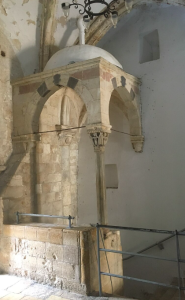
Stone canopy over the stairs in what is thought
to be the site of the Upper Room. Photo by
Onceinawhile, used via a CC BY-SA 4.0 license
(source).1
The implication of the doors being “closed” is not merely that they didn’t happen to be hanging open, but that they were secured in some way, probably by being locked—either in the sense that John Mark’s mother’s house was locked up, or that the Cenacle itself was locked, or both. (There must have been a little coming and going, given that St. Toma was absent at the Lord’s first visit but promptly reappears. My guess is that, in the interest of secrecy, most if not all such movement took place at night.) Locks were of course less advanced in the first century than they have become in the twenty-first, but on the whole they still did the trick; so if this guess about the Eleven being for the most part locked in is correct, it prompts the question of exactly how he got past this.
Natural means are not off the table. If John Mark’s mother recognized Christ, it would be fairly natural for her to let him in!—though this seems unlikely, since it’d probably have been exceedingly difficult to keep the entire household quiet in that case. If he, um, broke in, that’s weird. Not impossible. But it does feel out of character.
I’m therefore the more inclined to look for a partially-miraculous explanation, if partially-miraculous is even the right word. The reason I hesitate about the wording is, the resurrected Body gives the impression, here and there, of having a slightly different relationship to the world than, on the whole, we are familiar with—a phenomenon which happens to align with a few tidbits we find in other places in the New Testament. Luke 24:16 informs us that, in a different Resurrection appearance, two disciples’ “eyes were restrained” from recognizing whom they were talking to (which the author of the apocryphal “Longer Ending” of the Gospel of Mark evidently interpreted as his appearing “in another form” in 16:12). This may chime with the Lord’s teaching that “in the resurrection they neither marry, nor are given in marriage, but are as the angels” (Matthew 22:30), and St. Paul’s instruction to the Christians of Corinth:
But some man will say, “How are the dead raised up? and with what body do they come?” Thou fool, that which thou sowest is not quickened, except it die: and that which thou sowest, thou sowest not that body that shall be, but bare grain, it may chance of wheat, or of some other grain: but God giveth it a body as it hath pleased him, and to every seed his own body. All flesh is not the same flesh: but there is one kind of flesh of men, another flesh of beasts, another of fishes, and another of birds. There are also celestial bodies, and bodies terrestrial: but the glory of the celestial is one, and the glory of the terrestrial is another. There is one glory of the sun, and another glory of the moon, and another glory of the stars: for one star differeth from another star in glory.
So also is the resurrection of the dead. It is sown in corruption; it is raised in incorruption: it is sown in dishonor; it is raised in glory: it is sown in weakness; it is raised in power: it is sown a natural body; it is raised a spiritual body. There is a natural body, and there is a spiritual body. And so it is written, “The first man Adam was made a living soul”; the last Adam was made a quickening spirit. Howbeit that was not first which is spiritual, but that which is natural; and afterward that which is spiritual. The first man is of the earth, earthy; the second man is the Lord from heaven. As is the earthy, such are they also that are earthy: and as is the heavenly, such are they also that are heavenly. And as we have borne the image of the earthy, we shall also bear the image of the heavenly.
—I Corinthians 15:35-49 (emphases mine)
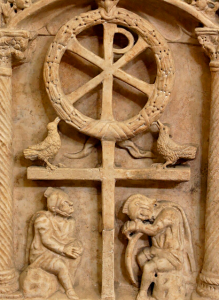
A sculpted Chi-Rho (a monogram for Christ)
enclosed in a wreath, symbolizing victory
(c. 350).
This seems to justify the idea that in the resurrection, the human body will be appreciably different; what it doesn’t make clear is how (which, for that matter, may not be something we can entirely grasp). If this new body is going to live forever, then clearly its relationship to matter, energy, space, and time has to be radically different than anything we have ever experienced! Maybe, for such a body, movement through what to us is extra-dimensional space in order to navigate a path around a material obstacle is perfectly easy—the same way it’s perfectly easy for us to step over an obstacle that would hopelessly thwart a two-dimensional being’s freedom of movement. Which is why I hesitate over whether “miraculous” strictly applies: to do what you have a natural capacity to do isn’t normally what we mean by words like “miracle” or “supernatural.” But, needless to say, this is about as speculative as theology gets, so again: I don’t know.
c. Peace be with you/Peace [be] upon you | Εἰρήνη ὑμῖν [eirēnē hümin]: Presumably, what he literally said was שָׁלוֹם עֲלֵיכֶם [shâloum ȝàlêykhem], a customary greeting in Hebrew—or he may have used its Aramaic equivalent, ܫܠܵܡܵܐ ܥܲܠܟ݂ܘܿܢ [shlama’ ȝalkun].
d. he breathed on them, and said to them, “Receive the Holy Spirit. If you forgive the sins of any, they are forgiven; if you retain the sins of any, they are retained”/he breathed on them and says to them, “Take Holy Spirit: if you remit someone’s sins, they are remitted to them; if you seize [them], they have been seized” | ἐνεφύσησεν καὶ λέγει αὐτοῖς· Λάβετε πνεῦμα ἅγιον· ἄν τινων ἀφῆτε τὰς ἁμαρτίας ἀφέωνται αὐτοῖς· ἄν τινων κρατῆτε κεκράτηνται [enefüsēsen kai legei autois: «labete pneuma hagion: an tinōn afēte tas hamartias afeōntai autois: an tinōn kratēte kekratēntai]: The imagery of breath here is subtly potent. In four-elements terms, most of us are apt, I think, to see fire or water as “the strong ones.” This is not just an effect of Saturday-morning cartoons; igneous or hydraulic effects, when applied to other material objects, tend to be both overt and rapid. If you take, say, this volume of Miss Katie Price’s Being Jordan and submerge it in either fire or water for as little as ten minutes, the volume may easily have become unreadable, if it’s still recognizably a “volume” at all. It doesn’t take much imagination to realize the power that inheres in earth, too, especially since stone is typically regarded as a variety of earth. It may take a little more deliberate reflection to recognize how powerful the effects of air are—sustaining fire, creating rainclouds, and eroding stone itself with time.
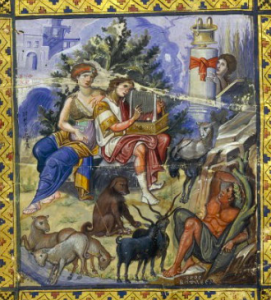
Illumination of David composing psalms
from the Paris Psalter (mid-10th c.),
a Byzantine manuscript.
Turning to the Tanakh, we see frequent use of the image of wind or breath. We may begin with its latest section, the Kethuvim or Writings. It appears in the Psalms:
In my distress I called upon the Lord,
…and cried unto my God:
he heard my voice out of his temple,
…and my cry came before him, even into his ears. …
There went up a smoke out of his nostrils,
…and fire out of his mouth devoured: coals were kindled by it.
He bowed the heavens also, and came down:
…and darkness was under his feet.
And he rode upon a cherub, and did fly:
…yea, he did fly upon the wings of the wind.
He made darkness his secret place;
…his pavilion round about him were dark waters
…and thick clouds of the skies. …
The Lord also thundered in the heavens,
…and the Highest gave his voice;
…hail stones and coals of fire.
Yea, he sent out his arrows, and scattered them;
…and he shot out lightnings, and discomfited them.
Then the channels of waters were seen,
…and the foundations of the world were discovered
at thy rebuke, O Lord,
…at the blast of the breath of thy nostrils.
—Psalm 18:6, 8-11, 13-15
Similarly, in the book of Job, it is twice specified (38:1 and 40:6) that God answers Job “out of the whirlwind.” Looking further back from the Kethuvim to the Nevi’im or Prophets, we find both these motifs to be echoes of older material. II Samuel 22 records the words of Psalm 18, while the book of Kings includes a justly-famous story from the Prophets:
And it came to pass, when the LORD would take up Elijah into heaven by a whirlwind, that Elijah went with Elisha … And Elijah said unto him, “Tarry, I pray thee, here; for the LORD hath sent me to Jordan.” And he said, “As the LORD liveth, and as thy soul liveth, I will not leave thee.” And they two went on. …
And Elijah took his mantle … and smote the waters, and they were divided hither and thither, so that they two went over on dry ground. And … Elijah said unto Elisha, “Ask what I shall do for thee, before I be taken away from thee.” And Elisha said, “I pray thee, let a double portion of thy spirit be upon me.” And he said, “Thou hast asked a hard thing: nevertheless, if thou see me when I am taken from thee, it shall be so unto thee; but if not, it shall not be so.” And … behold, there appeared a chariot of fire, and horses of fire, and parted them both asunder; and Elijah went up by a whirlwind into heaven. And Elisha saw it, and he cried, “My father, my father, the chariot of Israel, and the horsemen thereof.” And he saw him no more …
He took up also the mantle of Elijah that fell from him, and went back, and stood by the bank of Jordan; and he … smote the waters, and said, “Where is the LORD God of Elijah?” and when he also had smitten the waters, they parted hither and thither: and Elisha went over. And when the sons of the prophets … saw him, they said, “The spirit of Elijah doth rest on Elisha.” And they came to meet him, and bowed themselves to the ground before him.
—II Kings 2:1, 6, 8-12a, 13-15
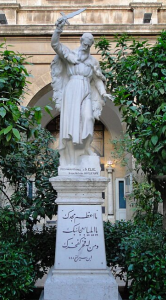
Statue of Elijah the Prophet outside the
Maronite Cathedral of St. Elijah in Aleppo,
Syria. Photo by Bernard Gagnon, used
via a CC BY-SA 3.0 license (source).
This symbol is older still, appearing in the Song of Moshe and Miriam in Exodus 15: “with the blast of the breath of thy nostrils, the waters were gathered together, the floods stood upright as an heap … Thou didst blow with thy wind, the sea covered them.” And—most relevant of all, given the elaborate evocation of the beginning, back in the prologue—we meet with this same motif in the very first verses of the Torah. Before the creation of light, when “the earth was without form and void; and darkness was upon the face of the deep,” already “the Spirit of God moved upon the face of the waters.” The Hebrew word rendered Spirit by the King James is רוּחַ [rúach], which can mean “spirit”; however, like the Greek ψυχή [psüchē] and πνεῦμα [pneuma], and for that matter the Latin spīritus, רוּחַ first meant “air, breath, wind.” Words themselves, which in this passage God is about to use to effect the creation of the world, are after all vibrations in the air. And it is this breath and this speech by which the Logos passes on to the Eleven … a majestic, quite frightening, and very oddly chosen, power.
If you remit someone’s sins, they are remitted to them; if you seize [them], they have been seized. This is the power of forgiveness, pardon, or absolution: more precisely, it is the power of forgiving or not forgiving, pardoning or not pardoning, absolving or leaving unabsolved. I describe it as “very oddly chosen” because, as touched on in the Outroduction (III.3), the Fourth Gospel is the only one which doesn’t take note of the controversy provoked by the Lord pardoning sins, nor depict him doing so (except arguably in the last chapter, after this). On rare occasions, we see the Apostles exercise this power elsewhere in the New Testament: we may suppose that the remission of post-baptismal sins was the more frequent action on their part, in keeping with their Master’s example, but the famous stories and references are mainly to the seizure of sins, e.g. in chapters 5 and 8 of Acts, in III John, and in I Timothy 1.
This topic is very prone to misunderstandings; I can’t be exhaustive here, but there are a handful of points I want to clarify.
- First, the Lord Logos is not here giving the priesthood as such the power to read men’s hearts or anything like that. The reading of hearts is a miracle manifested in God’s Church from time to time, but it is not attached to the priesthood; a tiny number of priests (and some people who were not priests) have received it, most have not..
- Accordingly, it’s possible for priests to make mistakes in the confessional. They may wrongly grant absolution to someone who isn’t repentant, or even wrongly deny absolution to someone who is. This is one of multiple reasons that priests do, and should, and are trained to, err overwhelmingly in the direction of granting absolution when there is any doubt whatever about the penitent. (The only circumstance in which they are supposed to refuse to absolve is when the confession they’ve heard seems, beyond reasonable doubt, to be someone looking to be enabled in their sin. In that case, not only would the absolution be void—there can be no forgiveness without repentance—their obtaining a false pardon would only add sacrilege to their preëxisting issues.)
- The priesthood holds the power of the keys—but not as if the keys have been taken away from God, and now only priests can get at them! The reason we speak of the priest acting in persōnā Christī when absolving is that, by saying the words of absolution, he conveys to the penitent the heavenly act of forgiveness. That still comes from God alone. Indeed, God can forgive people who have never heard of any sacrament. What sacramental confession gives us is the present experience of forgiveness and the assurance of it.2 In this, it continues Christ’s own ministry of forgiveness (which we’ll be examining soon in the Synoptic Gospels). Yeshua could have forgiven sins even if he said nothing about it—in the privacy of heaven, if you will. Presumably that would still have benefited those he forgave in some way; but if they didn’t know about it until after they died, that’s not nearly as satisfying, is it?—because one of the benefits of pardon is encouragement and consolation. Yeshua’s declarations of absolution, accordingly, are for the conscious, present benefit of the absolved, and this is why the authority to forgive or retain sins is here bestowed on the Apostles so as to continue in the Church.
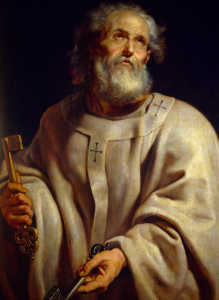
The Apostle Saint Peter (c. 1611), by Peter
Paul Rubens. The golden and silver keys
are associated in the West with the powers
of absolution and imposing penance.3
e. place/shove | βάλω [balō]: This is a form of the verb βάλλω [ballō], meaning “to throw, cast” (though it sometimes appears in Greek in contexts where an English-speaker would probably use a softer verb, like “put”). It is a verb found more frequently in the Synoptics—Matthew uses it twice as much as John—partly because they, unlike the Fourth Gospel, describe the Lord Yeshua “casting out” demons.
f. I will not believe/I will not have no faith | οὐ μὴ πιστεύσω [ou mē pisteusō]: I can offer no better comment on St. Toma than that given by C. S. Lewis in his essay “On Obstinacy in Belief”; and I notice, as an interesting coïncidence, that he too touches on the image of a courtroom in the course of his discussion.
If, for the first time, a doubt of his wife’s fidelity crosses the scientist’s mind, does he consider it his duty at once to entertain this doubt with complete impartiality, at once to evolve a series of experiments by which it can be tested, and to await the result with pure neutrality of mind? No doubt it may come to that in the end. … But the Christians seem to praise an adherence to the original belief which holds out against any evidence whatever. I must now try to show why such praise is in fact a logical conclusion from the original belief itself.
… In Christianity such faith is demanded of us; but there are situations in which we demand it of others. There are times when we can do all that a fellow creature needs if only he will trust us. In getting a dog out of a trap, in extracting a thorn from a child’s finger, in teaching a boy to swim or rescuing one who can’t, in getting a frightened beginner over a nasty place on a mountain, the one fatal obstacle may be their distrust. We are asking them to trust us in the teeth of their senses, their imagination, and their intelligence. We ask them to believe that what is painful will relieve their pain and that what looks dangerous is their only safety. We ask them to accept apparent impossibilities: that moving the paw further back into the trap is the way to get it out; that hurting the finger very much more will stop the finger hurting; … To support all these incredibilia we can rely only on the other party’s confidence in us—a confidence certainly not based on demonstration, admittedly shot through with emotion, and perhaps, if we are strangers, resting on nothing but such assurance as the look of our face and the tone of our voice can supply … Sometimes, because of their unbelief, we can do no mighty works. But if we succeed, we do so because they have maintained their faith in us against apparently contrary evidence. No one blames us for demanding such faith. No one blames them for giving it.
… To believe that God—at least this God—exists is to believe that you as a person now stand in the presence of God as a Person. What would, a moment before, have been variations in opinion, now become variations in your personal attitude to a Person. You are no longer faced with an argument which demands your assent, but with a Person who demands your confidence. … The saying “Blessed are those that have not seen and have believed” … was not addressed to a philosopher enquiring whether God exists. It was addressed to a man who already believed that, who already had long acquaintance with a particular Person, and evidence that that Person could do very odd things, and who then refused to believe one odd thing more, often predicted by that Person and vouched for by all his closest friends. It is a rebuke not to skepticism … but to the psychological quality of being “suspicious.” It says in effect, “You should have known me better.” There are cases … where we should all, in our different way, bless those who have not seen and have believed. Our relation to those who trusted us only after we were proved innocent in court, cannot be the same as our relation to those who trusted us all through.4
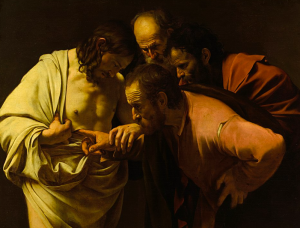
The Incredulity of St. Thomas (c. 1602), by
Michelangelo Merisi da Caravaggio.
g. but these are written that you may believe/but these have been written in order that you might have faith | ταῦτα δὲ γέγραπται ἵνα πιστεύητε [tauta de gegraptai hina pisteuēte]: Given the themes of the book, this feels like a natural place and tone for John to conclude on, and it’s possible that this initially was the end of the book—note the close similarity between 20:30-31 and 21:24-25. However, if that was the case at some point (and we have no manuscript evidence that it ever was), it seems that the author or authors returned to the work a little later to give us the bonus epilogue, which not only ties up a loose end, but gives us a little bit of space to breathe, post-Easter. This is really the only canonical Gospel to do so. Mark ends with no Resurrection appearances (we only meet the angels). Matthew and Luke each devote a chapter to this period; granted, Luke 24 is about twice as long as Matthew 28, but still, they each only feature two-ish Resurrection appearances. John spends two full chapters on the forty days between Easter Sunday and the Ascension, and details four distinct appearances, one to Miriam and three to varying collections of apostles.
Footnotes
1From what I understand, the interior of the building dates mainly to the period when Jerusalem was in the hands of the Crusaders (1099-1187)—hence the Medieval-looking architecture.
2Or rather, this is among the functions and benefits of sacramental absolution. There are others as well.
3This association, while perfectly pious, is not grounded on anything in Scripture; indeed, it probably arose in response to the artistic motif of making one key golden and one silver, a motif that itself probably came about merely to express the preciousness of the “power of the keys.” (In Biblical terms, it would be more logical to associate one of the keys with binding and the other with loosing.) Dante puts the double image to use in the Purgatorio, describing his entry to that realm (which, in the poem, symbolizes not only the purification of the dead but Christian repentance and amendment in general:
One golden and one silver key he had;
…With the white first, the yellow afterward,
…He wrought so with the gate that I was glad.
“Should one or other of the keys stick hard,
…Turning askew so that the tumblers block,”
…He said, “this wicket cannot be unbarred.
One’s costlier; the other needs good stock
…Of wit and skill to get the bolt to stir,
…For that one grips the wards and frees the lock.
From Peter hold I these, who bade me err
…In opening rather than in keeping fast …”
—Purgatorio ix.118-128, Sayers translation
In her commentary on this canto, Sayers explains:
These are the two parts of absolution: The Golden Key is the Divine authority given to the Church to remit sin; it is “the costlier” because it was bought at the price of God’s Passion and Death. The Silver Key is the unloosening of the hard entanglement of sin in the human heart: and this needs great skill on the part of the Church and her priesthood when administering the sacrament of Penance. Both keys must function smoothly for a valid absolution: the use of the golden key without the silver [i.e., the pronouncement of the sacramental formula without genuine repentance on the part of the sinner] lands you exactly where it landed Guido da Montefeltro (Inf. xxvii.67 sqq.): the silver without the golden (i.e. remorse for sin without seeking reconciliation) leads only to despair and the Gorgon at the Gates of Dis (Inf. ix).
For those who don’t happen to have every reference in the Inferno memorized: Guido da Montefeltro appears in the Eighth Circle, where “fraud simple” in its various kinds is punished (“fraud simple” is contrasted with “fraud complex,” a.k.a. treachery, which betrays not merely the general good faith of mankind but the confidence of people who have special reason to trust the traitor). Guido had led a sinful life as a soldier, until he entered the cloister in old age to prepare for his death. After living as a monk for a while, he was approached by Pope Boniface VIII for advice on how to conquer a rebellious city in the territory of the Papal States; he hesitated, knowing the advice he gave would be sinful, but the corrupt pontiff “gave him absolution in advance,” so in return, Guido advised him as he asked. Accordingly, Dante encounters Guido’s shade in hell: any priest can say the words required to absolve; so can a parrot, for all the good they’ll do, because there can be no absolution without repentance, and—as the demon who comes to collect Guido’s soul reminds him in that moment—while you might perhaps feel bad about it, you can’t repent of an act and do it at the same time, so Boniface’s absolution was meaningless noise in the first place.)
4I don’t have any of the collections in which this essay appears (I think I first read it in “The World’s Last Night” and Other Essays?); I obtained the text from The Sewanee Review here—as, apparently, did JSTOR! (I also made a couple of minor corrections, mostly to words that had chance mistakes in them, e.g. per haps instead of perhaps; I also moved the em-dash following the phrase “at least this God” in the third paragraph, which appears after the word “exists” in the Sewanne copy. As this leaves the first clause of the sentence without a verb in its main body, I take this to be a transcription error.) The lecture was originally given in 1955 to the Socratic Club, an academic society at Oxford.
History and Religion
Education and Religion


About Gabriel Blanchard
Gabriel Blanchard is a Catholic convert, gay author, radical leftist, unprofessional linguist, and Japanese food snob. He grew up as an evangelical Navy brat and got a degree in Classics from the University of Maryland. He currently lives in Baltimore and is a member of a local parish of the Ordinariate of the Chair of Peter. The everything notwithstanding, he is in fact not a vegan. You can read more about the author here.
Previous Post
July 30, 2026
The Gospel of John: The Exaltation, Part II
Next Post
August 13, 2026 Breakfast With the Risen Jesus: John 21
Recent Comments
"On the contrary, such a proclamation, among the Aztecs or Maya, would be disastrously misunderstood. ..."
The Gospel of John: The Bread ..."
"Many thanks for your scholarly study on the Cleansing of the Ten Lepers in the ..."
The Cleansing of the Ten Lepers
"Four Last Things: not the video game, but Death, Judgment, Heaven and Hell.Momento mori. Remember, ..."
"I am going by the time that these sayings began to be converted into written ..."
Are Our Bibles in the Wrong ..."
Browse Our Archives
Select a Category abuse antifascism art bad Catholic celibacy chastity Church crucifixion culture war eros forgiveness gay gender homophobia ikons language liturgy peace poems politics Pope Francis prayer pro-life race recommendations reform repentance review sacraments saints satire scandal schism scripture sex suffering theology Uncategorized violence
Select a Month October 2026 September 2026 August 2026 July 2026 June 2026 May 2026 April 2026 March 2026 February 2026 January 2026 December 2025 November 2025 October 2025 September 2025 August 2025 July 2025 June 2025 May 2025 April 2025 March 2025 February 2025 January 2025 December 2024 November 2024 October 2024 September 2024 August 2024 July 2024 June 2024 May 2024 April 2024 March 2024 February 2024 January 2024 December 2023 November 2023 October 2023 September 2023 August 2023 July 2023 June 2023 May 2023 April 2023 March 2023 February 2023 January 2023 December 2022 November 2022 October 2022 September 2022 August 2022 July 2022 June 2022 May 2022 April 2022 March 2022 February 2022 January 2022 December 2021 November 2021 October 2021 September 2021 August 2021 July 2021 June 2021 May 2021 April 2021 March 2021 February 2021 January 2021 December 2020 November 2020 October 2020 September 2020 August 2020 July 2020 June 2020 May 2020 April 2020 March 2020 February 2020 January 2020 December 2019 November 2019 October 2019 September 2019 August 2019 July 2019
Follow Us!
TAKE THE
Religious Wisdom Quiz
"God called to him out of the bush, 'Moses, Moses!' And Moses replied, '_______.'"
Select your answer to see how you score.
Who speaks to me? I hear and obey What is your name? Here I am
Related posts from Mudblood Catholic

The Sermon on the Mount, Part I: Matthew...

The Gospel of Matthew: Christ and Antichrist

John the Baptist and the Winnowing Fork: Matthew...

The Gospel of Matthew: The Coventry Carol
TRENDING AT PATHEOS Catholic

The Problem with False Prophets
Miller’s Station UMC| 10/18/26| Anchor Verse: Jeremiah 23: 1, 9-23 I...

Emotion in Early Christianity by Andrew Crislip
Andrew Crislip’s Emotion in Early Christianity examines an often overlooked dimension of...

16 Spiritual Touchstones for a More Grounded Life
After decades of spiritual study, here are 16 principles I try...

Catholic Evangelization: Sharing Your Faith Every Day
Welcome back to the Graceful Awakening mini-series called, “From Faith to Mission.” ...

The Pillar of the Boatmen: the Ancient Monument...
The Pillar of the Boatmen is a Romano-Gaulish sculpture that dates from...

In one sense walking into Westminster Abbey is like walking down the...
view all Catholic blogs
What Are Your Thoughts?leave a comment
Ad-Free & Subscriber Log-In Subscription Support
- About Us
- 2026 Calendar
- Videos
- Podcasts
- Library of World Religions
- Faith In Media Tracker
- Advertise With Us
- Write for Us
- Privacy Policy
- Terms of Service
- Do Not Sell My Data
- Contact Us
- Radiant Digital
- Manage Newsletter Subscriptions
- Unsubscribe From Notifications
- Sitemap
Copyright 2008-2026, Patheos. All rights reserved.
Subscription Support Ad-Free & Subscriber Log-In
Follow Patheos