
BuddhistCatholicContemplativeEvangelicalGeneral ChristianHinduJewishLatter-day SaintMuslimNew VisionsProgressive Christian
Beliefs
- Buddhist
- Catholic
- Contemplative
- Evangelical
- General Christian
- Hindu
- Jewish
- Latter-day Saint
- More Voices
- Muslim
- New Visions
- Pagan
- Progressive Christian
Topics
- Religion News
- Food and Religion
- Sports and Religion
- Religious Art
- Religious Music and Entertainment
- Religious Events
- History and Religion
- Style and Religion
- Politics and Religion
- Women in Religion
- Recreation Outdoors and Religion
- Business Finance and Religion
- Careers Workplace and Religion
- Education and Religion
- Family Parenting and Religion
- Health Fitness and Religion
- Home and Religion
- Relationships and Religion
- Technology and Religion
- Travel and Religion
Columnists
- Buddhist Columnists
- Business Finance and Religion Columnists
- Careers Workplace and Religion Columnists
- Catholic Columnists
- Contemplative Columnists
- Education and Religion Columnists
- Evangelists Columnists
- Family Parenting and Religion Columnists
- General Christian Columnists
- Health Fitness and Religion Columnists
- Hindu Columnists
- History and Religion Columnists
- Home and Religion Columnists
- Jewish Columnists
- More Voices Columnists
- Latter Day Columnists
- Muslim Columnists
- New Visions Columnists
- Nonreligious Columnists
- Pagan Columnists
- Politics and Religion Columnists
- Progressive Columnists
- Recreation Outdoors and Religion Columnists
- Relationships and Religion Columnists
- Religion News Columnists
- Religious Art Columnists
- Religious Events Columnists
- Religious Music and Entertainment Columnists
- Sports and Religion Columnists
- Style and Religion Columnists
- Technology and Religion Columnists
- Travel and Religion Columnists
- Women in Religion Columnists
Resource Library
- 2026 Calendar
- Library of World Religions
- The 100 Most Holy Places on Earth
- Patheos Answers
- Podcasts
- Videos
- Faith Leaders Database
- Anglican Episcopalian
- Bahai
- Baptist
- Buddhism
- Christianity
- Confucianism
- Eastern Orthodoxy
- Hinduism
- Holiness and Pentecostal
- ISKCON
- Islam
- Judaism
- Lutheran
- Methodist
- The Church of Jesus Christ of Latter-day Saints
- New Age
- Paganism
- Presbytarian and Reformed
- Protestantism
- Religion Behind the Scenes
- Roman Catholic
- Scientology
- Shia Islam
- Sikhism
- Sufism
- Sunni Islam
- Taoism
- Zen
- See all religions
Research Tools
 Ad-Free & Subscriber Log-In Subscription Support
Follow Patheos 

- Trending:
- Advent
- |
- Forgiveness
- |
- Thanksgiving
- |
- Election
- |
- Seasonal Holidays
- |
- Marriage

- Home
- Catholic
- History and Religion
- Breakfast With the Risen Jesus: John 21
Breakfast With the Risen Jesus: John 21
Last updated on: August 16, 2026 at 12:19 pm by Gabriel Blanchard
Breakfast With the Risen Jesus: John 21 2026-08-16T12:19:35-04:00 Gabriel Blanchard
Patheos Explore the world's faith through different perspectives on religion and spirituality! Patheos has the views of the prevalent religions and spiritualities of the world.
The Gospel of John: The Epilogue (John 21:1-25)
Here, we find something unique in the Gospels: a scene following the Resurrection, after it had become “common knowledge” among Christ’s followers that he had returned from the dead, which simply shows him spending time with them—neither breaking the news of the Resurrection to anybody, nor giving them a farewell blessing and ascending into heaven. (The only other passage that may be doing the same thing is Matthew 28:16-20, but this is widely associated with the Ascension.) This text features the last of the suspiciously-numbered six meals of the Gospel, as well as a ninth miracle, counting Christ’s own resurrection as the eighth. In vv. 18-19, this chapter of John also contains what is, as far as I know, the sole, oblique Biblical allusion to St. Peter’s martyrdom on an inverted Cross, and perhaps also to the Quō vadis Domine legend.
As this is a long passage with a lot of notes, I’ve returned to my trick of putting the less-important textual notes in smaller print to save space. Moreover, I took some of the material which was making note j colossally unwieldy and moved it into a postscript. In addition, this epilogue to the Fourth Gospel features a lot of “call-backs,” sometimes to passages which are not in fact in the Fourth Gospel, but which I suspect the author was nevertheless familiar with—through firsthand experience of the original events, through familiarity with other Gospels than his own, or possibly both. (I’ve grown increasingly to think that the evangelist had probably read Luke at least.) In especial, for multiple reasons, this chapter strongly evokes the account of St. Peter’s formal calling to follow Jesus set down in Luke 5. It so happens that I wrote a post about that passage last February (as in, not six months but a year and a half ago); it might be useful to glance over that selection from Luke, and over textual notes e, g, and k in that post.
John 21:1-25, RSV-CE

An Oreochromis niloticus (Nile tilapia),
similar to some species catchable in the Sea
of Galilee. Photo by Bjørn Christian Tørissen,
used via a CC BY-SA 3.0 license (source).
After this Jesus revealed himself again to the disciples by the Sea of Tiberias;a and he revealed himself in this way. Simon Peter, Thomas called the Twin, Nathanael of Cana in Galilee, the sons of Zebedee, and two others of his disciplesb were together. Simon Peter said to them, “I am going fishing.” cThey said to him, “We will go with you.” They went out and got into the boat; but that night they caught nothing.
Just as day was breaking, Jesus stood on the beach; yet the disciples did not know that it was Jesus. Jesus said to them, “Children, have you any fish?” They answered him, “No.” He said to them, “Cast the net on the right side of the boat, and you will find some.” So they cast it, and now they were not able to haul it in, for the quantity of fish. That disciple whom Jesus loved said to Peter, “It is the Lord!” When Simon Peter heard that it was the Lord, he put on his clothes, for he was stripped for work, and sprang into the sea.d But the other disciples came in the boat, dragging the net full of fish, for they were not far from the land, but about a hundred yards off.e
When they got out on land, they saw a charcoal fire there, with fishf lying on it, and bread. Jesus said to them, “Bring some of the fish that you have just caught.” So Simon Peter went aboard and hauled the net ashore, full of large fish, a hundred and fifty-threeg of them; and although there were so many, the net was not torn. Jesus said to them, “Come and have breakfast.” Now none of the disciples dared ask him, “Who are you?” They knew it was the Lord. Jesus came and took the bread and gave it to them, and so with the fish. This was now the third timeh that Jesus was revealed to the disciples after he was raised from the dead.
When they had finished breakfast, Jesus said to Simon Peter, “Simon, son of John,i do you lovej me more than these?”k He said to him, “Yes, Lord; you know that I lovej you.” He said to him, “Feed my lambs.” A second time he said to him, “Simon, son of John, do you lovej me?” He said to him, “Yes, Lord; you know that I lovej you.” He said to him, “Tend my sheep.” He said to him the third time, “Simon, son of John, do you lovej me?” Peter was grieved because he said to him the third time, “Do you lovej me?” And he said to him, “Lord, you know everything; you know that I lovej you.” Jesus said to him, “Feed my sheep. Truly, truly, I say to you, when you were young, you girded yourself and walked where you would; but when you are old, you will stretch out your hands, and another will gird you and carry you where you do not wish to go.” (This he said to show by what death he was to glorify God.) And after this he said to him, “Follow me.”
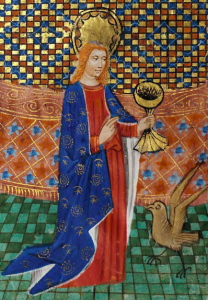
Depiction of St. John the Apostle from the
Llyfr Oriau De Grey [De Grey Book of
Hours] (c. 1390), now preserved in the
National Library of Wales.
Peter turnedl and saw following them the disciple whom Jesus loved, who had lain close to his breast at the supper and had said, “Lord, who is it that is going to betray you?” When Peter saw him, he said to Jesus, “Lord, what about this man?”m Jesus said to him, “If it is my will that he remain until I come, what is that to you? Follow me!” The saying spread abroad among the brethren that this disciple was not to die; yet Jesus did not say to him that he was not to die,n but, “If it is my will that he remain until I come, what is that to you?”
This is the disciple who is bearing witness to these things, and who has written these things; and we know that his testimony is true.o
But there are also many other things which Jesus did; were every one of them to be written, I suppose that the world itself could not contain the books that would be written.
John 21:1-25, my translation
After these things, Yeshua manifested himself again to his students at the Sea of Tiberias;a he manifested [himself] like this. Symeon Rocky and Toma called “Twin” and Nethanel from Qanah in the Galilee and the [sons] of Zevadyah and two of his other studentsb were together. Symeon Rocky tells them: “I’m going out fishing.”
cThey tell him, “We will also come with you.” They went out and went up onto the boat, and that night they caught nothing.
It was already getting to be early morning [and] Yeshua stood on the beach; although his students did not perceive that it is Yeshua. Then Yeshua says to them, “Little children, haven’t you anything to eat?”
They responded to him, “No.”
He tells them: “Throw the net in on the right-hand part of the boat, and you will find [something].”
So they threw [it in]—and they were not strong enough to draw it back, from the throng of the fish. Then that student whom Yeshua loved says to Rocky, “It is the Lord.”
Then Symeon Rocky, hearing that it is the Lord, belted up his over-tunic (for he was naked) and threw himself into the sea;d the other students came in the ship, for they were not far from the land but about two hundred cubits,e dragging the net of fish.
Then, as they came up onto the land, they saw a charcoal-bed lying there, and a sardinef lying on it, and bread. Yeshua tells them, “Now bring [some] from the sardines which you’ve caught.” So Symeon Rocky drew the net onto the land, packed with big fish, a hundred fifty-three;g there were so many, but the net was not torn. Yeshua tells them, “Come, dine.” None of his students dared to inquire of him, “Who are you?”, seeing that it is the Lord. Yeshua comes and takes the bread and gave it to them, and the sardines likewise.
This third [time] alreadyh Yeshua was manifested to his students, having been raised from the dead.
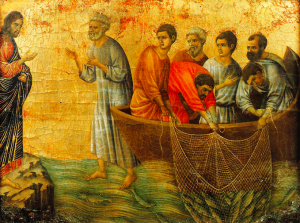
Appearance on Lake Tiberias (c. 1310), by
Duccio di Buoninsegna. The artist seems to
have confused this episode with that of St.
Peter walking on water (Matt. 14:25-31).
Then, when they had dined, Yeshua says to Symeon Rocky: “Symeon [son] of Yonah,i do you lovej me more than these?”k
He tells him, “Yes, sir, you know that I lovej you.”
He tells him, “Pasture my lambs.” He says to him again a second time, “Symeon [son] of Yonah, do you lovej me?”
He tells him: “Yes, sir, you know that I lovej you.”
He says to him, “Shepherd my sheep.” He says to him the third time, “Symeon [son] of Yonah, do you lovej me?”
Rocky was grieved, because he asked him the third time, “Do you lovej me?”, and told him: “Sir, you know everything—you’ve come to know that I lovej you.”
Yeshua says to him: “Pasture my sheep. ‘Amin, ‘amin, I tell you, when you were younger, you belted yourself and walked around where you wanted; whenever you grow old, you will stretch out your hands, and another will belt you and bring you where you don’t want.” He said this, signifying what kind of death he would glorify God by. And having told him this, he says to him: “Follow me.”
Turning back,l Rocky sees the student whom Yeshua loved following, who had also laid against his chest at the dinner and said “Sir, who is it that will hand you over?” So, seeing him, Rocky says to Yeshua: “Sir, what about him?”m
Yeshua tells him, “If I want him to stay until I come, what’s it to you? You follow me.”
Then this word went out among the brothers, that this student will not die. Yet Yeshua did not tell him that he will not die,n but: “If I want him to stay until I come, what’s it to you?” This is the student who witnesses about these things and wrote them, and we know that his witness is true.o There are also many other things which Yeshua did, which, if somebody wrote each one, I don’t suppose the world would have room for the books written.
Textual Notes
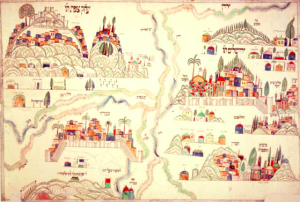
Plaque (19th c.) depicting the “Four Holy
Cities” of Safed (upper left), Jerusalem (upper
right), Tiberias (lower left), and Hebron
(lower right).1
a. the Sea of Tiberias | τῆς θαλάσσης τῆς Τιβεριάδος [tēs thalassēs tēs Tiberiados]: This is the same body of water as the Sea of Galilee; other monikers for it include the Sea of Chinnereth, Lake Tiberias, and Lake Gennesaret. The last two are strictly the most accurate, as this “sea” is in fact fresh water.
The Tiberias it is “of” is a city of that name, which was almost brand-new during Christ’s ministry, and which is still occupied today. Herod Antipas built it in 18 CE to serve as a new capital for his tetrarchate, which consisted in the Galilee itself plus Perea, and populated it mostly with local pagan Græco-Syrians. (This is the same Herod who married his sister-in-law Herodias and later executed St. John the Baptist.) The name alludes to Emperor Tiberius. Ironically, despite its name and founding populace, Tiberias went on to become such an important center of Jewish life and culture that it has enjoyed a prestige nearly equal to that of Jerusalem itself since about the seventeenth century, along with the cities of Safed and Hebron.1
b. Simon Peter, Thomas called the Twin, Nathanael of Cana in Galilee, the sons of Zebedee, and two others of his disciples/Symeon Rocky and Toma called “Twin” and Nethanel from Qanah in the Galilee and the [sons] of Zevadyah and two of his other students | Σίμων Πέτρος καὶ Θωμᾶς ὁ λεγόμενος Δίδυμος καὶ Ναθαναὴλ ὁ ἀπὸ Κανὰ τῆς Γαλιλαίας καὶ οἱ τοῦ Ζεβεδαίου καὶ ἄλλοι ἐκ τῶν μαθητῶν αὐτοῦ δύο [Simōn Petros kai Thōmas ho legomenos Didümos kai Nathanaēl ho apo Kana tēs Galilaias kai hoi tou Zebedaiou kai alloi ek tōn mathētōn autou düo]: This allusion to “the [sons] of Zevadyah” is the sole acknowledgement in the Fourth Gospel of St. Yakov, i.e. James, the Greater. If not for this, I would have assumed that the seven Apostles listed must have been the seven we are familiar with from the rest of the book, namely SS. Rocky, Yochanan, Andre, Philip, Toma, Nethanel, and Yudah; however, since Yakov bar-Zevadyah is here, there isn’t room among the two unnamed disciples to fit Andre and Philip and Yudah—at least one of them must be absent. Of course, things might be the other way round, i.e. the author might have left the last two unnamed to keep his heptads tidy. In such a case, SS. Yakov the Less, Shimon (Simon) the Zealot, and Lewy bar-Chalfai (Levi, a.k.a. Matthew, bar-Alphæus) would all be possibilities. St. Andre and St. Philip seem to me the likeliest candidates for the unnamed pair: the former at least, as we know from Matthew 4 and Mark 1, was involved in his brother’s fishing business before Yeshua called them both, and Philip was from Beyt Tzayad, another village on the Sea of Galilee, so it’s credible that he was also a fisherman before. (John even states that Beyt Tzayad was “the city of Andre and Rocky,” notwithstanding their usual association with K’far Nachum—see note c of this post on the end of chapter 1.)
c. .” | · [:]: Here, because I try to observe the practice of inserting a paragraph break for a new speaker in Biblical texts like I would anywhere else, I have been forced to choose between that and scrupulously exact translation of the punctuation marks in the Greek. The Greek here has a central dot, which loosely equates to, and is referred to as, a colon, not a period; you can’t end an English paragraph with a colon:
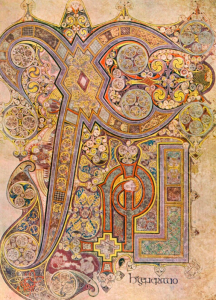
Chi-Rho monogram from the Book of Kells (c. 800).
It looks wrong. But (and we’ve touched on this before), since the punctuation marks were added far later, I’m slightly more comfortable “dissenting” from them in my rendering, as I have here.
d. he put on his clothes, for he was stripped for work, and sprang into the sea/belted up his over-tunic (for he was naked) and threw himself into the sea | τὸν ἐπενδύτην διεζώσατο, ἦν γὰρ γυμνός, καὶ ἔβαλεν ἑαυτὸν εἰς τὴν θάλασσαν [ton ependütēn diezōsato, ēn gar gümnos, kai ebalen heauton eis tēn thalassan]: The word γυμνός, literally “naked,” should not be taken as quite literal! Simply shedding of an outer layer of clothing could make a person γυμνός. St. Peter here was probably what we’d have called “shirtless” at most; Hebrew culture was much more sensitive about nudity than Græco-Roman culture in general was—in fact, this had been a point of tension in the lead-up to the Maccabean Revolt a couple of centuries before:
When Antiochus Epiphanes succeeded to the kingdom, Jason the brother of Onias obtained the high priesthood by corruption … When the king assented and Jason came to office, he at once shifted his countrymen over to the Greek way of life. He set aside the existing royal concessions to the Jews, secured through John the father of Eupolemus, who went on the mission to establish alliance with the Romans; and he introduced new customs contrary to the law. For with alacrity he founded a gymnasium right under the citadel, and he induced the noblest of the young men to wear the Greek hat. There was such an extreme of Hellenization and increase in the adoption of foreign ways that the priests were no longer intent upon their service at the altar. Despising the sanctuary and neglecting the sacrifices, they hastened to take part in the unlawful proceedings in the wrestling arena after the call to the discus, disdaining the honors prized by their fathers and putting the highest value upon Greek forms of prestige. For this reason heavy disaster overtook them. For it is no light thing to show irreverence to the divine laws.
—II Maccabees 4:7-17 (abridged)
For my part, I can never get over how funny the mental picture is of a man rushing to put his outer layer of clothes on before jumping into a lake! But at the same time, it’s incredibly touching; for of course, what it’s saying is that, while Rocky wanted to be decently dressed in the Lord’s presence, he also couldn’t wait, even for a couple extra minutes, to be a matter of feet closer to him.
e. a hundred yards/two hundred cubits | πηχῶν διακοσίων [pēchōn diakosiōn]: Although the cubit is by no means a common measurement, it does correspond reasonably well with the Ancient Greek πῆχυς [pēchüs]: both units come to about a foot and a half, or eighteen inches. The distance given in the RSV is perfectly correct (and to be clear, I’ve had no cause at any time to disagree with the RSV about these kinds of things). However, here as elsewhere, since numbers can be symbolic—and are especially prone to be so in the Gospel of John—I wanted to use units which would preserve the actual numbers given in the original text, not just translate the meaning.
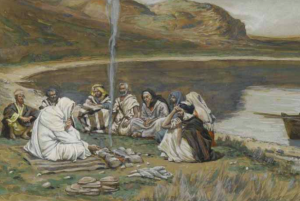
Meal of Our Lord and the Apostles (c. 1890),
by James Tissot.
f. a charcoal fire there, with fish/a charcoal-bed lying there, and a sardine | ἀνθρακιὰν κειμένην καὶ ὀψάριον [anthrakian keimenēn kai opsarion]: This is one of only two passages in the New Testament to feature an ἀνθρακιά, a charcoal-bed. We met with the other back in chapter 18. Thus, Yeshua has set the scene in advance for what he is about to do.
g. a hundred and fifty-three/a hundred fifty-three | ἑκατὸν πεντήκοντα τριῶν [hekaton pentēkonta triōn]: Bishops, monks, divines, and critics have tried to find a convincing meaning in this number for twenty centuries. To the best of my knowledge, they have thus labored without success, although 153 does have a handful of weird arithmetical properties (using “weird” colloquially—in the technical sense, 153 is not a weird number). Apparently in an homage to it, Jacobus de Voragine, a Dominican friar who served as the Archbishop of Genoa in the mid-thirteenth century, selected a hundred and fifty-three saints, sort of,2 for a collection of hagiographies. This collection became quite popular, and was later named the Legenda Aurea or “Golden Readings.”
h. This was now the third time/This third [time] already | τοῦτο ἤδη τρίτον [touto ēdē triton]: The author seems to be using “the disciples” or “his students” interchangeably with the Eleven: this is his third Resurrection appearance to them (in this narrative), though it is his fourth in total (counting his appearance to Miriam of Migdal).
i. Simon, son of John/Symeon, [son] of Yonah | Σίμων Ἰωνᾶ [Simōn Iōna]: Here, I have ventured to differ not only from the preferred reading of the RSV, but from the text supported by the Society for Biblical Literature, which I usually take my Greek from. (I touched on the same thing way back in chapter 1, though there I was even more shy and included Yonah rather than Yochanan only in the textual notes.) The long and the short of it is, most manuscripts do have “John,” but I think it’s more credible that this replaced “Jonah” than the other way around because John is a much commoner name. For a scribe, writing Ἰωάννης [Iōannēs] (or one of its variants) would become second nature, and it’d be easy to misread or mishear Ἰωνᾶς [Iōnas] as that other name you were far more primed to expect—but things wouldn’t go the other way nearly so easily, because Jonah is not a common name in the New Testament, and any time it appeared where it didn’t belong would therefore stick out.
j. love … love … love … love … love … love … love | ἀγαπᾷς … φιλῶ … ἀγαπᾷς … φιλῶ … φιλεῖς … Φιλεῖς … φιλῶ [agapas … filō … agapas … filō … fileis … fileis … filō]: Of these seven uses of the word “love” in the English, the first and third represent forms of the verb ἀγαπάω [agapaō], while the other five represent forms of φιλέω [fileō]. Both words mean “to love.” Φιλέω is, to grossly over-generalize, the “default” verb for love in Greek; the noun derived from it, φιλία [filia], is usually rendered “friendship.” The noun ἀγαπάω gives us is αγάπη [agapē], which is often thought of as so specialized that it hovers on becoming a loan-word into English: it is most associated with unconditional, selfless, divine love. We’ve touched on this topic before, and it’s come around again. Should the distinction in wording here be regarded as significant?
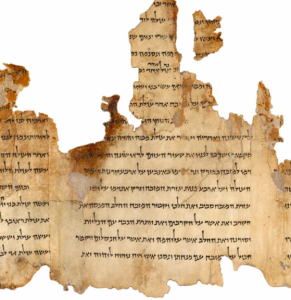
To review, structurally, the questions and answers in our text go like this, with the turn the narrator highlights in bold:
YESHUA: Symeon, son of Yonah, do you love me [agapaō]?
ROCKY: Yes, Lord; you know I love you [fileō].
YESHUA: Feed my sheep. Symeon, son of Yonah, do you love me [agapaō]?
ROCKY: Yes, Lord; you know I love you [fileō].
YESHUA: Feed my sheep. Symeon, son of Yonah, do you love me [fileō]?
ROCKY: [grieved] Yes, Lord; you know I love you [fileō].
YESHUA: Feed my sheep.
Since “should we consider this change in wording important” is a yes-or-no question, but “importance” admits of various degrees, there are two-ish approaches to this.
- Approach #1: “No.” On this interpretation, ἀγαπάω and φιλέω are simply alternating as synonyms often do; what grieves St. Peter is simply the repetition of the question this third time, recalling his apostasy.
- Approach #2: “Yes.” On this interpretation, Yeshua’s shift in wording in that third and final question is meaningful.
It must be said for Approach #1 that it makes perfect sense of the passage and is the majority interpretation. Indeed, I gather it has been for centuries.
However, I’ve discovered some evidence that seems to favor Approach #2. It was published twenty-five years ago by, who else, the Finnish Exegetical Society, headquartered in Helsinki. The argument is below; bits of it are a little technical, but you don’t need to understand Greek in general for it—only those two verbs we’ve been discussing. In hopes of making it easier to follow, I’ve transferred the “color coding” of ἀγαπάω and φιλέω (in all forms) from above to this quotation, even though it obviously wasn’t color-coded in the academic publication! I’ve also set some key phrases in bold.
Lexical choice is one of the major decisions any translator has constantly to make. ⸤…⸥ A decision can be come difficult as well as significant where the translator has to choose between synonymous or near-synonymous lexemes.
⸤…⸥ [M]uch has been written on the vocabulary of love in the Greek Bible. The current consensus seems to be that ἀγαπάω and ἀγάπη are not unique biblical words and the alleged distinction between them on the one hand and φιλέω and φιλία on the other should not be pressed. In the famous story on the treatment by aged Jacob of his sons we read—Gen. 37:3: Ἰακὼβ δὲ ἠγάπα τὸν Ἰωσὴφ παρὰ πάντας τοὺς υἱοὺς αὐτοῦ ⸤…⸥ <4> ἰδόντες δὲ οἱ ἀδελφοὶ αὐτοῦ ὅτι αὐτὸν ὁ πατὴρ φιλεῖ [Iakōb de ēgapa ton Iōsēf para pantas tous huious autou {…} <v. 4> idontes de hoi adelfoi autou hoti auton ho patēr filei—”Jacob loved Joseph over all his sons {…} <v. 4> His brothers, seeing that their father loved him“] ⸤…⸥ The Hebrew text reads אָהַב [‘âhav—”to love”] in vs. 3. On the choice of ἀγαπάω here Wevers writes: “The use of ἠγάπα to translate אהב is normal, since ἀγαπάω was the natural word for “love” in Hellenistic Greek, and not φιλέω as is often alleged, especially by NT scholars.” Indeed, ἀγαπάω is the commonest rendering of אהב ⸤…⸥ Our distinguished colleague, however, remains silent on the sudden change in the very next verse to φιλέω, which translates the identical Hebrew verb. In both cases it is about the relationship between Jacob and Joseph. Wevers does not even invoke the panacea of stylistic variation. Did the translator intend to signal that he perceived some subtle difference in the meaning of the same Hebrew verb in the two verses? ⸤…⸥ Harl also uses two different French verbs—chérissait … aimait ⸤…⸥ This is a most intriguing case of a Hebrew word rendered with two different Greek verbs in such a proximity. Where the direct object of φιλέω is human as here, it commonly means “to kiss” in the Septuagint ⸤…⸥ Indirect light on what the translator possibly intended may be thrown by the Vulgate here. Jerome also uses two distinct verbs: diligebat … amaretur. This is all the more striking, since his motto was hebraica veritas [“the Hebrew is the truth”]. In this instance, he seems to have allowed himself to be influenced by the Septuagint. ⸤…⸥
One cannot help reminding oneself of the precisely same variation in a post-resurrection dialogue between Jesus and Peter at the Lake of Galilee (John 21:15-17), in which Jesus puts three questions in quick succession: ἀγαπᾶς με; [agapas me?], ἀγαπᾶς με;, but for the third time, φιλεῖς με; [fileis me?], and Peter answers each time with φιλῶ σε [filō se]. The evangelist adds that Peter was grieved because εἶπεν αὐτῷ τὸ τρίτον, φιλεῖς με; [eipen autō to triton, «fileis me?»] The Vulgate shows here exactly the same correspondence between the two Greek verbs and the Latin verbs as in Genesis 37. Furthermore, Jerome correctly renders τὸ τρίτον with tertio [on the third occasion], not tres [three times] ⸤…⸥ The emphasis is not on frequency.
⸤…⸥ Of course one should not be dogmatic and insist that every time a given Hebrew word or phrase was rendered by multiple Greek words, the translator intended to convey some difference in meaning. A word and its derivatives ⸤…⸥ are a notoriously rich source of variæ lectiones. ⸤…⸥ I would plead, nonetheless, that stylistic variation be invoked as the very last resort.
—Takamitsu Muraoka, “Translation Techniques and Beyond,” from Helsinki Perspectives: On the Translation Technique of the Septuagint, published in 20013
As for what this change might mean or reflect, I thought I was stumped, and am still not sure that I’ve found the answer. That said, I have got a guess. SS. Lukas and Yochanan are gentler in their descriptions of Rocky’s apostasy, noting merely that he “denied” or “said ‘I do not know the man,'” etc.; the first two Gospels grimly note that he committed himself to this with oaths and even curses—i.e., curses invoked against himself, to add weight to an oath. Matthew mentions an oath as early as the second denial; the following is Mark‘s account (bearing in mind that Mark is reputed by tradition to more or less be Rocky’s memoirs).
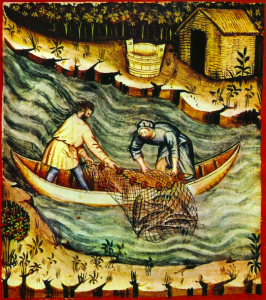
Fishing with nets, illustrated in a 14th-c.
Lombard edition of the Tacuinum Sanitatis,
a treatise on health based on the 11th-c.
Arabic Taqwīm aṣ-Ṣicha of Ibn Butlan.
And as Peter was beneath in the palace, there cometh one of the maids of the high priest: and when she saw Peter warming himself, she looked upon him, and said, “And thou also wast with Jesus of Nazareth.”
But he denied, saying, “I know not, neither understand I what thou sayest.” And he went out into the porch; and the cock crew.
And a maid saw him again, and began to say to them that stood by, “This is one of them.” And he denied it again. And a little after, they that stood by said again to Peter, “Surely thou art one of them: for thou art a Galilean, and thy speech agreeth thereto.”
But he began to curse and to swear, saying, “I know not this man of whom ye speak.” And the second time the cock crew. And Peter called to mind the word that Jesus said unto him, “Before the cock crow twice, thou shalt deny me thrice.” And when he thought thereon, he wept.
—Mark 14:66-72, emphasis mine
If this is what Christ’s change from ἀγαπάω to φιλέω is meant to reflect, and if the conventional NT-scholarly wisdom about the (soft!) distinction in their meanings holds any water—then, at the very point where Rocky’s apostasy sank to its worst, Yeshua’s wording in his “reply” gets … gentler. Less demanding. More within-reach. I recommend reviewing this post, especially its textual note b, for part of the reason this is such a striking choice.
k. more than these | πλέον τούτων [pleon toutōn]: Grammatically, it’s not completely clear what the “these” are which Christ is referring to: the bread and fish? the accoutrements of fishing, and thus by implication his old job? his companions? The ambiguity may be deliberate. However, given the Lord’s purpose here—see the postscript for full details about that—I’m most disposed to see this as referring to the fishing equipment.
l. turned/Turning back | Ἐπιστραφεὶς [epistrafeis]: This verb appears many times in the New Testament. Often (as here) it bears a literal sense; when it does not, it’s usually rendered with the Latinate term convert.
m. what about this man?/what about him? | οὗτος δὲ τί; [houtos de ti?]: It’s not entirely clear, at least not to me, why St. Peter poses this question. However, it is noteworthy—and I imagine the apostles noted it, out loud or not—that the Beloved Disciple was the only one who stayed with him (however much he was allowed to4) during the Passion and was there with the women at the foot of the Cross. I am not the first to point out that, so far as is known, none of the saints who did that—e.g. the Theotokos and the Magdalene—were martyred, but all the Apostles who ran away in Gethsemane were.
n. The saying spread abroad among the brethren that this disciple was not to die; yet Jesus did not say to him that he was not to die/Then this word went out among the brothers, that this student will not die. Yet Yeshua did not tell him that he will not die | ἐξῆλθεν οὖν οὗτος ὁ λόγος εἰς τοὺς ἀδελφοὺς ὅτι ὁ μαθητὴς ἐκεῖνος οὐκ ἀποθνῄσκει. οὐκ εἶπεν δὲ αὐτῷ ὁ Ἰησοῦς ὅτι οὐκ ἀποθνῄσκει [exēlthen oun houtos ho logos eis tous adelfous hoti ho mathētēs ekeinos ouk apothnēskei. ouk eipen de autō ho Iēsous hoti ouk apothnēskei]: A little ironically, given the stress laid by the author on the fact that Christ didn’t say this, there has been a minority tradition in the Church that St. Yochanan the Evangelist, like Enoch and Elijah and the Mother of God, was assumed bodily into heaven. A tenth-century Anglo-Saxon Benedictine, Ælfric of Eynsham,5 preached a homily “On the Assumption of St. John”; this homily dates the apostle’s assumption to the reign of Nerva (96-98 CE), and concludes:
When the apostle was ninety-nine years old the Lord Christ appeared to him with the other apostles, whom he had taken from this life, and said, “John, come to me; it is time that thou with thy brethren shouldst feast at my banquet. … Lo, on Sunday, the day of my resurrection, thou shalt come to me:” and after those words the Lord returned to heaven. The apostle greatly rejoiced in that promise, and at sunrise early rising came to the church, and from cock-crowing until the third hour, taught God’s law, and sang mass to them, and said, that the Savior had called him to heaven on that day. He then ordered his grave to be dug opposite the altar, and the dust to be removed; and he went quick and whole into his grave, and with outstretched hands cried to God, “Lord Christ, I thank thee that thou hast invited me to thy banquet … Thou hast set in my mouth the word of thy truth, and I have written down the lore which I heard from thy mouth, and the wonders which I saw thee work. Now I commit to thee, Lord! thy children … Receive me to my brothers with whom thou camest and invitedst me. Open towards me the gate of life … Amen.”
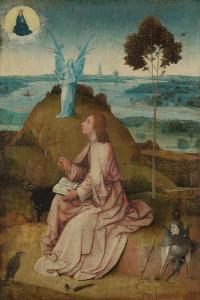
Johannes auf Patmos [John on Patmos] (1488),
by Hieronymus Bosch. Given both the subject and
the painter, it’s a surprisingly calm portrayal.
After this prayer a heavenly light appeared above the apostle, within the grave, shining for an hour so bright, that no man’s sight might look on the rays of light; and with that light he gave up his spirit to the Lord … Verily his grave was afterwards found filled with manna. … Now this food was found in the grave of John, and nothing else … Many miracles have there been manifested … This hath the Lord Christ granted unto him, to whom is glory and honor with the Father and the Holy Ghost, ever without end. Amen.6
I incline to accept the tradition of St. John’s assumption. I may be unduly eager to believe in assumptions in general, merely because I think they’re cool; but I’ve also long felt that this is just the sort of not-saying-yet-hinting thing that Christ would do—basically, that it strikes me as his sense of humor.
However. Whether my guess about that is right or not, we shouldn’t lose sight of the point the Lord is actually making here: “If I want him to stay till I come, what’s it to you? You follow me.”
o. we know that his testimony is true/we know that his witness is true | οἴδαμεν ὅτι ἀληθὴς αὐτοῦ ἡ μαρτυρία ἐστίν [oidamen hot alēthēs autou hē martüria estin]: This, which almost exactly reproduces the text of 19:35, I take to be commentary from St. John the Elder, who is implied in some of the early Church Fathers (e.g. Papias of Hierapolis) to have been an assistant to St. John the Apostle. My pet theory is that he was the apostle’s amanuensis—something like a personal secretary—and aided him in writing both the Gospel and the letter we know as I John, but was not allowed to share St. John’s internal exile to Patmos, and that this is why the Greek of Revelation is so different from that of John and I John, even though many of the motifs are the same.
A Postscript on Penance
The word penance can mean a few distinct things in Catholic usage:
- Good deeds of some type, usually either prayers of works of mercy, assigned as “homework” to penitents in the confessional.
- By extension of sense 1, any act of self-discipline or ascesis undertaken for religious reasons.
- An alternative name for the sacrament of confession. (Note: this usage has been deprecated for some time, and seems to be going out. Despite my affection for all things obsolete, is probably for the best—using “penance” as a name for this sacrament risks raising or reinforcing certain serious misunderstandings; just take the extra syllable and call it “confession.”7)
As we reviewed:
YESHUA: Symeon, son of Yonah, do you love me?
ROCKY: Yes, Lord; you know I love you.
YESHUA: Feed my sheep. Symeon, son of Yonah, do you love me?
ROCKY: Yes, Lord; you know I love you.
YESHUA: Feed my sheep. Symeon, son of Yonah, do you love me?
ROCKY: Yes, Lord; you know I love you.
YESHUA: Feed my sheep.
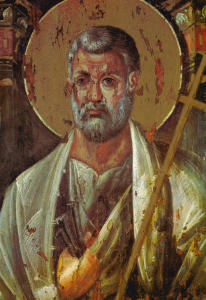
Byzantine ikon (early 6th c.) of St. Peter,
holding keys and a martyr’s cross.
This is a clear, deliberate evocation of Rocky’s triple denial of the Lord back in chapter 18 (cf. note f above). From a different sort of person, this might seem vindictive, but that’s definitely not the vibe here. Yeshua isn’t guilting Rocky; on the contrary, he’s addressing a problem, or rather, a tangled little knot of problems, with his characteristic sidelong courtesy. Given that Christ bestowed the power of absolution upon the Eleven only a chapter ago, it is striking that he makes a point of dealing with this himself; as usual, there are another hundred and fifty-two fish beneath John‘s surface.
Though unusual in its exact form, as the circumstances were unique, the sin St. Peter committed is a species of apostasy, or renunciation of the faith. (This is not really the same thing as lapsing, though apostates were first known in Latin as lapsī, but we can’t get into it.) An error as serious as apostasy would raise a question, in others’ minds and, doubtlessly, in Rocky’s own: was he still meant to play the role of “the Rock” that, once upon a time, Yeshua had appointed him to?8 We can see from the book of Acts and the collected letters of the apostles (whether we interpret Peter’s role in specifically Catholic terms or not) that this proved to be how the Church regarded him, but there was no guarantee that should be the case.
Think about it: come Pentecost, which is usually seen as the Church’s “birthday,” Beyt Yeshua9 as it existed a mere three months ago would be virtually unrecognizable to the Jewish public. Of the twelve apprentices handpicked by the school’s founding rabbi, one was dead by his own hand, and ten (all but the youngest!) had publicly defected when their rabbi got arrested. And oh yeah, their rabbi got arrested, after being betrayed by the aforementioned dead guy. So now the aforementioned founder is—um—probably dead? There are rumors that his horrifying public execution “didn’t take,” which is not usually an issue with public executions … At any rate, the founding rabbi of Beyt Yeshua isn’t around running things, and nearly all his credible successors have been disgraced: a revision of the org chart would seem to be called for, not least for PR reasons. If that’s not going to happen, inquiring minds will want further details, and it’ll be equally important to reconfirm the old org chart.
Then look at it from Symeon’s perspective. His decision to go out fishing again reads like he’s expecting to just … pick his old business back up. I cannot prove, but suspect, that he felt he had disqualified himself by apostatizing. He knew he was still loved and welcome as a disciple; his leaping into the sea shows his confidence in that! But his stubborn, loyal, impetuous, un-self-aware nature blazes from all four Gospels, and when people like that are forced into a moment of excruciating self-awareness—well, we have precedent for how that manifests with Symeon, in the miracle that this miracle seems to be a deliberate call-back to: the miraculous catch of fish in Luke 5, when Rocky was formally called in the first place. On witnessing the miracle, St. Peter’s first reaction was to shamefacedly tell the Lamb of God to, basically, have higher self-esteem and make some better friends: “Go away from me, for I am a man who is sinful, sir.”
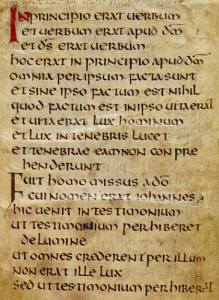
First folio of John from the St. Cuthbert
Gospel (c. 720), written in a beautiful
Hiberno-Saxon uncial10 hand.
But, now as before, the Divine Scapegoat wasn’t having any of that trash. He wanted Peter.
There are, accordingly, two purposes (that I’ve been able to detect) in the Lord’s three questions and the three replies he gives to Rocky’s answers.
#1: Penance.
First, these questions afford Rocky a series of concrete acts—stating, three times and before witnesses, “I love you”—by which he can symbolically void each of his three semi-public apostasies. I believe this would be of immense psychological importance for him. Note the formality of addressing him as “Symeon son of Yonah,” which Christ rarely does elsewhere in any Gospel: this answers to the gravity of his denials.
Some people might deride this as mere ritualistic gesture, without spiritual value, but I don’t agree. Human beings are creatures of symbolism, especially in the religious realm (where we are so permanently out of our depth). All three were lies, but, as Matthew and Mark relate, at least some were exacerbated still further with perjury and even, probably, blasphemy.11 Such grave misuse of sacred language, especially in a book so closely concerned with the Logos, demands specifically verbal renunciation, “with rod revers’t, And backward mutters of dissevering power”.12
To be clear, this penance is not “making up for” what he did. Penance doesn’t work like that; it’s not “an extra credit assignment, but for virtue” that we turn in to “balance” a past sin. The very lightness of most penances is a sign that that’s not their purpose. No one in his right mind could regard compensation to an infinite Being from creatures like ourselves as possible! Or necessary, when you think it through. After all, we can’t deprive God of anything! … Except ourselves. Which is who penance is for. Penance is aimed mainly at amending our own hearts. Like so, so many things, it turns out to be God’s gift to us, not ours to him. The point of penances is not recompense, except in token. Its purpose is healing, from whatever spiritual wound or weakness led us to sin in the first place. It’s not a coïncidence that penances are overwhelmingly prayers, nor that the few which aren’t are nearly always small acts of charity for others; forgetting God, both in himself and in our neighbor, is usually the wound and the weakness.
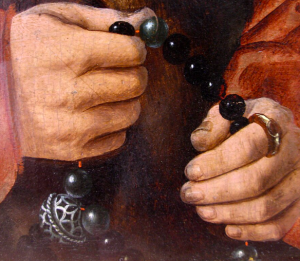
Detail from Diptych with Portraits of the
Pilgrum Couple (1528) by Bartholomæus
Bruyn the Elder, showing a rosary and
pomander.13
That said, I think “recompense in token” can be an important element in healing for some offenses. Now, I’m an extremely prideful person, so it’s possible I should be trusting my intuition here less. However, for whatever it is worth, my gut tells me the sincerely-repentant person will naturally wish they could set right what they did wrong and want to do something concrete to betoken this wish. They will want their own correction to cost them something. As I’ve hinted, this can be an ego thing. But not only ego, I don’t think; it isn’t pride alone which would feel wounded by someone truthfully saying Oh, you’re not important enough to be mad at. That we, we the sinner, have misused our own dignity is part of what’s wrong with sin. There is, to me, something deeply objectionable, even ugly, in the idea of doing nothing to at least ritually “dispel” a sin like apostasy. It would feel too much like a pretense that what we did “didn’t matter.”
#2: Reëstablishment.
With the repeated reply to tend the Lord’s flock, we get the other major purpose of this symbolic penance: Symeon is being reïnstated, or reconfirmed, as “the Rock.” The pastoral imagery, besides being a frequent motif in the Hebrew Bible when addressing rulers, calls back to chapter 10, in which the Lord said that
I set my life aside for the sheep. I also have other sheep which are not from this courtyard; it is necessary for me to lead them, and they will hear my voice, and there will be one sheepfold, one shepherd. This is why the Father loves me, that I set my life aside, in order that I may receive it again.
This clears up any doubts that either he or the others may have had about whether they were still “assigned to the same work” as before. (Well. Other than needing a new treasurer.)
Footnotes
1Although the fact of their inclusion is attested by the Jewish Encyclopedia of 1906 (see the last sentence of this article), I wasn’t able to find out why Safed and Tiberias were so highly esteemed. The reasons for Jerusalem being so regarded are obvious; Hebron was the Davidic capital before Jerusalem was conquered and also contains the Cave of Machpelah, where the patriarchs are buried.
2Really what he selected were a hundred and fifty-three saints’ days, some of which honor more than one saint. My own copy of the Legenda (the beautiful Penguin Classics edition of 1998) is an abridged version with only seventy-one entries, yet it technically covers 11,087 saints—and only mostly because Chapter 59 for 21st October is dedicated to “the eleven thousand virgins,” namely St. Ursula and her companions. (As ridiculous as that likely sounds, there is some historical basis for St. Ursula, and for her having had eleven companions; the editors of my edition include a footnote pointing out that an M for “martyrs” could easily have been mistaken for the Roman numeral M for “one thousand,” thus turning a plausible Romano-British convent into quite the “monstrous regiment of women.”)
3As the late Muraoka-san (requiescat in pace) chose to use ellipses in his writing, I was forced to find some way of distinguishing mine, and hit upon the use of half-brackets. Ellipses contained between them thus ⸤…⸥ are mine, as are those inside curlicue brackets (these things: { }). Any other ellipses are original to the work. I’ve done a very little more editing to make this more readable: the second paragraph break is my introduction, setting off the most relevant part of the quotation, and I also altered one use of the scholarly abbreviation LXX, replacing it with what it abbreviates, i.e. “Septuagint” (the Roman numeral LXX, 70, is used as a shorthand for the Septuagint due to the tradition it was created by seventy translators).
4It’s tough to say exactly how much he was allowed to. Evidently he was admitted for at least one of the ecclesiastical trials, seemingly the one before Chanan ben Set. (Perhaps we get no extra details about the trial before Yosef ben Qayafa because St. Yochanan was kept out of that one.) The text doesn’t say whether or not he was let inside the prætōrium during the hearing Pilatus gave Yeshua, or for that matter whether he tried to enter; if my half-baked speculation about when during Holy Week Christ and the Apostles observed Paskha has any truth to it, then young Yochanan may not have been worried about becoming ritually unclean by entering this Gentile precinct, since he had already partaken of the Passover meal.
5Improbable though it may seem, this name is pronounced ăł-frĭch [of] e͡yn-shàm (see this guide for further details).
6This translation of Ælfric of Eysnham’s homily comes from the first volume of The Homilies of the Anglo-Saxon Church, printed by Richard and John E. Taylor in 1844 (since made available in online format here by the good people of Project Gutenberg).
7The joke here is that liturgists, catechists, and people like that also don’t like it when you call this sacrament “confession.” To this I say: good. Get madder, bros. Don’t misunderstand me: I like and respect pointless exactitude as much as the next bookish jerk—but even by our standards, y’all do not know when to stop.
8In fact, apostasy was one of three sins (along with murder and adultery) about which there was some doubt in the primitive Church as to whether it could be absolved.
9For any who don’t recognize the term: “Beyt Yeshua” is my (conjectural, not to say imaginary!) name for the Lord’s following between the beginning of his mission and the descent of the Holy Ghost. It is formed on analogy with the two principal rabbinic schools among the Pryshaya of the day, Beyt Hillel and Beyt Shammai: these names mean the “House of Hillel [the Elder]” and the “House of Shammai [the Elder],” Hillel and Shammai both being illustrious Torah scholars of the generations just before the time of Jesus. Beyt Hillel and Beyt Shammai are explained a little further in the whopping textual note a of this post.
10Uncial was a Late-Antique variety of Roman book hand. It began as a majuscule hand, i.e., one with “all capital letters”—all its letter-shapes fit between a single pair of horizontal guiding lines, no ascenders or descenders. With time, it evolved toward being a minuscule: this term denotes a “lower case” system, where four parallel lines contain the letters (because some of its glyphs have ascenders, descenders, or both). The development of uncial script went hand-in-hand with the growing Late-Antique preference of parchment to papyrus: papyrus kept something of the fibrous texture of the plant it was made from, more like writing on leaves than on modern paper, whereas parchment offered a far smoother surface that allowed more rounded strokes and flourishes easily. The St. Cuthbert Gospel—so named because it was interred with that saint’s remains—shows an uncial script from the British Isles (where it was especially popular) that has evolved into a genuine minuscule: the letters f, p, and q all show consistently descending stems, while d, h, and l all have ascenders. The indiscriminate mixture of what we’ve come to regard as upper- and lower-case letter forms is visually interesting for us today, but was of no significance at the time.
11I say “probably” because, technically, the texts of Matthew and Mark do not say outright that he blasphemed. However, oaths were usually sworn on or by something sacred. Further, we have the Lord’s own guidance on how we ought to regard our sworn word, and for that matter our unsworn word, in Matthew 5; whether Rocky was thinking of this at the time or not, the point being made in the Sermon on the Mount is that all swearing is, implicitly, by God. On most monotheistic views, God is ultimately the only enforcer of oaths and vows, and of the curses which traditionally came attached to them. (For more on that in written form, I recommend this blog post from Dr. Bret Devereaux, an ancient historian from the University of North Carolina. If you prefer an audio format, Girl Next Gondor, the only good YouTuber, has a great video essay on the subject, which also happens to be where I found out about Dr. Devereaux’s post! Her essay features lovely Tolkien fan-art for its visuals, but it can be treated like a podcast if you need or want to.)
12I first encountered this line in C. S. Lewis, so of course I had no idea where it came from, as he often drops quotes without references (it seems a perk of teaching at Oxford for thirty years is that you can rely on people to recognize your quotes, which I am not writhing with envy about, just so you all know). Turns out it comes from John Milton’s 1637 masque Comus. I’ve adapted it slightly for my purpose: the text really reads “without his rod revers’d / And backward mutters of dissevering power,” as it is part of an explanation that the characters should have seized the sorcerer who has just disappeared, and still has his wand.
13A pomander was a small, spherical case of metallic openwork, which was a little bit like a tiny personal censer. Some aromatic substance would be placed inside it—spikenard, lavender, cinnamon, ambergris, tragacanth, agarwood resin, rosemary, you name it. The pomander might then be worn, for instance on a necklace or girdle, or as here on a rosary, and the scent of the aromatic would diffuse itself through the openwork. This was done both for the inherent pleasantness of the scent and because it was thought in the Medieval and Early Modern periods that many illnesses spread via stagnant, toxic air: in fact, via mal-aria. (I’m not kidding, this really is where the word “malaria” came from!)
History and Religion
Education and Religion


About Gabriel Blanchard
Gabriel Blanchard is a Catholic convert, gay author, radical leftist, unprofessional linguist, and Japanese food snob. He grew up as an evangelical Navy brat and got a degree in Classics from the University of Maryland. He currently lives in Baltimore and is a member of a local parish of the Ordinariate of the Chair of Peter. The everything notwithstanding, he is in fact not a vegan. You can read more about the author here.
Previous Post
August 6, 2026
How Did the Risen Jesus Get Through Locked Doors?
Next Post
August 22, 2026 Historica Apocrypha, Episode 1: What Was Gnosticism?
Recent Comments
"That is indeed a lovely version of "Idumea."For a different effect, (with additional verses) can ..."
"This Mudblood Catholic post examines why Jesus avoids giving direct answers to questions like whether ..."
Why Won’t Jesus Give Us a ..."
"On the contrary, such a proclamation, among the Aztecs or Maya, would be disastrously misunderstood. ..."
The Gospel of John: The Bread ..."
"Many thanks for your scholarly study on the Cleansing of the Ten Lepers in the ..."
The Cleansing of the Ten Lepers
Browse Our Archives
Select a Category abuse antifascism art bad Catholic celibacy chastity Church crucifixion culture war eros forgiveness gay gender homophobia ikons language liturgy peace poems politics Pope Francis prayer pro-life race recommendations reform repentance review sacraments saints satire scandal schism scripture sex suffering theology Uncategorized violence
Select a Month November 2026 October 2026 September 2026 August 2026 July 2026 June 2026 May 2026 April 2026 March 2026 February 2026 January 2026 December 2025 November 2025 October 2025 September 2025 August 2025 July 2025 June 2025 May 2025 April 2025 March 2025 February 2025 January 2025 December 2024 November 2024 October 2024 September 2024 August 2024 July 2024 June 2024 May 2024 April 2024 March 2024 February 2024 January 2024 December 2023 November 2023 October 2023 September 2023 August 2023 July 2023 June 2023 May 2023 April 2023 March 2023 February 2023 January 2023 December 2022 November 2022 October 2022 September 2022 August 2022 July 2022 June 2022 May 2022 April 2022 March 2022 February 2022 January 2022 December 2021 November 2021 October 2021 September 2021 August 2021 July 2021 June 2021 May 2021 April 2021 March 2021 February 2021 January 2021 December 2020 November 2020 October 2020 September 2020 August 2020 July 2020 June 2020 May 2020 April 2020 March 2020 February 2020 January 2020 December 2019 November 2019 October 2019 September 2019 August 2019 July 2019
Follow Us!
TAKE THE
Religious Wisdom Quiz
Which book of the Bible contains the most direct prophecies about the Messiah?
Select your answer to see how you score.
Micah Psalms Isaiah Zechariah
Related posts from Mudblood Catholic
What Kind of Man Do Wind and Sea...
The Sermon on the Mount, Part IV: Matthew...
The Sermon on the Mount, Part III: Matthew...
TRENDING AT PATHEOS Catholic

Reasons for Restraint: Ricardo Gonzalez, Florida and Dec...
The Morning of January 3 I begin with the dead. On the...

I published this column for Thanksgiving 2012 in the Deseret News....

For many years, Catholicism has been caught up in division over the...

'Statements of Faith' never get shorter
Nothing demonstrates a conservative commitment to faith and faithfulness like a "statement...

Michele's Reviews - Future Grace by John Piper
In God's Place, at God's Pace, by Future Grace Impatience is...

Bama Gramma's Blackout Christmas: the Power of Light...
Another Christmas Skit: I have an alter ego: Bama Gramma. She shows...
view all Catholic blogs
What Are Your Thoughts?leave a comment
Ad-Free & Subscriber Log-In Subscription Support
- About Us
- 2026 Calendar
- Videos
- Podcasts
- Library of World Religions
- Faith In Media Tracker
- Advertise With Us
- Write for Us
- Privacy Policy
- Terms of Service
- Do Not Sell My Data
- Contact Us
- Radiant Digital
- Manage Newsletter Subscriptions
- Unsubscribe From Notifications
- Sitemap
Copyright 2008-2026, Patheos, part of the Radiant Digital network of media brands. All rights reserved.
Subscription Support Ad-Free & Subscriber Log-In
Follow Patheos